


Privacy coins had one of the strongest years in crypto. The people marketing them now answer to three rulebooks that disagree with each other.
FinCEN withdrew its proposed crypto mixing rule on October 5, 2026. The notice said the rule’s broad definition could chill legitimate activity. Dubai, by contrast, prohibits any promotion of a privacy token in or toward the UAE. In the EU, crypto-asset service providers lose the right to handle anonymity-enhancing coins on July 10, 2027.
So one campaign for one token can be lawful in New York and prohibited in Dubai on the same day.
The capital is there. Glassnode data reported by Startup Fortune shows the privacy segment grew from a combined $7.1 billion market cap to $33.6 billion in the year through early September 2026. Zcash accounted for about 62% of that total. Grayscale’s Zcash ETF, ticker ZCSH, began trading on NYSE Arca on August 25, 2026, and AMBCrypto reported it passed $1 billion in assets on September 24.
|
$33.6B Privacy coin sector market cap, up from $7.1B in twelve months (Glassnode) |
$1B Zcash ETF (ZCSH) assets within a month of its NYSE Arca debut |
10 July 2027 Date EU service providers must stop handling anonymity-enhancing coins (AMLR) |
Promotion rules have not kept pace with that money, and they have moved in different directions. This playbook sets out how founders and marketers of privacy coins and ZK projects can run campaigns that hold up in the US, the EU and Dubai.
- Classify your token by what a transfer reveals. Branding does not change the answer, so get counsel to sign off on the classification before any campaign goes live.
- The US has no privacy-specific promotion ban, the EU cuts off regulated platforms from July 10, 2027, and Dubai prohibits privacy token marketing in or targeting the UAE today.
- Developer education and research content are the safest channels in all three markets, and paid KOL work stays viable when it is disclosed and geo-fenced.
What are privacy token promotion rules?
Privacy token promotion rules are the laws and regulator rulebooks that limit how a cryptocurrency with built-in transaction privacy can be advertised or offered to the public. They are written around the asset’s anonymity features. They apply according to where the audience is located, and the project’s place of incorporation does not change that.
The audience test catches many teams off guard. A foundation registered in Singapore running a global campaign on X can still fall under Dubai’s rules if the content targets UAE users.
1. Classify your project the way a regulator would
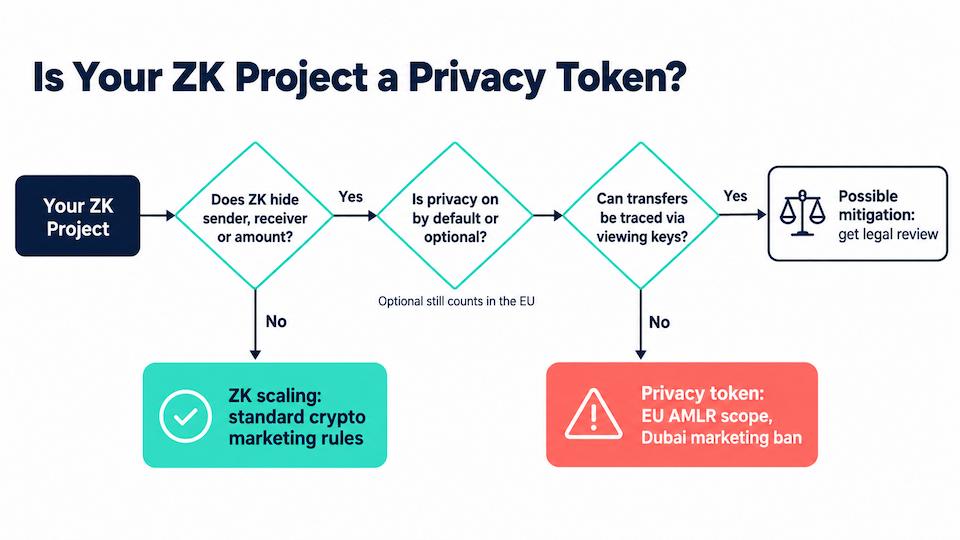
Settle which category your token belongs to before anyone drafts a post. A regulator won’t be swayed by labels like “privacy-preserving” or “ZK-powered.” The question it asks is what a transfer reveals and who can see it.
Check whether privacy is built into transfers
The EU’s Anti-Money Laundering Regulation defines anonymity-enhancing coins as crypto-assets with built-in features designed to make transfer information anonymous, either systematically or optionally. The word “optionally” matters. A coin with optional shielded transfers, like Zcash, sits inside that wording.
Separate ZK scaling from ZK privacy
A ZK rollup that compresses public transactions is not a privacy coin. A protocol that uses zero-knowledge proofs to hide the sender, receiver or amount may well be one. Your marketing should make that distinction obvious in the first paragraph of every page.
Document any traceability mechanism
Dubai’s VARA defines anonymity-enhanced cryptocurrencies as assets that prevent tracing and for which the service provider has no mitigating technology to allow traceability. If your design supports viewing keys or selective disclosure, write it up clearly. That documentation can affect how the asset is assessed, and only a legal review can confirm the outcome.
Write a one-page classification memo
Have counsel sign off on how the token is described. Every campaign brief, KOL script and press release should trace back to that memo.
2. Where promotion is restricted in the US, EU and Dubai
The three jurisdictions in this playbook moved in opposite directions this year. US policy loosened, while the EU and Dubai tightened, and Dubai’s restrictions are already in force.
United States
There is no federal ban on promoting privacy coins. FinCEN’s October 2026 notices withdrew both the 2023 mixing proposal and the 2020 unhosted wallet proposal. A Treasury report to Congress in March 2026 said mixers have lawful privacy uses. FinCEN also said it will keep watching mixer activity and may act later if needed.
For marketers, the live risks are the general ones. Section 17(b) of the Securities Act applies if a token is treated as a security, and the FTC Endorsement Guides apply to any paid promotion.
European Union
Two layers apply. MiCA Article 7 has governed crypto marketing communications since December 30, 2024. Content must be clearly identifiable as marketing, fair, clear and not misleading, consistent with the white paper, and carry the mandatory disclaimer. AMLR Article 79 follows on July 10, 2027. From that date, banks, financial institutions and crypto-asset service providers may not handle anonymity-enhancing coins.
The AMLR has no marketing clause of its own, but it changes what promotion can achieve. Once regulated EU platforms cannot list or custody your coin, an EU campaign that sends users toward a buy button becomes very hard to defend.
Dubai
VARA’s Marketing Regulations state that marketing any anonymity-enhanced cryptocurrency in or targeting the UAE is strictly prohibited. Law firm CMS notes the rules apply to domestic and foreign entities whether or not VARA licenses them. Inside the DIFC, the DFSA’s framework has barred privacy tokens from trading, promotion, fund activity and derivatives since January 12, 2026. Enterprise AM reported, from Bloomberg’s coverage, that fines under VARA’s marketing framework start at AED 500,000 and can reach AED 10 million.
| Jurisdiction | Rule | Who it binds | Promotion position | Risk |
| United States | SEC Section 17(b), FTC Endorsement Guides | Issuers, promoters and KOLs | No privacy-specific ban, disclosure rules apply | Low |
| EU, today | MiCA Article 7 | Anyone marketing a public offer or admission to trading | Allowed when consistent with the white paper and carrying the disclaimer | Medium |
| EU, from 10 July 2027 | AMLR Article 79 | Banks, financial institutions, CASPs | Regulated platforms cannot handle the coin, so buy-focused promotion loses its route | High |
| Dubai mainland | VARA Marketing Regulations | Local and foreign entities, licensed or not | Marketing privacy coins in or targeting the UAE is strictly prohibited | High |
| Dubai DIFC | DFSA crypto token rules | Firms operating in or from the DIFC | Privacy tokens barred from trading, promotion, funds and derivatives | High |
3. Which claims are safe to make
Most crypto marketing enforcement traces back to one sentence somebody thought was harmless. For privacy tokens the risky sentences are predictable, so you can screen for them before anything ships.
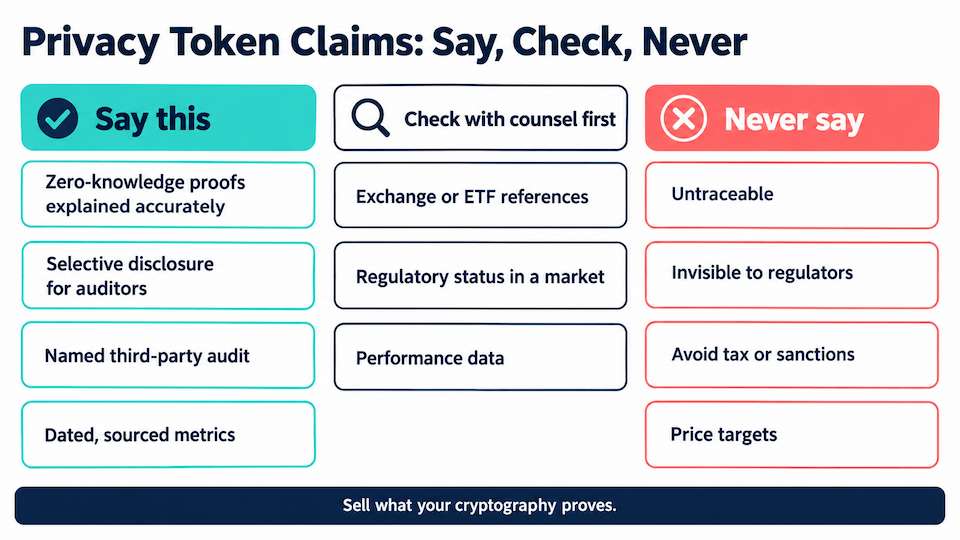
Claims that usually pass
- Accurate descriptions of the cryptography, such as zero-knowledge proofs, viewing keys or shielded transfers
- Selective disclosure features that let users share transaction data with an auditor or tax adviser
- Third-party security audits, with the auditor named and the scope stated
- Dated metrics like ETF holdings or network hashrate, sourced to a public filing or data provider
Claims that invite trouble
- “Untraceable,” “invisible to regulators” or “beyond the reach of the law”
- Anything that frames privacy as a way around tax, sanctions or AML checks
- Price targets or return projections, especially from paid voices
- “Legal everywhere” or “regulator approved” when it is neither
A five-step check for every message
- First, match the claim to the white paper or technical docs. If it isn’t there, it doesn’t ship.
- Second, replace evasion language with user benefit language. “Keeps your salary private from strangers” works, and “hides your funds” does not.
- Third, attach a source and a date to every number.
- Fourth, tag the audience. If the post could reach UAE users, it doesn’t run.
- Fifth, log the approval with the reviewer’s name so you can show your process later.
The Chainalysis 2026 Crypto Crime Report put illicit activity below 1% of attributed crypto transaction volume in 2025. It also found stablecoins carried about 84% of illicit volume. Those figures help when someone assumes privacy means crime. Use them as context and avoid turning them into a claim about your own coin.
4. Channels that still work
Paid ads and exchange co-marketing are closed to privacy tokens in parts of the world. The projects still growing under those conditions are the ones that teach, and for privacy projects education has become the main channel.
Research content
Long-form explainers and threat models earn links from developers and journalists, and so do audit summaries and incident write-ups. This material also gives AI answer engines something specific to cite when users ask how a privacy protocol works.
Developer education
Docs, SDK tutorials, hackathon tracks and grant programs reach builders without promoting the token’s price. They also produce adoption numbers you can report honestly.
Community with published rules
Discord and forum moderators should remove price shilling and evasion talk quickly. Publish the community rules where anyone can read them. A well-moderated channel is evidence of good faith if a regulator ever asks questions.
Geo-aware distribution
Geo-target ads and newsletters so UAE audiences are excluded from token promotion. Keep EU-facing content educational. A jurisdiction line in every landing page footer costs nothing and shows intent.
|
Planning a privacy or ZK token campaign? Get a jurisdiction-aware marketing plan built around what your protocol can prove. |
5. How listings change your audience
A listing changes who reads your content. The Zcash ETF is the clearest documented case of a privacy asset moving from crypto-native traders into ordinary brokerage accounts.
The ZCSH case
Grayscale converted its Zcash Trust into ZCSH, which began trading on NYSE Arca on August 25, 2026. A Grayscale release filed with the SEC on September 8 put assets above $500 million. That figure included more than $70 million in inflows and a roughly $100 million in-kind investment from DCG.
Assets reached $1 billion by September 24. AMBCrypto noted that cumulative net inflows at that point were $306.12 million, with legacy holdings and ZEC’s price gain making up the rest. Crypto Briefing reported the fund held about 596,000 ZEC on September 18, close to 3.5% of circulating supply.
What the case teaches marketers
- Regulated wrappers bring regulated language. ETF materials carry prospectus requirements and a named marketing agent, and readers will compare your token content with them.
- Precision builds trust. AMBCrypto separated new inflows from price appreciation, and your own reporting should do the same.
- Referencing the ETF is fine. Implying that Grayscale or the SEC endorses your project is a misleading claim.
Delistings cut the other way
Binance delisted Monero in February 2024, OKX dropped Monero, Zcash and Dash a month earlier, and Kraken removed Monero for EEA clients later that year. A study presented at ECIS 2026 found the Binance delisting had a significant negative effect on Monero’s price with no immediate recovery. Prepare delisting messaging before you need it. Include clear guidance on where users can still access the asset lawfully.
6. Guardrails for paid KOLs
Paid voices carry the most risk because you don’t write their posts. Contracts and briefs have to cover that gap.
Disclose the payment amount
The SEC’s case against Kim Kardashian shows why. She labeled her post as an ad but did not disclose the $250,000 she was paid, and she settled for $1.26 million. Under Section 17(b), US promoters of a security must disclose the nature, source and amount of compensation. A hashtag satisfies the FTC, while the SEC wants the dollar figure.
Treat paid posts as EU marketing communications
Commissioned influencer content about a specific crypto-asset falls under MiCA’s marketing rules. Every paid post needs white paper consistency and the mandatory disclaimer.
Keep UAE-targeted creators away from the token
VARA’s rules cover marketing that targets the UAE, and CMS notes that campaigns using UAE or Dubai imagery can count. A Dubai-based influencer posting about your privacy coin is a direct exposure.
Pitch the technology story
Journalists who cover privacy ask for audits and threat models. They also want time with named engineers. A founder explaining viewing keys on a respected podcast does more for credibility than a stack of paid listicles.
|
“If your cryptography can’t prove it, your campaign shouldn’t claim it.” A test for every line of copy |
7. Measuring trust without vanity metrics
Follower counts and impressions say little about a privacy project, and both can be bought. Track numbers that show real use and real scrutiny.
- Count developer activity through SDK downloads and active contributors.
- Track earned citations from research outlets and security firms, plus mentions in AI answer engines.
- Measure audit coverage as the share of your codebase under a published third-party audit.
- If your design supports viewing keys, track how many users generate one.
- Record the share of campaign assets that carry a logged legal approval.
Report these quarterly, and publicly if you can. A dated transparency report is also strong experience and trust material for search.
A four-phase launch plan
This is how the playbook fits on a calendar for a project starting a campaign this quarter.
|
PHASE 1 |
Classify and map Write the classification memo and list your target markets. Mark the UAE and the DIFC as excluded for token promotion. |
|
PHASE 2 |
Build the claims library Draft approved and banned phrases with the disclaimers each market needs. Get legal sign-off and lock the KOL contract template. |
|
PHASE 3 |
Launch education first Publish research content and developer docs first. Start geo-fenced distribution and disclosed KOL partnerships once that base is live. |
|
PHASE 4 |
Monitor and report Track rule changes ahead of July 2027 and publish a quarterly trust report. Refresh delisting messaging whenever exchange policies shift. |
Where privacy projects stand heading into 2027
Demand for privacy assets grew sharply this year, and the rules on promoting them split along jurisdictional lines. One global campaign does not fit that split. The workable approach starts with an honest classification memo and a geo-fenced audience list, and the content plan follows from those two documents.
Blockchain App Factory does this work for privacy and ZK projects. Our crypto marketing team builds jurisdiction-aware campaign plans and claims libraries mapped to MiCA and VARA requirements, which we review with your legal counsel. We also write developer-focused content and run KOL programs with disclosure terms in every brief. Our PR and community work keeps coverage focused on your technology.
The rules cited here come from the text of MiCA Article 7, AMLR Article 79, VARA’s Marketing Regulations and the DFSA rulebook, plus FinCEN’s October 2026 withdrawal notices. They reflect the position on October 14, 2026. This article is general information and is not legal advice.
Frequently asked questions
Short answers to common questions about privacy token promotion.
Can you legally market a privacy coin in the US?
Yes. There is no federal ban on privacy coin promotion. Paid promoters still need FTC disclosures, and if the token is treated as a security, Section 17(b) requires them to disclose the amount paid.
Does the EU ban privacy coins in 2027?
From July 10, 2027, AMLR Article 79 bars banks, financial institutions and crypto-asset service providers from handling anonymity-enhancing coins. The rule applies to those regulated firms. It does not ban individuals from holding the coins.
Can I promote a ZK project in Dubai?
It depends on what the ZK technology does. A ZK scaling project with public transactions is treated like other crypto. A token that hides transfer data falls under VARA’s ban on marketing privacy coins in or targeting the UAE.
Do crypto influencers have to disclose how much they were paid?
In the US, yes, when the token counts as a security. The SEC’s settlement with Kim Kardashian showed an “ad” label alone is not enough. In the EU, paid posts must follow MiCA’s marketing rules, and those rules require the disclaimer.
What is the safest marketing channel for a privacy token?
Developer education and research content. Both build credibility and earn citations from search and AI engines, and neither depends on the price promotion that regulators examine most closely.
|
Want your privacy project marketed without regulatory surprises? |

Vimal J is the Head of Sales at Blockchain App Factory, with 10+ years of experience in sales, client strategy, and Web3 business growth. He helps startups, enterprises, and project founders choose the right blockchain solutions for their goals, bringing a practical market perspective to topics like token development, crypto launches, and Web3 adoption.
Article Reviewed by:
Arun Kamala Santhanath
Marketing Head, Blockchain App Factory


