Property Asset
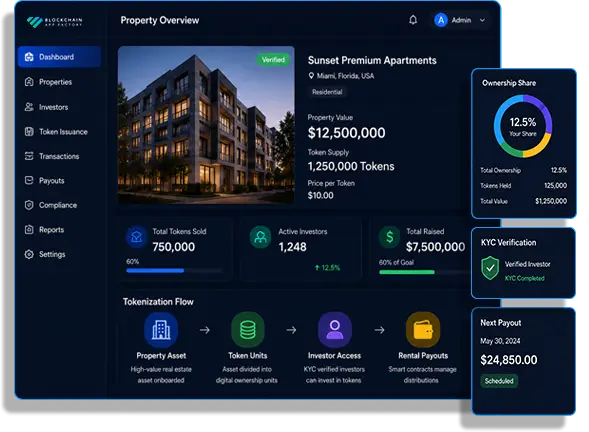
A real estate asset is selected, valued and structured under a legal wrapper.
For compliant, property-backed digital assets
Blockchain App Factory builds the platforms property businesses use for verified fractional ownership on-chain: SPV-linked tokens, audited ERC-3643 and ERC-1400 contracts, and KYC, compliance and custody built into every token.
Last updated: August 2026 · Reviewed by our Senior Tokenization Engineer

Real estate tokenization converts ownership rights in a property, or the entity holding it, into blockchain-based tokens representing fractional interests in equity, debt or income. An SPV, fund or trust holds legal title; smart contracts then handle eligibility checks, transfer restrictions, cap-table updates and pro-rata distributions automatically.
The result behaves like a modern financial instrument: split into small denominations, transferred in minutes rather than months, audited on a public ledger, and offered to verified investors across borders.
A real estate asset is selected, valued and structured under a legal wrapper.
The asset is tokenized on-chain, with supply and rights encoded in the contract.
Verified investors subscribe and receive fractional ownership positions.
Rental income and resale rights flow to holders per the structure.
Tokenized real-world assets crossed $32 billion on-chain by mid-2026, nearly tripling year over year, with holder accounts past 930,000. Real estate is next: Deloitte projects $4 trillion tokenized by 2035, up from under $300 billion in 2024.
Governments are building the rails. Dubai Land Department now issues Property Token Ownership Certificates and projects tokenized assets will reach AED 60 billion by 2033. Issuers who launch compliant platforms now capture the investor relationships late entrants have to fight for.
A developer's presale, a REIT's fund structure and a crowdfunding platform's investor base do not run the same way. We shape the platform around how your business actually raises capital and reports back.
Sell equity or revenue-share tokens in a project SPV, with releases tied to build milestones.
Turn assets or portfolios into digital securities with self-reconciling cap tables.
Sell verified fractional interests in income assets for liquidity, no sale or refinancing.
Tokenized fund units cut NAV overhead, lower minimums, and enable whitelisted transfers.
Move crowdfunding onto token rails: on-chain records, automatic payouts, compliant trading.
Launch on infrastructure we already run in production, instead of building it from scratch.
Issue ownership tokens tied to shares, SPV units, voting rights and investor distributions.
Create digital notes backed by real estate loans, interest schedules and maturity terms.
Distribute rental income, project proceeds or operating cash flow to verified token holders.
Digitize REIT, fund or portfolio units with automated records and transfer controls.
Open high-value properties to smaller ticket sizes while preserving investor eligibility rules.
Enable compliant resale flows between approved wallets through permissioned transfer logic.
You bring the property, the capital goal and the market ambition. We turn that asset into a digital investment product built to attract serious buyers.
We model the offering first: SPV vs. fund vs. debt note, investor jurisdictions, exemption strategy, token economics and payout waterfall.
Audited issuance, transfer-control and distribution contracts on ERC-3643, ERC-1400, ERC-20, ERC-721/1155 and Solana SPL, with upgrade and recovery built in.
Full-stack issuance platforms: issuer console, investor portal, offering management, document rooms, payment rails and an on-chain registry of who owns what.
KYC/KYB, AML screening and accreditation checks bound to wallet identity, so eligibility and jurisdiction rules execute inside every transfer, not a spreadsheet.
Permissioned peer-to-peer transfer venues, bulletin boards and marketplace integrations where trades settle only between verified, eligible wallets.
MPC custody, fiat on/off-ramps, appraisal and rent-yield oracles, plus SLA-backed maintenance, contract upgrades and compliance-rule updates as regulations shift.
Every platform we ship is organized into five layers. If you're comparing vendors, asking about these layers is the quickest way to find out how deep a real estate tokenization company's engineering really goes.
The property sits in an SPV, fund or trust. Offering documents, valuations and title records are hashed and anchored on-chain, linking every token to its legal substrate.
Permissioned security tokens (ERC-3643, ERC-1400 on EVM; SPL Token-2022 on Solana) encode supply, tranches, lock-ups and forced-transfer provisions for legal recourse.
On-chain identity binds each wallet to a verified investor profile. Transfers are checked against accreditation, jurisdiction and holding rules before they settle, or they revert.
Issuer console for offerings and payouts; investor portal for subscriptions, portfolio and tax reports; admin tooling for registry management and audit exports.
Fiat and stablecoin rails, MPC custody, automated distribution contracts and permissioned secondary transfers settle ownership and income changes in minutes.
From onboarding and KYC through token issuance, subscription, income distribution, to compliant secondary transfers between whitelisted wallets, the whole path runs on-chain.
Onboarding & legal wrapping
KYC / AML & accreditation
Token issuance against the SPV
Subscription in fiat or stablecoin
Registry updates & distribution
Compliant secondary transfers
Standards & Compliance
The token standard decides how your property offer behaves after launch. The regulatory framework decides who can hold it. We encode both directly into transfer logic.
Permissioned RWA Token
Identity and eligibility checks are built into transfer rules, so only verified investors can receive or move tokens.
Regulated real estate offerings, permissioned securities, SPVs and fund units with strict transfer controls.
On-chain identity registry, compliance modules, recovery support and issuer-controlled transfer restrictions.
Reg D 506(c), Reg S and Reg A+ set the exemption path, with Rule 144 lock-ups and accreditation checks enforced as token-level transfer rules.
MiFID II defines the security token, MiCA covers adjacent crypto services, and the DLT Pilot Regime opens tokenized trading venues.
Dubai's VARA regime and the Land Department's tokenized title program lead the region, with DIFC/DFSA and ADGM/FSRA offering parallel frameworks.
MAS treats tokenized property as securities under the SFA, with Project Guardian maturing institutional tokenization and CMS licensing built in.
We are a technology provider, not a law firm. We implement structures your securities counsel approves, and can introduce specialists per region.
Every asset class carries its own income pattern, risk profile, and investor appetite. We structure the token to fit the asset, not the other way around.
Single-family rentals, multifamily blocks and build-to-rent portfolios, sold in fractions to retail and accredited investors chasing yield.
Office and mixed-use assets that produce income today, structured into institutional tranches with lock-ups and tiered rights.
Shopping centers, hotels and serviced apartments, where the token's revenue share tracks operating income rather than a fixed coupon.
Warehouses and data centers sit on long leases, so the cash flow is steady enough to comfortably underpin income tokens.
Pre-development land banks and under-construction projects with milestone-gated capital release.
Student housing, senior living, healthcare and self-storage, all niche classes that traditional syndication underserves.
A full sale is the only way to unlock liquidity from the asset.
→Sell 20 to 40% in verified fractions and keep management control.
Six-figure minimums limit the offering to a narrow investor pool.
→Minimums drop to a few hundred dollars, reaching far more verified investors.
Escrow, title and registry sequencing stretch transfers into weeks.
→On-chain transfer and payment settlement close in minutes.
Manual admin and layers of intermediaries quietly eat into returns.
→Cap tables, distributions and compliance checks run themselves.
Compliance oversight erodes once tokens change hands after issuance.
→Eligibility and jurisdiction rules travel with the token through every trade.
Due diligence means weeks of chasing down manual ownership records.
→Every issuance, transfer and payout is timestamped, a registry export away.
A tokenization platform earns at launch, on every transaction, and again through ongoing management, three layers of revenue running at once instead of a single fee at the point of sale.
A one-time fee to onboard a property covers document intake, offering prep and platform review before it goes live.
Setup fees for token creation, contract deployment and offering configuration cover the technical build behind every issuance.
Paid KYC, wallet approval and eligibility checks turn investor onboarding into a recurring compliance revenue line.
A commission on every completed token purchase ties platform revenue directly to how much capital each raise closes.
Transaction fees on approved resale activity generate steady income as tokens change hands between verified investors.
Partner with lending protocols so investors can borrow against verified holdings, earning referral and facilitation fees.
Recurring fees for ownership tracking, compliance updates and reporting keep revenue flowing after a token sells out.
Service fees for handling income payouts and investor statements, with accurate records kept across every cycle.
License AI-driven valuation and portfolio analytics feeds to lenders, appraisers and institutional investors.
Licensing the platform to enterprises and property groups turns it into a long-term B2B revenue line across regions.
Three real estate tokenization platforms we designed, built and shipped, each with a different legal structure, chain and investor profile.
StoneForm needed to present premium property assets to global investors while keeping access controlled and participation verified, in a market where onboarding, allocation and asset tracking stayed fragmented.
Investment access widened while issuer control over asset movement remained fully intact.
High capital barriers, slow verification, thin liquidity and fragmented ownership records kept property equity out of reach. PropDeFi needed access without weakening trust, transparency or asset control.
Fractional participation became easier to access while issuers kept authority over allocation and records.
Institutional tokenization needs clean separation between technology, issuance, custody and compliance. OFA needed SPV-linked property and mortgage interests traceable and transfer-controlled without crossing regulated boundaries.
Sponsors gained a traceable technology layer for issuance, documents and transfers, with no custody or advisory overreach.
"We needed a secure and scalable blockchain platform, but we did not have an in-house development team. That is when we partnered with Blockchain App Factory. Their team was consistently available, quick to implement feedback, and always aligned with our timelines. The smart contract development was solid and security-focused. They did not just execute requirements, they offered valuable suggestions and took initiative at every stage of our startup journey."
Flexible packages, from single-property platforms to multi-issuer, custom-built ecosystems.
FEATURES |
Basic Package
|
Standard Package
|
Premium Package
|
|---|---|---|---|
| Platform Scope | Single Property | Multi-Property | Multi-Issuer |
| Asset & Legal Structure | Entity Mapping | SPV / Fund Model | Multi-Entity Model |
| Token & Contract Architecture | ERC-20 / 721 / 1155 | ERC-3643 / 1400 | Multi-Standard + Multi-Chain |
| Smart Contract Controls | Mint, Burn, Pause | Lockups + Transfer Rules | Compliance Rules + Recovery |
| Investor Onboarding | KYC / AML | + Eligibility Checks | Multi-Jurisdiction Rules |
| Wallet, Payments & Custody | Wallet + Crypto | Fiat + Crypto | Custody + Banking APIs |
| Offering & Admin Management | Listings + Approvals | Multi-Offering Controls | Multi-Entity Operations |
| Investor Portal | Holdings + Documents | Portfolio + Payouts | Custom UX + Reports |
| Ownership, Income & Payouts | Holder Registry + Admin Payouts | Live Ledger + Automated Payouts | Multi-Issuer + Rule-Based Payouts |
| Secondary Transfers | Transfer Requests | Permissioned Marketplace | Marketplace Integrations |
| Deployment & Support | 10-Day White Label | Custom Brand + APIs | Custom Stack + 24/7 Priority |
| Choose this plan | Choose this plan | Choose this plan |
HOW WE WORK
We review the property, target investors and jurisdictions, then agree the legal wrapper with counsel.
Standard selection, supply and tranche modeling, and a transfer-rule matrix per jurisdiction.
We design the issuer console, investor portal and registry around your workflows and brand.
Contracts built, unit-tested and internally audited; third-party audit coordinated for custom logic.
KYC/AML, custody, payments, oracles and chain infrastructure wired in with full sandbox testing.
Penetration testing, load testing and a mainnet dry run precede go-live; SLA support continues after.
WHY CHOOSE US
We have shipped blockchain systems since 2013, through four market cycles, for everyone from funded startups to Fortune 500 brands.
ISO/IEC 27001 and SOC 2 Type II certified delivery, with independent smart contract audits on every custom deployment.
We build for Reg D/Reg S, MiFID II and MiCA-adjacent, VARA and MAS structures. Transfer rules live in the contract, not a policy PDF.
Dedicated tokenization pods: engineers, protocol auditors, compliance analysts and UX teams under one roof in Chennai and Singapore.
Production experience across ERC-3643, ERC-1400 and SPL, plus Ethereum, Polygon, BNB Chain, Avalanche, Solana and Hyperledger Fabric. We recommend the standard your offering needs, not the one we sell.
White-label launch in 10 days, custom builds in 6 to 12 weeks, and an architecture that scales to a multi-issuer marketplace without replatforming.
How Smart Contracts Are Used in Real Estate Tokenization: 5 Live Examples
Read More...Real Estate Tokenization in the UAE: Regulations, Platforms, and Opportunities
Read More...A Complete Guide to Enterprise Real Estate Tokenization Software for Real Estate Firms
Read More...Whether you are fractionalizing one asset or launching a multi-issuer marketplace, it helps to work with a real estate tokenization company that builds compliance into the token itself. Book a technical scoping call and you will get a candid feasibility read plus a launch plan, white-label in 10 days or fully custom.
Crypto projects are easier to launch when strategy, technology, and growth work together. Blockchain App Factory brings together specialists across crypto marketing, token development, exchange solutions, NFT platforms, DeFi, Web3 growth, and enterprise blockchain services to guide your project from planning to execution.
Head of Sales, Blockchain App Factory
10+ years in sales, client strategy & Web3 growth
Vimal helps startups, enterprises, and project founders choose the right blockchain solutions for their goals. He brings a practical market perspective to token development, crypto launches, and Web3 adoption.
Marketing Head, Blockchain App Factory
Crypto & Web3 go-to-market strategy
Arun leads marketing at Blockchain App Factory, shaping how the company positions its crypto and Web3 services. He oversees go-to-market strategy across campaigns.
Business Development Manager, Blockchain App Factory
Web3 client growth & partnership development
Mohamed connects Web3 founders and enterprise teams with the company's blockchain development and marketing services. He helps clients identify the right service path based on their business goals and launch stage.