


Key Insights
- Pre-TGE attention only matters when it turns into repeat interest. Returning visitors, active community members, product use, referrals, and branded searches reveal more than follower spikes or giveaway entries.
- Consistency across every touchpoint builds trust before launch. Your website, founders, KOLs, community teams, and tokenomics should communicate the same project purpose, token role, and launch information.
- Strong token launch marketing should prepare people for what happens after TGE. Clear utility, transparent vesting, simple participation steps, and visible post-launch milestones give users stronger reasons to stay engaged.
What This Blog Covers
- How can token launch marketing build real market buzz before a TGE?
- How do you turn pre-TGE attention into actual participation on launch day?
- Which token launch marketing mistakes can kill momentum before the TGE arrives?
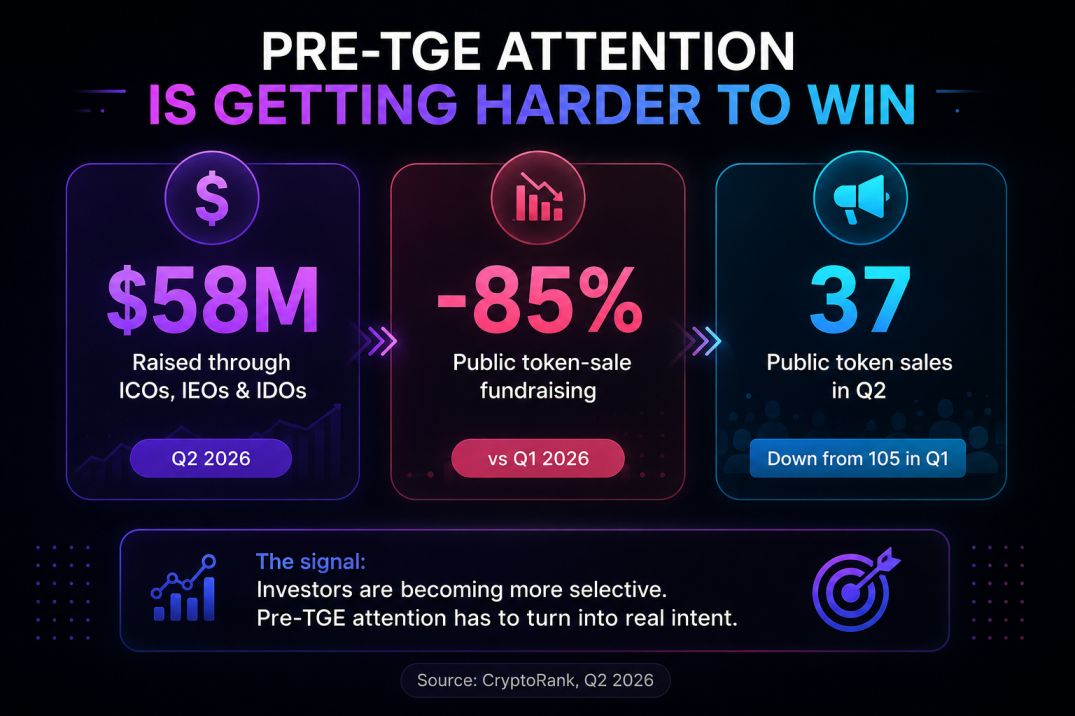
Why Pre-TGE Attention Has Become Harder to Hold
Getting attention isn’t the hard part anymore. Keeping it is. Your project can land a KOL post, pull people into Telegram, get a few strong mentions, and still lose most of that interest within days. Founders feel this fast because every campaign spike looks promising until the conversation suddenly goes quiet again.
The problem is what happens next. People check your site, compare your token with similar launches, look for proof, read community reactions, and decide whether they want to come back. If that second look gives them nothing new, no amount of promotion keeps the buzz alive for long.
Why Pre-TGE Interest Starts to Fade:
- Too many projects fighting for the same crowd at once.
- Paid mentions that disappear as soon as the campaign ends.
- Weak proof behind big launch claims.
- Token details that arrive too late or keep changing.
- Communities built around rewards instead of genuine interest.
- Long gaps between updates that give people nothing worth returning for.
8 Proven Token Launch Marketing Tips to Build Market Buzz Before TGE
Pre-TGE buzz is not built by flooding every channel with content. You need people to notice the project, understand why the token belongs, come back, and still care near TGE. But your Token Launch Marketing has to give them a reason to keep moving.
1. Prove Demand Before Spending Big
A bigger budget widens reach. But it cannot tell you whether anyone genuinely wants what you are launching. So before you scale KOL spend, PR, or community campaigns, look at what people do when no reward is pulling them back. And once you see that pattern, you can increase spending without relying on paid attention alone. If interest disappears when promotion stops, you have not validated demand. More budget only keeps weak attention alive longer.
Signal Check
- Weak Signal: Follower spikes, impressions, giveaway entries, one-off Telegram joins.
- Stronger Signal: Repeat site visits, product use, waitlist activity, branded searches, returning members.
- Best Signal: People return, participate, refer others, or look for updates without another paid prompt.
2. Make Your Token Story Connect
Your story can fall apart before TGE if every channel describes a different project. It starts small. The website leads with one angle, a KOL picks another, and Telegram reduces it to staking or price talk.
One Project, Three Versions
Website: “AI-powered DeFi infrastructure”.
KOL: “The next high-growth token”.
Telegram: “A staking ecosystem”.
Now the market has heard three different versions of the same project. So instead of writing separate narratives for every channel, keep one idea running through all of them.
What You Do → Who Needs It → Why the Token Belongs → Why Now.
From there, creators add personality, founders add context, and community teams answer questions without changing the project. If people cannot explain your token clearly, the story still needs work.
3. Turn Milestones Into Market Buzz
A useful milestone should not get one announcement and disappear down the feed. Instead, treat it as a market moment that keeps working beyond the original post.
One Milestone, Multiple Market Moments
Milestone: Mainnet reaches 25,000 active wallets
→ The founder explains what changed.
→ Demo shows the product in use.
→ The community discusses what comes next.
→ Creator adds context.
→ PR turns the milestone into a story.
→ X visual makes the result easy to share.
→ Newsletter reconnects people who missed it.
But do not copy the same announcement seven times. Let each format add something new. This keeps the milestone visible without feeling recycled and shows real progress behind the promotion.
4. Time KOL Campaigns for Maximum Impact
A wall of sponsored posts in the same 48 hours simply looks paid. So rather than squeezing every creator into one burst, give each wave a job.
Exposure Wave
Wave 1: CuriosityIntroduce the category, problem, product, or founder story.
Wave 2: Validation
Bring in product use, milestones, demos, integrations, and progress.
Wave 3: Token Education
Move into utility, token economics, participation, and TGE context.
Wave 4: Launch Attention
Use high-reach creator coverage when the audience already knows the project.
By then, people are not hearing your name for the first time. They have context. So the final KOL wave can reinforce interest instead of creating it from scratch.
5. Build a Community That Converts
A large Telegram or Discord can look impressive and still contribute little to your TGE. But the real signal appears after people join, when you can see whether they return, participate, and move closer to the project.
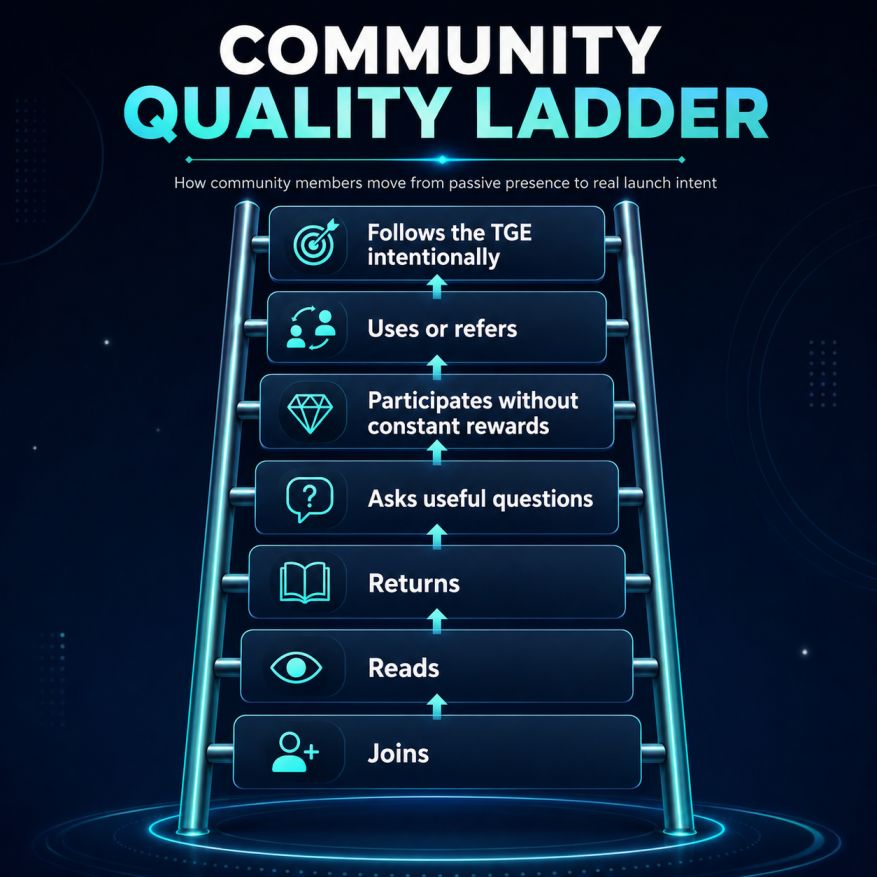
You do not need every member to reach the bottom. Still, enough people need to move beyond “joined once”. So watch repeat conversations, product activity, referrals, AMA attendance, and members helping newcomers. Those behaviours say more than a headline member count.
6. Reward Actions That Signal Intent
A quest can produce attractive numbers while telling you little about launch interest. Following X, reposting, and joining Telegram prove someone wanted the reward. But they do not prove real interest in the token.
Pay for This, Not That
Do not overvalue:
Follow + repost + Telegram join + one wallet action
Put more weight on:
Product use + educational tasks + useful referrals + repeat participation + community contributions
So before approving an incentive campaign, ask:
“If we removed the reward tomorrow, would this action still leave the person more connected to the project?”
If the answer is no, you are buying activity rather than building intent. Instead, rewards should introduce behaviours people have a reason to repeat later.
7. Make Tokenomics Sell the Story
Sooner or later, people stop reading campaign copy and inspect the token itself. And once they do, weak explanations around supply, vesting, utility, or distribution can undo weeks of work.
The Questions Your Marketing Cannot Dodge
- Why does this project need a token?
- What creates demand for it?
- How much is circulating at TGE?
- Who receives tokens early?
- When does major vesting start?
- What does holding or using it provide?
So your token-generation event marketing campaigns should address these points before speculation fills the gap. Also, your TGE marketing strategy should not bury token economics in a document. Instead, explain the numbers simply, keep them consistent, and make sure creators and community teams communicate those facts.
8. Give Holders Reasons to Stay
If your campaign ends at the listing, you have given people a date to watch, not a project to keep following. So while TGE is approaching, make the next chapter visible so people see why attention should continue.
TGE + What?
Weak path:
TGE → listing → price chart → silence
Useful path:
TGE
→ Product release
→ New utility
→ Ecosystem activation
→ User campaign
→ Integration
→ Next project milestone
Of course, do not invent a packed roadmap just to keep people interested. Use real product and ecosystem plans, then explain why each one matters. By the time the token goes live, people should know what comes next and why it is worth staying around for. Don’t market TGE as the final destination. Give holders concrete utility, releases, and ecosystem activity to look forward to after launch.
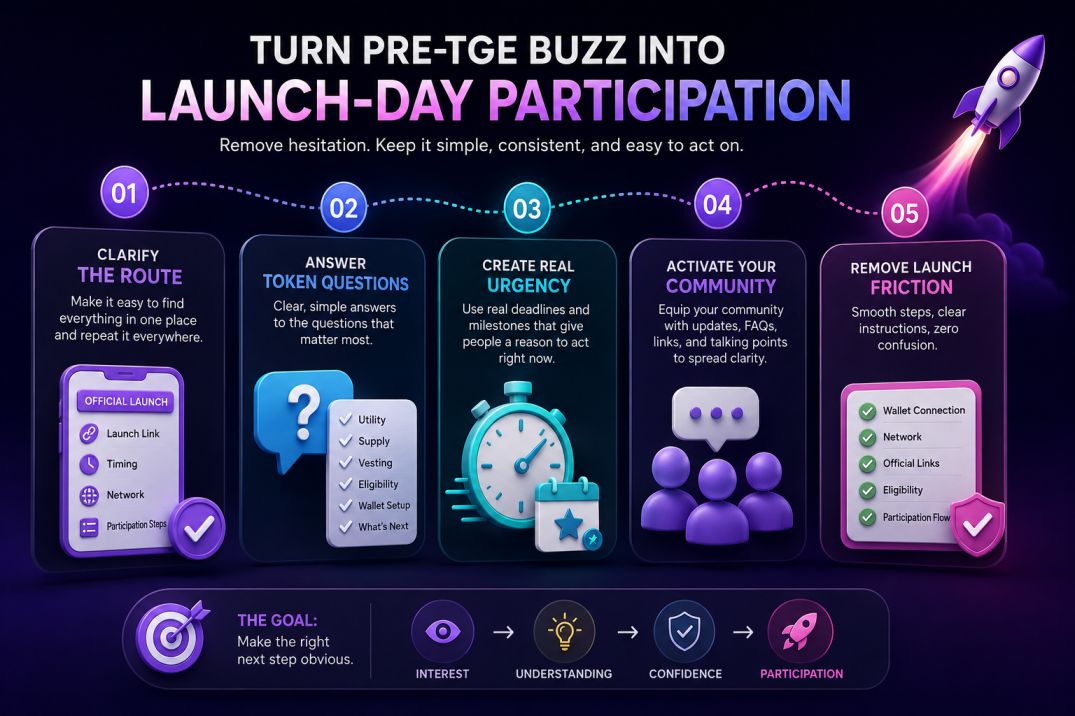
How to Turn Pre-TGE Buzz Into Launch-Day Participation?
Launch-day participation doesn’t happen just because your token finally goes live. By then, people should already know what to do, where to go, and why acting now makes sense.
So in the final stretch, we have one job: remove hesitation. Keep the path simple, the information consistent, and the next step obvious enough that interested people can move without second-guessing.
- Clarify The Route
- Keep the official launch link, timing, network, and participation steps in one place so nobody has to search across channels for them.
- Then repeat the same route across your site, socials, KOL content, and community so nobody gets lost.
- Answer Token Questions
- People now want specifics: utility, supply, vesting, eligibility, wallet setup, and what happens next.
- Answer those before launch day, so interest doesn’t fade while people search through scattered updates.
- Create Real Urgency
- Use deadlines, access windows, or milestones only when they’re real and directly tied to participation.
- Manufactured urgency burns trust. Real timing gives people a clear reason to act while launch attention is close.
- Activate Your Community
- Give active members clear updates, FAQs, official links, and talking points they can actually use.
- When the community knows what’s happening, it can help newcomers quickly instead of adding confusion.
- Remove Launch Friction
- Check every launch step: wallet connection, network, official links, eligibility, and participation flow.
- If one step feels unclear to your team, it will feel worse to someone arriving from a KOL post at TGE.
Common Token Launch Marketing Mistakes You Should Avoid
By the time TGE gets close, small marketing mistakes stop being easy to hide. A mixed message, rushed KOL wave, or reward-led community can weaken trust when people are deciding whether to take part.
Late token education → confused buyers
If people only learn about utility, supply, vesting, or how to participate right before TGE, many will still have basic doubts. So explain these details early, repeat them clearly, and make sure the same information is easy to find across your site and community.
Identical KOL posts → obvious paid hype
When every creator repeats the same script, people can tell the campaign is heavily coordinated. Instead, give KOLs accurate project facts and let each creator explain the token in their own voice and format.
Changing messaging → weaker trust
Your website, founders, KOLs, and community shouldn’t be telling different versions of the project story. If the story changes each time, people will question what is correct. Keep your project purpose, token purpose, and claims consistent.
Reward-only community → low launch intent
Giveaways and quests can bring people in, but many may leave once the rewards stop. So look beyond member counts and watch who returns, asks questions, uses the product, joins discussions, and stays active without another incentive.
No post-TGE story → attention drops after launch
If all your marketing ends at TGE, holders have little reason to keep following. Show what comes next, including product releases, token utility, integrations, or other real milestones already planned after launch.
Conclusion

Vimal J is the Head of Sales at Blockchain App Factory, with 10+ years of experience in sales, client strategy, and Web3 business growth. He helps startups, enterprises, and project founders choose the right blockchain solutions for their goals, bringing a practical market perspective to topics like token development, crypto launches, and Web3 adoption.
Article Reviewed by:
Arun Kamala Santhanath
Marketing Head, Blockchain App Factory


