What is a Polymarket arbitrage bot?
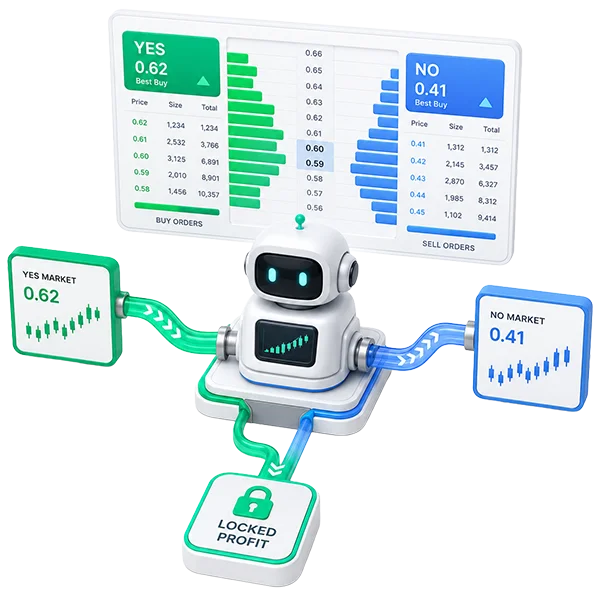
A Polymarket arbitrage bot is an automated program that watches prices across Polymarket and buys offsetting positions whenever their combined cost drops below the guaranteed payout. Because exactly one outcome in a binary market settles at $1.00, buying YES and NO together for less than $1.00 locks in the difference no matter which side wins, minus fees.
The reason this needs a bot rather than a person is speed. These gaps open and close in well under a second, and by 2026 most are captured by execution bots running below 100 milliseconds. Clicking through the interface by hand almost always arrives after the spread has already corrected.
In short: the bot detects when YES + NO (or two logically linked markets) are priced below their guaranteed settlement value, then fills both legs automatically before the market repairs the gap.
The math in one glance
Key terms, fast
CLOB
Polymarket's live order book where prices update in real time.
YES / NO
The two sides of a binary market. One always settles at $1.
Spread
The gap you capture when YES + NO costs under $1.
Latency
How fast the bot reacts. The edge lives under one second.
Is Polymarket arbitrage bot development legal in 2026?
Yes. Building, owning, and running a Polymarket arbitrage bot is a legitimate activity, and Polymarket publishes a public API precisely so developers can build tools on top of it. Automated trading is a normal, established part of how prediction markets work, and a large share of Polymarket's most active traders already run bots.
The one thing worth confirming is your own eligibility, which is true of any trading venue. Polymarket sets access rules by region, and Kalshi, which our cross-platform strategies also use, is a US-regulated exchange approved by the CFTC. That is a quick check on your side, and we are glad to point you to the right questions. We build and deliver the bot; you decide how and where you operate it.
At a glance
Arbitrage strategy types we build
We build bots around five approaches, each with its own detection logic, execution speed, and capital needs. Most serious builds combine two or more so the bot always has an opportunity to work on.
Intra-market arbitrage
When YES + NO for the same market cost under $1.00, buying both guarantees the difference. The most direct opportunity, and the most crowded in 2026, so it rewards low latency.
Cross-market arbitrage
Exploits impossible pricing across logically linked markets using a dependency graph. Lasts longer because it needs to understand how markets relate, which simple price-watchers miss.
Polymarket to Kalshi
The same event often disagrees in price by 2 to 5% across the two platforms. The bot accounts for the settlement-timing gap between crypto and fiat payouts.
Combinatorial arbitrage
Watches several outcome tokens in one market and coordinates a multi-leg order, validating each leg's fill before committing the full position.
AI probability scoring
A signal layer that scores likely outcomes from news and sentiment to prioritise which spreads to chase. Works best stacked on the strategies above.
Not sure which fits?
On a scoping call we look at your capital and target markets and recommend the strategy mix that is realistic to run profitably right now.
How does a Polymarket arbitrage bot work?
It works in a loop: connect a wallet, set the rules, watch the order book, check the edge after fees, fill both legs, then rotate the capital out. Here is the full sequence we build into every bot.
Wallet integration
The bot connects to your funded Polygon wallet holding USDC.e and signs every order with your key using EIP-712. Keys and funds stay under your control and are never pooled with ours.
Strategy configuration
You set the guardrails: active strategies, minimum edge after fees, per-trade and total position limits, and which market categories to trade.
Real-time surveillance
The bot streams Polymarket's WebSocket order book and, for cross-platform trades, polls Kalshi. For each candidate it computes combined cost, gas, and the fee due on the winning side.
Fee-adjusted edge check
No trade fires until the net edge clears your threshold after the 2% winning-side fee and gas. Opportunities that fail the net test are logged as near-misses and skipped.
Autonomous execution
When a trade passes, the bot submits both legs and validates each fill. If one leg fills and the other does not, its risk logic manages the exposure instead of leaving you half-filled.
Capital rotation and exit
Holding legs to resolution ties up capital, so the bot exits as soon as the market corrects and the position can close at a profit, freeing capital for the next opportunity.
Architecture & tech stack
Our bots are built in five layers, each a separate module, so a strategy change or an API upgrade touches one part instead of the whole system.
Market data ingestion
Streams Polymarket's WebSocket order book; polls Kalshi REST every 500 to 1,000ms. Both feeds normalised into one format.
Opportunity detection engine
Runs the strategy math over the normalised feed against your edge thresholds in real time.
Execution engine
Signs and submits orders with EIP-712, coordinates multi-leg fills, confirms each one. Built for the sub-second window.
Capital & risk management
Enforces position limits, tracks exposure, applies stop conditions and emergency exit logic.
Rotation & exit logic
Closes each position the moment the spread corrects, keeping capital moving instead of parked.
| Layer | What we use |
|---|---|
| Language | Python or TypeScript |
| Exchange API | Polymarket CLOB V2 (py-clob-client-v2) |
| Market data | Gamma Markets API, Data API, WebSocket |
| Chain / settlement | Polygon, USDC.e |
| Signing | EIP-712 |
| Cross-platform | Kalshi API |
| Infra | Latency-optimised VPS, Docker delivery |
Key features of our arbitrage bot
Every bot ships with the capabilities below. Beyond them, the detection logic, execution speed, and strategy mix are tailored to your capital and goals.
Fee-aware edge gating
No order fires until the net edge after the 2% fee and Polygon gas clears your threshold. Near-misses are logged, not traded.
Multi-strategy engine
Intra-market, cross-market, cross-platform, and combinatorial arbitrage run from one configurable bot.
Non-custodial control
Keys and signing stay with you through EIP-712. We never hold, pool, or move your funds.
Real-time surveillance
WebSocket order-book streaming plus Kalshi polling to catch spreads the instant they open.
Multi-leg fill validation
Each leg is confirmed before the full position commits, so you are never left holding one side.
Configurable risk controls
Per-trade and total position limits, stop conditions, and emergency exit logic you set.
Automatic capital rotation
Exits on correction so capital keeps working instead of sitting in resolved positions.
Clean, owned delivery
Full source code, Docker setup, and documentation on handover. Built on current CLOB V2, not deprecated V1.
Benefits of automating Polymarket arbitrage
A bot does the one thing a human cannot do on Polymarket: act fast enough and often enough to actually catch the price gaps.
It never sleeps. Watches every market 24/7 and reacts the moment a gap appears, including overnight and during big news.
Only trades when the math works. Every trade is checked against fees before it fires.
Covers more ground. One bot tracks hundreds of markets at once.
Fast enough to win. Gaps close in under a second; a bot under 100ms gets there first.
No emotion. Follows your rules exactly, every time, with no fear or greed.
Your money stays yours. Trades from your own wallet, never takes custody.
Manual trading vs. an arbitrage bot
By the time a person spots a gap and places both trades, the gap is usually gone. A bot does the same job in milliseconds, every time, without getting tired or distracted.
| Manual trading | Arbitrage bot | |
|---|---|---|
| Speed | Seconds to minutes | Under 100ms |
| Gaps caught | Misses most | Catches valid ones |
| Hours covered | Only when watching | 24/7 |
| Fee discipline | Easy to miscalculate | Checked every trade |
| Emotion | Fear and greed creep in | Follows the rules |
| Markets at once | A handful | Hundreds |
Polymarket arbitrage bot development packages
Transparent starting prices by scope. Pick a package as a starting point; we confirm a fixed quote after a short scoping call. Every package is non-custodial and delivered with full source code.
Starter
- * One arbitrage strategy (usually intra-market)
- * Fee-aware edge gating
- * WebSocket real-time surveillance
- * Your risk limits and thresholds
- * Non-custodial wallet integration
- * Docker setup + documentation
- * Delivery in 2 to 4 weeks
Growth
- * Everything in Starter, plus:
- * Up to 3 arbitrage strategies in one bot
- * Cross-market dependency graph
- * Multi-leg fill validation
- * Full risk controls + emergency exit
- * Historical backtesting + live validation
- * Capital rotation logic
- * Delivery in 5 to 8 weeks
Enterprise
- * Everything in Growth, plus:
- * Polymarket + Kalshi cross-platform arbitrage
- * Combinatorial multi-outcome execution
- * Latency-tuned VPS infrastructure
- * AI probability-scoring signal layer
- * Multi-wallet capital allocation
- * Monitoring dashboard + SLA support
- * Delivery in 10 to 14 weeks
Every package includes:
- * Full source-code ownership
- * Non-custodial by design
- * Docker + documentation
- * NDA on request
- * Post-launch support
Our development process
A five-step process that moves from idea to a bot running on live markets, with a real validation step before any meaningful capital is at risk.
Scope and feasibility
We map your goals, target markets, capital, and risk limits, then confirm which strategies are realistic to run profitably given current spreads and latency.
Architecture and design
We design the data, detection, execution, and risk layers, choose the stack, and lock the strategy logic and edge thresholds.
Build and backtest
We write the bot and test its logic against historical order-book data, modelling the 2% fee and Polygon gas so the numbers reflect real conditions.
Live validation
We deploy with $10 to $50 on high-liquidity, short-duration markets to confirm latency and fill accuracy on the real CLOB, since Polymarket has no testnet.
Deploy, monitor, and hand over
We scale up, set up monitoring, and deliver the source code, Docker setup, and documentation, with support arrangements in place.
Backtesting, validation & live testing
We prove a strategy works before you commit real capital. Because Polymarket has no testnet, every real order goes against live funds, so testing runs in two stages.
Historical backtesting
We replay historical order-book data through the bot's detection and execution logic, modelling the full cost of every trade including the 2% winning-side fee and Polygon gas at roughly $0.007 per transaction.
What it confirms
- * Strategy logic fires on real historical gaps
- * Edge holds net of fees and gas
- * Filters out spreads that only look profitable gross
Live validation
We deploy $10 to $50 of real capital on high-liquidity, short-duration binary markets. Only once the results hold do we scale to full capital.
What only live testing can confirm
- * Real end-to-end execution latency
- * Actual fill behaviour on the live CLOB
- * Both legs land inside the execution window
Security, fund custody & compliance
Your funds stay under your control at every step. The bots are non-custodial, and the way we build and hand over protects both your capital and your code.
Non-custodial by design
The bot trades from your own Polygon wallet. We never pool, hold, or move your money.
EIP-712 signing
Every order is signed with your private key. Signing authority stays entirely with you.
No key storage
No trading keys are ever stored on our infrastructure. There is no shared wallet to compromise.
You own the source code
Full ownership on handover, delivered under NDA, with no lock-in to us.
Compliance guidance
Polymarket restricts some regions; Kalshi is CFTC-regulated. We point you to the eligibility questions to confirm.
Enterprise standards
Built by an ISO/IEC 27001 and SOC 2 Type II certified team with 12+ years in blockchain.
ISO/IEC 27001
Information security certified
SOC 2 Type II
Audited controls
GoodFirms
Best Company to Work With
Why choose Blockchain App Factory
We are a Web3 development company with 12+ years of experience and 800+ delivered projects, including blockchain trading platforms for names like Brevan Howard. For Polymarket, that means bots built on the current CLOB V2 API, tested on live markets, and delivered so you can operate and own them.
Proven trading pedigree
We built Trufin, a blockchain options-trading platform, for Brevan Howard, plus exchanges and DeFi systems that run in real market conditions.
Current, not outdated
Built on CLOB V2 and py-clob-client-v2. Bots still written for the retired V1 API stopped working in production.
Tested on real markets
Every bot goes through historical backtesting and a small-capital live trial before it touches your full capital.
You own everything
Full source code, Docker setup, and documentation on handover, under NDA, with no lock-in.
Non-custodial by default
Your keys and funds stay with you at all times, backed by ISO 27001 and SOC 2 Type II practices.
Full team behind it
250+ Web3 professionals and a 90% launch success rate, from scoping to deployment and ongoing support.
Trusted by global brands
From Fortune 500 enterprises to funded Web3 startups across 12+ countries, teams choose Blockchain App Factory to build and ship blockchain products.
"The team delivered our requests in a timely manner and the security side was genuinely competitive. Smooth to work with."
"We worked with them for four months and are happy with the product. I would recommend them for any token-based development or app build."
"They built an innovative cryptocurrency exchange platform for us. We are very satisfied, and the pricing was competitive."
Post-launch support & maintenance
The handover is the start of the relationship, not the end. Prediction-market platforms change their APIs, spreads shift, and a bot that ran well last quarter can need tuning to keep performing. We stay on to keep yours current.
Support covers live monitoring, API and SDK upgrades (for example migrating a bot from a retired version to the current CLOB release), strategy tuning as conditions move, and response times set by an agreed SLA. You decide how hands-on you want us to be, from occasional updates to fully managed operation.
Polymarket arbitrage bot FAQs
Building and running a bot is a normal engineering activity, and Polymarket offers a public API for developers. What varies by region is who is allowed to trade on the platform. Polymarket restricts some users, and Kalshi is CFTC-regulated, so check your own eligibility before trading.
A single-strategy Starter bot begins at $7,500, a multi-strategy Growth bot at $18,000, and a full cross-platform Enterprise engine at $40,000. We give a fixed quote after a short scoping call.
A Starter bot takes about 2 to 4 weeks, a Growth bot 5 to 8 weeks, and an Enterprise engine 10 to 14 weeks. We confirm the timeline during scoping.
It can be, but margins are thin and intra-market arbitrage in particular is crowded. Profit comes from speed, low latency, and turning capital over across many trades, which is exactly what a well-built bot is for.
Yes. The bots are non-custodial. They trade from your own wallet and sign orders with your key using EIP-712. We never hold or pool your funds.
You can validate a bot with as little as $10 to $50 on live markets. What makes one worth running long-term is higher, and we help you model that during scoping.
Yes. Cross-platform arbitrage between Polymarket and Kalshi is part of the Enterprise package. The main challenge is the settlement-timing gap between the two, which the bot accounts for.
Ready to build your Polymarket arbitrage bot?
Book a free scoping call. We look at your target markets and capital, tell you honestly whether a bot makes sense, and give you a fixed quote and timeline. You own the code, you keep your funds, and we support it after launch.