Most crypto communities do not die loudly. They go quiet.
The Discord still has 40,000 members. The Telegram still shows a green dot. But the questions go unanswered for six hours, a fake support bot DMs three holders before anyone notices, and by the time the team wakes up in a different time zone, sentiment has already turned. That is what weak community management looks like, and it almost never shows up in a monthly report until it is too late to fix cheaply.
The market is large enough now that this matters. Crypto.com research put global crypto ownership at 741 million people in 2025, up 12.4 percent from 659 million in 2024. Triple-A, using a more conservative methodology, counted 562 million owners in 2024. Whichever number you trust, the audience is no longer a niche, and neither are the people trying to exploit it.
This guide compares the agencies actually doing this work in 2026, what separates moderation from growth, what you should pay, and how to run a selection process that does not end in a wasted retainer.
|
Key Takeaways
|
What You Are Actually Buying
Skip the job description. Here is what a competent crypto community operation delivers, and what you should expect to see in a scope of work before you sign anything.
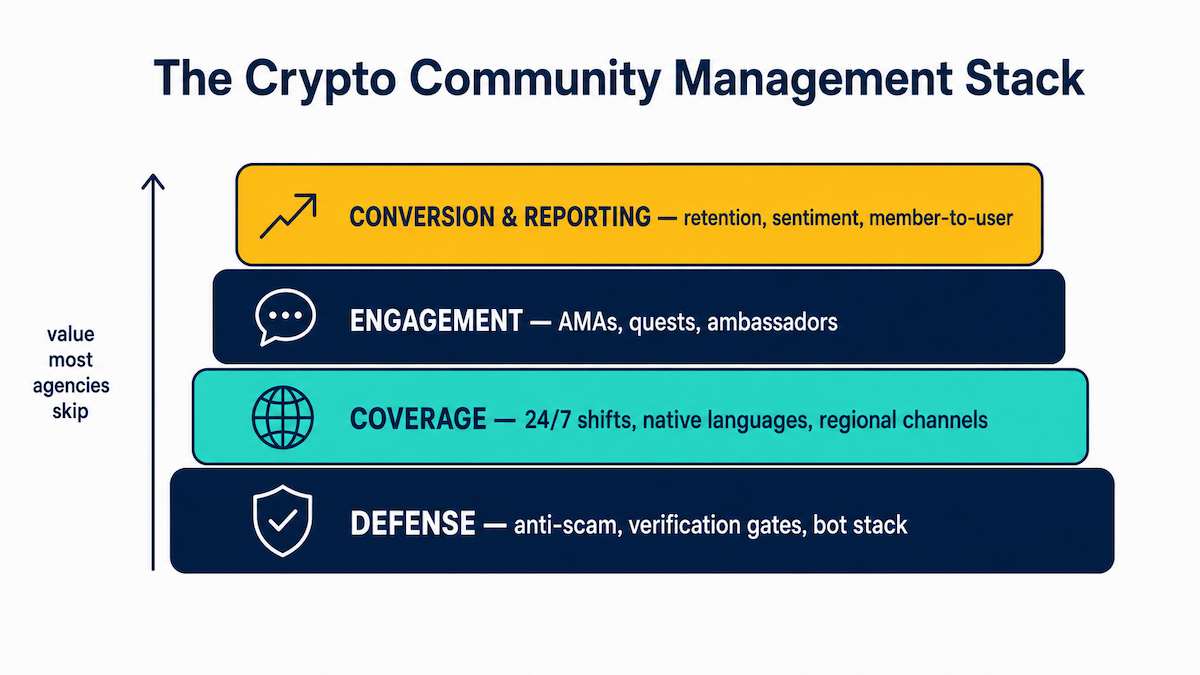
Coverage that matches your holder map
If 40 percent of your holders are in Korea, Vietnam and Turkey, English-only moderation during US business hours is a structural gap, not a staffing preference. Ask for a shift map by region and language, in writing, with named coverage owners.
Active defense, not passive cleanup
The FBI’s 2025 reporting showed Americans alone reported 11.4 billion dollars in crypto-related scam losses, up 22 percent year over year, with investment scams accounting for 8.6 billion. Chainalysis noted impersonation scams grew roughly 1,400 percent year over year and that AI-assisted scams were around 4.5 times more profitable than traditional ones. Your moderation stack needs verified-role gating, DM-scam warnings pinned and repeated, ticket-only support, and a fast escalation path when a fake admin appears.
Retention programs with a calendar
AMAs, quests, contributor tiers, ambassador cohorts and regional meetups need to exist on a calendar you can see 30 days ahead. If the agency cannot show you next month, they are improvising.
Reporting that connects to product
Engagement rate, median first-response time, sentiment trend, 30 and 90-day member retention, and how many community members actually used the product. That last one is the number that justifies the retainer.
|
741M Global crypto owners in 2025, per Crypto.com research, up from 659 million in 2024 |
$17B Estimated global crypto scam and fraud losses in 2025, per Chainalysis |
1B+ Telegram monthly active users, a figure Pavel Durov confirmed had passed one billion |
How This Ranking Was Built
Most agency roundups in this category are written by agencies, and the agency that wrote it happens to be number one. That is worth saying out loud, because it explains why the same seven or eight names circulate across every list.
This one was assembled differently. Candidates were drawn from Clutch’s Web3 marketing rankings, agency service pages that publicly document their coverage model, and published case studies with checkable numbers. Agencies that appear only inside competitor-written listicles, with no verifiable service page or third-party review presence, were excluded. Each surviving candidate was scored against six weighted criteria.
Two consequences worth flagging. Agencies that only moderate rank below agencies that moderate and grow. And a long logo wall with no numbers attached scores lower than three case studies with real figures.
The Best Crypto Community Management Agencies in 2026
1. Blockchain App Factory
Best for token launches that need community, PR, KOLs and listing visibility moving as one campaign.
|
Blockchain App Factory Best overall for launch-stage community management |
||||
|
Blockchain App Factory is a crypto marketing agency, and community is one pillar of a wider go-to-market engine rather than a standalone moderation contract. That is the reason it leads this list. Most agencies in this category can keep a Discord tidy. Far fewer can keep the Telegram announcement, the KOL posts, the press release and the exchange listing note saying the same thing in the same hour of launch week.
The published track record spans work across 800-plus Web3 projects, more than 500 marketing campaigns, over 380 million in cumulative community reach, a vetted creator network of around 3,500, 140-plus crypto media partners, 80-plus token launches supported, and over 1 billion dollars raised through token campaigns they have been involved in. Twelve years of crypto-native operating history sits behind that, which in a category where agencies appear and vanish inside a single market cycle is worth weighting.
Delivery runs out of India and Singapore. That matters more than it sounds for community work specifically. Those two bases cover the IST and SGT windows natively, which is when the Indian, Southeast Asian and East Asian segments of most holder bases are awake and talking, and it removes the coverage gap that agencies operating purely from North America or Western Europe have to plug with expensive night shifts.
What the community scope actually covers:
- Server and group architecture. Custom Discord builds with token-gated and NFT-gated access tiers, role hierarchies, channel structure, verification flows and bot configuration, plus matching Telegram group setup and announcement syncing.
- 24/7 multilingual moderation. Coverage across Discord, Telegram and X with shift structures mapped to holder geography rather than head office hours.
- Engagement and retention programming. AMA circuits, quest and campaign design, contributor tiers, ambassador cohorts and regional activation, run on a visible forward calendar.
- Acquisition, not just retention. KOL outreach and creator activation feeding new members in, so growth does not depend on reshuffling the members you already have.
- Launch-window operations. ICO, IDO and token generation event support where community, PR and listing comms are sequenced together across the critical 72 hours.
- Reporting tied to product. Engagement, sentiment, response time and member-to-user conversion rather than member count alone.
Best fit: token launches, DeFi protocols, RWA platforms, exchanges and NFT ecosystems that want one accountable partner across the full launch and retention cycle. Less relevant if you already have an in-house growth team and only need moderators to fill night shifts.
2. Coinbound
Best for engagement lift on Discord and Telegram with PR and influencer distribution attached.
|
Coinbound 14 verified Clutch reviews |
||||
|
Coinbound is one of the few agencies here with genuine third-party review depth rather than a logo wall, and one of fewer still that publishes a community result as a number you can interrogate. The Metamoose NFT case took engagement from 7.14 percent to 60 percent, which is a ratio improvement rather than a headcount claim, and ratios are much harder to buy than members.
The community team handles server architecture, role design, moderation strategy and engagement programming. What differentiates them is the in-house influencer and PR operation sitting alongside it. That combination matters for a specific failure mode: a community that has gone flat not because moderation is poor but because no new people are arriving. Moderation cannot fix an empty funnel. Coinbound can run both sides.
The tradeoff is price. At 150 to 199 dollars per hour they sit at the upper end of this list, and the New York base means US-centric coverage is stronger than deep CIS or East Asian regional work. If your holder map is heavily Korean or Turkish, pair them with regional moderation or look at Omni instead.
3. Omni Agency
Best for genuinely multilingual communities where English-only coverage quietly loses you holders.
|
Omni Agency 27 verified Clutch reviews |
||||
|
Omni built its offer around a gap most agencies paper over. If 40 percent of your holders sit in Korea, Turkey and Vietnam, translated English moderation reads as foreign, lands badly, and erodes trust in exactly the segments most likely to churn during a drawdown. Omni staffs native-language moderators who understand the cultural norms of each segment, which is a different hiring problem than running everything through one English desk with a translation layer.
They report supporting launches for over 100 brands, with more than 75 million dollars raised across client projects and billions in trading volume, operating since 2018. Coverage spans DeFi, gaming, AI, DePIN and infrastructure. Their published guidance on Discord community operations is also some of the more practical material in this space, which is a reasonable proxy for whether an agency has actually run these servers.
Consider them when regional depth is the constraint. Consider someone else when your community is single-language and your real problem is acquisition volume.
4. FINPR
Best for transparent, modular scoping without committing to a bloated retainer.
|
FINPR Established 2017 |
||||
|
FINPR publishes its community scope in more detail than almost anyone else in this category, and that transparency is the reason it earns a place here over larger names. You choose Telegram, Discord or both. You choose 8 hours per day or full 24/7. That second choice is rare honesty in a market where every agency claims round-the-clock as standard and then staffs one overlapping shift.
The Telegram plan includes weekly FAQ sheet maintenance, announcement drafting support, weekly and monthly community metrics reporting, structured engagement activity and continuous chat moderation. The Discord plan includes a custom moderation bot, full server boost, and announcement syncing across Discord, Telegram and X so the same message does not get retyped three times with three different tones.
The team is small, roughly 2 to 10 core staff drawn from a wider pool across the Middle East and Eastern Europe, and they have worked with more than 600 blockchain, NFT, DeFi and fintech companies since 2017. Named client work includes Polkadex, AscendEX, LBank and Seedify. Good fit for mid-size projects that want defined deliverables. Less suited to a mega-launch needing fourteen moderators live at once.
5. Distractive
Best for ecosystem-level and protocol community work rather than single-token campaigns.
|
Distractive Clutch verified, 3 reviews |
||||
|
Distractive is structurally different from everyone else on this list. It does not operate as an external vendor renting you moderators. It embeds as a core contributor inside ecosystems, leading integrated marketing initiatives for Polkadot and running as a dedicated marketing and growth team for the Moonbeam and Moonriver ecosystem. They secured a Web3 Foundation grant as a key marketing provider, which is a form of validation no amount of client logos replicates.
Clutch reviewers credit them with Moonbeam’s token generation event debuting inside the top 100 by market cap. Reviewers also consistently flag cultural fit and values alignment, which sounds soft until you have watched a generic marketing agency post something tone-deaf in a governance channel during a contentious vote.
Right choice for Layer 1s, Layer 2s, developer platforms and foundations where community, ecosystem development and brand are genuinely the same problem. Wrong choice for a memecoin launch needing volume in 72 hours.
6. TokenMinds
Best for APAC-weighted communities in gaming and NFT verticals.
|
TokenMinds 5.0 rating on Clutch |
||||
|
TokenMinds launched in Singapore in 2017 and its Singapore-based team works across APAC, the US and Europe. The technical grounding shows up in moderator quality: their people came up alongside blockchain build work, so protocol-level questions in a support channel are less likely to stall waiting for a developer to wake up.
Real strength sits in gaming and NFT communities, where named client work includes CryptoBlades, Double Jump and Gensokishi. Their community offer leans into airdrop management, partner outreach and AMA programming rather than pure moderation volume, which suits projects whose growth depends on ecosystem partnerships more than paid acquisition.
At a 5,000 dollar minimum and a 50 to 99 dollar hourly band, they carry the lowest entry point among the well-reviewed options here. The Clutch review count is thin at two, so weight the named client work more heavily than the star rating.
7. EAK Digital
Best for round-the-clock coverage paired with tier-one press access.
|
EAK Digital London plus regional hubs |
||||
|
EAK runs a dedicated 24/7 Discord and Telegram community management service line, which is worth noting because many agencies fold community into a general social retainer and staff it accordingly. Theirs is a named product with its own coverage commitment.
The differentiator is the media and event footprint sitting behind it. EAK organises Istanbul Blockchain Week and maintains tier-one press relationships, so community announcements can be sequenced with earned coverage rather than shouted into a server and hoped for. Client history includes major exchange and infrastructure names.
Pricing sits at the higher end of this list and is quoted rather than published, which is consistent with the coverage and press access on offer. Shortlist them when a launch needs both a live community and a press moment on the same day.
8. Lunar Strategy
Best for funded projects that want growth-oriented community work with European coverage.
|
Lunar Strategy 23 verified Clutch reviews |
||||
|
Lunar Strategy has worked with more than 200 crypto clients and publishes some of the most genuinely useful free education in this category, including detailed operational guides on running crypto Discord and Telegram communities. That is a meaningful signal. Agencies that have not actually run these servers cannot write that material.
Clutch reviewers across 23 verified entries consistently flag timely delivery, proactive communication and adaptability, with value for cost mentioned repeatedly. Project sizes range from the 10,000 dollar minimum up toward the million mark, so they scale across stages rather than serving one band.
Community, KOL and PR are offered together from a Lisbon base, with the team also hosting industry events locally. Strong European positioning. Less depth in East Asian regional coverage than Omni or TokenMinds.
9. X10 Agency
Best for launch-window coverage on ICO, IDO and IEO campaigns where you need to compare quotes honestly.
|
X10 Agency Coverage model published openly |
||||
|
X10 earns its place on a single unusual quality: it publishes the actual staffing math. Two moderators working twelve-hour shifts each to produce genuine round-the-clock cover, scaling from one up to fourteen community managers depending on community size and time zone spread. Nobody else on this list states it that plainly.
That transparency is worth real money during procurement. When three agencies all quote 24/7 coverage at wildly different prices, the only way to compare is headcount and shift structure. X10 hands you the benchmark to hold the others against.
Focus sits on DeFi and token sale communities where launch-week message volume spikes hard and then needs a retention plan rather than a quiet server. Review presence and published pricing are thinner than the larger names here, so treat this as a shortlist candidate you verify directly rather than a fully documented option.
10. NinjaPromo
Best for flexible multi-channel coverage under one subscription.
|
NinjaPromo 95 verified Clutch reviews |
||||
|
NinjaPromo carries the deepest review base here at 95 verified Clutch entries, and its subscription model is the real differentiator. You buy a block of hours and reallocate them across community, social, paid and video as priorities shift, rather than locking a fixed scope for twelve months.
That flexibility genuinely suits projects whose needs swing between quarters: heavy community during a launch, heavy paid during a listing push, heavy content during a quiet build period. At 50 to 99 dollars per hour with a 5,000 to 10,000 dollar entry, the commercial terms are among the more accessible on this list.
The tradeoff is continuity. Pooled models rotate specialists, so you are less likely to keep the same three moderators who know your protocol inside out across a full year. If deep product knowledge in your support channel is the priority, a dedicated team model serves you better.
|
Is your community actually growing, or just getting bigger? Get a free audit of your Discord and Telegram covering response time, scam exposure, sentiment and retention. |
Discord or Telegram, and How to Split Your Budget
This is the first real decision, and getting it wrong wastes half your retainer.
Telegram is where price conversations happen
Telegram’s monthly active user base passed one billion, and crypto is heavily over-indexed within it. Telegram suits traders, CIS and Asian markets, launch-day velocity and announcement distribution. It is fast, chaotic and unforgiving. Pavel Durov’s July 2026 announcement of a native non-custodial wallet rolling out to over a billion users pushes that even further toward Telegram as a primary crypto surface.
Discord is where builders stay
Discord hosts roughly 28.4 million servers and handles hundreds of millions of messages daily. Its structure suits DeFi, NFT, gaming and governance communities that need channels, roles, token gating and searchable support history. If you need contributor tiers and long-form discussion, Discord wins.
Most funded projects need both, weighted
The practical split for a token launch is Telegram-primary for announcements and holder velocity, Discord-primary for support, contributors and governance. Ask any agency to justify their weighting against your actual holder geography, not their internal preference.
X is the acquisition layer, not the community
Treat X as top of funnel. Community lives where conversation is threaded and support is possible.
|
A community that only feels alive when the price is up was never a community. It was an audience waiting for an exit. |
What This Should Cost
Pricing in this category is opaque, so here is a plain read on the ranges and what drives them.
Basic moderation runs roughly 2,000 to 3,000 dollars per month
That buys single-platform English moderation, usually on business hours or a partial-day window. Fine for a quiet product community. Not enough for a launch.
Comprehensive management runs roughly 5,000 to 15,000 dollars per month
This tier adds strategy, content production, engagement programming and genuine 24/7 cover. Enterprise-scale programs for major projects commonly exceed 20,000 dollars per month.
The floor is set by labor, and the math is checkable
Web3 career data puts average community manager compensation around 69,000 dollars per year globally, with hourly rates commonly reported between roughly 20 and 93 dollars. The standard 24/7 structure is two moderators on twelve-hour shifts, scaling up to fourteen community managers for large multi-region communities. Multiply and compare. Any quote well below that range is selling you part-time coverage with a 24/7 label on it.
Watch what sits outside the retainer
Bot licensing, quest platform fees, ambassador reward pools, KOL fees and translation are frequently excluded. Launch windows are usually quoted as a separate sprint. Ask for the all-in number.
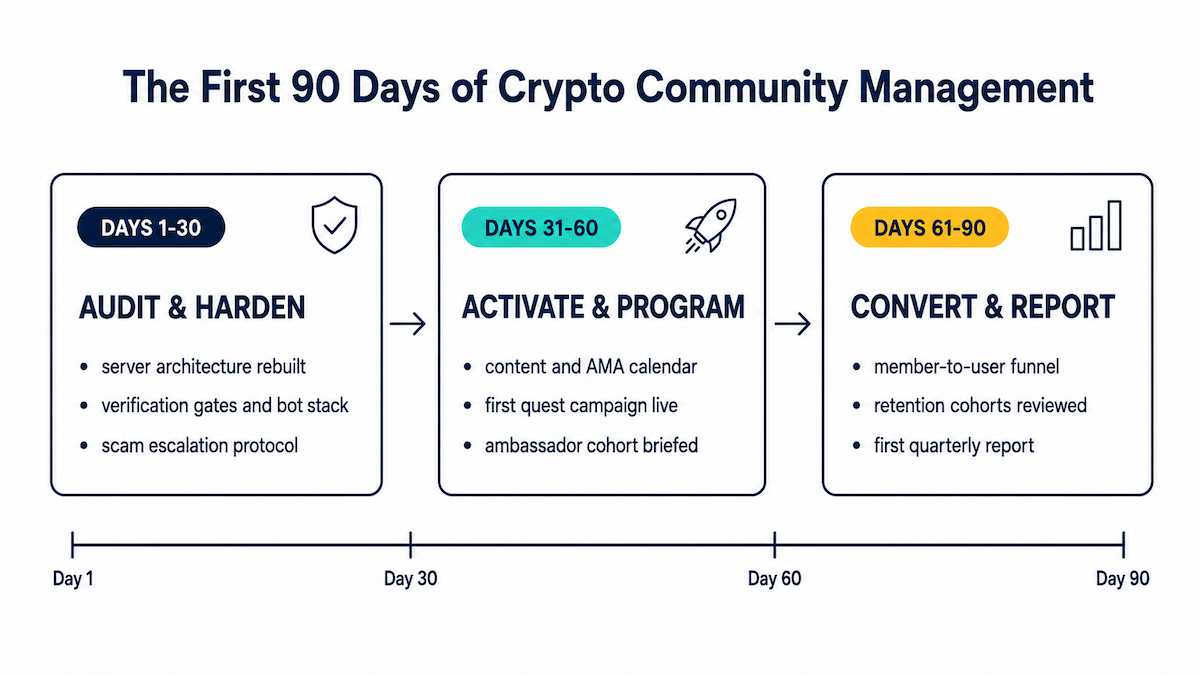
The First 90 Days, Phase by Phase
A good agency will propose something close to this without being asked. If their onboarding plan is a kickoff call and a Slack channel, keep looking.
|
Audit and harden Server and group architecture rebuilt, roles and verification gates set, bot stack configured, scam escalation protocol written and tested, moderator shifts assigned by region, baseline metrics captured. |
|
|
Activate and program Content and AMA calendar live, first quest or contributor campaign running, ambassador cohort recruited and briefed, regional channels opened where holder data justifies it, sentiment tracking in place. |
|
|
Convert and report Member-to-user funnel instrumented, retention cohorts reviewed, underperforming channels consolidated, first full quarterly report delivered against the day-one baseline. |
Red Flags Worth Walking Away From
Every one of these has cost a real project real money.
- Growth guarantees stated as member counts. Numbers are purchasable. If the pitch leads with “we will add 50,000 members,” ask what percentage will still be active at day 90.
- No named escalation path for scams. Ask directly: what happens in the twelve minutes after a fake admin starts DMing holders? A real answer names a person, a tool and a maximum response time.
- Moderators who cannot answer product questions. Have them sit a short technical quiz on your protocol during the pitch. The drop-off rate is instructive.
- Reporting that stops at engagement. If nothing in the report links to wallet connects, deposits or product signups, you cannot prove the spend worked.
- No anti-sybil thinking on incentives. Airdrop research consistently shows a majority of recipients sell almost immediately, and LayerZero removed 803,273 wallets, around 59 percent of applicants, before its ZRO distribution. Any agency designing your quest or reward program should raise sybil filtering unprompted.
Metrics That Actually Tell You Something
Replace the vanity dashboard with these five.
- Median first-response time by platform and by shift. This exposes coverage gaps faster than anything else.
- Daily active over monthly active members. A ratio, not a headcount, and the honest measure of whether people come back.
- Sentiment trend tracked weekly, with the delta explained. A dip you can explain is fine. A dip nobody noticed is not.
- Day-30 and day-90 member retention by acquisition cohort, so you can see which campaigns brought people versus farmers.
- Member-to-user conversion. The percentage of community members who took a real product action. This is the number your board should see.
Frequently Asked Questions
How much does crypto community management cost per month?
Basic single-platform moderation typically runs 2,000 to 3,000 dollars per month. Comprehensive management with strategy, content and 24/7 coverage typically runs 5,000 to 15,000 dollars per month, and enterprise programs for major projects often exceed 20,000 dollars. Launch windows are usually quoted as a separate sprint on top of the retainer.
Should I start with Discord or Telegram?
Telegram if your audience is traders, or concentrated in CIS and Asian markets, or if you are approaching a token launch. Discord if you need structured support, contributor roles, token gating and governance discussion. Most funded projects run both with a deliberate weighting.
Can I just hire an in-house community manager instead?
One person cannot cover 24 hours across multiple languages. In-house works well as a community lead who owns strategy and product context, with an agency supplying shift coverage and regional moderators underneath. The hybrid is usually cheaper than a full in-house team and more accountable than a pure agency setup.
How fast should I expect results?
Response time and scam incident rate improve within the first 30 days because those are operational fixes. Engagement ratios move in 60 to 90 days. Member-to-user conversion needs a full quarter of clean data before the number means anything.
What is the single biggest mistake projects make?
Hiring community management after the launch date is set. Server architecture, verification gating, moderator training and escalation protocols take weeks to build properly. Teams that start six weeks out spend launch week firefighting instead of converting.
|
Ready to hand your community to a team that has done this 800 times? |

Vimal J is the Head of Sales at Blockchain App Factory, with 10+ years of experience in sales, client strategy, and Web3 business growth. He helps startups, enterprises, and project founders choose the right blockchain solutions for their goals, bringing a practical market perspective to topics like token development, crypto launches, and Web3 adoption.