
Search behavior moved before capital did.
AI token searches climbed 421% year over year, and the money followed the same curve. Silicon Valley Bank’s 2026 crypto outlook found that 40 cents of every venture dollar deployed into crypto companies in 2025 went to teams also shipping artificial intelligence products, up from 18 cents a year earlier. Tiger Research counted $13.3 billion of crypto venture funding in the first half of 2026 across just 435 rounds, with AI-integrated crypto projects taking 128 of them. Fewer deals, bigger checks, and a much narrower list of narratives that actually clear the bar.
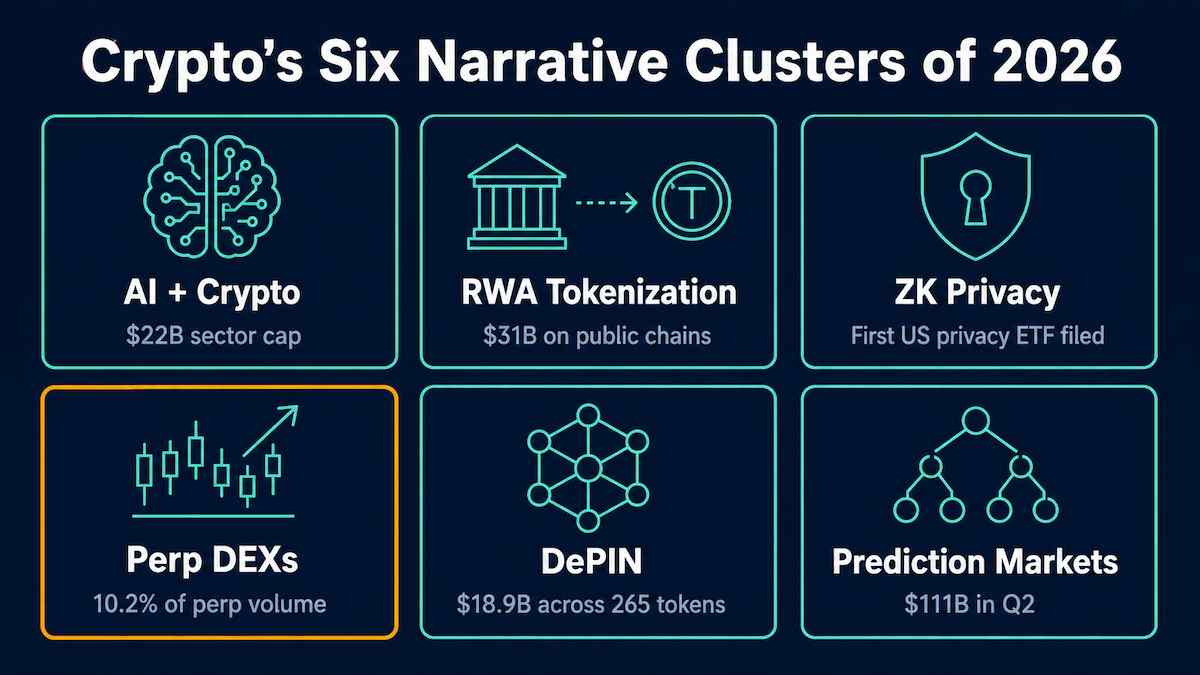
That narrowing is the story of 2026. The total crypto market cap sits near $2.25 trillion as of July 2026, well off the roughly $4.27 trillion peak recorded in October 2025, yet six clusters are compounding right through the drawdown: AI plus crypto, real world asset tokenization, zero knowledge privacy, perpetual DEXs, DePIN, and prediction markets. Attention is not evenly distributed anymore. It is clustered, and if your project or your content strategy is not sitting inside one of these clusters, you are competing for leftovers.
This piece breaks down all six, what the current numbers actually say, and how founders and marketers should position against each one.
- Capital and search demand are concentrating into six narrative clusters while the broader market cap sits roughly 45% below its October 2025 high, so narrative selection now matters more than market timing.
- Three of the six clusters are revenue-backed rather than speculative: perpetual DEXs cleared $739.5 billion in January 2026 volume, prediction markets did about $111 billion in Q2 2026, and tokenized real world assets excluding stablecoins reached $19.32 billion by 31 March 2026.
- Positioning inside a hot cluster requires proof, not adjacency. Published metrics, audits, named counterparties, and technical depth are what earn rankings and AI engine citations in these categories.
Why 2026 Rewards Narrow Positioning
Liquidity has thinned but it has not left. Stablecoin supply crossed $315 billion at the end of Q1 2026 and held near $313 billion through June, a rise of roughly 23% year over year, and stablecoins accounted for around 75% of all crypto trading volume in Q1, the highest share on record. The dollars are still on chain. They are just being deployed with far more selectivity than in 2021 or 2024.
The venture picture confirms it. Round count has fallen 78% from the 2022 peak of 1,978 deals, yet H1 2026 capital deployed nearly matched all of 2024. Payments and stablecoins alone went from $143.9 million to $2.85 billion in a single half year. When allocators concentrate like this, the market stops paying for generic infrastructure stories and starts paying for defensible positions inside specific verticals. That is the environment every founder and marketer is now writing into.
|
$13.3B Crypto venture funding in H1 2026 across only 435 rounds |
10.2% Perp DEX share of total perpetual futures volume, up from 2.0% |
$31B Distributed RWA value on public chains as of July 2026 |
1. AI + Crypto: The Cluster Everything Else Is Measured Against
This is the widest cluster and the noisiest. CoinGecko’s AI category tracked a combined market cap near $22 billion in mid 2026 after spiking above $26 billion in late May, which sounds modest against the sector’s share of voice. That gap between attention and capitalization is exactly where the opportunity sits, and also where most projects get exposed. Search volume is inflated by a broad definition that lumps decentralized GPU marketplaces, agent frameworks, subnet networks, and pure narrative memecoins into one bucket.
Where the real demand sits
- Compute and inference markets, where usage is measurable in GPU hours rather than token velocity.
- Agent payment rails, which is where the AI narrative and the stablecoin narrative overlap and where H1 2026 funding was heaviest.
- Data provenance and model attestation, driven by enterprise procurement rather than retail speculation.
How to position without getting lumped in with the noise
- Publish unit economics. Cost per inference, throughput, and utilization rates separate real networks from wrappers instantly.
- Name the model families and hardware you actually support. Vague claims about supporting AI workloads rank for nothing.
- Build comparison content against centralized alternatives. Search intent in this cluster is overwhelmingly comparative.
The marketing read
AI plus crypto queries are where AI Overviews trigger most aggressively, because the questions are definitional and comparative. Content that answers a specific question in the first 60 words, then supports it with named sources and figures, is the format that gets extracted and cited.
2. RWA Tokenization: The Institutional Track
RWA is the cluster with the least speculative energy and the most durable growth. According to RWA.xyz, total distributed real world asset value on public blockchains reached $31 billion as of July 2026, spread across 167 platforms and held by more than 961,000 individual holders. Excluding stablecoins, tokenized RWAs grew from $5.42 billion in January 2025 to $19.32 billion by 31 March 2026, a rise of roughly 257% in fifteen months.
The composition matters more than the headline. Concentration is extreme, and pretending otherwise damages credibility with the exact institutional audience this cluster attracts.
| Asset Class | Approximate 2026 Value | Maturity Signal |
| Tokenized US Treasuries | $12.88 billion, early April 2026 | Institutional, crowded |
| Commodities, mostly gold | $7.37 billion market cap | Retail driven, steady |
| Private credit | Around $5 billion distributed, March 2026 | Open, underbuilt |
| Equities and funds | Early stage, fragmented | Regulatory gated |
What actually wins deals here
- Named custodians, transfer agents, and auditors. Institutional buyers screen for counterparties before they screen for technology.
- Jurisdiction specific compliance content. A page about tokenizing private credit under a named regulatory regime outranks ten generic RWA explainers.
- Secondary liquidity mechanics. The unsolved problem in this cluster is exit, not issuance.
The content gap
Almost every RWA article on the internet explains what tokenization is. Very few explain what happens at redemption, how NAV is struck, or who bears settlement risk. That is the ranking gap and it is wide open.
3. ZK Privacy: From Compliance Risk to Institutional Product
The privacy cluster spent years priced for regulatory catastrophe. In 2026 that discount collapsed. The SEC closed its nearly two year investigation into the Zcash Foundation on 15 January 2026 without enforcement action, and Grayscale filed a Form S-3 on 12 May 2026 to convert its Zcash Trust into what would be the first US spot privacy coin ETF. Zcash traded at $642.18 on 9 May 2026, pushing its market cap near $9.96 billion and taking the largest privacy asset position from Monero.
|
Privacy stopped being a regulatory liability in 2026 and started being a product feature institutions ask for by name. |
Three positioning angles that work
- Selective disclosure over blanket anonymity. Viewing keys and proof of compliance narratives travel far better with institutional audiences than privacy maximalism.
- ZK as scaling infrastructure. The proving systems pioneered for privacy now underpin major Ethereum layer 2 networks, which gives the technology a second, entirely non controversial demand curve.
- Private settlement for enterprises. Payroll, treasury, and B2B invoicing on public chains are unsolved problems with real budget behind them.
What to avoid
Do not build your messaging around evading oversight. The entire 2026 repricing came from regulatory clarity, not defiance, and content that leans the wrong way will be filtered out of the exact citation sets you want to appear in.
|
Which narrative cluster fits your product? Get a positioning read on where your project has the clearest path to demand. |
4. Perpetual DEXs: The Revenue Cluster
No cluster has taken share faster. Decentralized perpetual futures volume hit $739.5 billion in January 2026, roughly eight times the $81.7 billion recorded two years earlier, and DEX share of total perpetual volume climbed from 2.0% to 10.2%. Hyperliquid processed around $432 billion in monthly volume by June 2026 and held about 38.3% of combined volume across the thirteen decentralized venues tracked in early July 2026, according to DefiLlama.
This is the cluster where product beats narrative most decisively. Traders move for execution quality and fees, not for a thesis.
Where new entrants still have room
- Long tail and pre launch markets that the dominant venue does not list.
- Regional and compliance specific access layers built on top of existing liquidity.
- Structured products, vaults, and market making tooling that sit above the matching engine.
Marketing implications
- Publish live, verifiable metrics. Volume, open interest, uptime, and fill quality dashboards are the highest converting asset in this category.
- Comparison content against the incumbent is unavoidable and highly searched. Do it honestly and with sourced numbers.
- Points and incentive campaigns generate volume, not loyalty. Model retention separately from launch spikes.
5. DePIN: Real Revenue, Slow Compounding
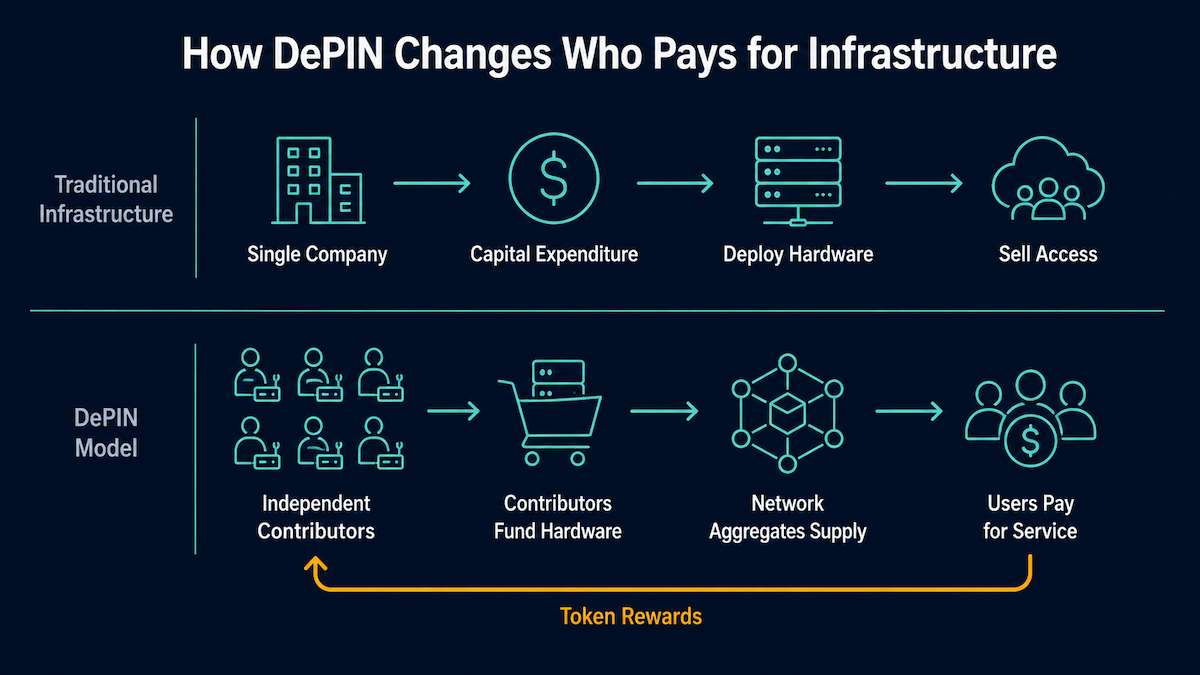
DePIN carries the widest spread between valuation and hype. CoinMarketCap tracked 265 DePIN tokens with a combined market cap of $18.92 billion as of May 2026, after the sector grew from roughly $5.2 billion in late 2024 to over $19 billion by September 2025. Messari estimated the sector’s total on chain revenue at around $72 million for fiscal 2025 with a projection closer to $100 million in 2026, which is real money and also a reminder that this cluster is early relative to its market cap.
The World Economic Forum’s projections for a multi trillion dollar DePIN market by 2028 get quoted constantly. Treat them as directional rather than as a planning input.
The segments with the clearest demand
- Compute and GPU networks, which inherit demand directly from the AI cluster.
- Wireless and connectivity, where unit economics are provable at the node level.
- Energy and grid data, driven by utility procurement rather than crypto native buyers.
- Mapping, sensing, and environmental data feeding into enterprise and AI training pipelines.
How to build authority here
Node operator economics is the most searched and least well served topic in DePIN. Payback period, hardware cost, realistic monthly yield, and churn data will outperform every visionary essay about decentralized infrastructure. Show the spreadsheet.
6. Prediction Markets: The Breakout of 2026
Prediction markets moved from crypto curiosity to mainstream financial product in under two years. The sector cleared roughly $111 billion in notional volume in Q2 2026 and about $50.6 billion in July 2026 alone across Polymarket, Polymarket US, and Kalshi. Kalshi handled $37.7 billion of July’s total, Polymarket’s international venue posted $10.8 billion, and its regulated US platform added $3.5 billion. Chainalysis attributed around $20 billion of on chain prediction market volume to the 2026 FIFA World Cup, with close to 400,000 wallets participating.
Sports drove the breakout, but the infrastructure built for it now serves elections, macro data, and corporate events.
Where the openings are
- Vertical markets in insurance, supply chain, and commodity risk where the audience already understands probability pricing.
- Oracle and resolution infrastructure, which is the single biggest trust bottleneck in the category.
- Liquidity provisioning tools and market maker infrastructure for long tail events.
- Compliance wrappers for regulated jurisdictions, which is where Kalshi’s advantage was built.
The narrative to own
Prediction markets sell best as information infrastructure, not as gambling. Content that frames markets as forecasting tools, cites resolution accuracy, and explains settlement rules earns trust with the media and institutional audiences that this category needs next.
A Practical Sequence for Entering Any of These Clusters
Picking a cluster is the easy part. Earning position inside it is a sequencing problem, and most teams try to do all three phases at once.
|
Claim the definitional ground Publish the technical explainers, glossary pages, and comparison content that AI engines pull from. Cite real figures and name your sources in plain text. |
|
|
Publish proof Audits, live dashboards, node economics, named partners, and reserve attestations. This is the layer that converts rankings into pipeline. |
|
|
Distribute for citation Get your data referenced by researchers, aggregators, and analysts. Third party citation is what makes AI engines treat you as a source rather than a vendor. |
What This Means for the Next Twelve Months
The six clusters are not equally mature and should not be approached the same way. Perpetual DEXs and prediction markets are already generating meaningful revenue, so the competitive battle there is product and liquidity. RWA and ZK privacy are gated by regulation and counterparty trust, which makes compliance depth the moat. AI plus crypto and DePIN carry the widest gap between attention and fundamentals, which means enormous top of funnel demand and a much harder job proving substance.
One pattern holds across all six. The projects gaining ground publish verifiable numbers. The ones losing ground publish adjectives.
Blockchain App Factory works across every one of these clusters, from RWA tokenization platforms and perpetual DEX infrastructure to DePIN network architecture, prediction market builds, ZK enabled privacy layers, and AI agent integrations. On the growth side, the same team handles the part most projects underestimate: the technical content, structured data, and authority signals that get a project surfaced in Google AI Overviews and cited by AI assistants when a founder or fund manager asks which providers are worth shortlisting. Development and visibility are treated as one workstream because in 2026 they genuinely are.
Choose one cluster. Prove your numbers publicly. Publish the depth nobody else is willing to write. That is the entire playbook this year.
|
Ready to build inside one of these clusters? End to end development and go to market for RWA, perp DEX, DePIN, ZK, AI and prediction market products. |
Frequently Asked Questions
Which crypto narrative is growing fastest in 2026?
By volume growth, perpetual DEXs and prediction markets lead. Decentralized perp volume reached $739.5 billion in January 2026, roughly eight times the level of two years earlier, and prediction markets cleared about $111 billion in Q2 2026.
Is RWA tokenization still concentrated in Treasuries?
Yes. Tokenized US Treasuries accounted for roughly $12.88 billion in early April 2026 out of a non stablecoin RWA total near $19.32 billion at the end of March, so a large majority of value sits in a single asset class. Private credit and equities remain the underbuilt segments.
Why did privacy coins rebound in 2026?
Regulatory clarity. The SEC closed its Zcash Foundation investigation without enforcement in January 2026, and Grayscale filed in May 2026 to convert its Zcash Trust into a US spot ETF, removing an overhang that had suppressed institutional participation.
Is DePIN profitable yet?
Partially. Messari estimated roughly $72 million in sector on chain revenue for fiscal 2025 with a projection near $100 million for 2026, against a token market cap around $18.92 billion in May 2026. Individual networks vary widely, so node level economics matter more than sector averages.
How do these narratives affect content and SEO strategy?
Search and AI citation demand is concentrating in the same clusters as capital. Content that answers specific technical questions, cites current figures with named sources, and provides verifiable proof of the project’s own metrics is what gets ranked and extracted into AI generated answers.

Vimal J is the Head of Sales at Blockchain App Factory, with 10+ years of experience in sales, client strategy, and Web3 business growth. He helps startups, enterprises, and project founders choose the right blockchain solutions for their goals, bringing a practical market perspective to topics like token development, crypto launches, and Web3 adoption.