



Papertrade opened for trading on October 10, 2026, with up to 1,000x leverage on Bitcoin and Ethereum. Within a day, community researchers were pointing at two wallets that appeared to nudge Hyperliquid’s ETH quotes to profit from the way the new venue priced its positions.
The product launched. The trust story did not.
That gap is where most perpetual DEX marketing breaks down. Founders spend months on matching engines and liquidation logic, then take the venue to market with a leverage number and a points campaign. Traders who have lived through a few exploits now read that pitch as a warning label.
The prize for getting it right is large. Castle Labs data shows onchain perp venues handled 12.33% of global perpetual futures volume in September 2026, up from 0.11% in January 2023. DefiLlama figures put 30-day perp DEX volume at roughly $593 billion as of September 9, 2026. Castle Labs also counts more than 261 perp DEXs launched since Hyperliquid, so a new venue is fighting for attention against hundreds of lookalikes.
Derivatives are also widening beyond perps. CryptoRank reported onchain options notional of $7.52 billion in Q3 2026, up 73% from the previous quarter, and Crypto Briefing reported that Derive alone cleared about $3.8 billion in September. Every new venue in this space faces the same first question from traders: why should I trust you with leveraged collateral?
This guide covers what to tell traders and what you have to prove before you tell them.
- Leverage headlines are the least trusted claim a perp DEX can make. Lead with the liquidation rules and the leverage tier table instead.
- Prove liquidity and solvency on a live public dashboard, and report organic volume separately from incentive volume.
- Oracle design is now a front-page marketing topic. Publish your price sources, open interest caps, failure rules and signer key setup before launch day.
|
12.33% Perp DEX share of global perpetual futures volume, September 2026 (Castle Labs) |
$593B 30-day perp DEX volume as of September 9, 2026 (DefiLlama) |
12 Oracle or price feed exploits in 2026 by mid-July, worth about $46.3M (DEXTools count) |
Start with who you are actually marketing to
A perp DEX has at least four audiences, and each one opens with a different question. Messaging that tries to answer all of them in one tagline ends up answering none.
Professional traders
Traders and funds care about depth at size, API latency, fee tiers and how the liquidation engine behaves when the market gaps. They will read your documentation before they read your tweets.
Market makers
A venue without market makers has nothing to sell. They want rebate structures, uptime history, risk limits and a clear explanation of how mark prices are set. Recruit them before you recruit traders.
Incentive-driven retail traders
Points and airdrops bring them in fast, and the volume they bring leaves just as fast. Aster’s surge after its September 2025 token launch, and the share it gave back as rewards normalized in early 2026, shows how quickly rented volume walks once the rewards shrink.
Integrators
Wallets, aggregators, vault builders and trading bot teams want SDK documentation and audit reports they can show their own users. They are your distribution, so treat their onboarding docs as marketing assets.
Write a one-sentence promise for each group before anyone writes ad copy.
Why leverage claims are the first trust test
“Up to 100x” is the most tested and least trusted line in derivatives marketing. Experienced traders know that a higher maximum means the venue has to handle faster liquidations and needs a deeper insurance fund to cover them. When you lead with the multiplier, you are promising all of that without showing any of it.
Put the risk engine first
Your homepage should explain how positions get liquidated and who absorbs losses before it mentions maximum leverage. That order alone separates you from most launches.
Publish the conditions behind every number
Maximum leverage usually varies by market and by position size. Publish the full tier table so nobody discovers the real limits mid-trade.
Show the liquidation math
Add a worked example: entry price, leverage, maintenance margin, the price at which liquidation triggers and the fee charged. A simple calculator on the docs page does more for trust than a launch video.
Never pair leverage with profit language
Copy like “turn $100 into $10,000” is exactly what regulators and serious traders flag. Keep leverage and returns in separate sentences, always.
| Common launch claim | What a trader checks | Documented control to publish |
| “Up to 100x leverage” | Is leverage tiered by market and position size? | Leverage and margin tier table for every market |
| “Deep liquidity” | How much size fits within 0.5% of mid price? | Live depth dashboard and a market maker count |
| “Audited and secure” | Which code was audited, and when? | Audit reports tied to commit hashes, with fix status |
| “Fair liquidations” | Where does the mark price come from? | Mark price methodology and public liquidation logs |
| “Fully onchain” | Where do matching, custody, price updates and liquidations run? | Architecture page stating which parts are onchain |
| “Protected by insurance” | How big is the fund and who pays into it? | Insurance fund address with balance history |
Put your liquidity proof in public view
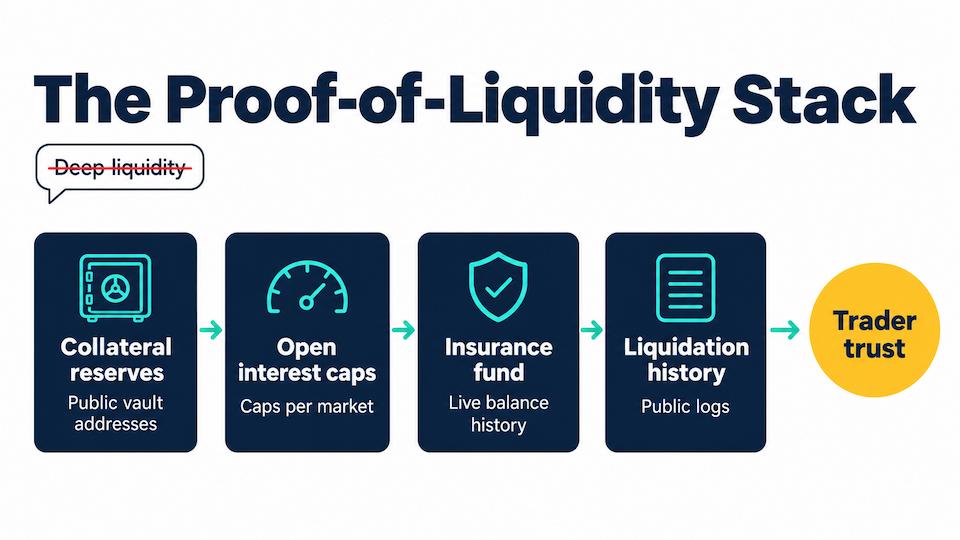
“Deep liquidity” costs nothing to claim. Proof is a link anyone can open. Castle Labs data put total perp DEX open interest at about $14.64 billion on September 24, 2026, with Hyperliquid holding 56.8% of it. Traders can inspect that venue’s order books and vault balances directly, and that visibility is part of what they are buying.
Build a live transparency page
List collateral and vault addresses, total collateral, open interest by market and the insurance fund balance. Update it in real time and link it from the main navigation.
Separate organic volume from incentive volume
DefiLlama reports both raw and normalized volume because self-reported figures and wash-filtered figures often diverge. Report both yourself, before an analyst does it for you.
Name your liquidity sources
If market makers agree to be named, name them. If they don’t, publish how many are quoting and the average spread on your top markets.
Show how the venue behaved on its worst day
After the first big volatility event, publish spreads, liquidation counts, funding rates and whether any losses were socialized. A calm post-mortem after a rough day earns more credibility than a month of growth charts.
Announce open interest caps
New markets should launch with caps, and the caps should be public. Raising them gradually with notice is a trust signal in its own right.
Oracle risk as a marketing asset: a documented case
Most teams treat oracle design as an engineering footnote. Traders now treat it as the main question. A venue that explains how prices reach its contracts, and what happens when those prices are wrong, earns a kind of trust competitors cannot buy with incentives.
What happened at Papertrade
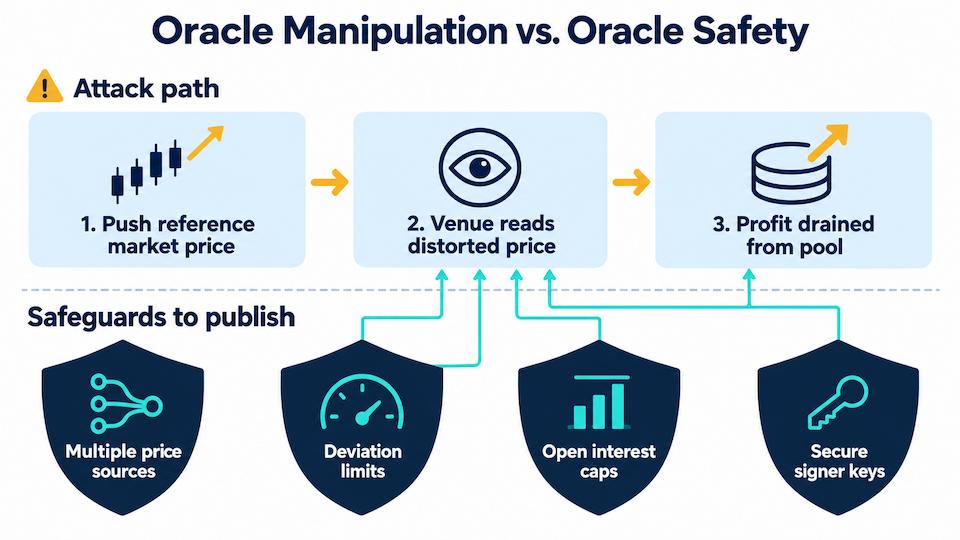
Crypto Briefing reported that Papertrade went live on HyperEVM on October 10, 2026, with up to 1,000x leverage on BTC and ETH and about $3 billion in BTC open interest on day one. It had no separate oracle network. Positions were priced off the midpoint of Hyperliquid’s best bid and best offer.
Pre-launch coverage from Bankless and research summarized by BlockTempo had already flagged the risk: if pushing Hyperliquid’s quotes costs less than the money in Papertrade’s pool, manipulation pays. ChainCatcher then reported a community user’s finding that two wallets appeared to move ETH by 10 to 20 basis points on Hyperliquid with roughly $20 million in trades.
According to Odaily, the team said the issue came from a higher open interest cap opened at launch to ease queues, and that it had started tightening position limits. It also argued that no system removes manipulation entirely and that the aim is to make attacks unprofitable.
Why this is a marketing lesson
ChainCatcher noted that Papertrade’s own documentation disclosed the pricing risk. A disclosure in the docs reaches the people who already read docs. The launch story led with 1,000x, the risk sat on a technical page, and once wallets started testing it, the conversation was about the flaw. The product barely came up.
The wider pattern
DEXTools counted 12 oracle or price feed exploits worth about $46.3 million in 2026 as of mid-July. The largest, at Ostium on July 15, cost about $18 million through a compromised oracle signer key, nearly a third of its $63 million TVL according to Blockaid’s analysis. Cointelegraph reported that security researchers see attacks moving toward offchain infrastructure such as oracle systems and key management.
|
A leverage number tells traders what they could win. An oracle page tells them whether they will get paid. |
What oracle-safety messaging should cover
- Every price source and how the sources are combined into a mark price.
- Deviation and staleness thresholds, plus the circuit breakers that fire when they are crossed.
- Open interest caps set against the real cost of moving the reference market.
- How oracle signer keys are held, rotated and monitored.
- What happens to user funds if the oracle fails: the pause rules and how open positions settle during a halt.
|
Is your perp DEX ready to answer the trust questions traders ask first? Get a launch messaging review of your leverage claims and oracle disclosures before they go live. |
Rules for paid promotion on a derivatives launch
Leverage amplifies bad promotion. A paid post about a spot token is speculation. A paid post showing a 500x winning trade is, for most followers, a set of instructions for losing money, and it will be screenshotted when things go wrong.
Ban PnL screenshots in paid content
Write it into every KOL agreement. Educational threads on how liquidation works are fine. Profit flexing tied to your referral link is not.
Brief KOLs on risk
Give creators a one-page sheet on leverage tiers and liquidation basics, with a link to the transparency page. Paid relationships should be disclosed in the post itself.
Pitch reporters on the mechanism
Coverage of Papertrade focused on its pricing model and payout queues because the mechanism was the story. Prepare a technical explainer and a named incident-response contact before launch day.
Invite people to break you
A public bug bounty, plus a plain-language post on known risks, turns adversarial researchers into early allies. It also gives AI search engines a clear, citable source on your safety design.
Moderate your own ambassadors
Guaranteed-return claims in your Discord or Telegram are your problem, even if a volunteer posted them. Set rules and enforce them publicly.
Compliance-safe promotion by region
Derivatives are the most regulated corner of crypto marketing, and where your ads land matters as much as what they say. Use this section as a starting checklist for your legal counsel. It is general information and does not replace legal advice.
United Kingdom
The FCA’s COBS 22.6 rules prohibit marketing cryptoasset derivatives to retail clients, and the FCA defines marketing to include communicating and approving financial promotions. Exclude the UK from paid targeting and avoid UK-focused KOL campaigns.
European Union
MiCA requires crypto marketing communications to be fair, clear, not misleading and clearly identifiable as marketing. Crypto derivatives can also fall under MiFID II as financial instruments, which brings a separate set of rules.
United States
The CFTC treats crypto derivatives as within its jurisdiction. Its 2023 settlements with the DeFi protocols Opyn, ZeroEx and Deridex showed that offering leveraged products to US persons without registration draws enforcement even when the protocol is decentralized.
Everywhere else
- Place a risk warning directly beside every leverage figure.
- Geo-gate restricted regions at both the interface and ad-targeting level.
- Remove words like “guaranteed”, “risk-free”, “can’t lose” and “safe returns” from all copy.
- Get legal sign-off on any campaign that mentions leverage or yield.
The launch calendar
A trust-first launch runs on a calendar. Each phase should leave behind a public document that traders and journalists can point to and AI engines can cite.
|
8 weeks out |
Foundation Publish the architecture page, audit reports, oracle documentation and leverage tiers. Lock market maker commitments and agree a regional targeting plan with counsel. |
|
4 weeks out |
Public testing Run a testnet competition, open the bug bounty, brief KOLs and pitch technical explainers to crypto media. |
|
Launch week |
Controlled go-live Start with conservative open interest caps, switch on the live transparency dashboard, staff an incident channel and post a daily status update. |
|
First 90 days |
Earned growth Raise caps with public notice and publish a monthly transparency report. Any incident gets a written post-mortem within 72 hours. |
Metrics worth reporting
- Organic volume as a share of total volume, tracked weekly.
- Open interest relative to the insurance fund balance.
- Depth within 0.5% of mid price on your top five markets.
- Trader retention 30, 60 and 90 days after reward programs end.
- Time from incident detection to first public notice.
- How often AI answers and search results cite your docs for questions about perp DEX safety.
Build the proof before the campaign
Castle Labs counts more than 261 perp DEXs launched since Hyperliquid. Traders compare them on fees and on what each venue is willing to show about its risk engine. A venue that publishes its oracle design and liquidation rules in plain language gives them something to check. Most give them a leverage number.
Blockchain App Factory works on both the build and the launch. Its engineers build perpetual DEX platforms, including white-label and Hyperliquid-style order book venues, with oracle and liquidation design documented from the start. Its crypto marketing team turns that documentation into transparency pages, technical PR, compliant KOL programs and search content written to rank on Google and get cited in AI answers. The people writing your launch copy can check every claim against the code.
Build the proof first. Then market it.
|
Want a perp DEX launch that traders trust on day one? Blockchain App Factory builds perp DEX platforms and runs the launch marketing around them. |
Frequently asked questions
How do you market a perpetual DEX without overpromising leverage?
Lead with the liquidation engine and the leverage tier table, and keep maximum leverage figures next to a clear risk warning. Never pair leverage with return claims.
What should a perp DEX transparency page include?
It should list collateral and vault addresses, open interest by market, the insurance fund balance, liquidation logs and both raw and normalized volume, all updated in real time.
Why does oracle design matter for perp DEX marketing?
Oracle failures decide whether traders get paid. DEXTools counted 12 oracle or price feed exploits in 2026 by mid-July, and traders now ask about price sources before they ask about fees.
Can a perp DEX work with KOLs and influencers?
Yes, with rules. Ban PnL screenshots in paid posts, require disclosure, brief creators on risk and keep UK and other restricted audiences out of targeting.
Which regions restrict crypto derivatives promotion?
The UK bans marketing crypto derivatives to retail clients. The EU applies MiCA and often MiFID II rules, and the US CFTC has taken action against unregistered DeFi derivatives offerings.

Vimal J is the Head of Sales at Blockchain App Factory, with 10+ years of experience in sales, client strategy, and Web3 business growth. He helps startups, enterprises, and project founders choose the right blockchain solutions for their goals, bringing a practical market perspective to topics like token development, crypto launches, and Web3 adoption.
Article Reviewed by:
Arun Kamala Santhanath
Marketing Head, Blockchain App Factory


