We asked ChatGPT, Perplexity and Gemini 300 crypto questions and recorded every source they cited. Across 900 answers, the three assistants agreed on which crypto brands to recommend far more often than they agreed on which websites to cite.
This is the first edition of the Blockchain App Factory AI Citation Index. The study covers 3,076 citations to 1,048 websites, from questions about proof of stake to “Which crypto should I invest in right now?” Below we explain what each assistant cites, which brands it names, and what that means for crypto teams who want to appear in AI answers. We plan to repeat the test each quarter.
- The assistants agree on who to recommend, not on where they learned it. On 63 of 69 “best provider or platform” questions, all three named at least one of the same brands, but on only 1 of those 69 did all three cite the same website.
- Being named is not the same as being linked. Only 14% of brand mentions in those answers came with a link to the brand’s own website.
- The question decides the source. Government sites made up 61% of citations on regulation questions, while agency and vendor pages made up 60% on crypto marketing questions.
How We Tested 300 Crypto Questions Across the Three Platforms
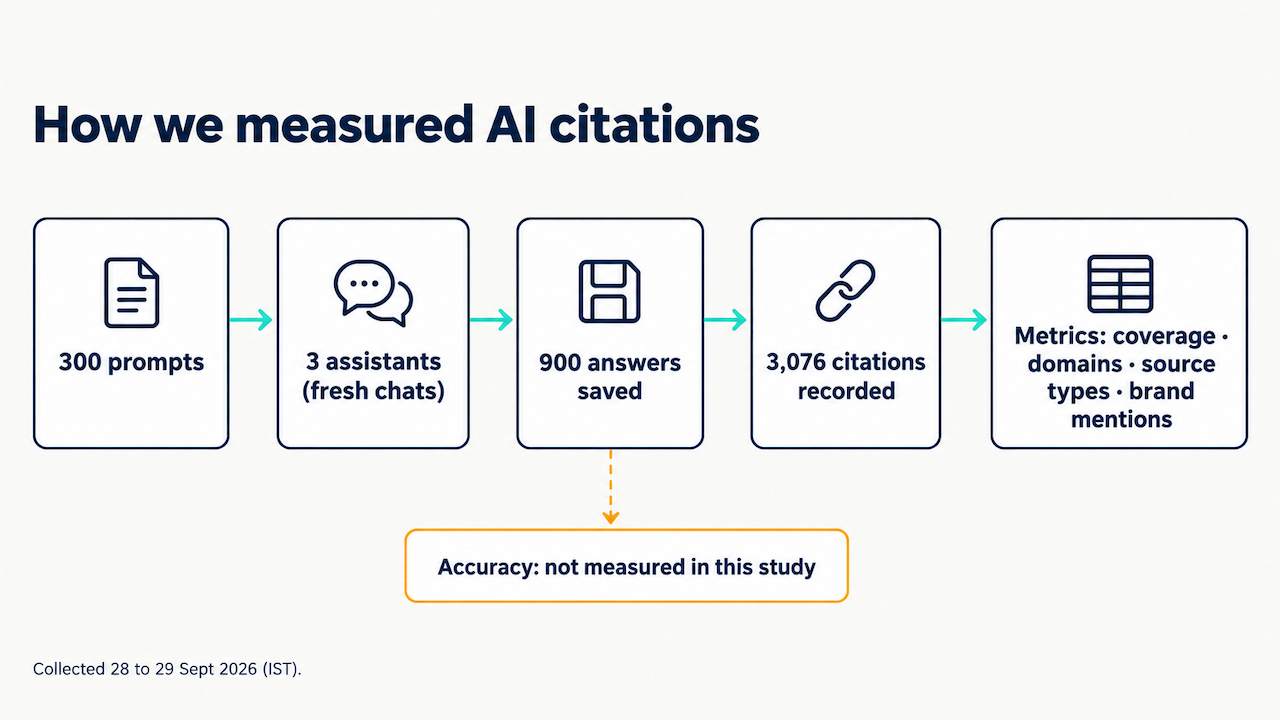
We wrote 300 crypto questions and sent each one to ChatGPT, Perplexity and Gemini. All 900 prompt and platform combinations produced a usable answer. When a platform returned an error or a sign-in message, we retried until it answered, which took 94 retries in total.
The prompt set
- 10 topics with 30 questions each: crypto basics, token development, smart contracts and infrastructure, DeFi, real-world asset tokenization, wallets and security, regulation, market data, crypto marketing, and commercial comparisons.
- 207 informational questions, such as “What is impermanent loss?”
- 93 commercial questions, including 77 “best provider or platform” questions and 16 investment questions such as “Which crypto should I invest in right now?”
We kept the wording neutral and never named an agency or service firm in a question. Twenty-two questions named a blockchain, coin or platform, such as Ethereum, Solana or CoinGecko. Sixteen questions named a country or region, and 21 asked about something current, such as “today” or “right now”. The set is a purposive sample built to reflect common crypto searches, not a random sample of all queries.
How we collected answers
- Every prompt ran in a fresh chat on each assistant’s consumer web app, from India, in English.
- Answers were collected between 28 September 2026, 5:05 PM IST, and 29 September 2026, 5:51 AM IST.
- ChatGPT ran logged in, in unpersonalized temporary chats, with web search requested. It answered 63 prompts with its standard model and 237 with a lighter “mini” model.
- Perplexity ran logged in, in its default search mode.
- Gemini ran logged in, in temporary chats. It answered 215 prompts with Flash-Lite, 52 with Pro and 33 with Flash.
What we counted
A citation is a visible source link attached to an answer. We removed tracking parameters and counted each URL once per answer. For Perplexity, we counted the links referenced in the answer text and report its separate source list on its own. For the 77 provider and platform questions, we also matched answer text against a list of 181 crypto brands to see which brands were named and whether their own sites were cited. We did not score answer accuracy.
|
44 of 1,048 cited websites that appeared in answers from all three assistants |
63 vs 1 “best of” questions where all three named the same brand, against those where all three cited the same site |
14% of 1,204 brand mentions that linked to the brand’s own website |
Which Source Types Appeared Most Often
The 900 answers contained 3,076 citations to 2,630 distinct pages on 1,048 domains. We sorted every domain into one of nine source types:
- Agencies, vendors, law firms and service providers: 605 citations (20%)
- Official project and protocol sites or documentation: 595 (19%)
- Exchanges, wallets and financial-firm education pages: 585 (19%)
- Government and regulators: 397 (13%)
- Crypto news and crypto media: 265 (9%)
- Market-data platforms: 224 (7%)
- General financial and business media: 180 (6%)
- Research, academic and policy institutions: 138 (4%)
- Other, including forums, directories and event sites: 87 (3%)
No single website dominated. The most cited domain, ethereum.org, appeared in 79 of 900 answers. Binance followed with 70, CoinGecko with 57 and the US SEC with 36.
A long tail of sources
Of the 1,048 domains, 820 (78%) were cited by only one of the three assistants. Just 44 domains were cited at least once by all three. They were mostly large reference sites: Ethereum’s documentation, exchanges, price trackers, regulators and a handful of crypto service providers.
How ChatGPT, Perplexity and Gemini Differed
The table compares the three platforms using the same definitions and the same collection window.
| Measure | ChatGPT | Perplexity | Gemini |
|---|---|---|---|
| Answers with a citation | 299 of 300 (100%) | 292 of 300 (97%) | 186 of 300 (62%) |
| Citations per answer | 4.2 (1,268 total) | 5.2 in text (1,564); 11.6 in the source list | 0.8 (244 total) |
| Distinct domains cited | 473 | 650 | 197 |
| Largest source type | Official sites and docs (28%) | Exchanges and vendors (21% each) | Agencies and vendors (30%) |
| Government and regulator share | 20% | 9% | 1% |
| Brand mentions linked to the brand’s site | 30% (102 of 341) | 9% (34 of 396) | 7% (35 of 467) |
| Most frequent domain | ethereum.org (55 answers) | binance.com (44 answers) | binance.com (7 answers) |
Source type percentages are shares of each platform’s citations, not of its answers.
ChatGPT: primary sources first
ChatGPT cited sources in every answer but one. It leaned hardest on primary sources: official documentation and government sites made up 47% of its citations. On regulation questions, 126 of its 153 citations (82%) went to government or regulator websites. It was also the most likely to link a brand it recommended to that brand’s own site.
Perplexity: the widest net
Perplexity cited 650 different domains, the most of the three. Its answers were the longest, with a median of 639 words, and each showed a source list averaging 11.6 links. It relied more than the others on exchange education pages, vendor blogs, crypto news and financial media.
Gemini: fewer links, mostly on commercial questions
Gemini cited sources in 62% of answers, with an average of fewer than one link per answer. The gap depended on the question type. Gemini linked sources in 82 of 93 commercial answers (88%), but in only 104 of 207 informational answers (50%). It almost never cited government sources: 3 citations across 300 answers.
“The assistants reached the same shortlists from different evidence. For a crypto brand, being widely known across many sources matters more than being cited by any one of them.”
Blockchain App Factory research team
How often the platforms agreed on sources
- ChatGPT and Perplexity shared at least one cited domain on 139 of 291 prompts where both cited sources (48%).
- Perplexity and Gemini did so on 34 of 179 (19%).
- ChatGPT and Gemini did so on 19 of 185 (10%).
- All three shared a cited domain on only 8 of the 178 prompts where all three cited sources.
Who Gets Named vs Who Gets Linked
For commercial questions, citations are only half the story. When someone asks for the best exchange, wallet or development company, the answer names brands, and those names may not link anywhere.
Agreement on brands, disagreement on sources
On 69 of the 77 provider and platform questions, all three assistants named at least one brand from our list. On 63 of those 69, they named at least one of the same brands. On only 1 of those 69 did all three cite the same website.
The well-known names in each category came up again and again: the leading exchanges, wallets, layer 2 networks, tokenization platforms and service firms. The assistants reached similar shortlists while citing different pages to support them.
Most mentions came without a link to the brand
The assistants made 1,204 brand mentions across 231 provider and platform answers. Only 171 of those mentions (14%) came with a citation to the brand’s own website.
- ChatGPT linked the brand’s own site for 30% of its mentions.
- Perplexity did so for 9%. It usually cited roundups and reviews about the brand instead.
- Gemini did so for 7%, and named the most brands per answer (6.1 on average).
For crypto marketers, this means tracking two things. Mention tracking shows whether you are in the answer. Citation tracking shows which pages put you there.
|
Do you know which brands AI assistants name in your category? We can run a documented prompt test for your project and map the mentions and sources behind each answer. |
How Citation Patterns Changed by Crypto Question
The topic of a question predicted the source type more reliably than the platform did. The shares below combine all three assistants.
Informational questions favored primary sources
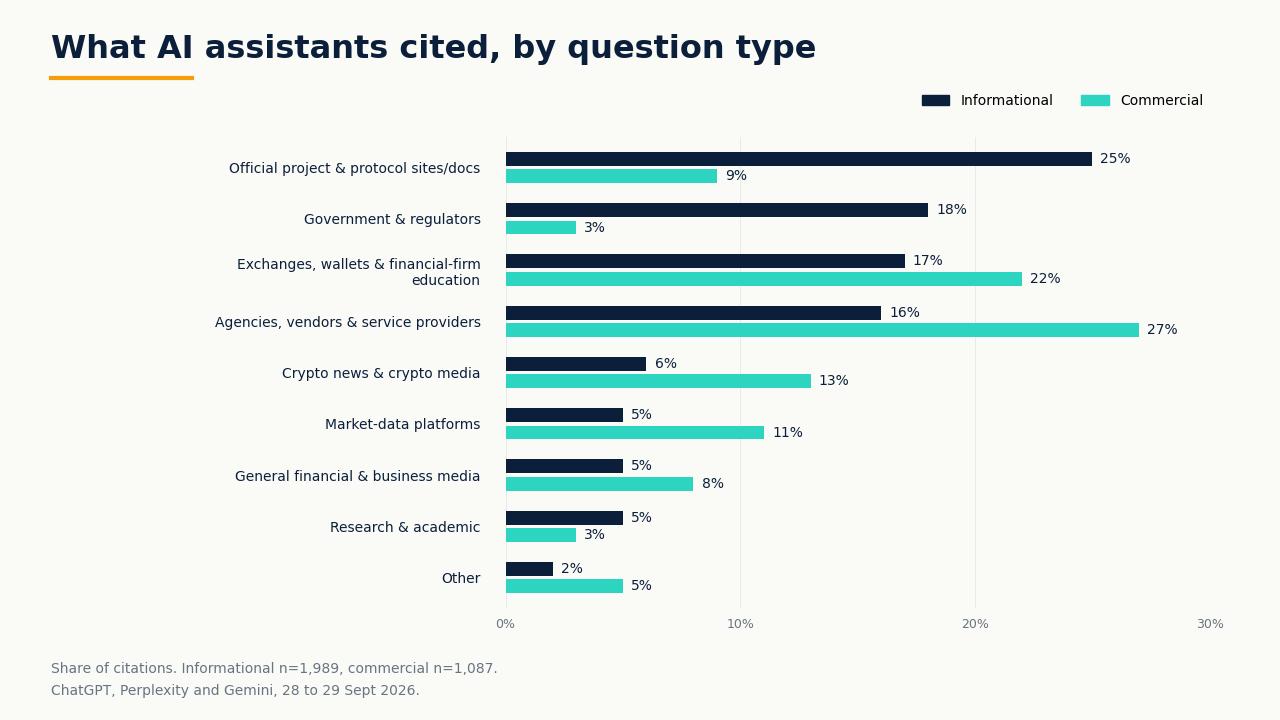
- Regulation and compliance: 227 of 375 citations (61%) went to government and regulator sites, such as the SEC, FATF, India’s income tax department and Dubai’s VARA.
- Smart contracts and infrastructure: 48% went to official documentation.
- Token development: 41% went to official documentation, and 24% to development firms and tool vendors.
- DeFi: 31% went to protocol sites and docs, and 27% to exchange education pages.
- Wallets and security: 43% went to exchange, wallet and financial-firm pages.
- Crypto basics: exchange education pages (33%) and official docs (32%) led.
Across all 207 informational questions, official sources made up 25% of citations and government sources 18%.
Commercial questions favored third-party lists
- Crypto marketing: 221 of 369 citations (60%) went to agency and vendor websites, mostly “top agencies” and how-to articles published by firms in the same market.
- Commercial comparisons: exchange and platform pages led (29%), followed by vendor content (22%) and crypto news (14%).
- Market data and current events: crypto news and market-data platforms each made up 24%, and general financial media 19%.
Across all 93 commercial questions, agency and vendor content rose to 27% of citations, while government sources fell to 3%.
Risk warnings on investment questions
On the 16 investment questions, 44 of 48 answers included at least one risk caution, such as volatility, speculation or the need for due diligence. Gemini included one in all 16 answers, Perplexity in 15 and ChatGPT in 13. These answers cited market-data platforms, exchanges and crypto news. Official project pages made up only 5 of their 154 citations.
What These Findings Mean for Crypto Content
The findings above are measured. What follows is our interpretation. A one-time test of 300 prompts shows patterns, not causes.
Broad recognition beats a single citation
The assistants named the same brands far more consistently than they cited the same pages. That points to a brand being well covered across many credible sources, not dependent on any single page.
Commercial answers depend on third-party content
For “best” questions, the assistants relied on roundups, comparisons, directories and industry articles. Accurate, current listings in that content are a real input to AI recommendations.
Documentation earns technical citations
Official documentation led on smart contract, token and DeFi questions, especially in ChatGPT. Clear, public, crawlable docs appear to be the default reference for “how does it work” questions.
Each platform needs its own measurement
ChatGPT favored primary sources, Perplexity cast a wide net, and Gemini linked sparingly. A single blended “AI visibility” score would hide those differences.
What Crypto Teams Can Do Next
These steps follow from the patterns above. None of them guarantees a mention or a citation.
|
1 |
Check crawler access OpenAI says sites that block OAI-SearchBot will not appear in ChatGPT search answers. Perplexity uses PerplexityBot to surface sites. Check robots.txt and bot-protection rules for both, and for Google’s crawler. |
|
2 |
Run your own baseline Write neutral questions for your category, both informational and commercial. Run them on each assistant in fresh chats, and record both brand mentions and cited links. |
|
3 |
Map the source gaps Sort the cited pages by type. Note where your project is missing from the documentation, comparison lists, directories or news coverage that the assistants already use. |
|
4 |
Improve, then re-test Strengthen your docs and reference pages, and correct or earn listings in third-party sources. Then repeat the same prompts and compare like with like. |
Study Limitations
- This is a snapshot collected over about 13 hours. Answers change as models and search sources change, and we did not repeat prompts to measure run-to-run variation.
- Model versions varied. ChatGPT mostly used its “mini” model, and Gemini mostly used Flash-Lite. Paid tiers may cite differently.
- All answers were collected from India, in English. Results may differ by country and language.
- Brand mentions were counted against a fixed list of 181 brands. Brands outside the list, including most individual tokens, were not counted.
- Source types were assigned by our team using documented rules. Some domains could reasonably fit more than one type.
- Visible citations do not reveal every page a model read or what shaped its training, and a citation does not prove the source supports the claim.
Blockchain App Factory helps crypto projects with technical SEO, content strategy, crypto PR and AI search visibility. Our crypto marketing team can run this kind of documented prompt test for your category. We map the brands and sources behind each assistant’s answers, then build accurate reference content and third-party coverage around the gaps. We report what we measure, and we do not promise placements in AI answers.
|
Want to know what ChatGPT, Perplexity and Gemini say about your project?
|
Frequently Asked Questions
Why do ChatGPT, Perplexity and Gemini cite different sources?
Each assistant uses its own search partners, index and model. In our test, 78% of cited domains appeared on only one platform, even when the answers recommended similar brands.
Does a Google AI Overview citation count as a Gemini citation?
No. AI Overviews appear in Google Search. The Gemini app is a separate product, and we tested only the Gemini app.
Do AI assistants link to the brands they recommend?
Not often. Only 14% of brand mentions in our provider and platform answers linked to the brand’s own site. The rest were unlinked or supported by third-party articles.
Do AI assistants warn users on crypto investment questions?
Mostly, yes. In our test, 44 of 48 answers to investment questions included a risk caution, but the level of detail varied by platform.
How often should we re-test our AI visibility?
No research sets a fixed interval. Because models and search sources change, we suggest re-running the same prompt set on a regular schedule, such as quarterly, and comparing like with like.

Vimal J is the Head of Sales at Blockchain App Factory, with 10+ years of experience in sales, client strategy, and Web3 business growth. He helps startups, enterprises, and project founders choose the right blockchain solutions for their goals, bringing a practical market perspective to topics like token development, crypto launches, and Web3 adoption.