



What replaced Kaito Yaps and how to run a creator-led mindshare campaign this quarter, with a brief template and a 90-day plan.
Kaito Yaps is gone, and the open leaderboard model behind most 2025 mindshare campaigns went with it. Projects now earn attention by hiring selected creators in the open and measuring the results on more than one platform.
The change took one day. On January 15, 2026, X revoked API access for apps that paid users to post, and the KAITO token dropped more than 10% almost immediately. Teams that had budgeted for a leaderboard campaign had to rebuild their plans from scratch.
- Kaito Yaps ended on January 15, 2026, when X cut off API access for apps that rewarded users for posting.
- Kaito replaced it with Kaito Studio, where brands choose approved creators and pay them for an agreed scope of work.
- Mindshare still matters, but you now buy it through selected creators who work from a written brief.
- The biggest risk is running a whole launch on one platform’s rules, because those rules can change overnight.
- Every paid post needs a visible disclosure, and a US promotion of a token that may be a security must also state the payment amount.
- Your first step is to set one outcome metric a leaderboard cannot fake, then write the creator brief around it.
This guide is for founders, token marketing leads and growth teams who ran or planned leaderboard campaigns. It is not legal or financial advice.
- Open leaderboard farming has ended on X, and selected, paid creator campaigns have taken its place.
- Spread creators across X, YouTube, TikTok and Telegram so a single rule change cannot stop the campaign.
- Judge mindshare against funded wallets, signups, branded search and cost per outcome.
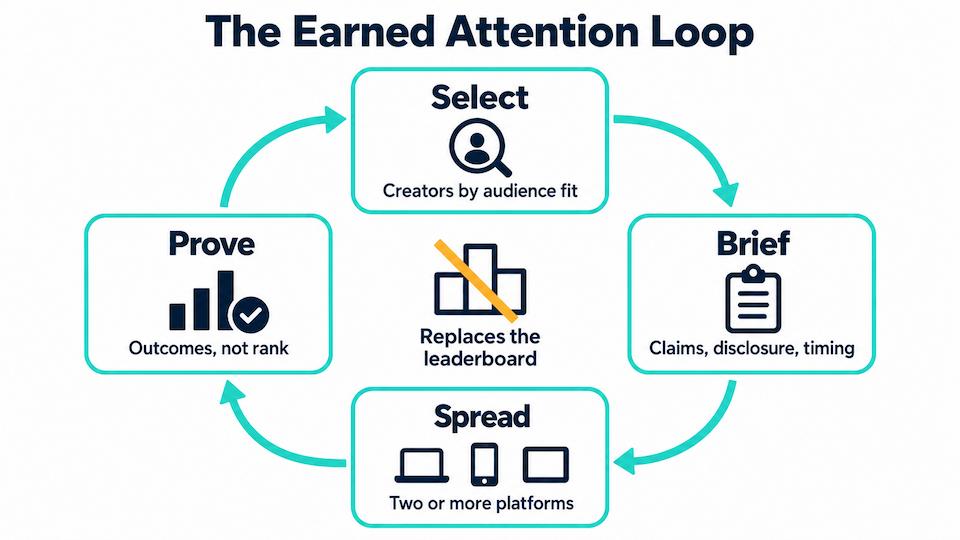
The rest of this guide follows Blockchain App Factory’s Earned Attention Loop, a four-stage model for creator campaigns that do not depend on any one platform’s reward system:
- Select creators whose audiences match your buyers, and check past results before follower counts.
- Brief each creator in writing with talking points, banned claims, a disclosure line and a posting window.
- Spread the campaign across at least two platforms so one policy change cannot end it.
- Prove the result with outcome metrics that sit outside any single leaderboard.
|
Jan 15, 2026 X revoked API access for pay-to-post apps Source: The Block |
16 Brand partners at the Kaito Studio beta launch Source: Kaito |
2,065 Creator applications in 10 days for Jumper’s first Studio campaign Source: Kaito Studio |
What happened to Kaito Yaps?
Kaito shut down Yaps and its incentivized leaderboards on January 15, 2026, the same day X banned apps that pay users to post.
In the post Decrypt quoted, X product lead Nikita Bier said X would “no longer allow apps that reward users for posting” and blamed AI-generated reply spam. Kaito founder Yu Hu announced the end of Yaps the same day. He told followers that Kaito had spent the previous year testing tighter eligibility, higher leaderboard thresholds, social and onchain filters, and new incentive designs.
Here is how the year unfolded:
| Date | Event |
| Jan 13, 2026 | Kaito receives an email from X about a possible review (Tiger Research via BlockMedia) |
| Jan 14, 2026 | X sends a formal legal notice, and Kaito replies the same day (Tiger Research) |
| Jan 15, 2026 | X revokes API access, and Kaito announces the Yaps sunset and Kaito Studio (The Block) |
| Mar 1, 2026 | X launches a native Paid Partnership label for sponsored posts (X Creators announcement) |
| Mar 6, 2026 | Kaito Studio beta goes live, after a February waitlist (Kaito) |
Kaito’s January announcement also said Kaito Pro, the Kaito API, Kaito Launchpad and the planned Kaito Markets would keep running. The mindshare analytics stayed. Only the paid farming layer on X closed.
What does mindshare mean after InfoFi?
Mindshare is a project’s share of the relevant conversation over a period, compared with other projects in the same category.
InfoFi, short for information finance, was the label for apps that paid people for that conversation. Kaito scored posts about projects and rewarded top posters with token allocations and partner perks. Projects chased a high rank because it signalled traction to exchanges and funds.
Why the old model broke
Rewards pulled in volume faster than quality. Critics called the result attention farming. Decrypt’s coverage of the ban recalled that on-chain investigator ZachXBT had accused Kaito of inflating user metrics in August 2025. Once posting paid, the leaderboard mostly measured how many people were paid to talk.
What mindshare still tells you
It remains a useful early signal when you read it as share of voice among accounts your buyers already follow. It becomes a weak signal of demand when most of the posts come from accounts you paid.
How is Kaito Studio different from Yaps leaderboards?
Kaito Studio is a selective marketplace: brands publish campaigns, and approved creators quote a price for the work.
CoinGecko’s Kaito guide lays out how it works. Each campaign sets objectives, a scope of work, a timeline, a reward structure and content guidelines. Brands pick creators at their own discretion, and selected creators sign a contract with the brand directly. A vendor write-up from BlockEden lists X, YouTube and TikTok as Studio’s platforms. At the beta launch, Kaito said its creator network reached 80 million combined followers.
| Dimension | Yaps leaderboard (2025) | Kaito Studio (2026) |
| Who takes part | Anyone with an X account could post and climb | Approved creators apply, and the brand selects |
| How creators get paid | Token rewards and allocations based on rank | A quoted fee for a defined scope |
| Platforms | X only | X, YouTube and TikTok |
| Quality control | Algorithmic scoring after posting | Brand selection and a written brief |
| Disclosure | Often missing or buried in hashtags | Expected on every paid post, with X’s native label available |
| Platform risk | Fully tied to X’s API terms | Spread out, but still subject to each platform’s ad rules |
How to read this table: the first four rows come from published program descriptions by Kaito, CoinGecko and BlockEden. The disclosure and platform risk rows are Blockchain App Factory’s own assessment.
A documented Studio campaign
Kaito Studio’s own case study on Jumper, an onchain super-app, is the clearest public benchmark so far. Jumper signed 69 creators for its first X campaign and paid an $18.90 CPM.
That CPM comes from Kaito and from a single campaign. Treat it as an opening reference when creator quotes start arriving.
Some Studio campaigns still pay creators in project tokens. Axis Robotics, for example, paid its creator rewards in AXIS on Base. A token payment is still a payment, and that matters for the disclosure section below.
How should you structure a mindshare campaign now?
Run it as a paid creator program with written scopes, and put it on more than one platform from day one.
In an analysis published by BlockMedia, Tiger Research expected surviving InfoFi projects to move toward bounty platforms, selection-based campaigns, multi-platform distribution and managed KOL rosters. A project can build the same structure itself without waiting for any platform.
Set the outcome before you pick creators
Choose one result a leaderboard cannot fake. Good options are funded wallets, waitlist signups with referral codes, testnet transactions or exchange deposits. Write down the target and how you will track it.
Build creator tiers
- Anchor creators are two to four large, trusted accounts who frame the narrative in launch week.
- Analysts are five to ten mid-size accounts who explain the mechanics in threads and long videos.
- Educators are ten to thirty smaller accounts who answer questions inside their own communities.
- Community members can still post freely, but nobody gets paid for raw post volume.
These ranges are Blockchain App Factory’s working defaults for a mid-size token launch. Adjust them to your budget.
Spread across platforms
Use X for real-time narrative and YouTube for explainers that keep ranking in search and get quoted in AI answers. TikTok reaches retail audiences in markets where X is weak, though crypto eligibility rules differ by region, as our crypto TikTok influencer guide explains. Telegram and Discord are where interest turns into signups.
Long-form explainers also feed answer engines. Our guide to answer engine optimization for Web3 brands covers how to structure that content so LLMs quote it.
Use Kaito Studio as one channel
Studio handles creator matching and attribution for its approved network. Run it next to direct creator deals so a single marketplace never controls your whole campaign.
|
A leaderboard rank was a proxy for attention. Proxies break the day a platform changes its rules. |
|
Planning a creator campaign after Yaps? Get a vetted creator shortlist and a tracking plan built around one outcome you can measure. |
What should a creator brief include?
A brief tells the creator what to say, what never to say, how to disclose and when to post.
The brief is now where most quality control happens. Under Yaps, an algorithm judged posts after they went live. Today you set the standard before anyone publishes.
- Write one sentence on what the project does, in words a creator can repeat accurately.
- Give two talking points tied to your outcome metric, with a link to a source for each claim.
- List banned claims, including price predictions, guaranteed returns, “risk-free” and any exchange listing that is not signed.
- Fix the disclosure wording for each platform, such as X’s Paid Partnership label plus a “paid partnership” line at the top of YouTube descriptions.
- State the payment, including its form and amount, so creators can disclose it where the law requires.
- Set a posting window and ask for drafts 24 hours before they go live.
- Assign each creator a unique referral code or tracked link.
- Explain what happens if a post breaks the brief: removal, and no payment for that deliverable.
Arun Kamala Santhanath, Marketing Head at Blockchain App Factory, says the brief is where his team’s KOL work changed most after January. “Before the ban, a lot of KOL briefs in this space were a thread topic and a hashtag. Ours now name the claims a creator cannot make, the disclosure they must use, the posting window and the result we will judge them on. The creators who push back on those terms are usually the ones we would not have hired anyway.”
How do you measure mindshare without trusting one leaderboard?
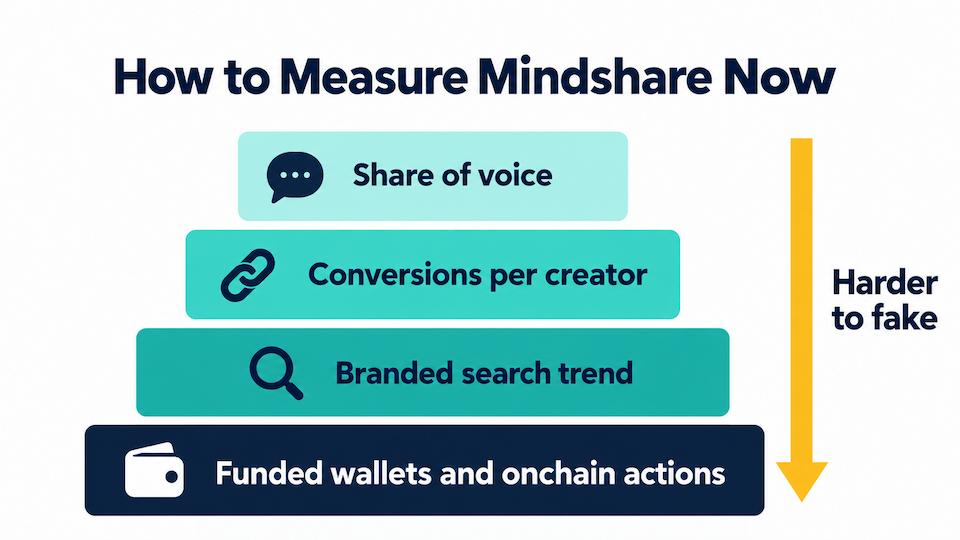
Pair a share-of-voice reading with at least two outcome metrics that you control.
Kaito framed Studio’s attribution goal as measuring influence, mindshare and conversion. Keep that split, but use data you can audit yourself.
| Metric | What it shows | Where to get it | Blind spot |
| Share of voice in your category | Relative share of the conversation | Kaito Pro or a social listening tool | Paid posts inflate it |
| Conversions per creator | Which creators drive action | Referral codes and wallet attribution | Misses people who search later |
| Branded search trend | Interest outside social feeds | Google Search Console, Google Trends | Lags by several weeks |
| Funded wallets or onchain actions | Real product usage | Your contracts, Dune dashboards | Sybil farms can fake volume |
| Cost per outcome | Spend efficiency by creator | Spend sheet plus the rows above | Only as good as your attribution |
These metrics and blind spots are Blockchain App Factory’s own assessment.
Watch the onchain row closely. Wallet counts are easy to farm, and the filters in our guide to sybil resistance for airdrops apply to creator campaigns too.
What disclosure rules apply to paid crypto creator posts?
Every paid post needs a clear disclosure, and in some markets an #ad tag is not enough.
Platform rules and regulator rules both apply, and they stack.
- X’s Paid Partnerships policy requires clear and prominent disclosure on organic sponsored posts, and creators have had a native Paid Partnership label since March 1, 2026.
- In the US, the FTC Endorsement Guides, last updated on June 29, 2023, cover when a disclosure is needed and how to present it.
- If the token could be a security, Section 17(b) of the Securities Act requires the promoter to disclose the payment and its amount. The SEC’s October 2022 order against Kim Kardashian shows why: she agreed to pay $1.26 million after a post marked #AD that left out the $250,000 she was paid.
- In the UK, the FCA’s FG24/1 guidance from March 26, 2024 puts influencers, and even memes, inside financial promotion rules.
Rules differ by market, so confirm each target country with local counsel before launch.
What should you check before launch?
Run through these ten checks before the first creator posts.
- One outcome metric is set, with a target and a tracking method.
- Every creator has passed an audience check for bots and recycled engagement.
- Each creator has accepted the written brief, including the banned claims.
- Disclosure wording is fixed for every platform in the plan.
- Payment terms are written down, including any token payments and vesting.
- Every creator has a unique referral code or tracked link.
- The campaign runs on at least two platforms.
- A review step checks drafts before they publish.
- One person owns daily monitoring and takedown requests.
- A fallback plan exists if a platform restricts the campaign mid-flight.
Red flags that should pause a deal:
- A creator prices only on follower count and will not share past results.
- A vendor promises a specific leaderboard rank or mindshare percentage.
- Engagement spikes come mostly from new or empty accounts.
- Someone suggests skipping disclosure because other projects do.
What does a 90-day mindshare plan look like?
Spend the first month on setup, the second on a controlled launch and the third on scaling what worked.
|
Days 1 to 30 |
Set up Ships: the outcome metric, a vetted creator shortlist, the written brief, disclosure wording and tracking links. Decision: which tiers and platforms make the first wave. |
|
Days 31 to 60 |
Launch Ships: anchor and analyst content on X and YouTube, with a weekly read of cost per outcome. Decision: drop creators who miss your cost-per-outcome threshold. |
|
Days 61 to 90 |
Scale Ships: educator content, YouTube explainers, TikTok tests and, if it fits your audience, a Kaito Studio campaign. Decision: renew and rebalance the budget across platforms, or pause. |
Where should you start this week?
Write the outcome metric and the creator brief before you shortlist a single creator.
Those two documents decide who you hire and how you judge them. Skip them and the campaign ends up built on follower counts.
Blockchain App Factory runs Kaito project marketing for token projects. The team shortlists and vets creators, writes briefs and disclosure rules, coordinates posts across X, YouTube and TikTok, and reports results against outcome metrics. BAF does not control Kaito Studio’s creator selection or any platform’s policies, and it does not give legal advice on whether a token is a security.
|
Is your mindshare plan still built on a leaderboard? Rebuild it around vetted creators and results you can audit. |
Frequently asked questions
Is Kaito Yaps coming back?
Nothing suggests it will. Kaito closed Yaps on January 15, 2026 and replaced it with Kaito Studio, and we found no reversal of X’s policy as of October 26, 2026.
Is InfoFi dead?
The open pay-to-post version of InfoFi is dead on X. The model survives in selective creator marketplaces such as Kaito Studio, and Kaito kept its analytics products running.
What replaced Kaito Yaps?
Kaito Studio replaced it. Brands post campaigns with a defined scope and approved creators submit a price. The brand then chooses who to hire and signs with them directly.
How do creators join Kaito Studio?
Creators apply through Kaito, and Kaito decides who qualifies based on follower count, reach and impressions. Approved creators then quote on individual campaigns, and the brand makes the final choice.
How do you measure crypto mindshare now?
Track share of voice in your category, then check it against outcomes you control, such as conversions per creator, branded search, funded wallets and cost per outcome. A rise in share of voice with no movement in outcomes usually means the posts are paid noise.
What is Blockchain App Factory’s Earned Attention Loop?
It is a four-stage model for creator campaigns: Select, Brief, Spread and Prove. Each stage replaces something a leaderboard used to do automatically, so the campaign keeps working when a platform changes its rules.
A note on this guide
This guide is for teams planning crypto creator and KOL campaigns in 2026. Facts were checked on October 26, 2026. The main third-party figures link to their sources, the rest name their publisher, and none were audited by Blockchain App Factory, and Kaito Studio’s campaign figures are Kaito’s own. Blockchain App Factory sells the marketing services described in this article.
Sources
- Kaito and Kaito Studio announcements on X, CoinGecko Learn, X Help Center (Paid Partnerships policy) and BlockEden.
- The Block, Decrypt, The Defiant, Odaily and CoinDesk.
- Tiger Research via BlockMedia, the FTC Endorsement Guides and the SEC settlement order with Kim Kardashian.

Vimal J is the Head of Sales at Blockchain App Factory, with 10+ years of experience in sales, client strategy, and Web3 business growth. He helps startups, enterprises, and project founders choose the right blockchain solutions for their goals, bringing a practical market perspective to topics like token development, crypto launches, and Web3 adoption.
Article Reviewed by:
Arun Kamala Santhanath
Marketing Head, Blockchain App Factory


