


A crypto exchange can hold position one for “best crypto exchange for institutional traders” and still never appear when someone asks ChatGPT the same question. That gap is now measurable. Ahrefs analyzed 15,000 prompts and found that only 12% of the URLs cited by ChatGPT, Gemini and Copilot rank in Google’s top 10 for the original query, with more than 80% of those citations coming from pages that do not rank at all for that prompt.
The Pew Research Center’s July 2025 browsing study adds the demand side of the same problem. Among the Google searches it tracked, users who saw an AI summary clicked a traditional result 8% of the time, against 15% for searches with no summary. Clicks on a source link inside the AI summary happened just 1% of the time.
So the question for Web3 brands is no longer only whether a page ranks. It is whether the page can be retrieved, verified and quoted by a system that will answer the user directly.
|
Key Takeaways 1. Ranking and being cited are now two separate outcomes. A Web3 page can sit at position one in Google and remain absent from the AI answer, because assistants retrieve passages across many reformulated queries rather than picking the top result for the one the user typed. 2. Retrieval favours self-contained passages. A paragraph that names the entity, states the claim and carries its own evidence can be lifted into an answer without the rest of the page, which is exactly what an answer engine needs. 3. Off-site presence matters more than most crypto teams assume. In Ahrefs’ December 2025 study of 75,000 brands, brand web mentions correlated with AI visibility at 0.664, while backlinks reached only 0.218. |
|
8% vs 15% Click rate on a traditional search result when an AI summary is present, against searches with no summary. Pew Research Center, 2025 |
12% Share of AI assistant citations that also rank in Google’s top 10 for the original prompt, across 15,000 prompts. Ahrefs, 2025 |
117% Year over year growth in total AI referral visits, with every tracked industry at least doubling. Similarweb, 2026 |
Why This Problem Hits Web3 Brands Harder
Web3 companies sell complex, regulated, fast-moving products to an audience that starts every evaluation from suspicion. That combination makes AI-assisted research unusually attractive to buyers and unusually punishing for vague content.
Three factors compound the difficulty. Crypto terminology overlaps heavily, so an entity like “Polygon” or “Arbitrum” can be read several ways without context. Regulatory positions change quarterly, which ages content faster than in most industries. And service pages across token development, ICO development and RWA tokenization providers read almost identically, which gives a retrieval system very little reason to prefer one over another.
Answer Engine Optimization, or AEO, is the practice of structuring content so that answer engines and large language models can retrieve it, verify it, and reproduce it accurately in a generated response. For Web3 brands, AEO is less about new tactics and more about removing the ambiguity that makes crypto content hard to quote.
Why AI Search Changes the Content Game for Web3 Brands
Traditional SEO optimizes a page to win a position. Answer Engine Optimization optimizes a passage to win an inclusion. Those are different competitions with different rules, and a Web3 brand can lose the second while winning the first.
The mechanism behind the difference is query fan-out. Rather than searching the exact phrase a user types, assistants generate multiple related queries, retrieve candidates for each, and merge the results. A page that appears consistently across “is real estate tokenization legal in the UAE”, “RWA tokenization compliance requirements” and “who regulates tokenized property” can be cited ahead of a page that dominates only one of those. Ahrefs points to this fan-out behaviour, combined with rank fusion methods, as a likely reason its measured overlap between AI citations and search rankings was so low.
Google’s own AI Overviews behave differently from standalone assistants. Ahrefs found 76% of AI Overview citations came from pages already in the top 10, which means traditional ranking still carries most of the weight inside Google’s surface. Outside it, in ChatGPT, Claude, Perplexity and Gemini, ranking is a weaker predictor and passage quality matters more.
Zero-click behaviour then decides what a citation is worth. When the answer is delivered in place, the value of appearing is the brand mention, the framing of your category, and the smaller number of visitors who arrive already convinced. Similarweb’s 2026 data shows AI referral visits growing 117.4% year over year across tracked industries, from a small base, which is the shape of a channel worth building for early rather than one to measure by volume today.
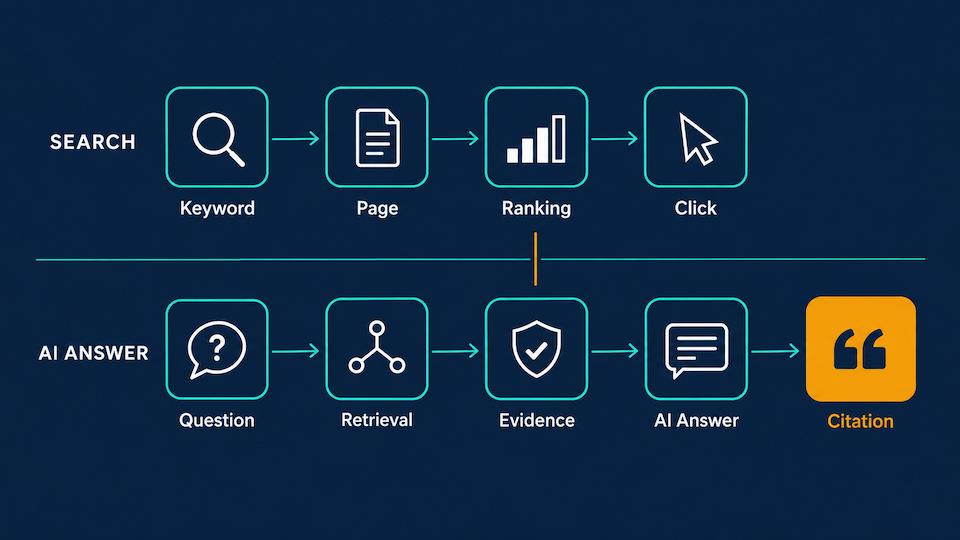
| Dimension | Traditional SEO | Answer Engine Optimization |
|---|---|---|
| Primary goal | Win a ranking position | Be selected as a source in a generated answer |
| Optimization unit | The page | The passage |
| Search target | A keyword and its close variants | A question and its fan-out reformulations |
| Content structure | Narrative flow toward a conversion | Answer-first blocks that stand alone |
| Authority signals | Links, rankings, domain history | Entity consistency, independent mentions, verifiable evidence |
| Measurement | Rankings, clicks, sessions | Citation frequency, share of voice, AI referral quality |
| Role of citations | Supporting credibility for readers | A retrieval and verification signal in its own right |
| Content freshness | Matters for competitive and news queries | Matters most for regulation, pricing and protocol changes |
Neither column replaces the other. Crawlable, well-ranked pages remain the supply that most answer engines draw from, and Answer Engine Optimization decides what happens to that content once a model reaches it.
What Makes a Web Page Easy for an LLM to Quote?
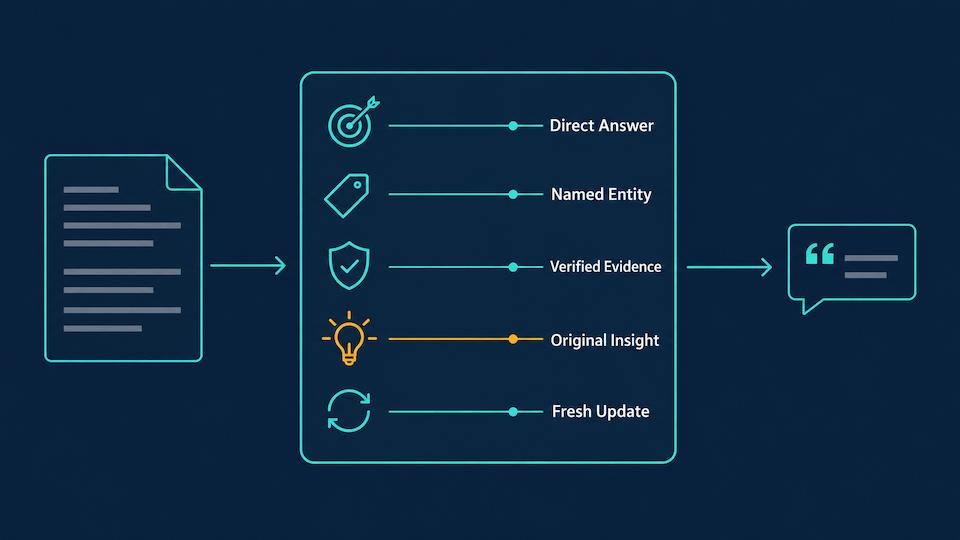
A passage is easy to quote when it can be removed from the page and still be true, attributable and specific. Four properties do most of that work.
A direct answer near the top of the section. Retrieval systems favour text that resolves the question rather than text that prepares to resolve it. A section titled “How long does a security token offering take?” should open with a range and the variables that move it, not with three paragraphs about the history of tokenized securities.
Named entities instead of pronouns. Compare “It supports over 40 chains” with “The Fireblocks custody platform supports over 40 blockchain networks.” Only the second survives extraction, because the first loses its subject the moment it leaves the paragraph above it.
Verifiable, attributed facts. The Princeton and IIT Delhi research published as “GEO: Generative Engine Optimization” at KDD 2024 tested optimization methods across roughly 10,000 queries and found that adding statistics, adding attributable quotations and citing sources produced the largest visibility gains, in the range of 30% to 40% relative improvement over unoptimized content.
Specificity that competitors cannot copy. “We deliver secure smart contract development” is interchangeable across a thousand crypto vendor pages. “Our audit process covers reentrancy, oracle manipulation and access control drift, with a median remediation window of nine days” is not.
Consider a DeFi protocol documenting impermanent loss. A page that explains the concept in general terms competes with hundreds of similar explainers. A page that states the formula, shows the loss at three named price ratios, and notes which of its own pools historically sat in each band gives an answer engine something it cannot assemble from anywhere else.
Structure Content Around Questions, Not Just Keywords
Answer engines retrieve against question sets, so Web3 content should be planned as a connected group of questions rather than a single keyword target. The practical method is to map six layers for every important page.
- Primary query. What is RWA tokenization?
- Follow-up questions. Which assets can be tokenized, and what does the process involve end to end?
- Comparison questions. How does RWA tokenization differ from a security token offering or a traditional fund structure?
- Commercial questions. What does an RWA tokenization platform cost, and how long does deployment take?
- Technical questions. Which token standards, custody models and oracle setups are typically used?
- Trust questions. Who regulates it, what happens in a default, and how are investors protected?
One page can cover this set without becoming bloated if each question gets a short, self-contained block rather than an essay. Depth belongs on dedicated pages that the hub links to. Bloat comes from repeating the same idea in longer form, not from answering more questions concisely.
|
Ranking decides whether your page is found. Passage structure decides whether your knowledge survives being summarized by a machine. |
Build Passage-Level Answers
Every subsection should work as a standalone unit, because that is the granularity at which retrieval operates. A useful test is to copy any single paragraph into a blank document and ask whether a stranger could tell what it is about and who is making the claim.
A weak version reads like this: “This is why it matters for compliance. It can create real exposure if teams ignore it, and this is something we see constantly with new launches.” Nothing in that passage names a subject, a jurisdiction, or a claim.
A retrievable version reads like this: “Token launch teams that distribute to United States residents without a Regulation D or Regulation S structure risk enforcement action, because the tokens may be treated as unregistered securities. Blockchain App Factory sees this issue most often in projects that open a public sale before finalizing jurisdictional gating.”
The second passage names the actor, the jurisdiction, the mechanism and the source of the observation. It can be quoted without the paragraph before it and it remains accurate.
|
Is Your Crypto Content Visible Beyond the Google Results Page? Build Web3 content that search engines rank and answer engines are willing to quote. |
Make Web3 Entities Unambiguous
Ambiguous naming is one of the most common and most fixable retrieval problems in crypto content. Models resolve entities from context, and crypto supplies unusually weak context.
Use one canonical form for every entity that matters: the legal company name, the product name, the network name, the token standard, the founder’s full name, the service category and the operating locations. Write “Blockchain App Factory, a Web3 development and crypto marketing company,” not “we” or “the team” in the passages you most want quoted.
The problem repeats across the sector: a token named after a common English word, a protocol that shares a name with an unrelated Layer 2, a company that appears as three variants across its own footer, press releases and LinkedIn page. Each inconsistency splits the evidence a model uses to decide whether two mentions describe the same organization. Technical entities need the same discipline. “ERC-3643 permissioned token standard” is resolvable. “Our compliant token standard” is not.
Give AI Systems Evidence Worth Citing
First-party evidence is the strongest form of information gain available to a Web3 brand, because it cannot be sourced anywhere else. A model that needs a number about token launch performance has thousands of recycled blog posts to choose from and very few original datasets.
Practical sources that Web3 companies already hold include audit findings across completed projects, gas cost benchmarks by network, average time from smart contract completion to exchange listing, investor conversion rates across sale structures, on-chain transaction analysis from deployed products, and anonymized outcomes from client engagements.
Publish the methodology alongside the number. Sample size, time period, definition of terms and known limitations turn a claim into something a model can attribute with confidence. A crypto exchange writing about withdrawal times should state the measurement window, the assets covered and the percentile, not simply promise fast withdrawals.
Expert commentary works on the same principle when it is attributed. A named engineer explaining why a specific bridge design failed carries retrieval value that an unsigned paragraph does not.
Create Authority Outside Your Own Website
What third parties say about a Web3 brand appears to influence AI visibility more than what the brand says about itself. In Ahrefs’ December 2025 correlation study of 75,000 brands across ChatGPT, Google AI Mode and AI Overviews, brand web mentions correlated with AI visibility at 0.664, brand anchors at 0.527 and brand search volume at 0.392, while backlinks reached 0.218. A follow-up analysis put YouTube mentions highest at 0.737.
Correlation is not causation, and none of these figures prove that acquiring mentions causes citations. They do suggest that brands widely discussed across the open web tend to be the ones models can describe confidently.
For crypto companies, that argues for earned coverage in industry publications, founder interviews and podcast appearances, conference participation with published sessions, credible directory and aggregator listings, partner and ecosystem pages, and developer community presence where the work is visible. Backlinks alone do not guarantee a citation, and a single high-authority link matters less than being described consistently in many places.
Keep High-Change Web3 Content Fresh
Freshness matters selectively. It matters most where the underlying facts change: regulatory frameworks, stablecoin rules, token standards, exchange listing requirements, DeFi yields, RWA custody arrangements and network upgrades. It matters far less for conceptual explainers, where authority and original evidence carry more weight.
Updating intelligently means changing the substance. Replace superseded figures, add developments that changed the conclusion, remove guidance that is no longer accurate, and state what changed and when. Changing a publication date without changing the content gives readers and models nothing new to work with. A workable rhythm is quarterly review for regulatory and market pages, event-driven updates when a rule or standard changes, and annual review for foundational explainers.
Technical Signals Still Matter
Answer engines cannot cite content they cannot access, so the traditional technical layer remains the entry requirement. Crawlability, indexability, clean semantic HTML, correct canonicals, sensible internal linking, structured headings and reasonable page speed all belong on the checklist.
Structured data deserves a precise claim. Organization, Article, FAQPage and Person markup give search engines machine-readable context about entities and relationships, and those benefits are well established in traditional search. Direct evidence that schema independently causes a large language model to cite a page is limited. Treat schema as a way to make your entity graph explicit, not as a citation lever.
Author information is worth the effort in crypto specifically. A named author with a real profile, credentials and a history of related work supports both search quality assessment and the entity clarity that helps a model attribute a claim.
A Practical Web3 AEO Content Framework
The framework below converts the preceding principles into a repeatable production sequence for a Web3 content team.
| 01 |
Define the entity and the core question Name the exact product, network or service the page is about, and the one question it must answer better than anyone else. |
| 02 |
Map the connected question set Collect follow-up, comparison, commercial, technical and trust questions that a buyer would ask in the same session. |
| 03 |
Gather verifiable evidence Pull named studies, on-chain data, internal benchmarks and expert commentary before drafting, and record the methodology. |
| 04 |
Write answer-first sections Open each subsection with the conclusion, then support it. Keep one core idea per passage and name the entity in each. |
| 05 |
Add original information Include at least one number, dataset or observation that exists nowhere else, so the page contributes rather than restates. |
| 06 |
Strengthen entity signals Apply consistent naming, author attribution, internal links to related entities and Organization and Article markup. |
| 07 |
Publish and distribute off-site Push the original finding into industry press, podcasts, communities and partner channels so the claim is discussed elsewhere. |
| 08 |
Monitor AI visibility and refresh Track citations and mentions across answer engines, then update the pages where the facts have moved. |
How to Measure Whether AEO Is Working
Attribution in AI search is incomplete, and any measurement plan should start by accepting that. Assistants strip referrer data inconsistently, conversations happen off-site, and the same prompt can return different sources for different users.
Within those limits, a Web3 brand can track a useful set of indicators. Citation frequency and share of voice across ChatGPT, Perplexity, Gemini and Google AI Overviews, measured through a visibility tracking tool against a fixed prompt set. AI referral traffic segmented by source in analytics. Branded search volume, which tends to rise when a brand is described more often in generated answers. Non-branded discovery on question-shaped queries. AI crawler activity in server logs, which shows whether your pages are being fetched at all. And assisted conversions from sessions that begin with an AI referral.
Read these together rather than individually. A rise in branded search alongside flat AI referrals usually means the brand is being mentioned without being linked, which is still commercially useful in a category where buyers shortlist before they click.
Common Web3 AEO Mistakes
Most failures in crypto content are not technical. They are failures of specificity.
- Publishing service pages that could describe any competitor, with no named methodology, timeline or constraint.
- Burying the answer under several hundred words of background before the section resolves the question.
- Repeating market statistics from 2021 and 2022 in pages about current regulation or token standards.
- Making unsupported performance claims, which is particularly damaging in a category where trust is the main barrier.
- Treating schema markup as a substitute for substance rather than a supporting signal.
- Writing for Google alone, with long narrative pages that no assistant can extract cleanly.
- Mass-producing AI-written articles that add no information a model does not already have.
- Using inconsistent brand and product naming across the website, press coverage and social profiles.
The Strategic Shift
Search is splitting into two related jobs. Ranking still governs whether your content enters the candidate pool, and increasingly the second job decides what happens next: whether a model can pull a clean, attributable passage out of your page and put it in front of a buyer who never visits your site. Web3 brands that write for both will keep compounding visibility as the mix shifts. Brands that optimize only for position will watch their category get explained to prospects by someone else’s content.
Blockchain App Factory works with token projects, crypto exchanges, RWA platforms, DeFi protocols and Web3 SaaS companies on exactly this problem, combining crypto AI SEO with technical SEO, Answer Engine Optimization, generative engine optimization, content architecture and crypto marketing so that a brand’s expertise is structured for search engines and answer engines at the same time. The work is less about publishing more and more about making what you already know retrievable, verifiable and worth quoting.
|
Ready to Make Your Web3 Brand Easier for AI Engines to Find and Quote? Talk to the Blockchain App Factory crypto AI SEO team. |
Frequently Asked Questions
What is Answer Engine Optimization for Web3?
Answer Engine Optimization for Web3 is the practice of structuring crypto and blockchain content so that answer engines and large language models can retrieve, verify and quote it accurately. It focuses on passage-level clarity, unambiguous entity naming, verifiable evidence and original data, applied to topics such as token development, RWA tokenization, DeFi and exchange infrastructure where terminology is dense and facts change quickly.
How is AEO different from traditional SEO?
Traditional SEO optimizes a page to win a ranking position. Answer Engine Optimization optimizes individual passages to be selected as sources inside a generated answer. Ahrefs found that only 12% of URLs cited by ChatGPT, Gemini and Copilot rank in Google’s top 10 for the original prompt, which shows the two outcomes are related but distinct. Most Web3 brands need both disciplines running together.
Can Web3 brands optimize content for ChatGPT and Perplexity?
Web3 brands can influence how ChatGPT and Perplexity describe them, though neither system can be directly controlled. The practical levers are answer-first structure, consistent entity naming, original first-party data, credible third-party coverage and technical accessibility for AI crawlers. Perplexity aligns more closely with Google rankings than ChatGPT does, so traditional SEO still contributes meaningfully to Perplexity visibility.
Does schema markup improve AI citations?
Schema markup improves machine-readable context and supports established search benefits, but direct evidence that it independently causes a large language model to cite a page is limited. Organization, Article, Person and FAQPage markup help clarify entities and relationships, which is useful for a crypto brand with ambiguous naming. Treat schema as supporting infrastructure rather than a citation guarantee.
How can a crypto company measure AI-search visibility?
A crypto company can measure AI-search visibility through citation frequency and share of voice across ChatGPT, Perplexity, Gemini and Google AI Overviews using a visibility tracker with a fixed prompt set, plus AI referral traffic in analytics, branded search growth, AI crawler hits in server logs and assisted conversions. Attribution remains imperfect, so read these indicators together rather than in isolation.

Vimal J is the Head of Sales at Blockchain App Factory, with 10+ years of experience in sales, client strategy, and Web3 business growth. He helps startups, enterprises, and project founders choose the right blockchain solutions for their goals, bringing a practical market perspective to topics like token development, crypto launches, and Web3 adoption.
Article Reviewed by:
Arun Kamala Santhanath
Marketing Head, Blockchain App Factory


