



A week-by-week plan for marketing a token generation event, built on the terms Q4 2026 projects actually published.
TGE marketing works when every holder can check two things before launch day: how they qualify for tokens and how much supply trades on day one. Hype can fill a sale window, but the published terms decide what the chart and the replies look like a week later.
Predict.fun ran the full sequence inside one week. It published its tokenomics on 28 October, with 16% of total supply released at TGE. A day later it ran a two-hour pre-TGE sale on Binance Wallet. On 30 October, Binance Wallet postponed the planned start of PREDICT trading on Binance Alpha. Each of those moments needed its own message, and each one is a template for the next founder.
- Public TGE marketing should start about eight weeks out, while eligibility rules can still be published and frozen.
- Points rules and the snapshot date belong in public before the final season closes.
- A pre-TGE sale is a separate campaign with its own audience and venue rules.
- Airdrop claim options work best as plain math that also shows what happens to unclaimed tokens.
- The TGE float and the insider release schedule belong in one table before trading starts.
- Promotion rules in each target market need checking before any paid reach goes live.
This guide is for founders and marketing leads planning a token generation event in the next quarter, and it is not legal or financial advice.
- A TGE marketing plan runs on published terms: eligibility, sale access, claim math and the day-one float.
- Q4 2026 projects disclosed very different day-one floats, from Predict.fun’s 16% to Cambria’s planned 23%.
- Promotion rules reach teams based overseas, as the FCA’s HTX settlement and MiCA Article 7 both show.
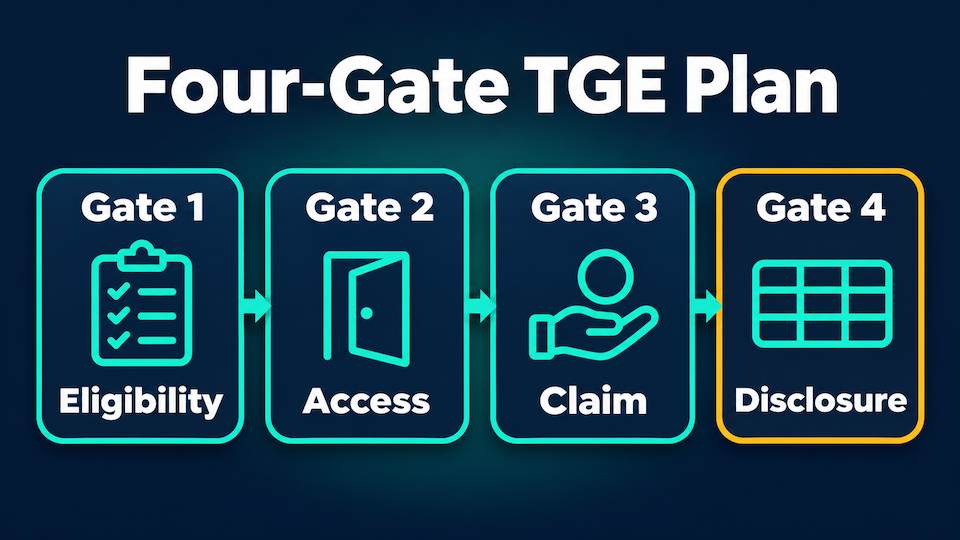
What is Blockchain App Factory’s Four-Gate TGE Plan?
Blockchain App Factory’s Four-Gate TGE Plan treats a token generation event as four public decisions, each published before money or tokens move.
Each gate is a document the community can read and hold the team to. A skipped gate leaves the question open, and people answer it for you in the replies.
- The eligibility gate publishes how points convert into tokens and when the snapshot closes.
- The access gate states who can buy before TGE and on which venue.
- The claim gate sets out each claim option with its math and its deadline.
- The disclosure gate shows the TGE float and every insider release date in one table, then reports against it.
The sections below follow the gates in order. Weeks eight to four belong to eligibility and access, and the final month covers claim design and disclosure.
|
Planning a TGE for early 2027? We turn your token terms and launch dates into one public calendar before the first announcement. |
|
19 Projects planning a Q4 2026 TGE in one industry roundup Source: PANews |
$48.6M vs $3M Jumper sale commitments against the amount it accepted Source: PANews, TechFlow |
1,528 FCA alerts on unauthorised crypto firms and promotions in 2025 Source: FCA |
What does marketing own in a TGE?
A token generation event (TGE) is the moment a project’s token is created and first distributed to holders, usually alongside its first trading venue and its airdrop claims.
Tokenomics belong to the founders and their advisers. Marketing owns the explanation, and holders judge the explanation first.
- The eligibility page tells users how points or activity convert into an allocation.
- The sale brief tells eligible buyers where they can buy before TGE and what limits apply.
- The claim page shows each claim option and its deadline in plain numbers.
- The day-one disclosure shows how much supply can trade and when insiders receive tokens.
Community growth and KOL briefs still matter, and our token launch marketing plan covers both. This guide stays on the terms layer, where each Q4 2026 example below made its main public decisions.
What does a week-by-week TGE marketing timeline look like?
A workable TGE marketing timeline starts eight weeks out with eligibility rules and ends about four weeks after TGE with a public report against the published terms.
The order matters more than the exact week. Each step depends on the one before it, so a slip early on pushes every later message.
- Eight weeks out, publish the points rules with the snapshot date, then freeze them.
- Six weeks out, publish the token allocation table and the vesting terms for insiders.
- Four weeks out, announce any pre-TGE sale with its venue and eligibility rules.
- Two weeks out, release a draft claim page with every claim option worked through as an example.
- One week out, confirm the TGE date and list the only official channels for announcements.
- On TGE day, post the claim link from verified accounts only and pin the supply table.
- In the first week after TGE, answer claim questions daily and publish any date change the moment it happens.
- Two to four weeks after TGE, publish a short report comparing claims and circulating supply with the plan.
Teams that start later can compress the first steps. The claim page and the supply table are the two items that should never be skipped.
How should a points program set eligibility before TGE?
A points program should publish how points convert into tokens and when the snapshot closes before the final season ends, because a rule changed after the snapshot lands on the users who did the work.
Many projects in the PANews roundup of Q4 2026 TGEs ran a points season first. The share of supply tied to points varies widely, so the conversion rule deserves its own announcement.
- Extended plans to allocate 30% of its initial supply to eligible Points participants. Its full token model was due on 31 October.
- Variational has scheduled a genesis airdrop of 32% of total supply for its Q4 TGE.
- Saturn Credit said up to 5% of initial supply may go to participants in its second Orbital Points season.
- GenLayer completed its first-season snapshot on 25 October and closed wallet registration a day later. Only registered, eligible wallets can claim on TGE day.
GenLayer’s approach is easy to explain: a fixed snapshot and one claim condition. The cost is a hard cutoff for anyone who missed the window, so the registration call needs repeated reminders across every channel.
Filtering farmed wallets belongs in the same announcement. Our guide to Sybil resistance for airdrops covers filters and appeals, and the appeal route should go live with the rules. If points reward posting on X, read how mindshare campaigns changed after Kaito Yaps before paying for volume.
How does a pre-TGE sale like the Binance Wallet Prime Sale work?
A pre-TGE sale lets a limited group buy tokens before trading opens, and the Binance Wallet Prime Sale ties that access to Binance Alpha Points earned inside the wallet.
For marketing, the venue sets the audience. A Prime Sale reaches Binance Wallet users who already hold enough Alpha Points, so parts of the project’s own community may not qualify.
What Predict.fun’s Prime Sale shows
- A PANews flash set the subscription window at two hours on 29 October, with participation through Binance Alpha Points.
- Binance Wallet then told holders of Prime Sale Keys they could trade PREDICT on Binance Alpha from 09:00 UTC on 30 October.
- It later postponed that start and said a new time would follow in an official announcement.
- Predict.fun’s own tokenomics post warned users that official news would come only from its verified accounts and Discord.
A delay on someone else’s platform still reaches your community, so your own delay message needs writing in advance.
Other sale routes in the Q4 list
- Jumper sold 4% of its supply through a public sale on Legion. Half of the sale tokens are released at TGE and the rest over four months.
- STRATO sold 2.5% of its supply through Uniswap’s Continuous Clearing Auction in June, months before its TGE.
- 1win sold 13% of its supply in a public sale, with every sold token released at TGE.
- Slop Cash planned an auction for 45% of its supply on Umia from 5 November.
Oversubscription headlines need care. Jumper accepted only a fraction of the commitments it received, so the headline figure and the token count tell different stories. Announce both.
Should airdrop claims be instant or locked?
Locked or discounted claims slow early selling and instant claims are simpler to explain, so the marketing job is to publish the trade-off in plain numbers before claim day.
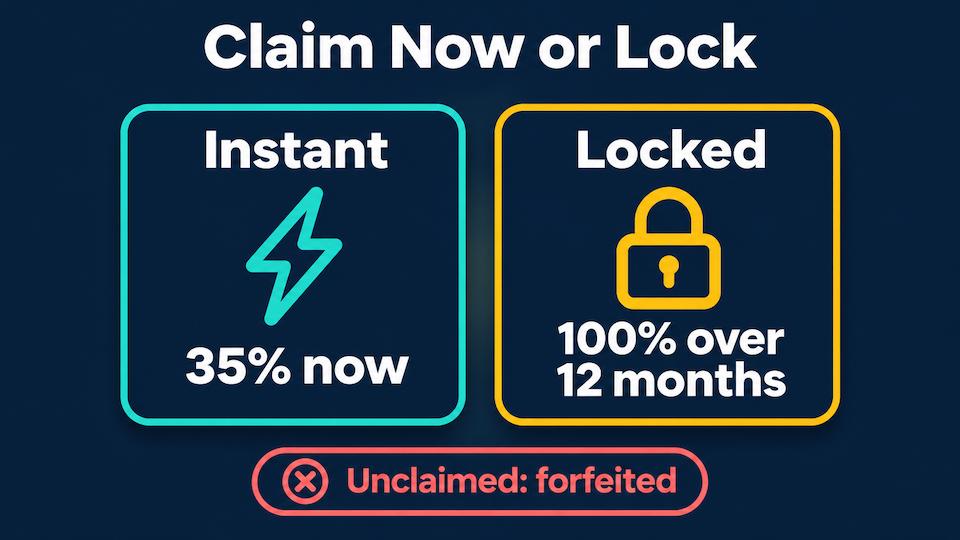
Predict.fun’s tokenomics post gave Season 1 recipients a choice between 35% of their allocation at once or the full amount over 12 months. Users who chose the vest could switch to the instant claim within one month of TGE. Anything still unclaimed after the one-month window is forfeited.
A TechFlow analysis reads the design as a way to turn airdrop selling pressure into a cost measured in holding time. That framing is useful for marketing teams too. The discount is the price of liquidity, and it should be written that way.
| Claim design | How it works | Day-one selling risk | What to publish |
|---|---|---|---|
| Full instant claim | All tokens are claimable at TGE | Highest | Airdrop size set against the TGE float |
| Linear vest only | Tokens release on a fixed schedule | Lower | The schedule as dated amounts |
| Claim-or-lock choice | A smaller share now or the full share over time | Lower, set by each user’s choice | Worked examples for each option and the forfeit rule |
| Activity-linked release | Release depends on continued use | Lower | The exact activity rule and how it is checked |
Risk ratings in this table are Blockchain App Factory’s own assessment.
|
“When we plan a TGE with a founder, the first page we write is the claim page, because that is the page people screenshot. If the team can’t explain each claim option in two sentences, it isn’t ready to announce a date.” Arun Kamala Santhanath, Marketing Head, Blockchain App Factory |
How do you disclose TGE supply in a way people trust?
Publish the share of supply that can trade at TGE and every insider release date in one table, using the project’s own figures, before trading opens.
Projects in the PANews roundup disclosed very different day-one positions. The table below records each project’s own published terms, which is what holders will check the launch against.
| Project | Share at TGE (project-disclosed) | Insider lockup disclosed | Distribution route |
|---|---|---|---|
| Predict.fun | 16% of total supply | Locked 24 months, then monthly over 36 months | Points airdrop with a claim-or-lock choice, plus a Binance Wallet Prime Sale |
| STRATO | About 21.7% of total supply | Not detailed in the roundup | Earlier CCA sale; community allocation of about 55.2% |
| City Protocol | About 17.9% of total supply | Team and investors locked 12 months, then linear | TGE first planned for around 28 September |
| Jumper | Half of the sale tokens | Not detailed in the roundup | Public sale on Legion; remaining sale tokens over four months |
| 1win | All of the sale tokens | Not detailed in the roundup | Public sale with pro-rata allocation |
| Cambria | About 23% of total supply | Not detailed in the roundup | Token launch on Base planned for 29 October |
How to read this table: each figure is the project’s own disclosure, taken from Predict.fun’s post or the PANews roundup, and none was audited. A “sale tokens” entry covers only the sale allocation, so it cannot be compared directly with a share of total supply.
That distinction is easy to blur in a thread. A trust signal is a number that means the same thing everywhere it appears.
- Use one supply figure across every channel, and say whether it is a share of total supply or of the sale.
- Show insider release dates as calendar dates next to token amounts.
- Repeat the forfeit rule and the claim deadline on the claim page itself.
- Keep the table pinned, and add a dated note whenever anything changes.
What should TGE day communications include?
TGE day communications need one verified source for every link and a prepared message for delays.
Predict.fun’s launch week shows why. In the days before its tokenomics post, attackers drained 29 user accounts through a tampered third-party documentation site. TechFlow put the losses near $400,000 and found the core contracts were not compromised. The team committed to full compensation.
Dates can also slip. Apyx postponed a TGE it had planned for 13 October and had not named a new date when PANews compiled its list.
- Post a list of official accounts and domains a week ahead, and repeat it in every TGE-day message.
- Publish a single claim URL from verified accounts and pin it in every channel.
- Write the delay notice in advance, with what is known and when the next update will come.
- Name one owner for replies in each channel for the first 48 hours.
If something breaks during TGE week, our 72-hour crisis communication playbook covers the first statements.
What should a post-TGE report cover?
A post-TGE report should compare claims against the forecast and circulating supply against the published table, then explain every difference.
The report closes the disclosure gate. It is also the first document the next points season will be judged on.
- Report claim uptake by option, with the number of recipients who chose to lock.
- Compare circulating supply with the disclosed TGE figure and explain any gap.
- List every date that moved, with the reason.
- Summarise support volume and the top questions, which feed the next season’s rules.
Which promotion rules apply to a TGE campaign?
Every market a campaign targets can apply its own rules, and both the EU and the UK regimes reach token marketing run from overseas.
Under MiCA Article 7, marketing for a public offer of a crypto-asset must be clearly identifiable and consistent with the white paper where one is required. It must also carry a set statement that no EU authority has reviewed it. Where a white paper is required, no marketing can go out before it is published, which moves the white paper ahead of the first teaser.
The FCA’s crypto promotion rules require clear risk warnings and ban incentives to invest, alongside friction and appropriateness checks. Points or referral rewards shown to UK users need a legal view under that ban.
On 29 October, the FCA said HTX had left the UK after it secured High Court undertakings over the exchange’s crypto promotions. Its enforcement director said an overseas base does not put a firm beyond UK law.
- Map each campaign asset, KOL posts and paid ads among them, to the markets it will reach.
- Geofence sale and claim pages wherever a market’s rules cannot be met.
- Add the required statements and risk warnings before assets go to KOLs.
- Keep a dated archive of every published version of the terms.
What should you check before announcing a TGE date?
Run these checks before the date goes public, because each one becomes harder to fix once people are counting down.
- The points conversion rule and the snapshot date are published and frozen.
- The Sybil filter has a published appeal route.
- The allocation table adds up to total supply.
- Every insider release appears as a calendar date with a token amount.
- The pre-TGE sale venue and its eligibility rule are stated in your own channels.
- Each claim option has a worked example with real numbers.
- The forfeit rule and the claim deadline appear on the claim page.
- The list of official accounts and domains is posted and pinned.
- A delay notice is written and approved.
- Each target market’s promotion rules have been reviewed, with geofencing set where needed.
Red flags
- The TGE float is quoted as a share of the sale in one place and of total supply in another.
- Points rules change after the snapshot without a dated explanation.
- The claim link first appears in a reply or a direct message.
- KOL briefs promise price or returns.
What does a 90-day TGE marketing plan look like?
A 90-day plan runs from the first legal review to TGE day, with one decision closing each phase.
|
Days 1 to 30 |
Terms and markets Ships the allocation table and a draft of the points rules, reviewed for each target market. Decision: which markets the campaign will target and which it will geofence. |
|
Days 31 to 60 |
Eligibility and access Ships the published points rules with the snapshot date and the shortlist of sale venues. Decision: whether to run a pre-TGE sale, and on which venue. |
|
Days 61 to 80 |
Claim and disclosure Ships the draft claim page with worked examples and the pinned supply table. Decision: the final claim design and its forfeit rule. |
|
Days 81 to 90 |
TGE week Ships the TGE-day messages and the approved delay notice. Decision: go or postpone, based on venue readiness and claim testing. |
The post-TGE report follows two to four weeks later and opens planning for the next season.
Next step: put your TGE terms on one page
Before booking KOLs or a sale venue, write a one-page terms sheet covering points conversion, sale access, claim options and the day-one supply table. If any line on it is hard to explain, fix the term before you announce the date.
Blockchain App Factory’s token marketing services plan and run TGE campaigns from the eligibility announcement to the post-TGE report, and we review each asset against the promotion rules of the markets you target. We do not set your tokenomics or give legal opinions, and no agency can promise price or trading volume.
|
Can your community explain your claim rules in two sentences? If not, start with a review of your TGE terms before the date goes public. |
FAQ
What is a TGE in crypto?
A TGE, or token generation event, is when a project’s token is created and first distributed to holders through airdrops or sales. It usually arrives with the first trading venue, so holders judge it on day-one supply and claim rules.
When should TGE marketing start?
Public TGE marketing should start about eight weeks before the event, while points rules and the snapshot date can still be published and frozen. Legal review and the allocation table come before that, which is why a 90-day runway is safer.
What is a pre-TGE sale?
A pre-TGE sale lets an eligible group buy tokens before trading opens, through a venue such as Binance Wallet’s Prime Sale or a platform such as Legion. The venue sets who can take part, so the project must explain those eligibility rules in its own channels.
Should airdrop claims be instant or locked?
It depends on how much day-one selling the token can absorb: instant claims are simpler, while locked or discounted claims slow selling. Predict.fun let users take 35% at once or the full amount over 12 months, which shows how to state the trade-off in numbers.
What is Blockchain App Factory’s Four-Gate TGE Plan?
It is a TGE marketing framework with four public gates: eligibility, access, claim and disclosure. Each gate is a document the community can read before tokens or money move.
Do crypto promotion rules apply to points and airdrop campaigns?
They can, depending on the market: MiCA Article 7 covers marketing for crypto-asset offers in the EU, and UK rules ban incentives to invest in cryptoassets. Get legal advice for each target market before rewarding deposits or referrals.
A note on this guide
This guide is for founders and marketing leads planning a token generation event. The main third-party figures link to their sources, and Blockchain App Factory audited none of them. Project figures are each project’s own disclosures, as published by the project or compiled by PANews, and the risk ratings are our own assessment. Blockchain App Factory sells the token marketing services described here.
Sources
Project, venue and media reports: Predict.fun tokenomics post on X; Binance Wallet posts on X; PANews Q4 2026 TGE roundup; PANews flash reports carried on Binance Square; TechFlow reports on Predict.fun and the Jumper sale.
Regulators: ESMA interactive single rulebook (MiCA Article 7); FCA PS23/6 policy statement; FCA press release on HTX; FCA freedom of information release on crypto alerts.

Vimal J is the Head of Sales at Blockchain App Factory, with 10+ years of experience in sales, client strategy, and Web3 business growth. He helps startups, enterprises, and project founders choose the right blockchain solutions for their goals, bringing a practical market perspective to topics like token development, crypto launches, and Web3 adoption.
Article Reviewed by:
Arun Kamala Santhanath
Marketing Head, Blockchain App Factory


