A KOL sends you a media kit. It shows 340,000 followers, a 6.2 percent engagement rate, and a quote of 12,000 dollars for one thread plus a pinned post for 48 hours. You pay. Two weeks later your dashboard shows 71 link clicks, four wallet connections, and no measurable lift in Telegram joins.
The reach was real. The audience was not.
This is the most expensive silent failure in Web3 growth marketing right now. Influencer Marketing Hub put total influencer marketing spend at 32.55 billion dollars in 2025, and crypto pulls a disproportionate share of that per capita because token launches compress a year of demand generation into a two-week window. HypeAuditor’s State of Influencer Marketing research found that 55 percent of Instagram influencers had engaged in some form of fraudulent activity, from buying followers to sitting in engagement pods. Crypto Twitter, where most KOL money lands, has no equivalent published audit, and the incentive to inflate is far higher because deal sizes are larger and buyers rarely check twice.
So the audit is on you. Here is how to run it properly before the invoice goes out.
- Engagement rate is the easiest metric to fake and the one most media kits lead with. Judge comment quality, follower growth shape, and click-through instead.
- Crypto gives you an audit tool no other vertical has. On-chain data shows whether a KOL’s audience actually transacts, so demand wallet-attributed tracking, not screenshots.
- Move the risk into the contract. Performance-tiered payment, a fraud clawback clause, and post-campaign analytics access make inflated numbers expensive for the seller.
Why crypto budgets leak faster than other verticals
Bot density on X is the structural problem. Independent academic estimates have put automated accounts at somewhere between 9 and 15 percent of active users platform-wide. Crypto sits far above that baseline. Nikita Bier, during his time as X head of product, publicly claimed that around 80 percent of crypto activity on the platform is bot-driven. Treat that as a directional claim from an insider, not a peer-reviewed figure, but nobody who has spent an hour in a token’s mention feed will find it surprising.
There is harder evidence too. A study published on arXiv analysing social media engagement against cryptocurrency performance used Botometer scoring to measure bot probability across coin discussion, and found that tokens with higher bot-probability conversation performed worse, not better. Fake noise is a negative signal for the asset, which means buying it does more than waste budget.
Regulators have added a second cost layer. The SEC fined Kim Kardashian after she was paid 250,000 dollars to post about EMAX tokens without disclosing the payment, and later charged eight celebrities including Jake Paul, Soulja Boy, Lindsay Lohan, and Ne-Yo over undisclosed token promotion tied to the Justin Sun matter. FINRA has since fined a firm 350,000 dollars for onboarding more than 100 social media influencers without a supervision system for their communications. A KOL who has been sloppy about disclosure is a liability on your cap table story, separate from whether their followers are real.
|
$32.55B Global influencer marketing spend in 2025, per Influencer Marketing Hub |
55% Of Instagram influencers found to have used some form of fraudulent activity, per HypeAuditor |
9-15% Academic estimate of automated accounts among active X users, before crypto-specific skew |
Five signals that expose fake reach
None of these require a paid tool. You can run all five on a public profile in about twenty minutes, and any single failure is enough to move a KOL to the reject pile before you look at price.
Follower growth that climbs in steps
Organic accounts grow in a jagged line with occasional spikes tied to a viral post or a listing. Bought accounts grow in staircases: a flat week, then 40,000 followers in 72 hours, then flat again. Pull the follower history on Social Blade or a similar tracker and look at the shape before you look at the number. If a spike exists, ask what post caused it. A real KOL will name the thread immediately and it will still be findable. A fraudulent one will say the algorithm picked them up.
Engagement that ignores what the post says
Compare a KOL’s technical post against their meme post. Real audiences respond unevenly. A deep thread on restaking mechanics should get fewer likes and more replies than a market-cycle joke. When every post lands within a narrow band of likes regardless of subject, effort, or time of day, you are looking at a purchased floor.
Comments with no memory
Open the replies on three consecutive posts. Real followers reference earlier calls, argue with the take, ask about entry price, or tag a friend. Fake reply networks produce generic affirmation: fire emoji strings, “great analysis,” “this is the alpha,” repeated by accounts with egg-adjacent profile pictures and creation dates clustered in the same month. Click five commenters at random and check when their accounts were made.
An audience in the wrong place
Ask for a screenshot of the KOL’s X analytics showing top follower locations and languages. A Turkish-language exchange KOL with 60 percent of followers in Indonesia may have a real regional pocket, or may have bought from a farm. The point is to make them account for the mismatch. If your token is targeting US and EU liquidity, an audience concentrated in a market where your product is geo-blocked has no value regardless of authenticity.
Reach that never becomes a click
This one settles arguments. Ask for the click-through data from their last three paid campaigns, with the tracking links intact. A 300,000-follower account that produced 400 clicks on a paid post has an audience that either does not exist or does not trust them. Both are reasons to walk.
How to read an engagement rate without fooling yourself
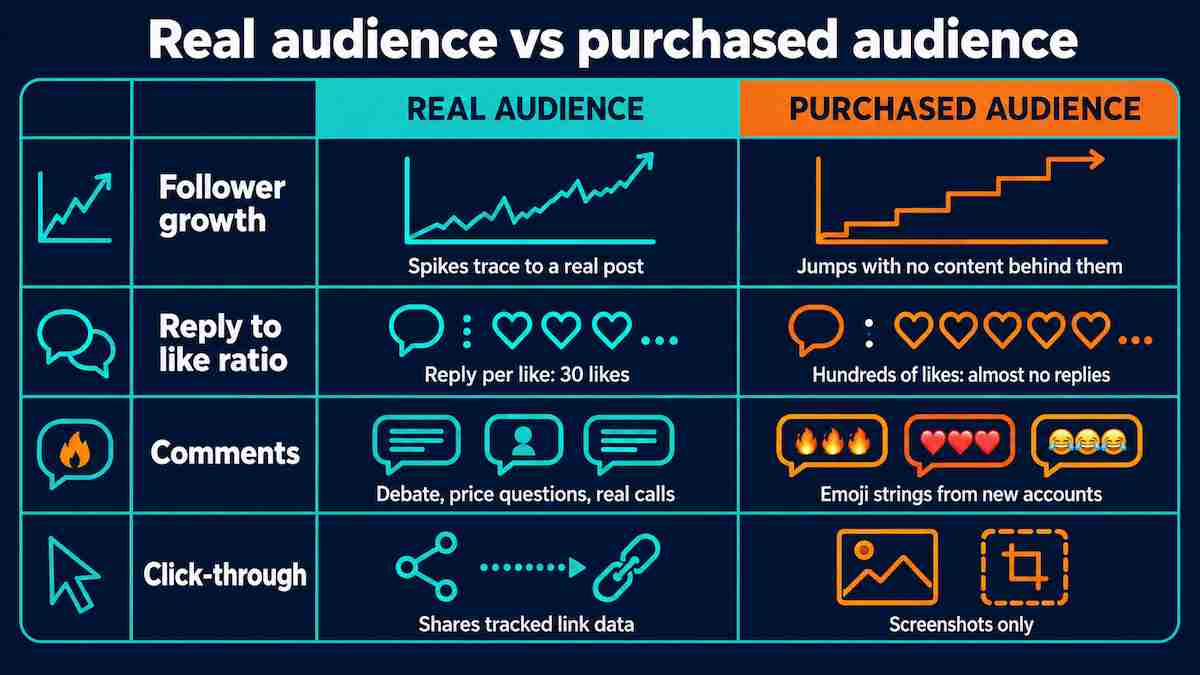
Engagement rate is the number every media kit leads with because it is the number easiest to manufacture. Buy 500 likes on a small account and the percentage looks elite. The useful version of the metric compares engagement type against follower tier, then checks the ratio between reply volume and like volume.
Replies are expensive to fake convincingly. Likes are not.
| Signal | Real audience | Purchased audience |
| Reply to like ratio | Roughly 1 reply per 15 to 30 likes on discussion posts | Hundreds of likes, single-digit replies, no thread depth |
| Engagement spread | Wide variance between posts, occasional flops | Flat band across every post, no flops ever |
| Comment content | Disagreement, price questions, references to past calls | Emoji strings and identical praise from new accounts |
| Follower curve | Jagged, with spikes traceable to a specific post | Staircase jumps with no content behind them |
| Click-through | Shares campaign links and post-campaign data willingly | Offers screenshots only, refuses tracked links |
One caveat on high engagement rates. An account with 8,000 followers and a 9 percent engagement rate is often more valuable to a token launch than a 400,000-follower account at 1.2 percent, because the small account has a community and the large one has an audience. Price accordingly.
|
Not sure if your KOL shortlist is real? We audit follower quality, engagement authenticity, and on-chain conversion history before a single dollar moves. |
What the follower list tells you
The profile is a shop window. The audience is the inventory. Most fraud slips through because buyers evaluate the KOL as a personality and never inspect the people who follow them.
Sample the followers manually
Take 30 followers at random from different points in the follower list, not just the top. Count how many have a default avatar, fewer than 20 posts, a creation date in the last six months, and a following-to-follower ratio above 10. If more than a third fail that test, the account is padded. Tools automate this, and you should use one, but doing it by hand once teaches you what padding looks like.
Check who else they follow
Real crypto KOLs follow protocols, researchers, competitors, and devs they argue with. Farm-built accounts follow other farm-built accounts. Overlap analysis also tells you whether two KOLs on your shortlist share the same audience, which is the fastest way to stop paying twice for the same 40,000 people.
Read their paid-post ratio
Scroll back 60 posts and count how many were sponsored. An account running four paid promotions a week has trained its followers to scroll past promotion. Anything above roughly one in five posts being paid is a yellow flag, and above one in three the audience has stopped listening even if it is entirely human.
Search their name plus “rug”
Crude, effective, and skipped constantly. Search the KOL’s handle alongside terms like rug, scam, exit, and refund. Crypto Twitter documents its own history relentlessly. If three projects they shilled went to zero within a month of promotion, that pattern is public and your investors can find it as easily as you can.
The on-chain check most projects skip
Crypto marketers have an advantage that no consumer brand has. The audience settles on a public ledger. A KOL cannot fake wallet activity as cheaply as they fake likes, so on-chain evidence is where soft due diligence turns into proof.
Do they hold what they promote
Ask for a public wallet address. Then check it. A KOL promoting a token they have never touched, or one they received and dumped inside 24 hours, has told you exactly what the endorsement is worth. Nansen, Arkham, and Bubblemaps make this a five-minute job, and Bubblemaps in particular exposes clustered wallets that received allocation together.
Attribute conversions at the wallet level
Give every KOL a unique referral path that carries through to wallet connection. Clicks tell you the post was seen. Wallet connections tell you the audience acted. The delta between those two numbers is the single most honest measure of a KOL’s real influence, and it is the number you should be negotiating price against on renewal.
Trace outcomes on past calls
Pick three tokens the KOL promoted in the last year. Chart price and holder count from the promotion date forward using Dune dashboards or any public explorer. You are checking whether their audience produced sustained holders or a 90-minute wick followed by a slow bleed. The second pattern means their followers are traders farming the KOL, not buyers you can retain.
A four-step audit you can run in an afternoon
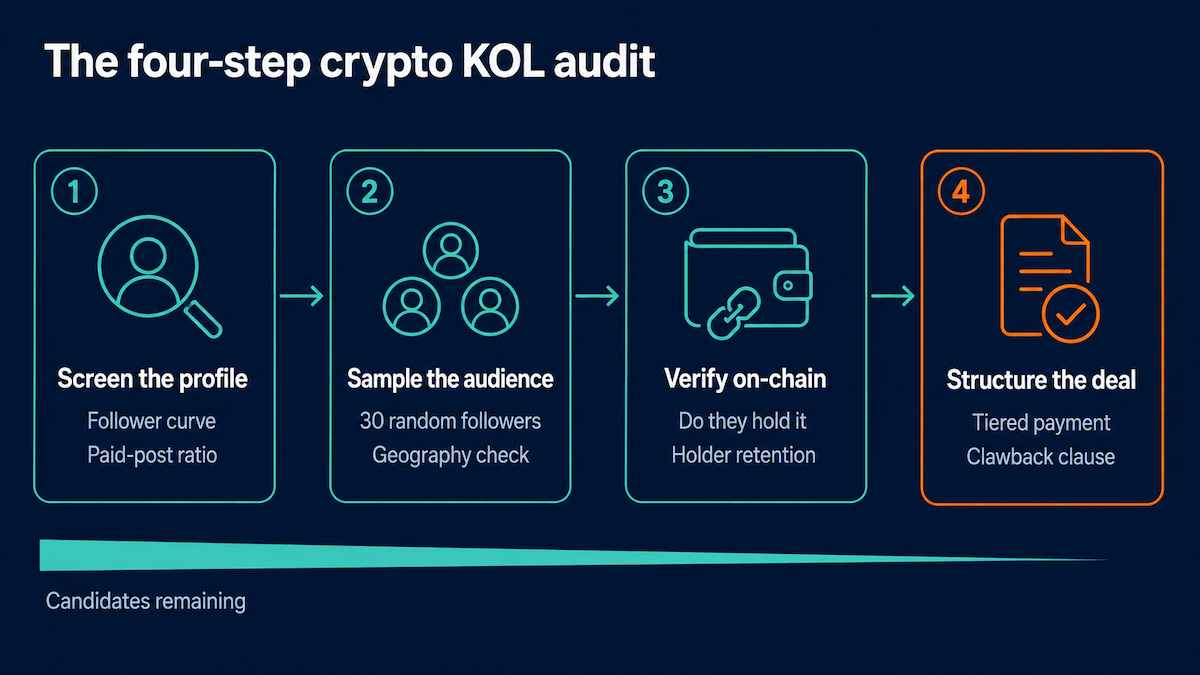
Run these in order. Each stage is designed to eliminate candidates cheaply so you spend real effort only on the shortlist that survives.
|
STEP 1
|
Screen the profile in ten minutes Follower curve, engagement spread, reply quality on three recent posts, and paid-post ratio over the last 60 posts. Most of the shortlist dies here. |
|
STEP 2
|
Sample the audience Manual check of 30 random followers, geography and language breakdown, audience overlap against the rest of your shortlist. |
|
STEP 3
|
Verify on-chain Public wallet review, holding behaviour on tokens they previously promoted, and holder retention charts for three past calls. |
|
STEP 4
|
Structure the deal around proof Tracked links, tiered payment, disclosure requirements, and a clawback clause covering verified bot engagement. |
|
If a KOL will not accept a tracked link, the thing they are protecting is their price list. |
Contract terms that make fraud expensive
Detection catches the obvious cases. Contract design handles the rest, because it moves the cost of inflated numbers onto the person selling them. Four clauses do most of the work.
- Split payment across delivery and performance. A 60 percent fee on publication and 40 percent tied to a tracked click or wallet-connection threshold changes the seller’s incentives immediately, and honest KOLs accept it without much argument.
- Require analytics access. Ask for a post-campaign screen share or export showing impressions, profile visits, and link clicks from the KOL’s own dashboard within 72 hours of the post going live.
- Add a bot clawback. Define a threshold, for example more than 40 percent of engagement traced to accounts created within 90 days, and make the performance tranche forfeit if an independent audit hits it.
- Mandate disclosure language. Given the SEC and FINRA actions on undisclosed promotion, specify the exact wording, its placement in the post, and that it stays visible for the full pinned duration.
Tools worth having open during the audit
No single tool settles the question, and any vendor claiming a definitive fake-follower score is overselling. Use them in combination and treat outputs as evidence, not verdicts.
- HypeAuditor and Modash give audience quality scores, follower authenticity estimates, and demographic breakdowns across major social platforms.
- Social Blade gives free follower history charts, which is all you need to spot staircase growth.
- Botometer, from Indiana University’s Observatory on Social Media, scores the bot probability of individual accounts, useful when sampling commenters.
- Nansen, Arkham, and Bubblemaps cover wallet labelling, holding history, and cluster analysis on tokens the KOL has previously promoted.
- Dune lets you build or fork dashboards tracking holder counts and price behaviour from a specific promotion date.
- Kaito tracks mindshare and narrative reach across crypto Twitter, which helps separate genuine attention from purchased volume.
What to measure once the campaign is live
The audit does not end when you sign. Set a 30-day measurement window with three numbers agreed in advance: tracked clicks, wallet connections attributed to the KOL’s referral path, and 14-day holder retention among wallets that arrived through it. That last number is the one that predicts whether a renewal is worth funding. A KOL who sends 900 wallets that all exit within a week costs you more than they earn you once you account for sell pressure.
Rank your roster by cost per retained holder. Do it once and the CPM ranking you started with usually inverts. The mid-tier KOL charging 2,000 dollars frequently beats the 15,000-dollar name, because their audience reads their posts instead of scrolling past them.
This is the work Blockchain App Factory does before recommending a single name to a client. Our crypto KOL marketing team maintains vetted rosters across major regions and languages, and every name on them has been through the follower sampling and on-chain verification described above. Campaigns ship with wallet-level attribution wired in from day one, so you can see which KOL actually moved holders. We also handle contract structuring, disclosure compliance, post-campaign reporting, and the renewal call at the end of it. Projects usually come to us after paying for reach that never converted, and the first thing we do is show them what their previous roster looks like under a real audit.
Run the checks. The twenty minutes you spend on a follower curve is the cheapest insurance in your marketing budget.
Frequently asked questions
What engagement rate should a real crypto KOL have?
It depends on tier. Accounts under 20,000 followers commonly sit between 4 and 10 percent, while accounts above 200,000 typically land between 1 and 3 percent. A large account claiming 8 percent deserves scrutiny, not applause.
Can I audit a KOL without paying for tools?
Yes for a first pass. Social Blade covers follower history free, manual follower sampling costs only time, and on-chain checks on Arkham and Bubblemaps have free tiers. Paid tools save hours once your shortlist grows past ten names.
Is a high follower count ever worth paying for on its own?
Only for awareness plays where impressions are the deliverable, such as a listing announcement. For anything measured in wallets or holders, community size beats audience size at almost every budget level.
How do I handle a KOL who refuses tracked links?
Treat it as a decline. Some genuinely dislike link shorteners for phishing reasons, so offer a branded domain or a landing page you control as an alternative. If they still refuse, they are selling numbers they cannot support.
What happens if I discover fraud after paying?
Without a clawback clause your recovery options are thin, which is why the clause matters more than the detection. Document the evidence, raise it with the KOL directly, and share findings with other founders in your network. Reputation is the only enforcement mechanism most of this market has.
|
Who should you actually be paying? Vetted KOL rosters, wallet-level attribution, and contracts that put the fraud risk where it belongs. |

Vimal J is the Head of Sales at Blockchain App Factory, with 10+ years of experience in sales, client strategy, and Web3 business growth. He helps startups, enterprises, and project founders choose the right blockchain solutions for their goals, bringing a practical market perspective to topics like token development, crypto launches, and Web3 adoption.
Article Reviewed by:
Arun Kamala Santhanath
Marketing Head, Blockchain App Factory