



A trader who wants to know which exchange charges the lowest maker fee on perpetuals does not open ten tabs anymore. They type the question into ChatGPT, read the four exchanges it names, and pick one. Your exchange was either in that list or it was invisible.
The scale of that shift is no longer arguable. OpenAI reported 900 million weekly active users for ChatGPT in February 2026, more than double the 400 million it reported a year earlier, and The Information put the figure close to a billion by late July 2026. Alphabet reported more than 950 million monthly active users for the standalone Gemini app in its Q2 2026 earnings. Perplexity handles roughly 780 million queries a month. Google AI Overviews now trigger on around 48% of tracked queries as of February 2026, and Similarweb measured the zero-click rate on Google at 68% in early 2026.
The audience has moved with it. A March 2026 survey of 938 American adult investors found that 53.5% of those who had tried AI tools used chatbots for investing research, and Bitget’s 2026 user survey put the share of retail traders using AI in investment decisions at 51%. For crypto brands the consequence is blunt. Search still creates demand, but the answer is increasingly assembled before anyone reaches your site.
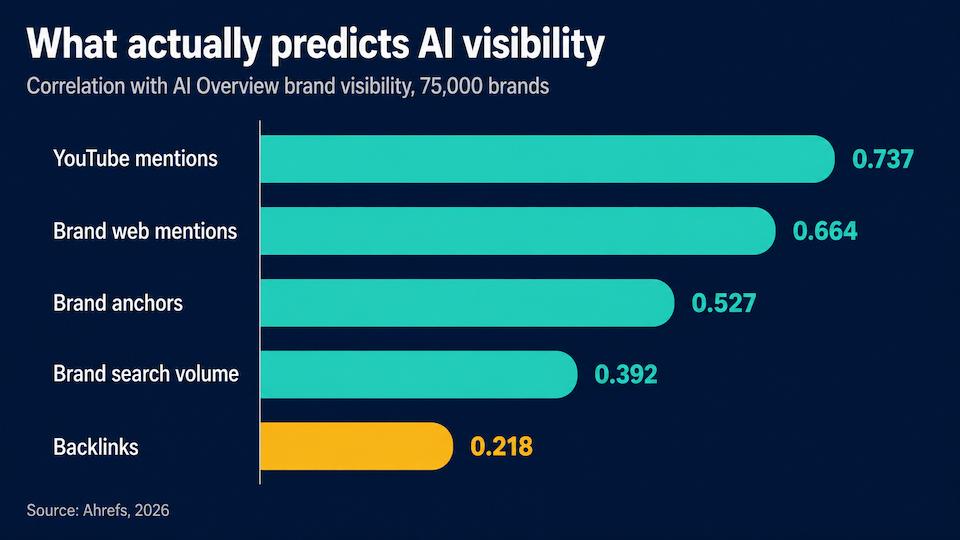
- Off-site brand signals beat backlinks for AI visibility. Ahrefs measured a 0.664 correlation between brand web mentions and AI Overview visibility across 75,000 brands, against 0.218 for backlinks.
- Ranking is no longer a shortcut to being cited. In Ahrefs’ study of 863,000 keywords, 38% of AI Overview cited pages also ranked in the top 10, down from 76% in the earlier run of the same study.
- The traffic that does arrive is worth more. Semrush found AI-referred visitors convert at 4.4 times the rate of standard organic search visitors.
What happens between the prompt and the citation
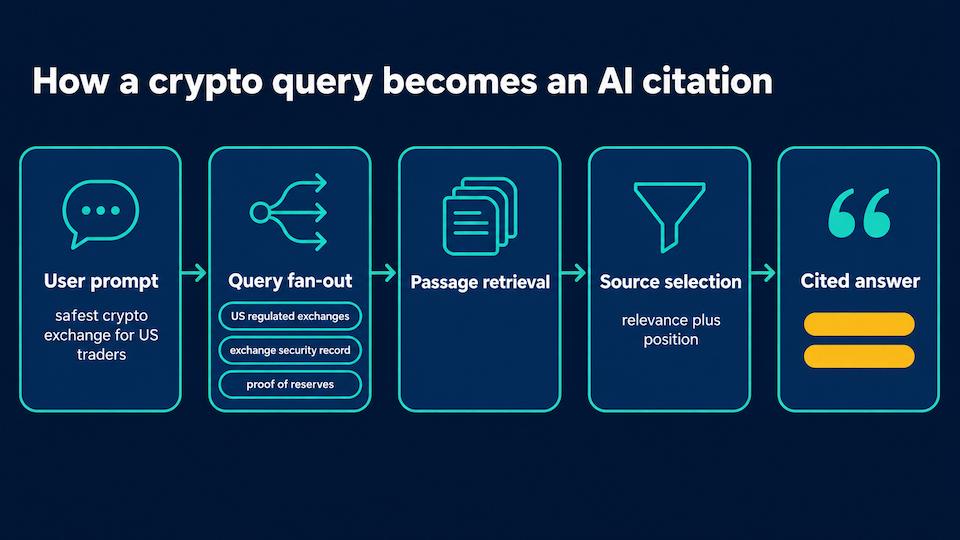
Understanding the mechanism changes what you build. When someone asks about the safest exchange for US users, the model does not run one search. It rewrites the prompt into several sub-queries, retrieves candidate passages from a live index, scores those passages for relevance to each sub-query, then drafts an answer and attaches citations to the sources it actually used.
Two things follow from that. Your page competes at the passage level, so a 4,000 word guide with the answer buried on screen three loses to a 300 word section that states the answer cleanly. The model also needs to recognise your brand as a distinct entity before it will risk naming you in a financial answer.
Pick the prompt tiers you can realistically win
Crypto teams waste quarters chasing prompts that no brand can own. Sort your target prompts by how much room a model has to name a specific company before you write anything, because the tiers behave very differently.
Comparison prompts are the winnable tier
Questions like “best exchange for perpetuals with low fees” or “cheapest chain for stablecoin transfers” force the model to produce a shortlist. Shortlists are where mid-size brands break in, because the model needs four or five names and the obvious two do not fill the slot. Build a dated, sourced comparison page for every one of these.
Branded prompts are the ones you lose quietly
When someone asks “is Project X safe” or “Project X vs Project Y”, the model answers from whatever the web says about you, and your own site may not be the source it uses. Run every branded variant you can think of and read the wording that comes back. Correcting a wrong fee, an outdated supply figure, or a stale security incident summary here has faster commercial impact than any new blog post.
Jurisdiction prompts reward specificity
“Which exchanges can UK residents use” and its equivalents across the EU, UAE, Singapore, and India get filtered hard by geography. Projects that publish licence numbers and country coverage in crawlable text win these by default, because most competitors leave it vague or bury it in terms of service.
Leave price prediction prompts alone
Models refuse or heavily hedge forecast questions in financial categories, so citation opportunity is close to zero and the compliance exposure is real. The equivalent effort spent on tokenomics documentation or staking mechanics gets cited far more often.
Fix the entity layer before you touch content
Models build an internal picture of who you are from everything they have read about you across the web. Your homepage claim is one input among thousands. Crypto brands break this constantly by shipping three names for the same product. Fix the identity problem first, because content published on top of a confused entity does not get attributed to you.
Use one canonical name everywhere
Pick the exact string you want models to output and enforce it across your site, your exchange listings, your GitHub organisation, your press releases, and your social profiles. If your token appears as “XYZ Protocol”, “XYZ Network”, and “$XYZ” in different places, retrieval splits across three weakly-supported entities instead of one well-supported one.
Get your data consistent on the trackers
CoinGecko, CoinMarketCap, DefiLlama, Etherscan, and Messari are read heavily by every major engine. Contract addresses, circulating supply, chain deployments, and launch dates that disagree across those sources produce hedged answers or none at all. Audit all five, submit corrections, and keep them synced after every deployment.
Put real people on a real about page
Founder names, prior roles, verified LinkedIn profiles, and conference appearances give a model something to attach credibility to. Anonymous teams are a legitimate choice in crypto, and they are also a measurable disadvantage in generative visibility. If your team is pseudonymous, compensate with audit reports, verifiable on-chain history, named advisors, and independent coverage.
Own the third-party profiles you can control
Crunchbase, LinkedIn company pages, GitHub organisation profiles, and Wikidata entries all feed entity resolution. These take an afternoon each and they persist. A Wikidata item with correct properties for your project is one of the cheapest entity signals available.
|
0.664 Correlation between brand web mentions and AI Overview visibility, Ahrefs, 75,000 brands |
38% Of AI Overview cited pages that also rank in Google’s top 10, down from 76% |
4.4x Conversion rate of AI-referred visitors versus standard organic, Semrush 2026 |
Write pages a model can lift from
Retrieval rewards passages that resolve a question completely inside a small window of text. Most crypto content does the opposite, opening with 400 words of market narrative before it says anything a model can quote. Restructure so the answer arrives immediately and the context follows.
Answer in the first 50 words under every heading
State the answer as a plain declarative sentence, then support it. “Binance charges 0.02% maker and 0.05% taker on USD-margined perpetuals at the base VIP tier” is quotable. “Fee structures vary widely across exchanges depending on several factors” is not.
Make each H2 a question someone types
Section headings that mirror real prompts give retrieval a clean match target. “How much does it cost to launch an ERC-20 token” outperforms “Cost considerations” by a wide margin, because the embedding of the heading and the embedding of the query land in the same neighbourhood.
Attach a date and a source to every number
Crypto figures decay in weeks. A gas fee quoted without a date is a liability, and models increasingly discount undated claims in volatile categories. Write “as of August 2026, per Etherscan” and update it on a schedule.
Use tables where the data has two dimensions
Fee comparisons, chain throughput, staking yields, and custody arrangements all extract cleanly from tables and badly from paragraphs. Keep the first column as the entity name and the header row as plain text, with no merged cells.
Keep a visible changelog on money pages
A short “last updated” line with what changed tells crawlers the page is maintained. For exchange fee pages and token supply pages, this is the difference between being cited and being skipped for a fresher competitor.
|
Generative engines do not rank crypto brands. They assemble them out of whatever the rest of the web already agrees on. |
Earn mentions in the places models actually read
This is where the Ahrefs data matters most. Across 75,000 brands, brand web mentions correlated at 0.664 with AI Overview visibility, brand anchors at 0.527, and brand search volume at 0.392, while backlinks came in at 0.218. A follow-up analysis put YouTube mentions highest at 0.737. Link building alone is a weak lever here. Being talked about is the strong one.
Reddit carries disproportionate weight
Reddit is the most-cited domain across generative engines in 2026. It accounts for 46.7% of Perplexity’s top-source citations and 21.0% in Google AI Overviews. For crypto that means r/CryptoCurrency, r/ethfinance, r/defi, and chain-specific subreddits are retrieval surfaces. Astroturfing gets detected and punished, so the workable play is genuine participation by named team members answering technical questions.
YouTube transcripts are read as text
Given the 0.737 correlation, a modest cadence of explainer videos with accurate transcripts does more for AI visibility than most link campaigns. Interviews on established crypto channels count too, because the mention lives on a domain with existing authority.
Wikipedia sits at the centre of ChatGPT’s sourcing
Wikipedia represents 47.9% of ChatGPT’s top sources in the citation studies published this year. You cannot write your own entry, and you can build the independent, non-promotional coverage that notability requires. Coverage in CoinDesk, The Block, Cointelegraph, and Decrypt is the raw material.
Get quoted in other people’s articles
A named executive quoted in a journalist’s piece produces a brand mention on a high-authority domain without a link negotiation. Reactive commentary on regulation, exchange incidents, and protocol upgrades is the fastest route into this.
|
Do AI engines mention your token at all? We test your brand against real buyer prompts across ChatGPT, Gemini, Perplexity, and Google AI Overviews. |
What generative engines reward differently
Teams that run their GEO programme as a rebranded SEO programme underperform, because the two systems optimise for different things. The table below maps the practical differences a crypto marketing team will feel.
| Factor | Classic search | Generative engines |
| Unit of competition | The page | The passage |
| Strongest off-site signal | Backlinks | Unlinked brand mentions |
| Winning content length | Long, comprehensive | Short, self-contained blocks |
| Primary metric | Position and clicks | Citation share per prompt |
| Freshness tolerance | Months | Weeks in volatile categories |
Give machines structured data they can verify
Structured data is not a citation lever on its own. Its job is removing ambiguity about what your page contains, which matters more in crypto than in most verticals because the same ticker often maps to several projects.
Ship the schema types that fit
Organization with sameAs pointing at your verified profiles, FAQPage on question sections, HowTo on wallet setup guides, and Product or FinancialProduct on exchange listing pages. Skip speculative types nobody consumes.
Let the AI crawlers in
Check robots.txt for GPTBot, OAI-SearchBot, PerplexityBot, ClaudeBot, and Google-Extended. Plenty of crypto sites block these by default through a security template, then wonder why they never appear in answers. Decide deliberately.
Publish an llms.txt file
Support is uneven and the cost is close to zero. A plain markdown index at the root pointing to your documentation, fee schedules, audits, and token specification gives agents a clean map of what you consider authoritative.
Serve content without requiring JavaScript
Many AI crawlers do not execute JavaScript the way Googlebot does. Client-rendered token stats and dashboards are invisible to them. Server-render the numbers you want quoted, or mirror them in static HTML.
Clear the trust bar crypto starts below
Crypto carries a penalty most categories do not. It sits in the money-and-health class of topics where models are tuned to be conservative, so the bar for being named is higher. A model will happily list five project management tools. It hesitates before naming five places to buy an asset. Every trust artefact you publish reduces its reason to hedge around your brand.
Put a named author on every page
A byline with a bio, credentials, and prior work carries weight that “Team” does not. For technical documentation, link the author’s GitHub commits. The Google Search Central documentation on experience, expertise, authoritativeness, and trust remains the clearest public statement of what this looks like in practice.
Publish audits where they can be read
Reports from CertiK, Trail of Bits, Hacken, or Quantstamp hosted on your own domain as crawlable HTML, with a summary of findings and remediation status, do more than a PDF badge in the footer. Proof-of-reserves attestations belong in the same place for exchanges.
Be explicit about jurisdiction
State which countries you serve, which licences you hold, which registrations are pending, and which markets you exclude. Answers about regulated services get filtered heavily by geography, and vague coverage claims get you excluded from region-specific prompts.
Carry risk language that reads as honest
Balanced content that names the downside gets treated as more trustworthy than promotional copy. This is one of the rare cases where a compliance requirement and a visibility tactic point the same direction.
Measure what citation actually looks like
Rank tracking will not tell you whether ChatGPT mentions you. Build a measurement layer around prompts before you spend a quarter on execution.
Define a fixed prompt set
Write 50 to 150 prompts a real buyer would type. Cover category questions, direct comparisons, problem-first questions, and branded questions about your own project. Run them on a fixed weekly schedule across ChatGPT, Gemini, Perplexity, Claude, and Google AI Overviews. Consistency of the prompt set matters more than its size.
Track mention share against named competitors
The number that moves budget is the percentage of prompts where you appear versus the percentage where a competitor appears. Ahrefs Brand Radar, Profound, Peec AI, and the Semrush AI Toolkit all do this now, and a scripted API loop works if you want full control.
Segment AI referral traffic properly
Create GA4 channel groupings for chatgpt.com, perplexity.ai, gemini.google.com, and claude.ai. Volume will look small next to organic search. Judge it on revenue per session instead, given the 4.4x conversion multiple Semrush measured.
Log the sentences, not just the mentions
Save the exact wording of every answer that names you. Being described as “a cheap option for beginners” when you sell institutional custody is a positioning failure that a mention count will never surface.
A 90-day rollout for a token or an exchange
Sequencing matters because entity signals compound slowly and content fixes land fast. This order gets early wins without wasting the slow-moving work.
|
Days 1 to 30 |
Baseline the entity Lock the canonical brand name, audit CoinGecko, CoinMarketCap, DefiLlama, Etherscan, and Messari for conflicts, open robots.txt to AI crawlers, ship Organization schema with sameAs, and run the first prompt-set measurement to get a starting number. |
|
Days 31 to 60 |
Rebuild the money pages Restructure fee pages, comparison pages, token specifications, and developer documentation into answer-first blocks with dated figures and extractable tables. Add named author bios, publish audits as crawlable HTML, state jurisdiction coverage in plain text, and put a last-updated line on every money page. |
|
Days 61 to 90 |
Push the off-site signal Start the YouTube explainer cadence with clean transcripts, get founders answering real questions on Reddit and in developer forums, place reactive quotes in crypto press, and re-run the prompt set to measure mention share against competitors. |
Where crypto teams go from here
The uncomfortable part of this data is that most of the work sits outside your CMS. You can rewrite every page on your domain in a fortnight. Moving the signal behind a 0.664 correlation takes quarters of press coverage, community presence, video, and third-party data hygiene. Teams that treat GEO as a content task get a small lift. Teams that treat it as a distribution problem get named in answers.
This is the gap Blockchain App Factory works in with crypto clients. The team runs prompt-level visibility measurement across ChatGPT, Gemini, Perplexity, and AI Overviews, cleans up the entity layer across exchange listings and data aggregators, rebuilds fee pages and documentation into passage-ready structures, and drives the off-site mention programme through crypto press, YouTube, developer forums, and community channels. That work sits alongside technical SEO and editorial output, because the 38% overlap between AI citations and top-10 rankings means classic search performance still feeds the machine.
Start with the measurement. You cannot argue for budget on a channel you have never counted, and the first prompt run usually settles the argument on its own.
|
Who can make your exchange the answer ChatGPT gives? Crypto AI SEO built around entity signals, passage-ready content, and measurable citation share. |
Frequently asked questions
How long does it take to get cited by ChatGPT?
On-site restructuring can show up in browsing-enabled answers within days to a few weeks. Entity and mention signals move on a quarterly timescale. Most crypto teams see meaningful movement in mention share between month three and month six.
Do backlinks still matter for AI visibility?
They matter, at a lower weight. Ahrefs measured backlinks at a 0.218 correlation with AI Overview visibility against 0.664 for brand web mentions. Links still help you rank, and rankings still feed roughly 38% of AI Overview citations.
Should a crypto project block AI crawlers to protect content?
Blocking GPTBot or PerplexityBot removes you from the answers those systems generate. For a project that wants discovery, that trade is a poor one. Protect proprietary data at the endpoint level and leave marketing and documentation pages open.
Does GEO work for anonymous or pseudonymous teams?
It works less well. Named people are one of the trust artefacts models lean on in financial topics. Pseudonymous projects can substitute third-party audits, verifiable on-chain history, named advisors, and independent press coverage.
What is the single highest-return first action?
Run a fixed prompt set across the major engines and record where you appear. It costs one afternoon and produces the baseline every later decision references. It also tends to surface competitors winning prompts nobody on your team knew existed.

Vimal J is the Head of Sales at Blockchain App Factory, with 10+ years of experience in sales, client strategy, and Web3 business growth. He helps startups, enterprises, and project founders choose the right blockchain solutions for their goals, bringing a practical market perspective to topics like token development, crypto launches, and Web3 adoption.
Article Reviewed by:
Arun Kamala Santhanath
Marketing Head, Blockchain App Factory


