
Most crypto teams hire a KOL agency to solve a reach problem. Six weeks later they discover they had a verification problem instead.
The campaign ran. The screenshots came back. Impressions looked enormous. And nobody in the room could answer three basic questions: who actually saw this, what did the creator actually get paid, and what happened next that would not have happened anyway.
That gap is the whole story of crypto influencer marketing in 2026. Budgets are climbing fast while the instrumentation underneath them is not keeping pace. The Influencer Marketing Hub Benchmark Report 2026, built on responses from more than 600 marketers, found that 87.49 percent of respondents expect their influencer budgets to increase this year, and 72.22 percent expect an increase of 50 percent or more. Only 5.55 percent expect a decrease.
Now hold that against the same report’s fraud data. Fake or bot followers account for 56.5 percent of all reported fraud and quality issues, and only 10.9 percent of respondents selected “none of the above” when asked which quality problems they encounter. Roughly nine in ten teams treat audience fraud as a standing condition, not an occasional accident.
So the money is scaling. The proof is not. This guide is about closing that gap, and about which agencies are actually built to close it.
- Audience fraud, not pricing, is the biggest source of wasted crypto KOL spend. Fake and bot followers make up 56.5 percent of all reported influencer fraud and quality issues.
- Budgets are outrunning measurement. Teams planning 50 percent or larger increases account for only 64.23 percent of measurement tool selections in the 2026 benchmark data.
- Disclosure is now a contract term, not a courtesy. MiCA in the EU and the FTC Endorsement Guides in the US both put liability on the project, not just the creator.
Why Crypto KOL Buying Got Harder, Not Easier
Three forces collided, and they all point the same direction.
Supply exploded. CoinGecko Research counted roughly 5,300 new tokens launching every day in early 2024, with more than 540,000 new tokens created in the first months of that year alone against 830,000 across all of 2023. Creator attention did not multiply at anything close to that rate. When supply of projects outpaces supply of credible voices, the price of credible voices holds firm and the market fills with substitutes that look credible.
Trust degraded. Chainalysis put crypto scam losses at roughly 17 billion dollars in 2025, the highest figure ever recorded, with impersonation-driven inflows growing about 1,400 percent year over year and the average scam payment climbing from 782 dollars in 2024 to 2,764 dollars in 2025. Audiences absorbed that. A crypto audience in 2026 reads a paid post with a level of suspicion that no other vertical has to manage.
Regulation arrived properly. The EU’s Markets in Crypto-Assets Regulation now requires that marketing communications tied to a crypto-asset offer be clearly identifiable as marketing, fair, clear, not misleading, and consistent with the published white paper. Google confirmed in April 2025 that only MiCA-authorised crypto-asset service providers may run crypto ads in the EU. In the US, the FTC Endorsement Guides require material connections to be disclosed, and civil penalties are inflation adjusted annually and now sit above 50,000 dollars per violation, with each undisclosed post potentially counting separately.
None of that makes KOL marketing a bad channel. It makes an unverifiable KOL campaign a bad idea.
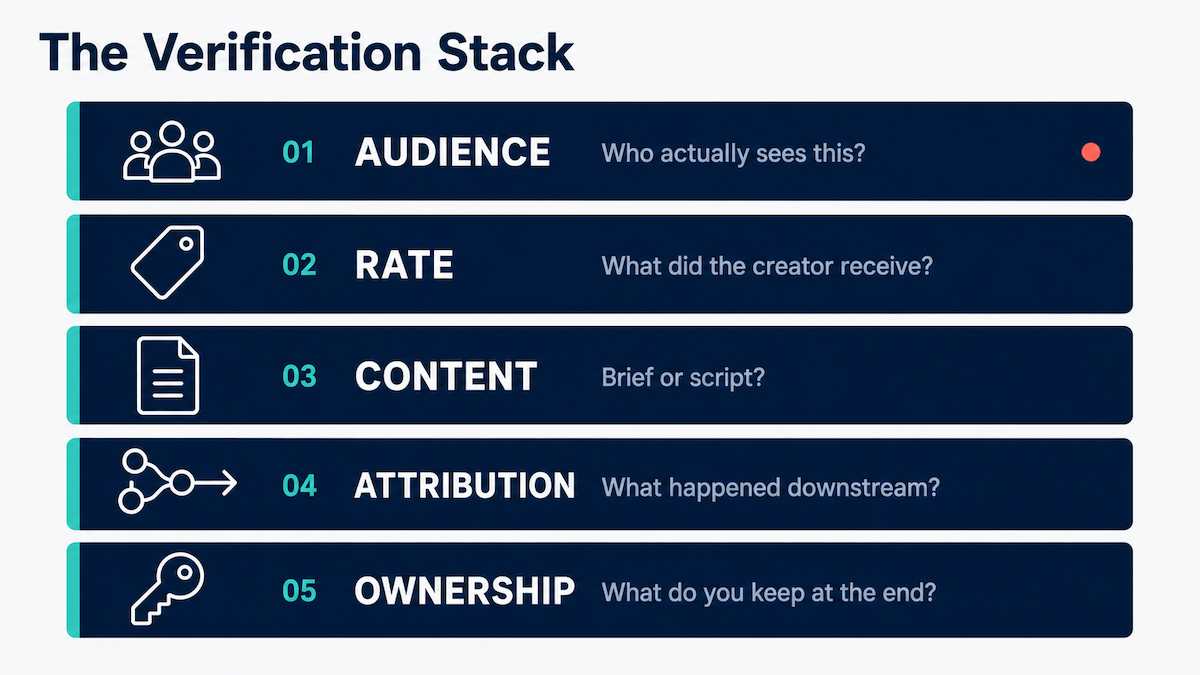
The Verification Stack: Five Layers a Good Agency Can Prove
Every crypto KOL campaign has five layers where value either exists or evaporates. A strong agency can show you evidence at all five. A weak one can only show you the top layer, which is also the layer that is easiest to fake. Run this stack across any shortlist and the differences stop being subtle.
Layer 1: Audience
Not follower count. Composition. Ask what percentage of a creator’s followers are active accounts, what the engagement rate is against impressions rather than followers, and how the agency screened for inflated audiences before recommending the name.
Use the benchmark ranges as a sanity check. Typical healthy engagement on X sits between one and three percent of impressions, and large accounts above 200,000 followers usually settle between 0.5 and 1.5 percent. Sustained engagement under one percent on a large account is a tell. X removed 1.7 million bot accounts in a single purge in October 2025, and the supply keeps regenerating.
Layer 2: Rate
You should be able to see what the creator received, separately from what the agency charged for its labour. Those are two different numbers and bundling them removes your ability to evaluate either one.
This is not about assuming bad faith. An agency that earns an undisclosed spread has a structural reason to recommend the creators with the widest gap between real rate and quoted rate. Disclosure removes the incentive problem entirely.
Layer 3: Content
A brief is not a script. The gap between a creator explaining your protocol in their own register and a creator reading your marketing copy aloud is the gap between a post that converts and a post that gets ratioed.
Ask to see a real brief from a past campaign with the client details removed. If the brief is a paragraph of positioning and a link, the creative work is being skipped.
Layer 4: Attribution
The benchmark data shows the weak spot clearly. Promo and discount codes lead measurement adoption at 45.9 percent, followed by affiliate links at 26.0 percent, and the teams scaling budgets fastest slightly under-index on measurement tooling relative to their share of planned spend growth.
In crypto you have better options than most verticals. Unique referral codes, UTM-tagged destinations, and wallet-level events give you a chain of evidence from post to on-chain action. If attribution is quoted as a paid add-on, that tells you how confident the agency is in the numbers.
Layer 5: Ownership
When the engagement ends, what stays with you? Rate history, creator performance data, the audience-fit analysis, and the attribution setup are all assets you paid to create. Some agencies hand them over. Some consider them proprietary. Either position is defensible. Not knowing which one applies is not.
What Crypto KOL Agencies Charge in 2026
Pricing in this category comes in four shapes. The same 15,000 dollars behaves completely differently depending on which one you are buying, which is why comparing headline monthly fees across models tells you almost nothing.
| Model | How It Works | Verification Difficulty | Best Suited To |
| Pass-through plus fee | Creator spend billed at cost, agency charges a stated management fee | Low | Ongoing programs where you need auditable numbers |
| Flat retainer | Fixed monthly fee for strategy, creator ops and reporting, spend separate | Low to medium | Teams that want predictable cost and defined scope |
| Packaged tiers | Published bundles by creator tier and post count | Medium | Early-stage projects that need a known price fast |
| Fully bundled | One number covering labour, creator spend and amplification | High | Campaigns where speed matters more than auditability |
Two planning notes that matter more than the model itself. Creator spend minimums usually dwarf the agency fee, so a modest retainer attached to a large minimum is a much bigger commitment than it looks. And a fee that seems unusually low almost always means the revenue is being earned somewhere you cannot see.
|
Can you prove what your last KOL campaign actually delivered? Blockchain App Factory runs the Verification Stack across your creator list, your rates and your attribution setup before a single post goes live. |
Crypto KOL and Influencer Marketing Agencies Worth Shortlisting
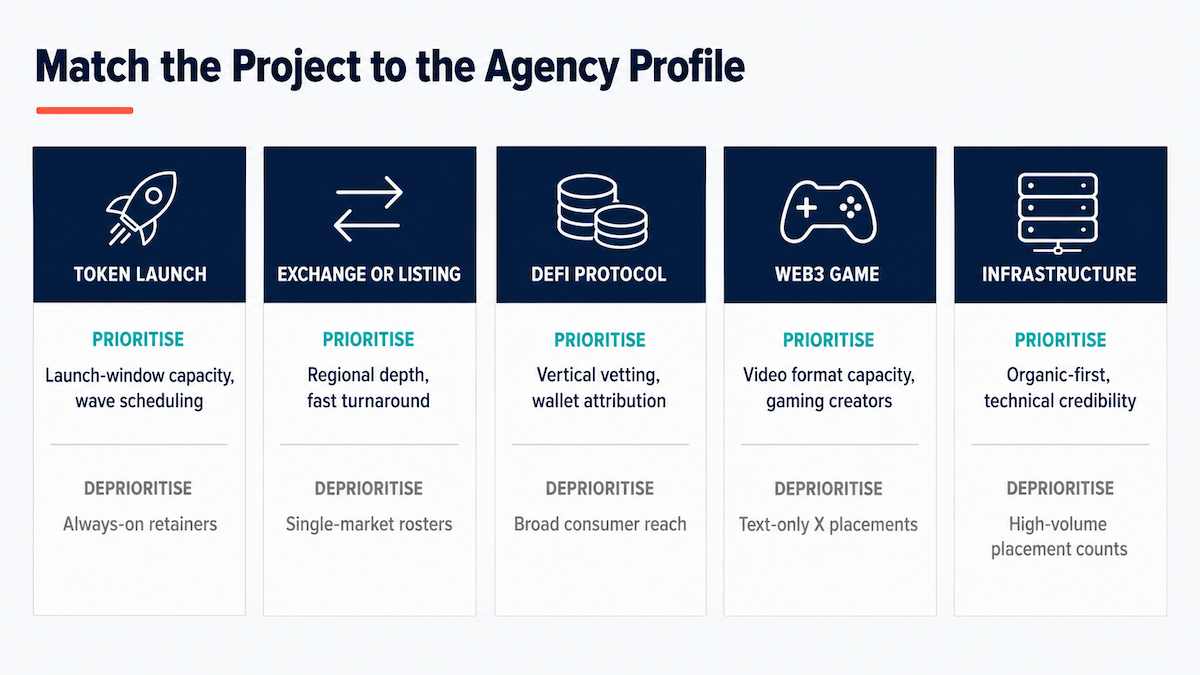
These eight are ordered by how completely each one covers the Verification Stack, not by size or noise. All of them are active, established operators in the crypto creator space.
1. Blockchain App Factory
Blockchain App Factory sits at the top of this list because creator work is wired into the same team that handles token launch, exchange listing, community and PR, which means the KOL layer is briefed against the same narrative and measured against the same downstream events as everything else in the program.
- Reported network of more than 500 crypto KOLs and influencers across global Web3 markets, with more than 50 million combined audience reach and over 200 crypto media partners connected to that network.
- A five-point creator selection process covering audience relevance and wallet behaviour, engagement authenticity, reach quality, regional fit, and niche expertise across DeFi, NFTs, RWA, gaming, exchanges, tokens and AI-driven Web3 projects.
- Campaign formats across X threads, quote posts and Spaces, Telegram group activation and AMAs, YouTube long form, and regional creator outreach in local language markets.
- Performance tracking built around engagement quality, community growth, sentiment and user actions rather than impression totals alone.
- Packaged KOL tiers that scale from three to five micro creators up to macro and top-tier programs, plus more than 12 years in the blockchain industry and 800-plus delivered projects across major chains.
Best fit: token launches, exchange campaigns, DeFi protocols and Web3 games that want creator activation coordinated with development, listing and community work under one roof rather than stitched together across three vendors.
2. Crowdcreate
Founded in 2014 and based in Los Angeles, Crowdcreate is one of the longest-running growth agencies in the space and one of the few where influencer work sits at the centre of the business rather than beside it.
- Reports more than 600 completed projects and around 250 million dollars raised for clients, with Forbes recognition as a top crypto marketing firm.
- Built around distributed campaigns using small and mid-tier creators combined with community growth, which is a different cost profile from premium placement buying.
- Client work spans native protocols and mainstream brands entering Web3, including Solana and Celo.
- Strongest when 40 credible mid-tier creators will outperform four large ones. Less useful when a launch genuinely needs a single tier-one name for credibility signalling.
3. Coinbound
One of the longest-running crypto marketing agencies, with deep US-centric creator relationships concentrated on X and YouTube.
- Best for consumer-facing crypto products chasing English-speaking retail reach at volume.
- KOL work is bundled into a broader service offering, so ask early how creator spend is separated from service fees.
- Long client history across exchanges, wallets and consumer apps.
4. Lunar Strategy
Lisbon-based and operating since 2019, with one of the more established European footprints in crypto creator marketing.
- EU-weighted creator networks, which matters because most crypto rosters skew heavily US.
- Useful for projects navigating European positioning and local language coverage.
- Thinner in APAC and MENA, where a large share of retail attention now sits.
5. NinjaPromo
Sells time in auditable units through a subscription-style retainer, which is unusual in a market where almost everything is quote-only.
- Creator work is reported against conversion metrics alongside paid media.
- Scope can be adjusted month to month, which suits always-on acquisition.
- Crypto is one vertical among several, so crypto-native creator depth varies by team.
6. Guerrilla Buzz
Organic-first, with creator and community work grounded in genuine conversation rather than placement volume.
- Strongest for infrastructure, developer tooling and B2B crypto where credibility beats reach.
- Founder-led content and thought leadership feature heavily.
- Not the right partner for a fixed-date launch window needing concentrated activation.
7. TokenMinds
Publishes service packages with visible tiers, which saves early-stage teams weeks of discovery calls.
- Accessible entry point for pre-seed and seed projects with defined budgets.
- Packaged scope means less flexibility once campaigns get complex.
- Sits alongside a blockchain consulting practice.
8. Blockwiz
Reporting-led crypto specialist that treats campaign analytics as part of the product rather than an upsell.
- Good fit for teams with internal stakeholders who need spend documented.
- Broad service coverage means creator work shares attention with other channels.
- Retainer plus media commercial model.
Run a 30-Day Pilot Before You Sign Anything
The single most expensive mistake in this category is a six-month minimum term signed on an untested agency. A paid pilot costs you one month and tells you almost everything a long contract would have revealed too late.
|
Intake and instrumentation Positioning, prohibited claims, audience definition and the one metric the campaign must move. Attribution gets built now, before any creator is contacted. A creator list arriving this week was generic before it reached you. |
|
|
Sourcing, vetting and rates A shortlist with engagement data and a stated reason for every name. Rate negotiation opens. The brief is drafted with you rather than at you. |
|
|
Contracting and content Creator contracts go out with disclosure language already inside them. Briefs are distributed, first drafts return, and the campaign calendar is published with wave structure and contingencies. |
|
|
Sequenced go-live Placements land on a schedule instead of all at once, someone watches the window live, and the first attributed data arrives inside 72 hours of the opening posts. |
An agency that compresses all of this into two weeks is usually skipping vetting or attribution. One that lets it drift past six weeks with no reason is usually under-resourced on your account.
|
The fee is the number clients negotiate hardest and the number that matters least. The one that matters is the one nobody volunteers, which is what the audience on the other side of that post is actually worth. |
Red Flags and the Contract Terms That Outweigh the Fee
The monthly number gets negotiated for hours and the contract gets skimmed in ten minutes. That is backwards. These clauses move total cost and total value further than the fee ever will.
Proposal red flags
- Creator lists with follower counts and estimated reach but no engagement data attached.
- No named creators at all, only tier descriptions and projected impressions.
- Guaranteed impression or engagement numbers, which cannot be guaranteed on organic content.
- Any suggestion of token price movement or a guaranteed exchange listing.
- Attribution presented as a premium add-on rather than a default.
- Campaign minimums or minimum terms that appear only in the contract, never in the proposal.
- Creator contracts with no disclosure language, which is a liability you inherit.
Contract terms to pin down
- Minimum term. Push for a one-campaign or one-month paid pilot with no obligation to continue.
- Notice period. Thirty days after the initial term, not ninety.
- Unspent budget. Returned or rolled forward at your election, in writing.
- Creator contract ownership. Your paper where practical, or a right to contract directly after a defined period.
- Rate disclosure. Creator rates shown on every invoice.
- Data ownership. You own the campaign data and receive it on exit.
- Content usage rights. Negotiated per campaign and priced openly, never assumed.
On disclosure specifically, this is not hypothetical. The SEC settled with Kim Kardashian for 1.26 million dollars over an undisclosed 250,000 dollar promotion of EthereumMax. The FTC Endorsement Guides treat ambiguous tags such as sp, spon and collab as inadequate disclosure. An agency that treats this as optional is manufacturing exposure that lands on your project, not theirs.
Measuring Whether It Actually Worked
Grade the campaign on the wrong number and even a good campaign looks like a failure. Agree the primary metric in writing before a single creator is contacted.
- Pre-launch awareness. Measure branded search volume growth and share of voice. Ignore raw impressions.
- Community building. Measure attributed joins and 30-day retention. Ignore total member count.
- Product adoption. Measure attributed wallet connections or signups. Ignore click volume on its own.
- Token launch. Measure participation from attributed traffic and holder distribution. Ignore day-one price, which moves for a hundred reasons unrelated to your creators.
- Ambassador programs. Measure cost per sustained impression across the term and content consistency. Ignore individual engagement spikes.
The benchmark data is blunt about why this matters. Teams scaling budgets hardest are not scaling instrumentation at the same rate, and the flat-budget group is proportionally heavier on measurement tooling than their share of the sample would suggest. Discipline, not budget, is what separates the programs that compound.
|
Ready to run a KOL campaign you can actually verify? Vetted creators, disclosed rates, disclosure-compliant contracts and attribution wired in from day one. |
Frequently Asked Questions
How much does a crypto KOL agency cost in 2026?
Agency fees typically run as a flat monthly retainer or as a management fee on creator spend, with creator spend billed separately and usually carrying its own minimum. The fee is rarely the governing number. Ask for the minimum retainer, the minimum creator spend and the minimum term together, because those three combined are your real commitment.
How do I know if a crypto KOL has fake followers?
Compare engagement against impressions rather than follower count. Healthy engagement on X generally sits between one and three percent of impressions, and accounts above 200,000 followers usually land between 0.5 and 1.5 percent. Sustained performance below one percent on a large account, comment sections full of generic replies, and reach that does not scale with audience size are all signals worth investigating.
Should I hire a KOL agency or contact creators directly?
Go direct if you are running fewer than about five placements, already have relationships, and have someone in-house who can brief, contract and measure. Bring in an agency when campaign volume, multi-region coordination, rate negotiation across many creators or attribution runs past what your team can carry. The break-even usually sits somewhere around ten to fifteen placements.
Who is liable if a crypto influencer fails to disclose a paid post?
Both the creator and the project can be exposed. The FTC Endorsement Guides put obligations on advertisers to have reasonable programs in place for monitoring endorsers, and MiCA places responsibility for compliant marketing communications on the offeror in the EU. Requiring disclosure language inside every creator contract is the cheapest insurance available.
What is a realistic minimum budget for a crypto KOL campaign?
Below roughly ten thousand dollars in creator spend you are buying a handful of posts rather than a campaign, and you cannot draw reliable conclusions from that sample. If your budget sits under that line, concentrate it on a small number of well-briefed mid-tier creators with genuine audience overlap instead of spreading it thin across cheap placements.

Vimal J is the Head of Sales at Blockchain App Factory, with 10+ years of experience in sales, client strategy, and Web3 business growth. He helps startups, enterprises, and project founders choose the right blockchain solutions for their goals, bringing a practical market perspective to topics like token development, crypto launches, and Web3 adoption.