A crypto campaign rarely dies because a regulator knocks on the door. It dies because an ad reviewer rejects a landing page for the third time, a KOL posts without a label, or a single localized tweet drags a project into a jurisdiction it never meant to enter.
That is the part founders underestimate. Compliance in crypto marketing is not a legal formality that sits next to the campaign. It is the gate the campaign has to pass through before a single impression is served.
The numbers behind that shift are not subtle. The EU’s MiCA transitional period closed on July 1, 2026, and ESMA’s interim MiCA register listed roughly 213 authorized crypto-asset service provider entries across 23 jurisdictions at that point, out of close to 3,000 firms that had been operating in the bloc beforehand. In the UK, the FCA issued more than 1,700 alerts about unauthorized crypto promotions in the first twelve months of its financial promotions regime, and in February 2026 it took its first enforcement action under that regime, opening High Court proceedings against HTX. In the US, the picture inverted: Cornerstone Research counted 13 SEC crypto enforcement actions in 2025 against 33 in 2024, with monetary penalties falling to about 142 million dollars, less than 3 percent of the prior year’s total.
Lighter enforcement in one market does not mean a lighter compliance load. It means the pressure moved. Ad platforms, exchanges, banking partners, and listing committees now run the checks that regulators used to run first.
That relocation is the thing to internalize. A quieter SEC docket does not make a misleading yield claim safe, because the same claim will be caught by a Google reviewer, an exchange listing committee, or a fund’s diligence team long before it reaches a courtroom. The cost simply shows up as a rejected campaign, a delayed listing, or a term sheet that goes cold, and none of those arrive with a press release explaining why.
| Key Takeaways | ||||||
|
The Market Context That Changes the Math
Total crypto market capitalization sat near 2.15 trillion dollars in early August 2026, well under the roughly 4.27 trillion dollar peak recorded in October 2025. Budgets have tightened accordingly. When acquisition spend is scarce, a rejected campaign is not an inconvenience. It is a quarter of runway spent on nothing.
Meanwhile the transactional layer kept expanding. Total stablecoin supply stood at roughly 313 billion dollars at the end of June 2026, and global crypto ownership reached about 559 million people. More users, more regulated products, and more institutional money moving through the same rails means more scrutiny of how those products are sold.
The regulatory calendar reinforces it. The GENIUS Act, signed on July 18, 2025, put payment stablecoin issuance under federal supervision, with the OCC publishing its proposed implementing rules on March 2, 2026 and a comment window that closed May 1, 2026. The Act takes effect on the earlier of January 18, 2027 or 120 days after final rules are issued. The broader CLARITY Act, which would settle token classification, cleared the House on July 17, 2025 by 294 to 134 and advanced out of Senate Banking 15 to 9 on May 14, 2026, but had no floor vote scheduled as of early August 2026. Marketing teams are building campaigns against a framework that is half-finished.
|
213
Authorized CASP entries on ESMA’s interim MiCA register
|
1,700+
FCA alerts on unauthorized crypto promotions in year one
|
$53,088
FTC maximum civil penalty per violation in 2026
|
Four Regimes Decide Whether Your Campaign Is Legal
Most token projects market across borders by default. A single post can create exposure in four jurisdictions before lunch. The practical skill is not memorizing statutes. It is knowing which rulebook a given piece of creative activates, and adjusting before publication rather than after a takedown notice.
United States: classification decides the regulator
If the token is a security, the SEC governs the promotion. If it is a commodity, the CFTC does. Everything else, including most utility tokens and NFTs sold as collectibles, falls to the FTC under consumer protection law. The FTC Endorsement Guides apply across all three categories whenever money or tokens change hands for a post, and the maximum civil penalty for the relevant FTC Act provisions stands at 53,088 dollars per violation in 2026 after federal agencies skipped the annual inflation adjustment.
European Union: MiCA is now live with no grandfathering
MiCA’s marketing standard is short. Communications must be fair, clear, and not misleading, identifiable as marketing, and consistent with the published white paper. Risk warnings are mandatory in client-facing copy, and any promotion of a public offer must reference the white paper. Supervisors cannot demand pre-approval, but they can demand the materials on request. Penalties reach 5 million euros or 10 percent of annual turnover. The transitional window closed on July 1, 2026, so an unauthorized provider serving EU clients is simply operating illegally.
United Kingdom: the regime follows the audience
The FCA treats crypto promotions as restricted mass market investments. Every promotion aimed at UK consumers needs a prominent risk warning, a 24-hour cooling-off period for first-time investors, and no referral incentives. Jurisdiction attaches to the audience, not the advertiser, which is why an offshore exchange running untargeted social ads is still in scope. The HTX proceedings in February 2026 confirmed the FCA is willing to litigate the point.
Asia-Pacific: two opposite models
Singapore’s MAS effectively bars mass-market advertising by Digital Payment Token service providers, pushing licensed firms toward owned channels, education, and B2B. Dubai’s VARA runs the opposite model, licensing marketing activity and requiring approvals and disclaimers, with penalties for marketing breaches running from 100,000 to 5,000,000 AED. Hong Kong, South Korea, Japan, and Australia all sit somewhere between the two.
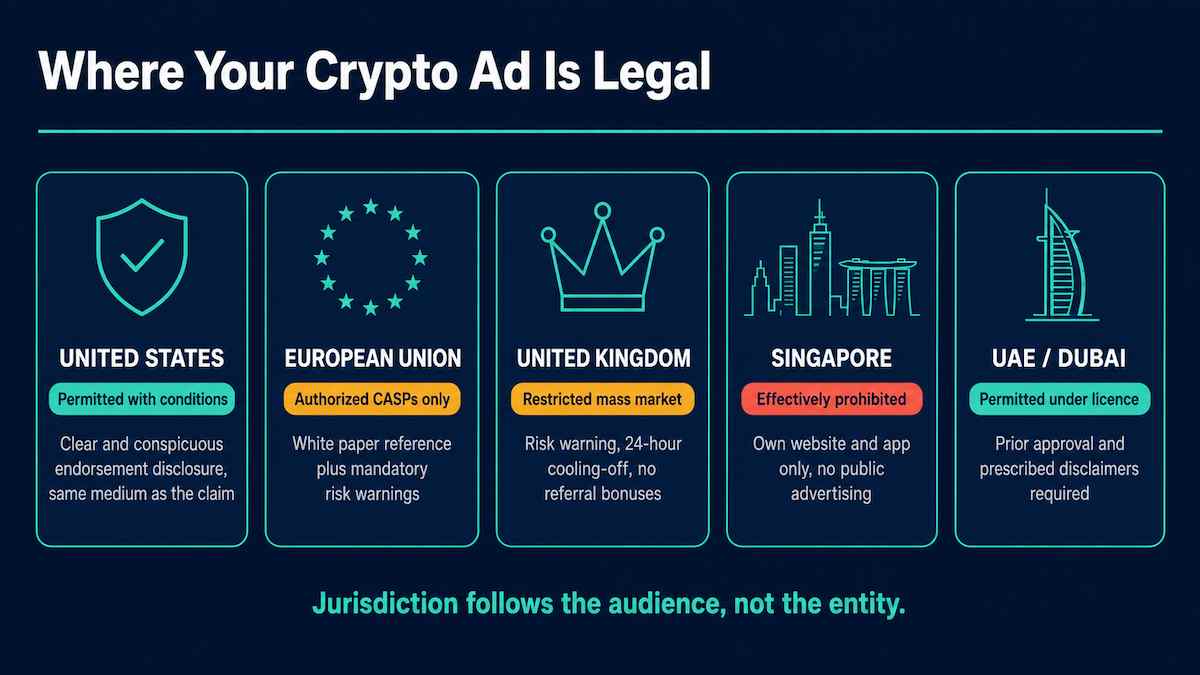
| Jurisdiction | Mass-market retail ads | Non-negotiable requirement |
| United States | Permitted with conditions | Clear and conspicuous endorsement disclosure in the same medium |
| European Union | Authorized CASPs only | White paper reference plus mandatory risk warnings in every promotion |
| United Kingdom | Restricted mass market | Risk warning, 24-hour cooling-off, no referral bonuses |
| Singapore | Effectively prohibited | Promotion confined to a firm’s own website and app |
| UAE (Dubai) | Permitted under licence | Prior approval and prescribed disclaimers on all materials |
The Platform Layer Is Where Campaigns Actually Get Stuck
Regulatory clearance gets you to the starting line. Every major ad platform then applies its own policy on top, with its own reviewers and its own timeline. Teams routinely budget for legal review and forget that the platform gate is longer and less negotiable.
There is no appeal process worth the name at this layer. Platforms are not obliged to explain a rejection, and a second submission that fixes the wrong thing costs another review cycle. The projects that move fastest are the ones that treat certification as a procurement task with a documentation checklist, started early, rather than as a formality handled the week before launch.
Google Ads and YouTube
Google certifies crypto advertisers on a per-country basis under its Financial Products and Services policy, with approved categories limited to exchanges, software wallets, hardware wallets, and coin trusts. Local legality is not sufficient on its own. The advertiser must fit an allowed category, target a permitted location, complete advertiser verification, and hold the relevant licence, which in the US typically means FinCEN registration plus at least one state money transmitter licence. From June 2026, applications moved fully in-account and are no longer accepted through the Help Center. Certifications cannot be bought, rented, or transferred, which retires an old grey-market workaround.
Meta
Meta runs pre-approval built around regulatory documentation and proof of authorization in the target market. Exchange and wallet promotions typically clear. Token sales, yield products, and most DeFi offers do not. First submissions usually fail on the landing page rather than the ad, because reviewers compare risk warnings, stated regulatory status, and the advertised entity against what the destination page actually shows.
X
X lifted its global ban on paid crypto promotions in late February 2026 and rolled out paid partnership labels in early March. Any paid arrangement must now carry the label, with automated warnings and eventual suspension for repeat failures. The important detail for token projects is regional: paid crypto promotions remain prohibited in the EU, the UK, and Australia because of local financial promotion rules. Organic paid placements and formal X Ads follow separate review paths and should be treated as two distinct workstreams.
TikTok and crypto-native networks
TikTok maintains a near-total ban on paid crypto advertising, and organic creator content still triggers FTC disclosure obligations when compensation is involved. Crypto ad networks such as Coinzilla, Bitmedia, and Cointraffic accept a wider range of promotions and target by wallet and exchange behaviour rather than demographics. Their standards are narrower but real, generally covering advertiser KYC and bans on guaranteed-return language and unregistered securities offers.
|
Is your campaign compliant, or just unreviewed?
We pressure-test creative, disclosures, and platform certifications before a single dollar of media goes live.
|
Influencer and KOL Disclosure Carries the Most Risk
Paid creator content is the single most exposed channel in crypto, because liability is shared and the project is usually the more attractive target. The FTC, FCA, and EU supervisors have all pursued both sides of these arrangements, and none of them accept “the creator handled it” as a defence.
What makes the channel dangerous is that it looks casual. A Telegram message, a quote tweet, a two-minute segment in a livestream. None of it feels like advertising, all of it is, and the compensation trail sits on a public blockchain where anyone can find it. The fix is procedural rather than clever.
- Disclosure must appear in the same medium as the endorsement, positioned close to the claim, not parked in a description or a comment thread.
- Payment in tokens, allocations, or unlocked supply counts as a material connection exactly as cash does.
- Contracts should specify approved language, review rights, and indemnification, rather than leaving disclosure to the creator’s judgment.
- Every paid post needs an archive with a timestamp, because proving compliance after a takedown is far harder than documenting it at publication.
- Regional creators need regionally correct disclosures, since a compliant US post can still breach FCA rules when it reaches UK followers.
| Regulators do not audit intent. They audit what a retail user saw, in the language they saw it in, on the day they saw it. |
The Claims That Reliably Trigger Enforcement
Across every jurisdiction reviewed above, the same four categories of language show up in enforcement files. They are worth treating as hard bans in your creative brief rather than as edge cases for legal review.
Guaranteed or implied yield
Any promise of a specific return, any implication of a guarantee, and any presentation of historical yield as forward-looking is treated as misleading by default. Under the GENIUS Act framework, interest payments on payment stablecoins are prohibited outright, which closes off an entire category of yield-led messaging for that asset class.
Selective token supply data
Circulating supply figures that omit locked allocations, vesting cliffs, or scheduled emissions are a documented enforcement trigger. If the number in the ad does not reconcile with the number on-chain, it is a misstatement.
Undisclosed paid promotion
This remains the most common violation and the easiest to prove. Automated platform detection has made it worse for projects, because X and YouTube now flag sponsorship signals even when the label is absent.
Securities-implying language
Phrases like investment opportunity, expected returns, and profit sharing push a token toward securities treatment under the Howey test and its equivalents. Marketing copy is evidence of how an asset was offered, which means the words in the ad can change which regulator you answer to.
A 90-Day Build for a Compliance Workflow That Holds
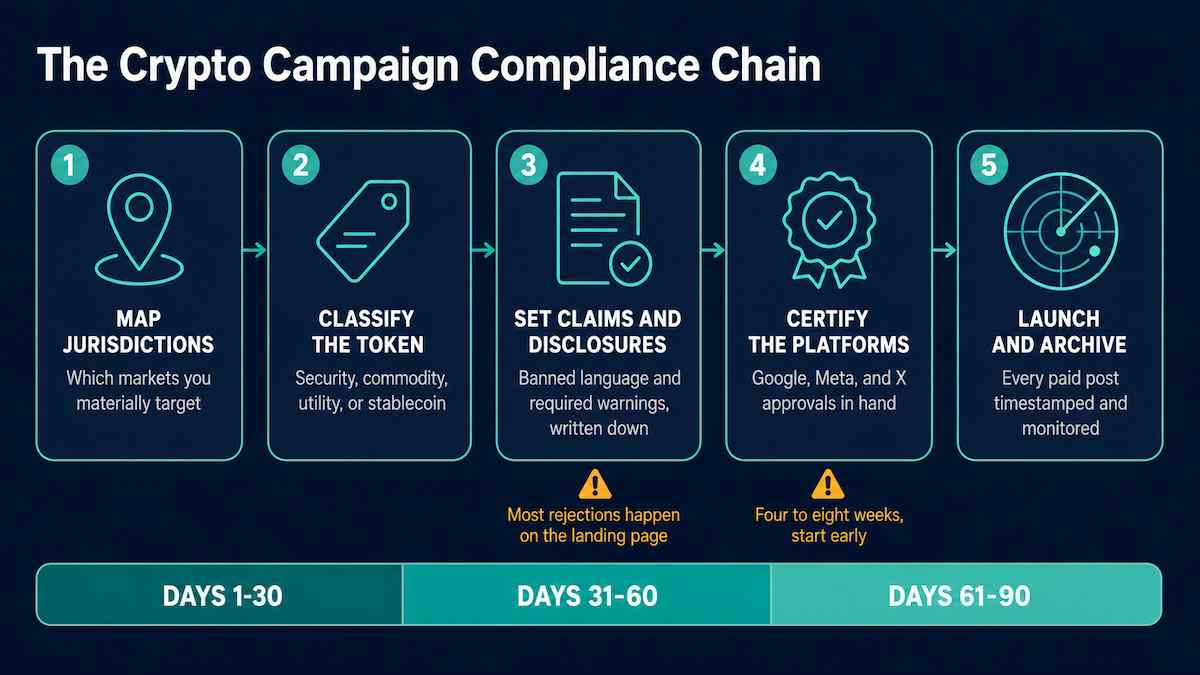
Compliance fails when it is a review step bolted onto the end of a campaign. It works when it is a workflow with owners, artifacts, and a repeatable sequence. Ninety days is enough to build one if the phases run in order.
|
DAYS 1-30
|
Map and classify
Confirm which jurisdictions you materially target, how the token is classified in each, and which regulator that implicates. Produce a written claims policy listing banned language and required warnings, and appoint a single named owner for sign-off.
|
|
DAYS 31-60
|
Certify and standardize
Start platform certifications in parallel with legal work, since Google and Meta approvals commonly run four to eight weeks and longer with incomplete documentation. Roll one disclosure standard across ads, email, organic social, KOL briefs, and community moderation.
|
|
DAYS 61-90
|
Launch and monitor
Go live with certifications in hand, archive every paid placement at publication, and run a recurring review so creative refreshes pass through the same chain that cleared the original. Schedule a quarterly re-read against rule changes.
|
Mistakes That Still Sink Experienced Teams
- Applying one country’s rules globally and assuming a US-legal campaign is safe in Europe.
- Paying KOLs informally in tokens and treating the resulting posts as organic content.
- Clearing legal review and then discovering the platform gate adds another six weeks.
- Running compliant ads that point at a landing page nobody reviewed.
- Leaving community moderators and AMA hosts outside the disclosure standard, when regulators increasingly treat those messages as promotional communications.
- Refreshing creative without re-running review, so an approved campaign quietly drifts out of compliance.
What Is Coming Next
Three shifts are already visible. Automated regulatory screening is spreading, with supervisors scanning promotional content for language, targeting signals, and missing disclosures rather than waiting for complaints. Cross-border coordination is maturing under MiCA, which means an action in one member state increasingly travels. And platform-level KYC on the advertising entity itself is tightening, so the account running the campaign now needs the same documentation as the entity issuing the asset.
The direction of travel is consistent: fewer places to hide, and more of the enforcement burden moved onto intermediaries who would rather reject a campaign than defend it.
Marketing That Ships Instead of Stalling
This is the part of the work Blockchain App Factory handles for Web3 teams that need campaigns to survive review. Our compliant crypto marketing services cover jurisdiction mapping and token classification input, claims policy and disclosure standards written to FTC, MiCA, and FCA requirements, Google and Meta certification management, KOL contracting with disclosure and indemnification built in, archived campaign records, and paid media across mainstream and crypto-native networks that goes live with approvals already in place. We build the workflow once, document it properly, and hand you a paper trail you can put in front of an exchange, a bank, or a regulator without rewriting it first.
Compliance is not what slows a crypto campaign down. Discovering it late is.
|
What is the fastest way to launch crypto ads without triggering a takedown?
|
Frequently Asked Questions
Does a project need a MiCA licence just to advertise in Europe?
To provide crypto-asset services to EU clients, yes. The transitional period ended on July 1, 2026, so an unauthorized provider cannot legally serve those clients, and marketing that service is marketing an illegal activity. Issuers making a public offer face a separate set of white paper and marketing communication obligations under MiCA.
Can a US-based project ignore UK rules if it does not target the UK?
Only if it genuinely does not target the UK. The FCA regime follows the audience, so untargeted social ads, UK-language landing pages, and GBP pricing all create exposure. The safer approach is explicit geo-exclusion plus documentation showing the exclusion was configured.
How long does Google Ads crypto certification take?
Four to eight weeks is typical for a clean application, and longer when licensing documentation is incomplete or the landing page does not match the application. Applications now run in-account rather than through the Help Center, and certification is granted per country and per category.
Who is liable when a KOL posts without a disclosure?
Both parties, in practice. The FTC Endorsement Guides place obligations on the advertiser to establish, monitor, and enforce disclosure, and equivalent rules in the UK and EU work the same way. Projects are usually pursued first because they have the contracts, the payment records, and the assets.
Are crypto ad networks a way around platform restrictions?
They are an alternative channel, not an exemption. Networks like Coinzilla and Bitmedia accept promotions that Google and Meta reject, but advertiser KYC, prohibitions on guaranteed returns, and the underlying regional regulations all still apply. A claim that is illegal on Google is illegal on a crypto network too.

Vimal J is the Head of Sales at Blockchain App Factory, with 10+ years of experience in sales, client strategy, and Web3 business growth. He helps startups, enterprises, and project founders choose the right blockchain solutions for their goals, bringing a practical market perspective to topics like token development, crypto launches, and Web3 adoption.