Most tokens do not fail at launch. They fail in the ninety days nobody watched.
The numbers are hard to argue with. RootData’s review of 2025 token generation events found that 84.7 percent of tracked projects, 100 out of 118, were trading below their opening valuation, with median fully diluted valuation down 71 percent from issuance. A separate Delphi Consulting analysis of 652 new listings across Binance, Bybit, Coinbase, Gate and Kraken since the start of 2025 found only 12 percent were profitable, with a median return of negative 82 percent.
Those are not tokenomics failures alone. They are demand failures. A token that lists into an empty room has to manufacture buyers on the same day it manufactures supply, and that has never worked.
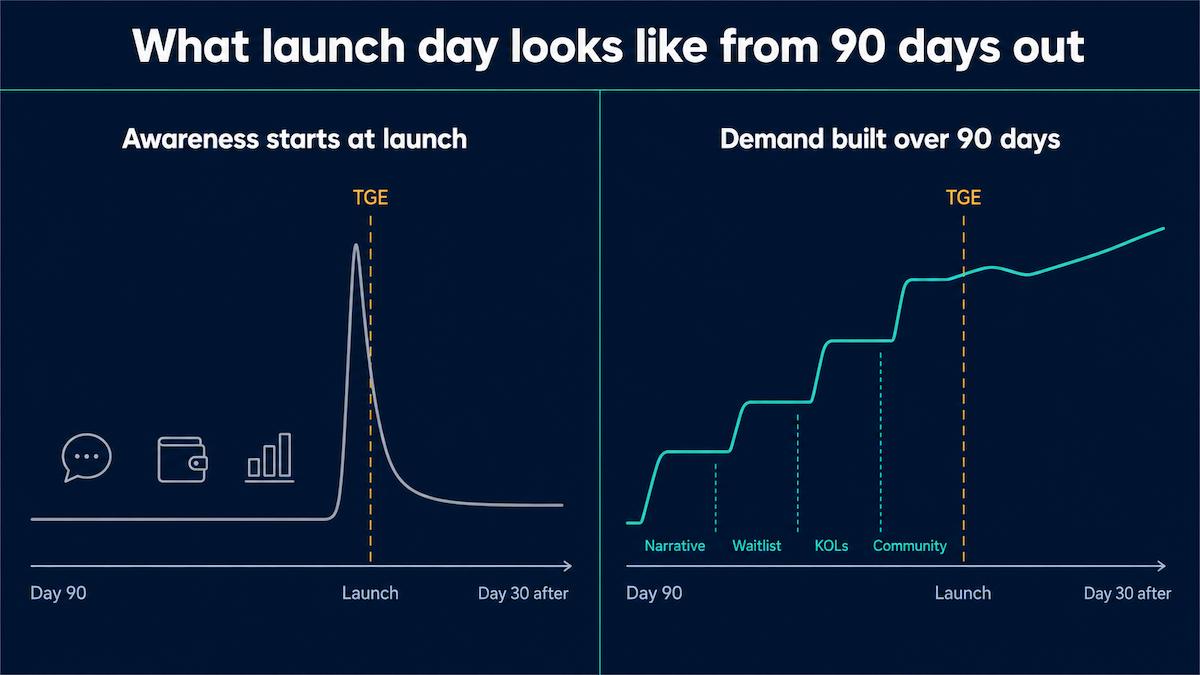
The pre-TGE marketing playbook that follows treats launch day as a settlement date, not a starting gun. Ninety days out, you begin building the thing that actually determines listing performance: a group of people who already know what your token is for, already want it, and are already waiting.
- Launch day performance is decided in the preceding 90 days, not on the day itself. With 84.7 percent of 2025 TGEs trading below opening valuation, the projects that held up were the ones with demand assembled in advance.
- Sequence beats spend. Narrative lock-in comes first, then a filtered waitlist, then KOL seeding from the bottom tier upward, then exchange conversations backed by evidence you already collected.
- Build your waitlist as a filter rather than a crowd. Roughly 40 percent of Linea’s eligible airdrop addresses were flagged as Sybil wallets, and 64 percent of airdrop recipients sell at TGE, so raw signup counts predict almost nothing.
The Market You Are Actually Launching Into
Supply of new tokens is effectively infinite. Pump.fun alone saw 655,770 tokens created by 243,123 distinct creator addresses in the month from September 1 to October 1, 2025, and daily creation stayed above 20,000 through December, peaking above 25,000 on December 2. Of those September tokens, roughly 0.63 percent graduated. Attention, meanwhile, has not scaled at all.
Exchange access has narrowed in a similar way. Binance listed 100 tokens across 2025 with a median return of 0.22x. Coinbase listed 111, of which 94 were trading lower, at a median 0.43x. Binance Launchpad ran only 8 sales in the first half of 2025, though those averaged 4.8x, which tells you the bottleneck is selection, not demand for good launches.
Add the supply structure problem. Tokens with under 20 percent circulating supply are considered low float, mature assets typically sit between 30 and 60 percent, and CoinGecko has found roughly one in five top crypto assets carry low float with large future unlocks ahead. If your float is thin and your demand is thinner, every unlock becomes a sell event with no bid on the other side.
|
84.7% of 2025 token generation events traded below their opening valuation |
12% of 652 new CEX listings since early 2025 were profitable, median return negative 82 percent |
64% of airdrop recipients sold at the token g eneration event itself |
The 90-Day Structure at a Glance
Four phases, each producing an asset the next phase depends on. Narrative feeds the waitlist. The waitlist feeds KOL credibility. KOL traction feeds the exchange conversation. Everything feeds the content stockpile that carries launch week.
|
DAY 90 to 61 |
Narrative lock-in One sentence, one category, one proof stack. Tokenomics rationale published before anyone can invent their own version of it. |
|
DAY 60 to 31 |
Waitlist and KOL seeding Behavior-gated signups, Sybil filtering from day one, and a KOL sequence that starts with small accounts and works upward. |
|
DAY 45 to 15 |
Exchange and liquidity conversations Listings teams evaluate evidence. Every number you show them was generated in the two phases above. |
|
DAY 30 to 1 |
Community pre-seeding and content stockpile Roles, rituals and regional pods in place. Launch week assets written, approved and scheduled before the week begins. |
Days 90 to 61: Lock the Narrative Before Someone Else Writes It
If you cannot say what your token does in one sentence, the market will write that sentence for you, and it will usually be unflattering. This phase exists to make your positioning fixed and repeatable long before the noise starts.
Write the one sentence and stop editing it
The sentence needs a category, a mechanism and a beneficiary. Something like “a perps DEX that pays sequencing revenue back to liquidity providers” works because a stranger can repeat it. Test it by asking five people outside your team to say it back after one reading. If they paraphrase it differently, it is not locked.
Assemble a proof stack, not a claims list
Every assertion in your messaging should have something behind it. Audit report, testnet numbers, a named partner, a working demo. In 2026 the projects getting cited in AI answer engines and picked up by research desks are the ones with verifiable specifics rather than adjectives.
Publish tokenomics rationale early, not just the pie chart
Given how much of the 2025 underperformance traces back to low float and unlock pressure, explain your float, cliff and vesting logic in writing. Show what percentage circulates at TGE and why. Projects that do this ahead of time are treated as candid. Projects that publish it on launch day are treated as evasive.
Decide what you will refuse to claim
Write down the promises you will not make, including price expectations, listing guarantees and timeline commitments you cannot control. This document protects you when a KOL or a community manager improvises later.
Days 60 to 31: Build the Waitlist as a Filter, Not a Crowd
A big waitlist is worthless if it is made of wallets that exist only to farm you. Linea filtered roughly 517,000 of 1.3 million eligible addresses as Sybil, about 40 percent. LayerZero’s CEO publicly estimated that only 400,000 to 600,000 of six million accounts were real. Build the filter into the funnel instead of bolting it on at snapshot time.
Gate on behavior, not on clicks
Require an action that costs something: a testnet transaction, a deposit, a completed quest with an on-chain trace, a verified social account with history. Cheap actions attract cheap users.
Segment on day one
Tag every signup by acquisition source, region, wallet age and activity depth. When you eventually design allocation, this table is the difference between rewarding contributors and rewarding scripts.
Run Sybil detection continuously
Cluster analysis, funding-path tracing and timing correlation should run weekly, not once. Tools like Bubblemaps and independent analysts including ZachXBT surface wallet clusters publicly, and you would rather find yours first.
Give waitlist members something before launch
Early access to a feature, a private call, a named role. People who receive value before the token exists are the ones still there after the first unlock.
| What you are measuring | Waitlist built on incentive | Waitlist built on access |
| Signup motive | Expected allocation value | Wanting to use the product early |
| Typical Sybil load | High, often 40 percent or more of claimants | Low, because the gate costs more than the reward |
| Behavior at TGE | Sells into the first bid, matching the 64 percent day-one sell rate | Holds or deploys into the protocol |
| Value to exchange conversations | Weak, listings teams discount raw counts | Strong, retention and depth are the metrics they ask for |
|
Is your waitlist real demand or rented attention? We audit pre-TGE funnels for Sybil load, retention signal and exchange readiness before your snapshot locks. |
Days 60 to 31: The KOL Seeding Sequence
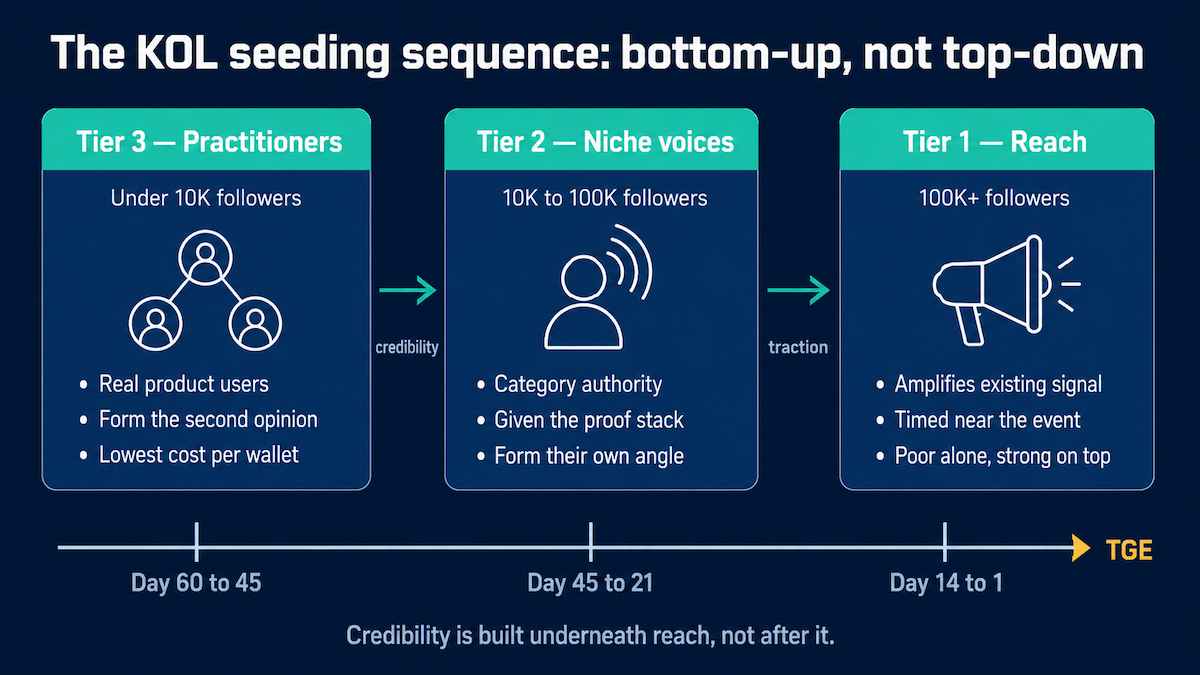
Most projects run KOL campaigns backwards. They pay the biggest account first, get one spike, and discover the audience has no reason to stay. The sequence that works moves upward, so that by the time a large account posts, the claim is already corroborated in smaller corners of the market.
Start with tier three, the practitioners
Accounts under 10,000 followers who actually use products in your category. Give them access, not a script. Their posts are what a larger KOL’s audience finds when it goes looking for a second opinion. During the BELIEVE launch in April 2025, five mid-tier KOLs drove 12,436 new wallets in 48 hours at roughly 2.70 dollars per wallet, which is the kind of efficiency that disappears at the top of the pyramid.
Move to tier two once there is something to point at
Accounts in the 10,000 to 100,000 range with defined niches. By now you have testnet numbers, a waitlist figure and third-party commentary. Give them the proof stack and let them form their own angle.
Bring in tier one last, and only for reach
Large accounts convert poorly on their own but compound well on top of existing signal. Time them for the final two weeks so that the spike lands close to the event rather than 60 days before it.
Contract on outcomes, not on posts
The market has moved toward paying against wallet connections, swaps and retained users rather than flat fees per tweet. Ask for disclosure, ask for their last three campaigns’ on-chain results, and structure at least half the fee against measurable KPIs.
|
A large account can tell people you exist. Only a small one can make them believe it. |
Days 45 to 15: Exchange Conversations Run on Evidence
Listings teams are not evaluating your vision. They are evaluating whether your token will trade with real volume and whether it will embarrass them in three months. Given the median 2025 listing returns of 0.22x on Binance and 0.43x on Coinbase, their bar has risen accordingly.
Prepare the evidence pack before the first call
Retained user counts with the Sybil-filtered methodology attached, geographic distribution, testnet or mainnet volume, float at TGE with a full unlock schedule, legal opinion and audit reports. Everything here comes from work you already did in phases one and two.
Start with tier two exchanges and regional venues
Volume on a mid-tier venue is a reference point for a top-tier one. Regional exchanges also give you natural entry into markets where your community pods are strongest.
Line up market making early
Agree spread commitments, depth obligations and loan or option terms well before listing. Thin books turn ordinary sell pressure into a chart that scares away the next cohort.
Sequence the announcements
Listing news is your highest-value asset. Do not spend it in a quiet week. Map it against your content calendar so it lands where it lifts everything around it.
Days 30 to 8: Pre-Seed the Community You Want on Launch Day
Communities that form on launch day are price communities. They arrive for the candle and leave with it. Communities formed in the month before launch have a shared history, and that history is what survives the first drawdown.
Create roles that mean something
Testers, translators, regional leads, documentation contributors. Named roles with real permissions produce a group of people with something to lose.
Install rituals before you need them
A weekly call, a build log, an office hours thread. Rituals started before TGE feel native. Rituals started after TGE feel like damage control.
Build regional pods, not one global channel
Separate language channels with their own leads consistently outperform a single English room. They also give you distribution in markets where your exchange conversations are happening.
Staff moderation ahead of the spike
Scam links, impersonation accounts and fake claim sites arrive on schedule. Have your moderation team, verified link list and reporting workflow in place two weeks early.
Days 14 to 1: Stockpile Content So Launch Week Is Execution
Launch week is the worst possible time to write anything. Everything you will need should be finished, reviewed and queued before the final fortnight begins.
The core stockpile
- Announcement copy in every language you support, plus the visual set for each
- A tokenomics explainer page with the full unlock schedule in a structured, machine-readable format
- A how-to-claim or how-to-buy guide with screenshots, published before it is needed
- Three to five founder threads covering origin, mechanism and roadmap
- Press and research desk briefing materials with quotable, specific figures
Write the two document types that get cited
Answer engines and research aggregators pull from pages that state facts plainly and structure them clearly. A definitive tokenomics page and a thorough FAQ page, both published pre-launch, tend to become the source everyone else quotes. Resources like Tokenomist, RootData and DefiLlama also index this material, which extends your reach past your own channels.
Prepare holding statements for the bad scenarios
Draft responses now for a failed claim contract, a delayed listing, a price drop below launch, and an exploit allegation. You will not have the composure to write these well in the moment.
Map distribution, not just creation
Every asset needs a channel, a time and an owner. Build the hour-by-hour launch day grid and give one person the authority to change it.
How to Know the 90 Days Actually Worked
Vanity metrics will tell you the campaign succeeded right up until the moment the chart says otherwise. Track the signals that predict post-listing behavior instead.
- Sybil-adjusted waitlist size, meaning the number after clustering analysis rather than before
- Week four retention among people who joined in week one, which is the closest proxy you have for post-TGE holding
- Percentage of community members who completed a costly action rather than a free one
- Unprompted brand mentions and how consistently your one sentence is being repeated back
- Depth of committed market making relative to expected day-one float
Getting the Sequence Right the First Time
A pre-TGE program has one property that makes it unforgiving: you cannot run it twice. The narrative can be revised, the community can be rebuilt, but the launch happens once and the chart it produces follows the project for years. Most teams attempting this internally are simultaneously shipping a product, closing a raise and negotiating listings, and the marketing sequence is the piece that quietly slips.
This is where our pre-TGE marketing services tend to earn their place. Our team runs narrative development, filtered waitlist construction with Sybil screening built in, tiered KOL seeding with outcome-based contracts, exchange listing preparation and the full launch-week content stockpile as one coordinated ninety-day program rather than five disconnected workstreams. Having supported token launches across DeFi, gaming, RWA and infrastructure categories, the practical value is knowing which levers matter in week two versus week ten, and having the KOL relationships and exchange contacts already in place rather than building them under deadline pressure.
|
How many days until your TGE? Whatever the answer, there is a version of this playbook that fits the time you have left. |
Frequently Asked Questions
How long before a TGE should marketing actually start?
Ninety days is the working minimum for a token with meaningful ambitions. Narrative and community take roughly sixty days to compound, and exchange conversations typically need thirty to forty-five days of lead time. Below sixty days you are buying attention rather than building demand, which is the pattern behind most underperforming launches.
What is the biggest mistake teams make in the pre-TGE window?
Optimizing for waitlist size. Large unfiltered lists are dominated by farming wallets, and those wallets sell instantly. Linea filtered roughly 40 percent of its eligible addresses as Sybil, and MYX found over 40 percent of claiming accounts were fake. A smaller list of behavior-verified users produces better price stability and better exchange conversations.
Do KOLs still work for token launches?
They work when sequenced and contracted properly. A 2024 survey found 62 percent of crypto projects reported increased token adoption after working with influencers, but the results now come from mid and micro accounts with genuine category knowledge, paid against on-chain outcomes rather than flat per-post fees.
How much circulating supply should be available at TGE?
There is no universal number, but below 20 percent is generally treated as low float and carries elevated unlock risk, while mature tokens usually sit between 30 and 60 percent. What matters more than the figure is publishing the rationale early and making the full unlock schedule easy to find and verify.
Can a strong pre-TGE campaign fix weak tokenomics?
No. Marketing determines how many people show up and how informed they are. Supply structure determines what happens after they arrive. A well-run ninety-day program on top of an aggressive unlock schedule buys you a better first week and a worse third month, which is why tokenomics review belongs at the start of the ninety days rather than the end.

Vimal J is the Head of Sales at Blockchain App Factory, with 10+ years of experience in sales, client strategy, and Web3 business growth. He helps startups, enterprises, and project founders choose the right blockchain solutions for their goals, bringing a practical market perspective to topics like token development, crypto launches, and Web3 adoption.