
Key Insights
- ICO platforms in 2026 are shifting toward flexible pricing, allocation, and on-chain fundraising models that can respond to changing investor demand and oversubscription.
- Security and compliance now need to be built into the entire token sale flow, covering investor eligibility, disclosures, smart contracts, treasury controls, monitoring, and post-sale governance.
- Post-TGE performance depends on decisions made before the sale, especially initial circulating supply, liquidity depth, holder distribution, vesting schedules, and the market’s ability to absorb token unlocks.
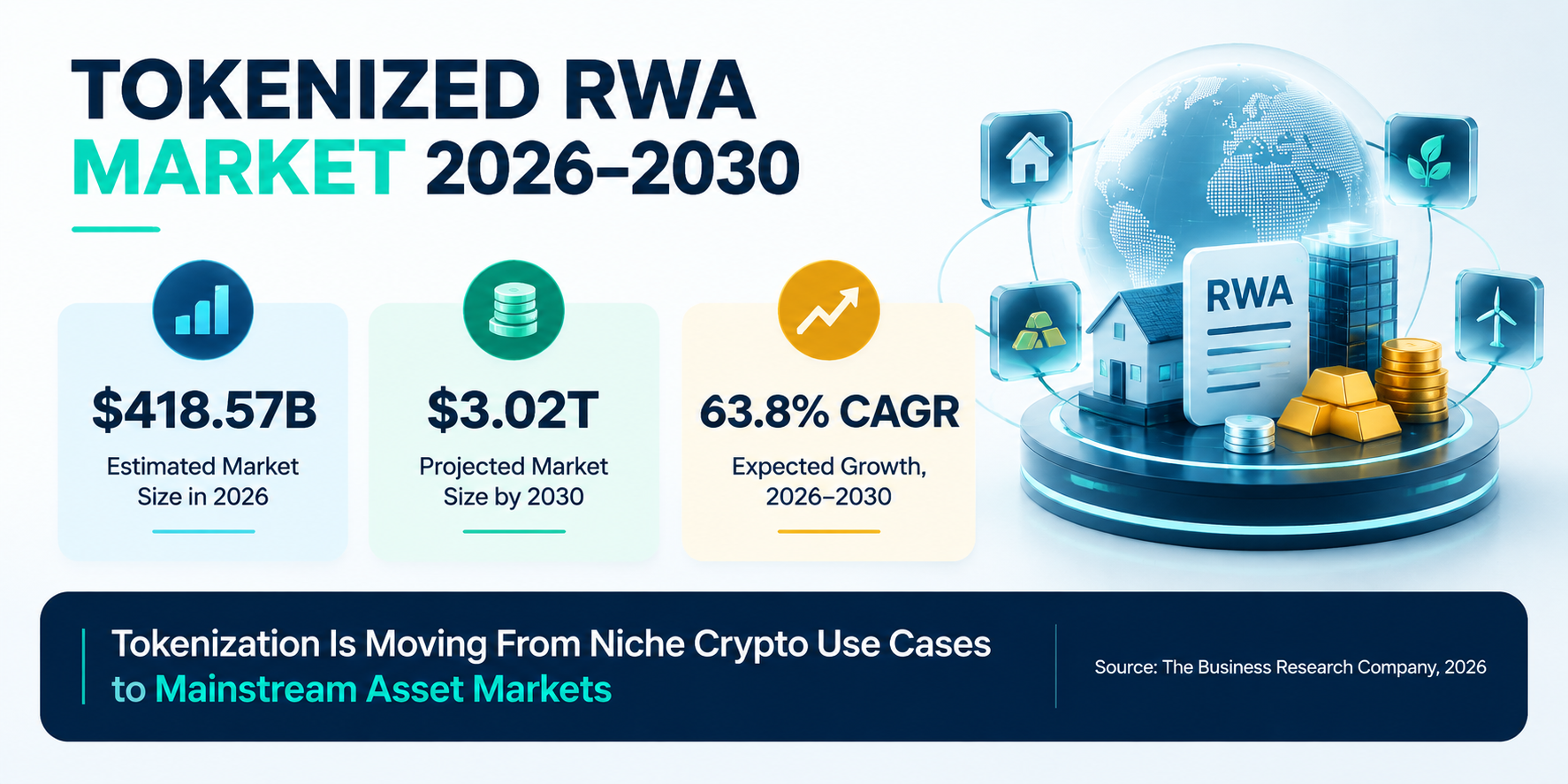
If you’re planning a token raise in 2026, you’re entering a market where tokenization is moving far beyond crypto-native assets. Tokenized real-world assets are gaining traction across real estate, private credit, commodities, securities, and other financial assets. The Business Research Company estimates that the tokenized RWA market will reach $418.57 billion in 2026 and grow to around $3.02 trillion by 2030, representing a projected 63.8% CAGR during the forecast period.
That growth is changing what investors expect from token-based fundraising. As more traditional assets move onchain, a token sale cannot rely on hype, a quick fundraising target, or an exchange listing alone. Investors are looking more closely at valuation, token utility, allocation, compliance, security, liquidity, and how much supply can enter the market after TGE.
This shift also makes the underlying ICO infrastructure more important. Your ICO development setup needs to handle investor access, eligibility, pricing, allocation, settlement, token distribution, and post-sale controls as one connected process. In this blog, we’ll look at how ICO platforms are adapting to a more selective token sale market in 2026 and what founders need to consider before taking their tokens to market.
What This Blog Covers
- How should founders price ICO tokens when public-sale demand is unpredictable in 2026?
- How can ICO platforms handle oversubscription, investor eligibility, and on-chain allocation fairly?
- What token supply, liquidity, and compliance decisions affect performance after TGE?
The Current State of Crypto Fundraising in 2026
The 2026 fundraising numbers are pretty blunt: money is still available, but investors are choosing fewer public sales and scrutinizing what reaches TGE.
Public Token Sales in a More Selective Capital Market
- Fewer Sales, More Concentrated Capital:
CryptoRank recorded 47 public sales raising $40 million in Q2, the weakest quarter in four years.
Yet July rebounded to $121 million, up 245% from June. The money is still there, but it’s landing on a much smaller group of sales.
- Thinner Exchange Liquidity:
CoinGecko reported top-10 CEX spot volume fell 27.9% quarter over quarter to $1.95 trillion in Q2.
If you’re raising now, you can’t assume exchange liquidity will absorb weak distribution or heavy supply after TGE.
Why Traditional Fundraising Models Are Losing Effectiveness
- Recent Post-TGE Performance:
Memento Research found 84.7% of 118 token launches from 2025 below their TGE valuation by December 20, 2025.
Buyers remember outcomes like that, so valuation and sale terms face much closer scrutiny.
- High FDV Meets Thin Liquidity:
High FDV, thin initial float, oversized insider allocations, and a listing-first plan can quickly work against you.
Your pricing, allocation, and supply plan need to stand up to scrutiny before TGE and still hold together once trading starts under today’s thinner liquidity conditions.
How Modern ICO Platforms Are Redefining Public Token Fundraising
The biggest change in ICO platform development isn’t one new feature. It’s how much of the raise now lives inside the platform itself. Instead of jumping between separate tools for onboarding, sales management, treasury, distribution, and reporting, you can run those moving parts through one connected fundraising setup.
1. Fundraising Control
Sale rounds, contribution limits, eligibility rules, payment options, refund conditions, vesting terms, and distribution schedules can all follow the same rules and records instead of being handled through disconnected systems.
2. Data Continuity
You feel the difference as soon as people start registering. Once someone registers, completes verification, contributes, receives an allocation, or claims tokens, the same investor record can follow them from verification through allocation and claims. You’re not reconciling five dashboards after every sale phase or chasing mismatched records when commitments change.
3. Treasury Coordination
The platform can also stay involved once capital starts coming in. Funds can move through defined treasury rules, multisig approvals, release schedules, and accounting records, so you can see exactly what was committed, settled, refunded, and received.
4. Launch Management
And because all of this sits together, you’re managing one fundraising operation rather than a pile of tools. For a founder, that cuts out avoidable gaps and gives the raise a much stronger base before the token reaches the market.
New Approaches to Token Pricing & Onchain Fundraising
Once you fix the token price before launch, you’re committing to a valuation before buyers have shown you what they’re actually willing to pay. Miss the price, and you feel it immediately: price it too high and demand can stall; price it too low and an oversubscribed sale can leave you wondering how much capital you left on the table.
Pricing Models
- Fixed price
Simple for buyers, but all the pricing risk sits with you.
- Pro-rata
Useful when demand runs above supply. Everyone can participate, while final allocations shrink based on total commitments.
- Dutch auction
Let bids work toward a clearing price instead of asking you to lock one number upfront.
- Sealed-bid auction
Keeps bids private until the process closes, which can limit reactive bidding and make price discovery less influenced by what others are doing.
So you’re not deciding only what one token should cost anymore.You now need to decide how the sale should respond when demand changes.
Allocation Under Pressure
Oversubscription sounds like a win. It can also create a mess. If commitments come in far above your cap, you still need to decide who gets filled, how much they receive, and what happens to the rest of the capital.
You Can Use:
- Allocation caps to limit whale concentration.
- Pro-rata distribution to spread access.
- Automatic refunds for excess commitments.
- Discretionary limits when you don’t want to accept every dollar offered.
At that point, pricing and allocation become part of the same decision.
Moving the Sale Onchain
Once the pricing rules are set, more of the execution can happen directly through smart contracts. Contributions can be recorded on-chain. Allocations can be calculated automatically.
Refunds can be returned without manual processing. Claims and lock conditions can follow preset rules. For you, that removes a lot of reconciliation between spreadsheets, wallets, dashboards, and treasury records.
But every extra rule you move onchain adds more contract, wallet, and frontend risk to manage.
Matching the Model to Your Raise
There isn’t one sale format every founder should copy. A broad retail round may need simplicity. Heavy oversubscription may require pro rata allocation.
With custom ICO platform development, you can set those rules around your sale instead of accepting whatever a preset launchpad allows.
Instead of squeezing your raise into one preset model, you can build pricing, allocation, refunds, settlement, and claim logic around how you actually expect your sale to run.
Compliance, Security & Investor Protection in Modern ICO Platforms
A public token sale can look polished and still leave you exposed if the controls behind it are weak. In practice, the problem rarely starts with one dramatic failure. It usually begins with small gaps across access, disclosures, wallet checks, permissions, and fund handling.
Investor Eligibility & Access Control
- Participation Eligibility
Your sale shouldn’t show the same path to every visitor. Jurisdiction, KYC or KYB status, sanctions checks, investor type, and offer restrictions need to decide what someone can see and whether they can participate.
- Pre-Sale Verification
If those checks happen only at checkout, you may already have shown the wrong offer or purchase route to the wrong audience. So the compliance logic has to sit inside the sale flow, not beside it, with the right disclosures shown before anyone commits.
Offering Terms & Disclosure Management
- Disclosure Consistency
Once someone qualifies, the next risk is inconsistency. Token rights, vesting, refund terms, use of proceeds, contract addresses, sale dates, and participation rules should match across the website, whitepaper, dashboard, and checkout. Buyers shouldn’t have to guess which page carries the current terms.
- Version & Acceptance Records
If a term changes, your platform should record what changed, when it changed, and which version a buyer accepted. That gives you a clean record even if pricing, eligibility, or the sales phase changes.
Sale Infrastructure Security
- Full-System Attack Surface
A clean audit doesn’t protect against a weak frontend, an exposed admin key, a compromised cloud account, a fake domain, or careless wallet approval. One weak control can still redirect funds or expose sale functions.
- Access & Treasury Controls
Role-based access, multisig or MPC treasury controls, transaction checks, dependency review, access logs, and strict limits on privileged actions should cover the route from contribution to settlement.
Real-Time Risk Monitoring
- Wallet & Transaction Surveillance
Related wallets, repeated funding patterns, suspicious transaction routes, sudden contribution spikes, and account abuse should trigger a review instead of sitting unnoticed in the dashboard. Unusual admin actions or treasury movements deserve the same attention.
- Incident Response Controls
Verified contract addresses, official support channels, phishing warnings, emergency pause controls, and refund procedures should already be in place before commitments start landing. If a suspicious transaction or admin action appears, your team needs a clear way to stop the affected action quickly.
Post-Sale Governance & Control
- Treasury & Distribution Oversight
Treasury transfers, token distribution, vesting, claims, and post-sale permissions still need clear approvals and traceable records. Investors may be done buying, but your operational risk is still active.
- Control Continuity
This is where you’d need professional ICO platform development services. Compliance, security, and investor protection need to be applied consistently across the entire sale, from first access through final distribution, so your team isn’t stitching together decisions after the money has already moved.
How Token Supply, Liquidity & Unlocks Affect Post-TGE Performance
A strong raise can still run into trouble the moment trading opens. From there, the market starts testing every decision you made around supply, holder mix, liquidity, and future token releases.
1. Initial Circulating Supply at TGE
- Low Initial Float: Price can swing hard on small trades, especially when only a narrow slice of supply is available.
- Excess Initial Float: Early demand can get buried before the token settles into normal trading.
So your opening supply needs to match your buyer base and liquidity, not the number that looks neatest on a tokenomics chart.
2. Early-Market Liquidity Conditions
- DEX Liquidity Depth: A pool can exist and still be too shallow for normal selling.
- CEX Order-Book Depth: CEX liquidity can look healthy until a few large orders start moving price sharply.
- Circulating Supply Concentration: Thousands of wallets don’t help much if most tradable supply still sits with a small group.
At this point, you can see whether your distribution plan can handle normal trading. The market shows you quickly whether the token can absorb ordinary buying and selling without turning every large trade into an event.
3. Post-TGE Holder Retention & Activity
By this point, launch-day excitement has faded, and the buyer mix becomes easier to read.
- Holder Activity Signals: Claims, transfers, staking, governance, product use, and selling activity show you who stayed involved and who was waiting for liquidity.
If short-term holders control too much float, sell pressure usually becomes obvious here.
4. Token Releases & Market Absorption
A scheduled release can look harmless on paper and still hit the market hard.
Practical comparison should be:
- Release-to-Float Ratio
- Release-to-Volume Ratio
- Release-to-Liquidity Ratio
Team, investor, treasury, and incentive releases all need to be judged against what the market can realistically absorb.
5. Pre-TGE Market Readiness
This is why post-TGE performance starts to take shape before listing. Your ICO platform development setup should connect distribution, vesting, treasury movement, circulating supply, and liquidity planning early enough for you to spot pressure before the market does.
Conclusion
If you’re planning an ICO in 2026, most of the decisions that look small before launch don’t stay small for long. Pricing affects demand, distribution affects who holds the token, and liquidity decides how much selling the market can absorb once trading opens. So the sale itself is really only one part of what you’re preparing for.
And once capital starts coming in, there’s very little room to fix basic gaps calmly. Your platform, compliance flow, treasury setup, token distribution, and marketing need to be lined up before that pressure starts building. For that, you’d need a solid ICO development company by your side.
If you’d rather handle all of that with one team, Blockchain App Factory’s custom ICO development services can build your platform and support the marketing around the raise too. You get one experienced team working from the same sales plan, so the platform, campaign, and TGE timeline don’t drift apart.

Vimal J is the Head of Sales at Blockchain App Factory, with 10+ years of experience in sales, client strategy, and Web3 business growth. He helps startups, enterprises, and project founders choose the right blockchain solutions for their goals, bringing a practical market perspective to topics like token development, crypto launches, and Web3 adoption.