A token can start trading on an exchange and still show up on CoinMarketCap or CoinGecko with no market cap, or with no page at all. The cause is usually the submission evidence. Each aggregator reviews that evidence against its own published rules, and the two rulebooks differ in ways that matter.
This guide covers what each platform currently asks for and how to submit through the official channels. It also explains what decides CoinMarketCap ranking and CoinGecko ranking once a page is live, and how to keep that page accurate.
Research checked: September 2026. Both help centres change often, so confirm each requirement on the official page before you submit.
Takeaways
- Submission, approval, market-data tracking, market-cap rank and trending placement are separate outcomes on both platforms.
- Both platforms expect active trading on at least one exchange they integrate with, plus a working website and block explorer.
- Paid review options on both platforms shorten the wait, and both platforms state that payment does not guarantee approval.
A listing page does not come with a rank
Getting a page is the first of several outcomes, and each one has its own conditions. Teams that treat them as one event tend to misread their own status.
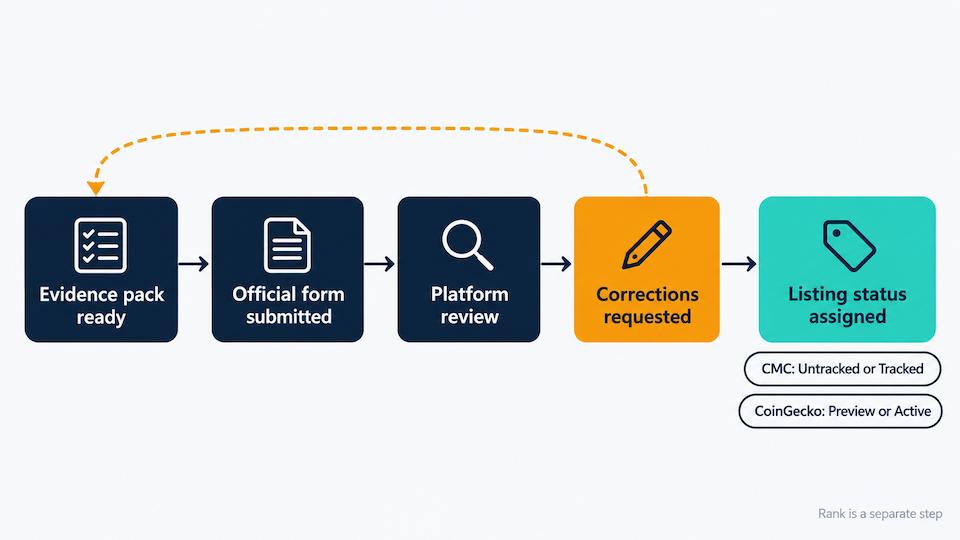
- Submission happens when you send the official form. Nothing is published at this point.
- Listing approval means the platform has reviewed the asset and created a page for it.
- Market-data tracking starts when price and volume from integrated exchanges feed that page.
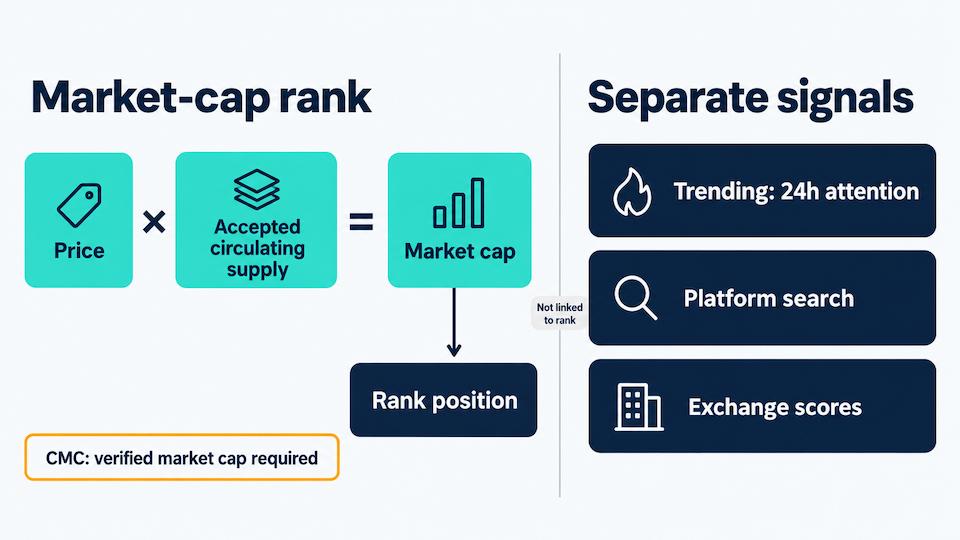
- Market-cap ranking gives the asset a numbered position, calculated from the circulating supply the platform accepts.
- Trending lists and on-site search reflect user attention. Market size plays no part in them.
Market capitalization is price multiplied by circulating supply. Fully diluted valuation (FDV) multiplies price by maximum supply, so it describes a hypothetical future float. A token with a large FDV and a small verified float can sit far lower in the rankings than its headline valuation suggests.
Reported volume and real liquidity are also different measurements, and both platforms filter or flag markets that look unreliable. Exchange rankings are a separate system again. CoinMarketCap scores exchanges with a multi-factor model and CoinGecko rates them with its Trust Score; neither score sets a token’s position.
Search visibility splits the same way. A CoinMarketCap or CoinGecko page may appear in Google results for your token name, but neither aggregator has any say in how Google ranks your own website.
CoinMarketCap vs CoinGecko: what applicants should compare
Both platforms want an active market and verifiable project information. Their routes, status labels and ranking rules differ, and the table sets out what each one publishes.
| Area | CoinMarketCap | CoinGecko |
| Submission route | Online request form only; email and social requests are redirected to it | Request form in the logged-in Partners Platform, under Request & Listing |
| Baseline eligibility | Website, block explorer, active trading on at least one integrated exchange with material volume, a project representative | Website with sufficient information, block explorer, active trading on at least one integrated exchange, clear supply details |
| Listing status terms | Unverified DEX pages; verified listings marked Untracked/Preview, Tracked, or Inactive | Active Listing, or Preview Listing before the token trades |
| Supply verification | Verified circulating supply needs material trading on at least three supported exchanges; self-reported figures carry no ranking effect | Locked and vested wallet addresses required unless supply is fully circulating; a dash means supply data is insufficient |
| Ranking eligibility | Verified market cap for any rank; extra published criteria for the Top 200 | Ranked by market cap; no separate tiered eligibility rule published |
| Timing and fees | Free tier with no guaranteed turnaround; paid CMC Priority with estimated turnaround, no approval promise | Regular Pass reviewed within up to 5 days; paid Fast Pass within 24 hours, no approval promise |
| LISTING ESSENTIALS | ||
|
1 exchange Minimum active market both platforms require before an active listing |
3 exchanges Material trading CoinMarketCap needs for verified circulating supply |
No paid rank CoinMarketCap refuses payment for rank-related updates such as circulating supply |
Prepare the submission evidence
Reviews move faster when there is nothing to question. Build one evidence pack first and adapt it to each form.
Documented requirements
- A working website that explains what the project does and who runs it.
- A working block explorer link for each network the token lives on.
- Correct contract addresses and decimals for every chain.
- At least one live market on an exchange the platform already integrates.
- Circulating, total, and maximum supply figures, with every address that holds non-circulating tokens.
- Proof that the request comes from the official team.
Recommended supporting evidence
- A public token allocation and vesting schedule.
- Burn transactions linked on the explorer.
- Audit reports and a link to the code repository.
- Technical documentation or a whitepaper that matches the current tokenomics.
- Official announcements confirming the launch date and contract details.
- A public supply API endpoint, which CoinGecko documents as a requirement for some supply updates.
Reconcile before you submit
Reviewers compare your form with your website, explorer, whitepaper and exchange pages. When those sources disagree, expect questions or a rejection.
Choose one source of truth for supply, usually on-chain data backed by a published allocation table, and update every public page to match it. Token name, ticker, logo and contract address should be identical everywhere. Old announcements that still show a retired contract address should be corrected or clearly labelled.
|
Is your listing evidence consistent everywhere? Our team can check your supply data and contract details against every public source before you file with either platform. |
How to list on CoinMarketCap
To list on CoinMarketCap, submit the new cryptoasset form on the official request page and wait for review. CoinMarketCap’s Listings Criteria, updated in September 2026, say this form is the only official way to request a listing.
- Confirm your token trades on at least one exchange CoinMarketCap already tracks, with material volume. The platform publishes no minimum volume figure.
- Open the request form and choose the option for a new cryptoasset listing. CoinMarketCap says applications filed under the wrong option are discarded.
- Complete every field with specific, verifiable information. The criteria ask applicants to back claims with independent sources and quantified progress.
- For new coins, prepare the supplementary Annex M and Annex C material that CoinMarketCap says applicants should strive to submit.
- Submit once, then wait. The guidance warns that duplicate requests and repeated status checks add to the queue.
The CoinMarketCap listing requirements go further than the baseline checklist. Reviewers weigh eight areas, from trading activity and community interest to team credentials and longevity, and benchmark each application against others in the same cohort. Meeting the minimum is no guarantee of approval.
Learn the status labels. A verified page can be Untracked/Preview: the project shows strengths but does not yet meet the guidelines for tracked market data. A Tracked listing meets those guidelines and appears in CoinMarketCap’s data API with a CMC Rank. CoinMarketCap also auto-generates unverified DEX pages from on-chain data, and nobody at CoinMarketCap has manually reviewed those.
The free tier has no guaranteed turnaround, and CoinMarketCap says it can take anywhere from days to much longer. CMC Priority is the official paid route. Its support page, updated July 2026, lists the C1 coin tier at USD 5,000 with an estimated turnaround that starts after payment and depends on a feasibility check. The same page says CoinMarketCap does not accept payment for rank-related updates such as circulating supply.
How to list on CoinGecko
To list on CoinGecko, submit a New Coin/Token Listing request through the Partners Platform while signed in to your account. According to CoinGecko’s listing guide, checked in September 2026, the token must be actively tradable on an exchange CoinGecko tracks.
- Create or sign in to a CoinGecko account and open the Request & Listing tab.
- Choose Active Listing for a trading token, or Preview Listing if the token has not launched.
- Complete the mandatory fields and upload the token image.
- Publish a verification post from an official social account linked on your website, then reply to it with your Request ID, as the verification guide describes.
- Select Regular Pass or Fast Pass, then accept the terms and submit.
The biggest practical difference from CoinMarketCap is timing. CoinGecko publishes a review window of up to 5 days on its free Regular Pass. Its Fast Pass FAQ, updated February 2026, prices a listing review at USD 1,000 with a response within 24 hours. The same FAQ says Fast Pass does not guarantee approval and that passes are non-refundable.
Preview Listing is for teams with a confirmed token generation event. CoinGecko asks for a verifiable TGE date, supporting announcements, exchange details and proof that the official team made the request. The page shows no price or market cap until it is activated.
CoinGecko listing requirements also reach supply. Its supply update guide asks for locked and vested wallet addresses, and a request without them is rejected unless the entire supply circulates.
What to do when a listing stalls or is rejected
Start by separating what the platform told you from what you suspect. A published rejection reason is something to fix. A silent delay is a reason to audit your own materials, and on its own it proves nothing.
CoinGecko’s help article on unlisted tokens names several documented reasons: no integrated exchange, thin website information, trademark or naming conflicts, weak proof of team affiliation, suspected malicious contracts, and rug-pull concerns such as liquidity that is not locked. That article, last updated in September 2025, adds that a token not listed within two weeks probably did not meet the criteria. CoinMarketCap lists misleading or incomplete information among its delisting triggers.
Then check the common internal causes:
- Supply figures on the form that differ from the explorer.
- A wrong contract address or incorrect decimals.
- A chain missing from the form.
- Markets on exchanges the platform does not integrate.
- Locked wallets not disclosed, so circulating supply cannot be calculated.
- Verification steps left incomplete.
Follow up only through official channels. CoinMarketCap says duplicate requests and repeated status checks slow the queue, and CoinGecko marks repeated submissions for the same token as spam. CoinGecko also warns that community “When list?” campaigns can get a token disqualified. If market data is incomplete after listing, use the update or market-pair form and leave the original listing request alone.
Watch for impersonators while you wait. CoinMarketCap’s criteria warn about spoofed support emails and fake staff accounts. They also warn about services that promise listings for a fee and third parties that claim credit for applications CoinMarketCap processed in the normal way.
How market-cap ranking works on each platform
CoinMarketCap ranking and CoinGecko ranking both order assets by price multiplied by the circulating supply each platform accepts. Page views and trending status have no place in that calculation.
CoinMarketCap’s ranking methodology, updated August 2026, requires a verified market cap for any numbered rank. Assets without one are unranked and sorted by 24-hour volume. The Top 200 has further conditions: verifiable supply, strength across the listing evaluation areas, market depth, a minimum Profile Score, price consistency across exchanges, and trading on exchanges that meet quality standards. CoinMarketCap describes the Profile Score as a measure of data completeness and freshness.
CoinGecko sorts coins by market cap and shows a dash when circulating supply data is insufficient or doubtful. Since February 2026 it has also left wrapped, bridged, and liquid staking tokens, which it calls rehypothecated tokens, out of its default market-cap ranking.
A hypothetical example, based on no real project: a token trades at USD 0.50 and has 40 million verified circulating tokens. Its market cap is USD 20 million. With a maximum supply of 200 million, its FDV is USD 100 million, yet the rank uses the USD 20 million figure.
|
A listing page reports what the market and your disclosures show. It cannot report a float you have not proven. |
Trending lists measure attention. CoinMarketCap describes its trending coins as those with the most visibility on the site over the last 24 hours, and CoinGecko’s API documentation defines trending coins as the most popular searches over 24 hours. Neither list changes market-cap rank.
What teams can improve legitimately:
- Verified, well-documented circulating supply.
- Real liquidity on reputable, integrated exchanges.
- Complete and current profile data.
- Clear public communication about token release schedules and migrations.
Teams cannot control the market price or the platform’s review judgement, and other projects’ valuations move the rankings too. Wash trading and bought volume are not shortcuts. Both platforms filter unreliable market data, and CoinMarketCap lists suspicious trading activity as grounds for delisting.
Keep project data current after listing
A listing stays accurate only while the team keeps sending accurate information. Each platform has separate update forms, and picking the correct one saves a round of back-and-forth.
CoinMarketCap’s request forms cover market pairs, supply figure updates, cryptoasset swaps such as chain migrations, and information updates such as rebrands or URL changes. Projects can also display a self-reported circulating supply next to the verified figure, though CoinMarketCap states it has no ranking effect.
On CoinGecko, the Partners Platform handles token info updates, supply updates, and contract migration or rebranding requests. Migration requests need public announcements stating the swap ratio, dates, and new contract address. CoinGecko updates the existing page for a 1:1 migration and creates a new page for any other ratio.
|
01 |
Prepare Confirm an integrated market is live and align supply data across every public source. |
|
02 |
Submit File once through each official form. Pick the correct request type and verification method. |
|
03 |
Respond Answer reviewer questions with evidence and avoid duplicate tickets. |
|
04 |
Maintain File supply, market, migration, and profile updates as soon as material changes happen. |
Your next step
Before opening either form, compare your supply numbers and contract details with every public source, and confirm an integrated exchange is live. If everything matches, submit. If it does not, fix the mismatch first.
Blockchain App Factory provides crypto marketing services that include CoinMarketCap and CoinGecko listing support, crypto PR, community management and crypto AI SEO. For a team approaching a listing, that means help preparing consistent submission materials and explaining supply or migration changes to holders. The crypto AI SEO work covers how the project shows up in search. Approval and rank stay with the platforms.
|
Need help preparing your listing materials? |
Frequently asked questions
Is a CoinMarketCap or CoinGecko listing free?
Both platforms have a free route. CoinMarketCap’s free tier has no guaranteed turnaround, while CMC Priority is paid, with the C1 tier listed at USD 5,000. CoinGecko’s Regular Pass is free, and its Fast Pass costs USD 1,000 for a listing review. Neither paid option guarantees approval.
How long does review take?
CoinGecko states that Regular Pass requests are reviewed within up to 5 days and Fast Pass requests within 24 hours. CoinMarketCap publishes no fixed free-tier timeline and says turnaround is highly variable. Paid CMC Priority turnaround is estimated in business days after payment is confirmed.
Can a project submit before active trading starts?
On CoinGecko, yes, through Preview Listing, which requires a verifiable TGE date and exchange details and shows no price or rank until activation. CoinMarketCap’s baseline criteria require active trading on an integrated exchange, and its Untracked/Preview status covers projects not yet meeting market-data guidelines.
Does a listing guarantee a market-cap rank?
No. CoinMarketCap assigns a numbered rank only when market cap is verified, and the Top 200 has further criteria. CoinGecko shows a dash instead of market cap when circulating supply data is insufficient or doubtful. Rank also moves with price and with other assets’ valuations.
Can an agency guarantee approval or ranking?
No. Each platform decides approval and rank through its own review and methodology. CoinMarketCap explicitly warns about services that promise listings for a fee. A reputable agency can help prepare accurate evidence and communications, but it cannot promise outcomes that only the platforms control.

Vimal J is the Head of Sales at Blockchain App Factory, with 10+ years of experience in sales, client strategy, and Web3 business growth. He helps startups, enterprises, and project founders choose the right blockchain solutions for their goals, bringing a practical market perspective to topics like token development, crypto launches, and Web3 adoption.