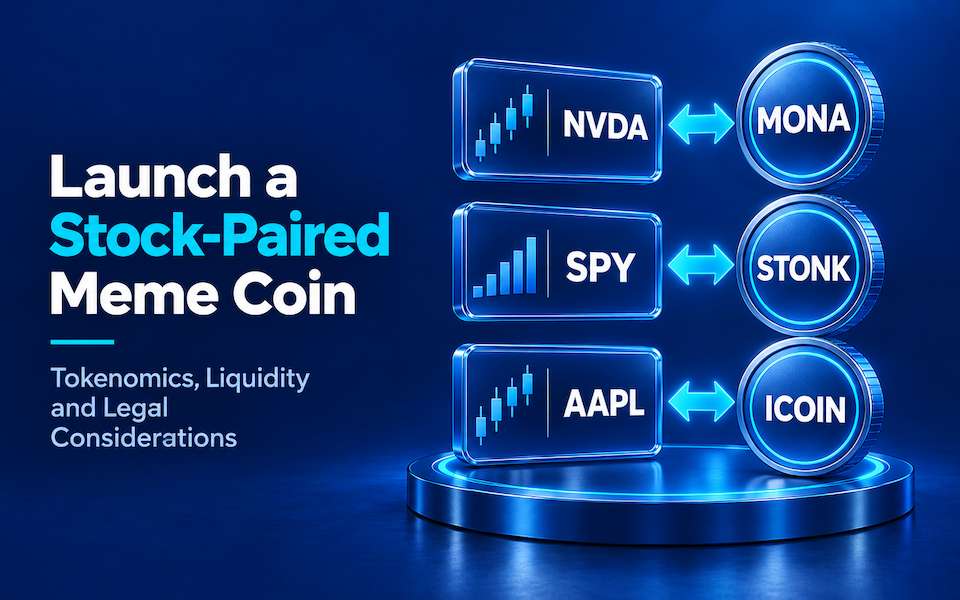
In early July, Robinhood launched a blockchain built for tokenized stocks. Within weeks, traders found a use for those stock tokens that nobody had put on the launch slide. They started using them as the trading pair for meme coins.
A token called Artificial Inu began trading against tokenized Nvidia. Another, BONER, locked up more than half of all tokenized Hims & Hers shares on the chain in a single weekend. By September, CoinGecko and CoinMarketCap had both built dashboards for the category and given it a name taken from a 2017 internet joke: Stonks.
The numbers moved fast. DeFiPrime counted 432 pools pairing meme coins with 19 Robinhood stock tokens on September 1. Those pools turned over roughly $95 million a day. A week later, CryptoRank put the combined market value of meme coins across the seven largest stock groups at about $536 million. Decrypt reported that meme coin and stock pairs generated $217 million in trading volume on September 2 alone.
Then the other side of the market showed up. An onchain analyst tied 53 Robinhood Chain launches to a single operation that pulled out at least $18.4 million, according to The Block.
That is the market you would be launching into. Heavy attention, thin liquidity, open legal questions and buyers who have already been burned once.
This guide walks through how to launch a stock-paired meme coin that can hold up in those conditions, from picking the pair to the legal checks that should happen before a single token is minted.
|
$536M Combined market value of meme coins across the top 7 stock groups (CryptoRank, Sep 8) |
432 Meme coin pools paired with 19 Robinhood stock tokens (DeFiPrime, Sep 1) |
$217M Single-day trading volume from meme coin and stock pairs (Decrypt, Sep 2) |
- The paired stock is part of your token’s price. A stonks token moves with its own trading and with the stock it is quoted in, so choosing the pair is a tokenomics decision.
- Tokenized stock supply is often small and cannot be minted while U.S. markets are closed, so plan for weekend price gaps and liquidity squeezes.
- Most legal risk comes from the stock token you pick and from how you use the company’s name in marketing. Settle both before launch.
What are stock-paired meme coins?
A stock-paired meme coin is a meme token whose main liquidity pool uses a tokenized stock as the other side of the trade. Instead of MEME/USDC or MEME/ETH, the pair looks like AI/NVDA or MEMESTOCK/GME.
Crypto traders call them Stonks. CoinGecko’s category page describes them as meme coins paired with tokenized stocks, and CoinMarketCap uses the same name for its dashboard.
- The meme coin is the base asset, and the stock token is the quote asset you pay with.
- Holders get no shares or voting rights. They hold a meme token that happens to be priced in a stock.
- HTX Research calls the category a second-order equity exposure. In practice, it is a bet on the attention around a stock.
- Some projects add mechanics on top, such as trading taxes that buy the paired stock and send it to holders or into a vault.
How tokenized stocks became meme coin liquidity
Nobody designed this use case. It came out of a few things landing within the same few weeks.
Robinhood Chain gave stock tokens an open home
Robinhood Chain went live on July 1 as an Ethereum layer 2 built for tokenized assets. Its Stock Tokens use the ERC-20 standard, so any DEX can pool them. The chain listed more than 190 stock tokens, 100 of them in a single batch on August 13, according to Investing.com.
Meme coins took over the chain first
Traders showed up for speculation before they showed up for stocks. CoinGecko data cited by KuCoin put meme coins at 79.2% of Robinhood Chain DEX volume on July 27. CashCat, the chain’s first breakout meme, passed $200 million in market value, per CryptoRank.
Launchpads connected the two
In mid-July, launchpads such as Long and Bankr let creators launch tokens against stock tokens instead of ETH or stablecoins. On Long, the stock token sits in a Uniswap v4 pool as the quote asset. Artificial Inu, paired with tokenized Nvidia, became the first to take off.
Other chains copied the model
Coinbase’s tokenized stocks reached Base on August 24. Pump.fun added Custom Pairs on Solana on September 9. On BNB Chain, MarsCoin paired itself with a bStocks token tracking SpaceX.
CryptoRank calls the side effect derived demand: traders now need tokenized NVDA just to buy an NVDA-paired coin, even if they have no view on Nvidia at all. Meme trading became a reason for stock tokens to circulate.
How the pair changes your token’s math
Get this wrong and your tokenomics model is off from day one. A meme coin paired with USDC has one price. A meme coin paired with a stock token has two moving parts.
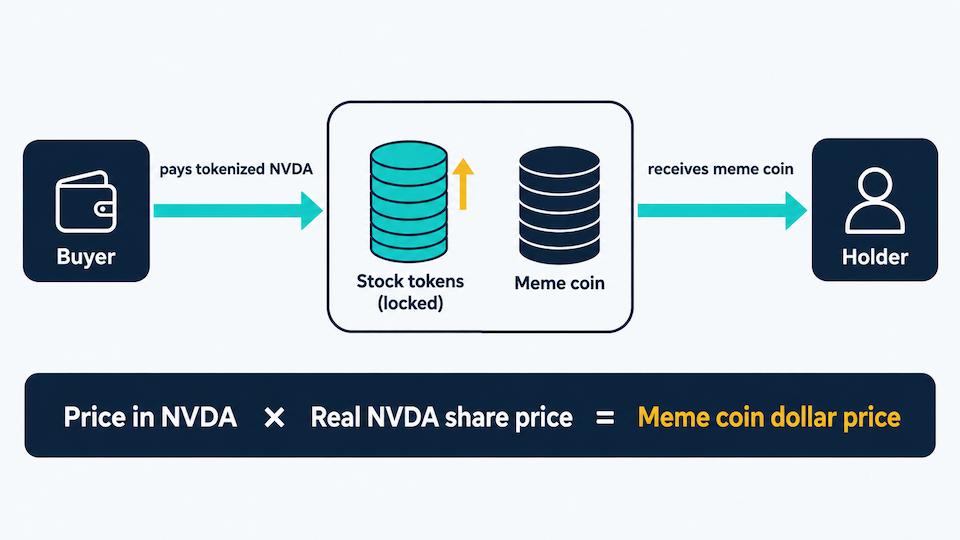
- The pool only tracks the ratio. Buyers put tokenized NVDA in and take the meme coin out, so the price is quoted in stock units.
- The dollar price is that ratio multiplied by the stock price. Arkham’s research team points out that if Nvidia rises 10% on earnings, an NVDA-paired coin’s dollar price rises 10% too, even if nobody trades it.
- Every buy locks stock tokens. Demand for your coin pulls the stock token out of circulation and into your pool. U.Today reported on September 30 that MEME held more than 35% of all tokenized AMC in its pool.
- The stock becomes a moving benchmark. As CryptoRank puts it, a buyer is really betting on whether the coin will outperform the stock.
Your fee design and your liquidity plan both rest on this two-layer price.
Which stonks are trending right now
Leadership in this category changes fast. In early September, NVDA, AMC and HIMS pairs dominated. By the end of the month, CoinGecko’s Stonks page showed a different top five.
A few patterns stand out in that data.
- NVDA is still the deepest market. It has the most paired memes and more than $12 million in liquidity. Artificial Inu remains the flagship, with U.Today putting its market value near $200 million and more than $2.6 million of NVDA locked in its pool.
- SpaceX pairs have grown into the third-largest group by volume, led by MarsCoin on BNB Chain.
- Index ETFs are climbing. QQQ and SPY pairs both sit in the top five, with StonkFun’s STONK leading the SPY group. Traders now pair meme coins with the broad market as well as with single hype names.
- The early leaders have cooled. AMC ranked 19th and HIMS 22nd by 24-hour volume on September 30, even though MEME still holds more than 35% of tokenized AMC.
Treat the market cap totals on these dashboards with care, since a single mispriced token can inflate a group. Volume and liquidity give a steadier read.
Narrative picks the first winners. Liquidity decides who stays.
Step 1: Choose a stock pair that fits your story
The pair decides your narrative and a large share of your risk. It also puts you in a crowded field. In CryptoRank’s September 8 sample, NVDA-paired coins made up about half of the combined market value, and NVDA, AMC and HIMS together accounted for roughly 81%.
Match the ticker to a story people already tell
The coins that broke out borrowed a story that already existed. Artificial Inu rode Nvidia’s AI story. MEME leaned on AMC’s meme stock history. OPTIMUS paired with Tesla, and MarsCoin picked SpaceX. A random pairing gives buyers nothing to repeat to their friends.
Check the onchain float first
A small float means your pool can soak up a big share of it fast. That creates hype, and it also creates distortion. DeFiPrime found only 8,941 tokenized MSTR onchain on September 1, with 33% already sitting in meme pools.
Know which kind of stock token you are using
Not every “tokenized Nvidia” is the same instrument. The type affects your legal exposure and how prices behave when markets close.
Avoid tickers with a hostile issuer
AMC CEO Adam Aron publicly called Robinhood’s AMC tokens “contemptible” in early September and said outside counsel would review them. A coin built on a company whose management is openly against tokenization walks straight into that fight.
Step 2: Decide where to launch
Stock-paired launches started on Robinhood Chain, but the model spread within weeks. Your venue decides which stock tokens you can use and which traders see you first.
- Robinhood Chain. Launchpads such as Long, Bankr, O1 and Pons let creators choose a Robinhood stock token as the quote asset. On Long, the stock token sits in a Uniswap v4 pool, and tickers are locked for 24 hours to slow down copycats, as discussed on the Bankless podcast.
- Solana. Pump.fun launched Custom Pairs on September 9 with 93 quote assets through xStocks and Sunrise. The list includes tokenized stocks, crypto majors and metals. Creators set fees between 0.05% and 1%, paid in whatever asset the token is paired with.
- BNB Chain. MarsCoin launched on the Flap launchpad against SPCXB, a bStocks token tracking SpaceX, and uses a 3% trading tax to fund SPCXB rewards for holders.
- Base. Coinbase’s tokenized stocks went live on August 24. Base’s head of marketing told Forbes that pairing meme coins with them “has taken off in a big way.”
Pick the pair first and the venue second. The venue’s stock list and fee rules should fit the pair from Step 1.
Step 3: Design tokenomics around the stock
Tokenomics for a normal meme coin mostly cover supply and allocation. A stonks token adds another question. What happens to the stock tokens your fees collect?
Price the launch in stock units
Your bonding curve and starting market cap are effectively set in the paired stock. Model what happens if the stock drops 20% while your coin trades flat. Holders will see a loss they had nothing to do with, and your community channels will hear about it.
Decide where fees go
- Creator revenue paid in the stock itself, the way Pump.fun Custom Pairs pays out.
- Holder rewards, like MarsCoin’s 3% tax that distributes tokenized SpaceX.
- A vault that builds up stock or gold, the model Tesoro’s TORO token uses on Robinhood Chain.
- Buybacks or burns of the meme token.
Keep the tax reasonable
A 3% tax shows up again and again in this niche. Higher rates discourage trading and start to look like an exit plan. Whatever rate you choose, publish it and remove the contract’s ability to raise it later.
Allocate in the open
Team and marketing allocations should vest, and the wallets should be public. Expect buyers to read the allocation table before they read the website.
|
In a stonks launch, the stock does half the pricing. Your tokenomics have to account for a market you don’t control. |
|
Planning a stock-paired meme coin launch? Get a tokenomics and liquidity model built around your chosen stock pair before you go live. |
Step 4: Plan liquidity for weekend squeezes
Liquidity is where most stonks launches run into trouble. It usually happens on a weekend.
Expect weekend premiums
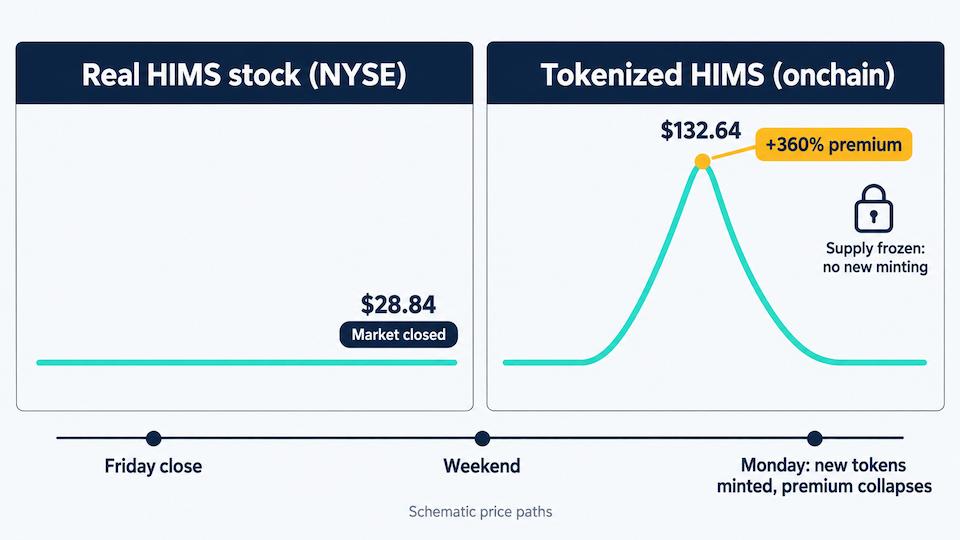
Robinhood lets only one licensed partner mint or burn its stock tokens, Decrypt reported, so supply cannot react while the NYSE is closed. Over the August 30 weekend, BONER’s pool held 31,198 of the 58,714 tokenized HIMS shares in existence. The token hit $132.64 against a Friday close of $28.84. DeFiPrime measured the peak premium at 112% above the prior close, and it collapsed once new tokens were issued.
The real HIMS stock barely moved. Your holders, though, would have been trading a price that had nothing to do with the company.
Seed enough depth on both sides
Your pool needs meme tokens and stock tokens. If the stock side is small, one large order swings the price and scares off the next buyer. Line up your stock tokens well before launch day.
Don’t sell LPs on headline APY
HTX Research looked at claims of 100,000% APY for liquidity providers in these pools and showed how short time windows and hourly compounding produce figures like that. Its suggested test is a fee-coverage multiple: fees earned divided by losses compared with simply holding the tokens. Only a result above one means providing liquidity actually paid.
Plan for the 30-day check
HTX lists two-sided depth after seven and thirty days as one of four conditions for the model to last. Treat those dates as milestones and time your incentives around them.
Step 5: Build launch security buyers can check
Trust is low on stonks chains right now, and for good reason. Bitquery linked 56 Robinhood Chain launches to one crew between July 10 and September 23, with a median fall of 99% from each coin’s peak.
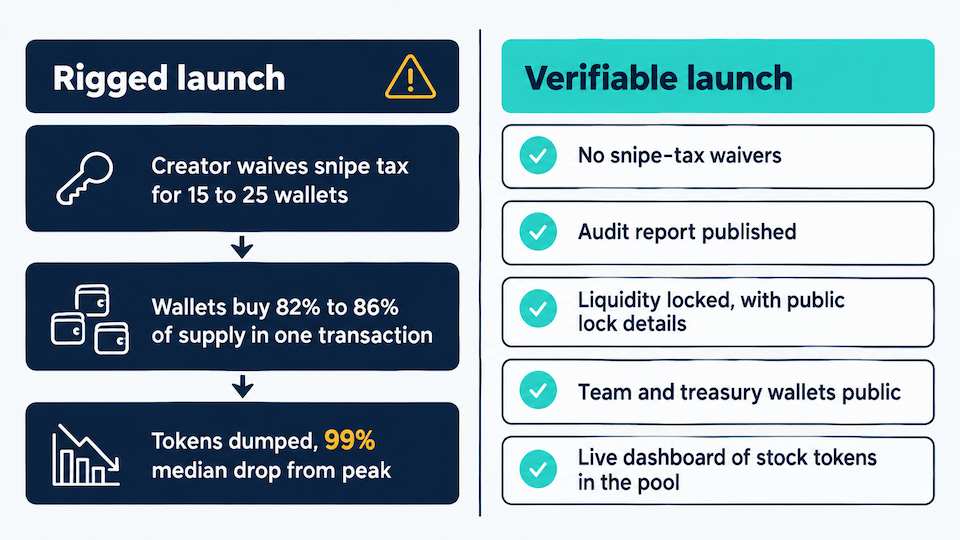
The Block’s review showed how the snipes worked. Pons V2 charges a 99% snipe tax in the first seconds after launch. The tax falls to zero in about five seconds, and creators can waive it for up to 32 addresses. In the flagged launches, creators waived it for 15 to 25 wallets, which then bought 82% to 86% of supply in a single transaction.
Build your launch so any buyer can confirm none of that is going on:
- Skip snipe-tax waivers, or disclose every exempt wallet before launch.
- Audit the token contract and any vault or reward contracts, and publish the report.
- Lock liquidity with a public, time-bound lock.
- Publish every team and treasury wallet address.
- Give holders a live dashboard showing the stock tokens held in the pool and vault.
Every safeguard you skip gives buyers one more reason to assume the worst.
Step 6: Legal considerations to settle before launch
Most meme launches skip this part. With stock-paired coins, that is much harder to get away with, because the coin touches securities and uses a public company’s ticker. Get qualified legal advice for your jurisdiction. The points below are the questions to bring to that conversation.
Understand what your stock token actually is
Robinhood’s documentation describes its Stock Tokens as tokenized debt securities issued by Robinhood Assets (Jersey) Limited. They provide economic exposure without ownership, and they cannot be offered to U.S. persons. Your coin inherits those limits.
Read the SEC’s Innovation Exemption closely
On September 17, the SEC issued a five-year exemption that lets tokenized NMS stocks trade through permissioned automated market makers and liquidity pools, with caps on volume and tickers. Forbes noted that Robinhood’s debt-style tokens fall outside it. Permissionless meme pools are a different setup from the one the order describes, so don’t read it as a green light.
Keep the company’s brand out of your marketing
Using a ticker as a trading pair is one thing. Using a company’s brand to sell your coin is another. Leave out logos and executive photos. Avoid anything that suggests the company endorses the coin. The AMC dispute shows how quickly an issuer will push back.
Watch how you describe rewards
Stock-token rewards paid from trading taxes can start to look like an investment product. Don’t promise returns or dividends, and never describe the coin as ownership. Lotto Coin on Base took the opposite approach. Its website says holders “receive nothing, earn nothing, and are entitled to nothing.”
Geo-restrict where required
If your stock token or vault excludes U.S. persons, your website and terms should too. Tesoro’s terms, for example, bar U.S. persons. That matches the restriction on Robinhood’s tokens.
A practical launch timeline
A careful stonks launch takes roughly five weeks of preparation before the first trade. Here is how that time usually breaks down.
|
1
|
Weeks 1 to 2: Legal review Pick the pair and venue, confirm the stock token type, get advice for your jurisdiction and draft your terms. |
|
2
|
Weeks 3 to 4: Contract build Build the token contract along with the fee routing and vault logic. Run the audit and fix what it finds. |
|
3
|
Week 5: Pre-launch setup Source stock tokens and set pool depth. Publish wallet addresses and lock details, then switch on the holder dashboard. |
|
4
|
Launch day Go live with no hidden waivers and watch the pool closely. Avoid launching into a weekend unless your liquidity can handle a squeeze. |
|
5
|
Days 1 to 30: Stabilize Track depth at day 7 and day 30. Report vault holdings weekly and adjust incentives from what the data shows. |
Marketing a stonks launch without overpromising
Attention is the product in any meme launch. With a stock pair, how you earn that attention also carries legal weight.
- Lead with the mechanism. Explain the pair and the fee flow in one graphic before launch day.
- Get tracked by the data sites. A listing on CoinGecko’s Stonks page or CoinMarketCap’s Stonks dashboard gives buyers an independent place to check your numbers.
- Publish educational content early. The category is new, and a clear explainer has a real chance to rank and to show up in AI-generated answers.
- Brief KOLs on what they can and cannot say. No return promises and no hint of company endorsement.
Where the category stands
Prices across the category have cooled. U.Today reported on September 30 that Artificial Inu fell 10.4% and CashCat fell 12.3% in a day. The amount of stock tokens locked in meme pools kept climbing over the same stretch, and Pump.fun, Raydium and Base all support stock pairing now.
For a founder, the tools exist on four chains, and buyers are looking much harder at how a launch is built.
Blockchain App Factory builds these launches for founders. Our stock-paired meme coin development team plans the pair and the tokenomics, then builds and audits the token and vault contracts. We set up liquidity on Robinhood Chain, Solana, BNB Chain or Base and work with your legal advisors on geo-restrictions and disclosures. Our crypto marketing team handles the launch campaign and exchange listings, so your stonks token goes to market with fewer surprises.
|
Ready to launch your stonks token the right way? |
Frequently asked questions
What is a stonks token?
It is a meme coin that trades against a tokenized stock, such as NVDA or TSLA, instead of ETH or a stablecoin. CoinGecko and CoinMarketCap both track the category under the name Stonks.
Does holding a stock-paired meme coin give me shares in the company?
No. The pool holds stock tokens, but coin holders have no claim on them or on the company. Robinhood’s stock tokens carry no ownership rights either.
Which chains support stock-paired meme coin launches?
Robinhood Chain, Solana through Pump.fun Custom Pairs and Raydium, BNB Chain through bStocks-based launchpads such as Flap, and Base using Coinbase’s tokenized stocks.
Why do tokenized stocks trade at a premium on weekends?
New supply cannot be minted while U.S. markets are closed, so heavy buying in a meme pool can push the token above the real stock price. The HIMS token reached a 112% premium in August, according to DeFiPrime.
Is it legal to launch a stock-paired meme coin?
It depends on your jurisdiction, the stock token you use, who is allowed to buy and how you market it. Robinhood’s tokens exclude U.S. persons, for example. Get legal advice before you launch.

Vimal J is the Head of Sales at Blockchain App Factory, with 10+ years of experience in sales, client strategy, and Web3 business growth. He helps startups, enterprises, and project founders choose the right blockchain solutions for their goals, bringing a practical market perspective to topics like token development, crypto launches, and Web3 adoption.