In May 2026, J.P. Morgan Asset Management launched a tokenized money market fund on public Ethereum. There was no campaign. No KOL round. No Telegram group.
The firm put 100 million dollars of its own money into the fund at launch, Anchorage Digital participated alongside it, and qualified investors subscribed through Morgan Money, the same liquidity management platform they already used. By early July the fund had grown roughly 250 percent to about 695 million dollars.
That is what distribution looks like when the buyer is an institution. It is not a marketing failure that no campaign ran. It is that the campaign was never the mechanism.
Marketing leads moving from token launches to real world asset products discover this in week one, usually the hard way. The playbook that built a 40,000 member Telegram group does almost nothing for a treasury desk evaluating a tokenized fund. The two disciplines share vocabulary and share almost nothing else.
The market is large enough now that this matters commercially. Tokenized real world assets excluding stablecoins passed 31 billion dollars by May 2026, up from roughly 6 billion in early 2025. Tokenized treasuries alone sit near 15 billion dollars in assets under management, with private credit around 8 billion. Include cash-like instruments and regulated stablecoin rails and the tokenized asset market reached above 340 billion dollars in early 2026.
- RWA marketing sells to a committee over quarters, not to an individual over days, which means the entire cadence, channel mix and content library has to be rebuilt rather than adapted.
- Securities law caps what you are allowed to claim, so the persuasion has to come from verifiable proof such as attestations, audits and named counterparties instead of upside language.
- Roughly half a crypto marketing team transfers directly, but the demand generation and community functions have to be replaced with institutional sales support, compliance review and research production.
The Market Context Behind the Divergence
Two transactions from 2026 explain the gap better than any framework.
The first is the J.P. Morgan launch described above. The second is Invesco, a 2.2 trillion dollar asset manager, taking over management of Superstate’s tokenized treasury fund USTB, which held roughly 967 million dollars. Invesco renamed it and put its global liquidity team, which manages more than 200 billion dollars in short-term assets, in charge of the portfolio. Superstate continued running the technology layer, including token issuance, on-chain settlement and the digital transfer agent system.
Notice what did not change. The ticker stayed. The token structure stayed. The smart contracts stayed. What changed was the name on the door, and that alone repositioned the product for a different class of buyer. No amount of content marketing produces that effect, which tells you something important about where credibility actually comes from in this segment.
Meanwhile the retail crypto market operates on completely different physics. Total crypto market capitalization sat near 2.19 trillion dollars in August 2026, down from an all-time high around 4.27 trillion in October 2025. CoinGecko’s research on Pump.fun found 18.67 million tokens deployed between January 2024 and June 2026, with 68.67 percent recording their last trade on the same day they launched. Roughly 60 percent of tokens trade below their listing price within 30 days.
|
$31B Tokenized RWAs excluding stablecoins, May 2026, up from about $6B in early 2025 |
14 weeks Average institutional due diligence process in 2026, up from 8 weeks in 2024 |
72% Of 1,200 surveyed institutional investors deepened operational due diligence in the past year |
The Buyer Is a Committee, Not a Person
This single difference drives most of the others. Retail crypto marketing persuades an individual who can act immediately. RWA marketing persuades a process that involves several people who each have veto power and none of whom get promoted for saying yes quickly.
The decision has multiple gates
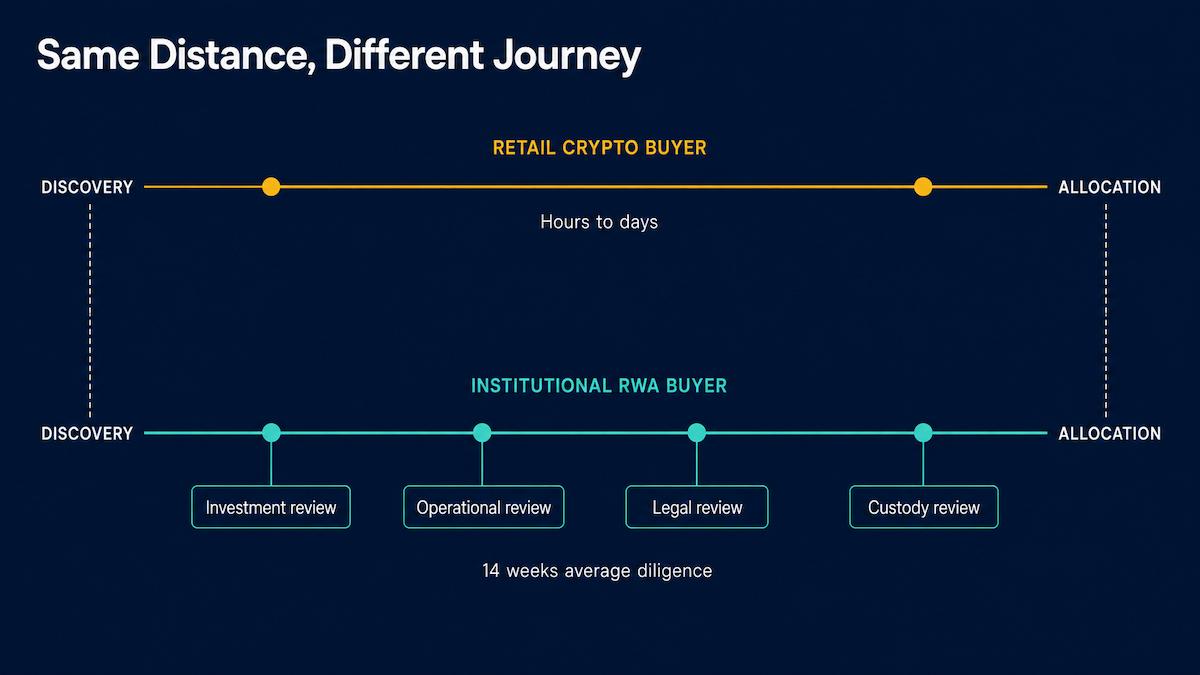
A treasury desk or allocator evaluating a tokenized fund typically routes it through investment, operational, legal and custody review. The operational reviewer is not assessing your yield. They are assessing whether your transfer agent works, who holds the keys, and what happens at redemption if your technology provider disappears.
Nobody in the chain is a crypto native
Content that assumes familiarity with wallets, gas, or bridging loses the room. Content that over-explains blockchain to a portfolio manager who has read about it for three years loses them differently. The register you need sits between the two, and getting it wrong is the most common early mistake.
The buyer is protecting downside, not chasing upside
Retail buys a token because it might go up. An allocator buys a tokenized treasury fund because it settles faster and reconciles cleaner than the legacy version, with the same underlying risk. Your marketing is competing against operational inertia, not against other tokens.
Referral outranks reach
A warm introduction from an existing counterparty carries more weight than any content asset you produce. This is uncomfortable for marketers because it is not a channel you can scale on command, but it is where a large share of institutional allocation originates.
The Cycle Runs in Quarters, Not Days
Token marketing compresses everything into a launch window. RWA marketing operates on a timeline where the launch is barely an event.
Diligence timelines have lengthened, not shortened
Typical institutional evaluation of a new manager runs 60 to 120 days, and the average full diligence process stretched from 8 weeks in 2024 to 14 weeks in 2026. First-time managers are advised to plan for 18 to 24 month fundraising processes. Nothing about that rewards urgency messaging.
Response windows tightened while decisions slowed
One survey of 1,200 institutional investors found the window to respond to an initial due diligence questionnaire shrank from 14 days to 5, even as the overall process lengthened. That combination has a specific marketing implication. Your documentation has to be pre-built, because you will not have time to produce it when asked.
Momentum tactics work against you
Countdown timers, limited allocations and urgency framing read as pressure selling to a compliance officer. The same tactic that lifts a token sale conversion rate can end an institutional conversation.
The content library matters more than the campaign calendar
Because buyers arrive at unpredictable points across a long cycle, the asset that converts is whichever document answers the question they have today. That favors a deep, maintained library over a sequenced campaign.
The Channel That Converts Is Different
Around 84 percent of crypto users concentrate their time across X, Telegram and YouTube. That statistic is the foundation of most token marketing plans, and it is close to irrelevant for RWA distribution.
Research notes replace social content
Institutional audiences consume written analysis, and they consume it because someone credible circulated it. A well-argued paper on settlement efficiency or collateral treatment travels through allocator networks in a way a thread does not.
Regulated venue presence replaces exchange listings
For a token project, the listing is the distribution event. For an RWA product, distribution runs through platforms the institution already uses. J.P. Morgan’s fund is accessible through Morgan Money because that is where its qualified investors already manage liquidity. Being present in existing workflow beats being visible in a new one.
Direct sales replaces community
There is no community equivalent in institutional distribution. There are relationships, maintained individually, over years. Marketing supports that motion with materials and credibility rather than replacing it.
Conferences and industry press still work
Coverage in Bloomberg, Reuters, the Financial Times and specialist outlets like Blockworks and Messari carries weight with this audience that crypto-native social coverage does not. The same is true of speaking slots at institutional events rather than crypto conferences.
|
Invesco changed the ticker’s manager and nothing else. The token structure and smart contracts stayed untouched. The distribution came from the name on the door. |
Securities Law Sets a Claim Ceiling
Crypto marketing operates with wide latitude on language, constrained mostly by platform policy. RWA marketing operates inside securities regulation, and the constraint is legal rather than editorial.
General solicitation is not automatically available
Under Regulation D, a 506(b) offering prohibits general solicitation entirely, while 506(c) permits advertising but requires that sales go exclusively to verified accredited investors. Which exemption your client relies on determines whether public marketing is even permitted, and marketers who assume it is create real exposure.
Verification has become more workable for tokenized offerings
Wallet addresses do not prove accredited status, which historically forced issuers to layer on-chain whitelisting over off-chain KYC. In January 2026, SEC staff guidance permitted issuers to use different verification methods for different investors within the same 506(c) offering, and in July 2026 the Division of Corporation Finance confirmed that certain tokenized 506(c) offerings may satisfy verification through programmatic digital attestations.
Performance language is heavily constrained
Yield figures, past performance and comparative claims all carry disclosure requirements. The words that drive token conversion, including guaranteed, safe and passive income, are unusable and in some cases actionable.
Every asset needs review before it ships
Landing pages, decks, one-pagers and even social posts go through compliance. Marketing teams accustomed to publishing within the hour have to rebuild their process around review cycles measured in days.
|
Marketing an RWA product to institutional buyers? The channels that launch a token do not reach an allocator. We build the ones that do. |
What Counts as Proof Changes Completely
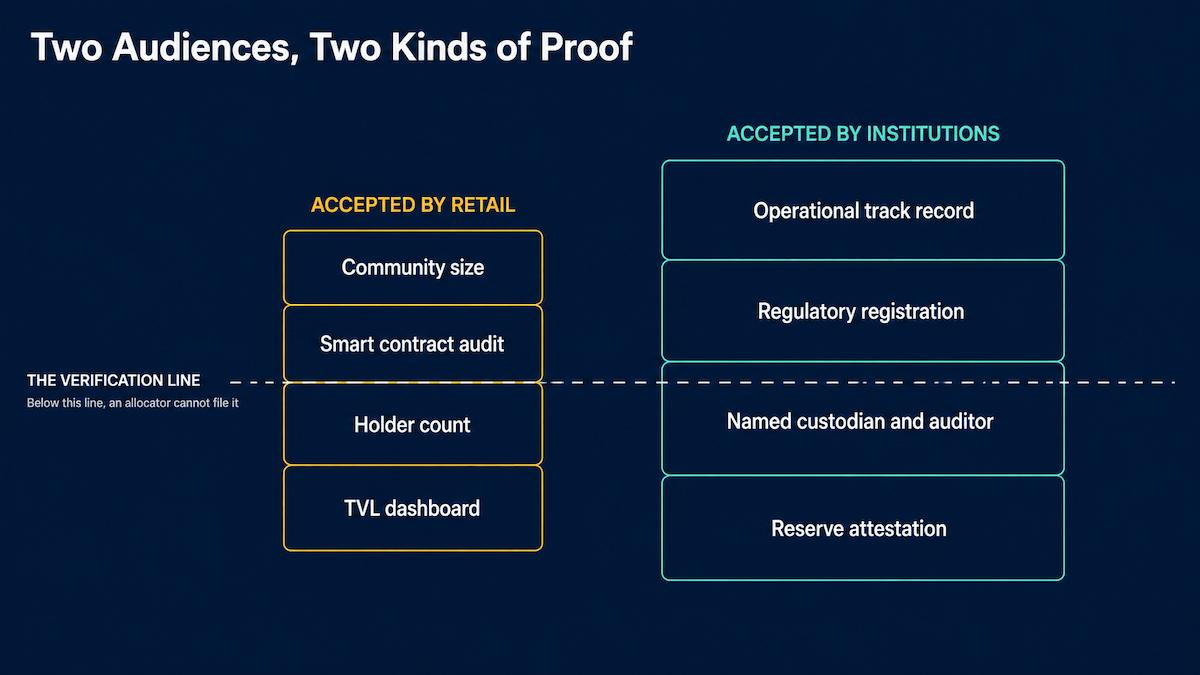
Both audiences want evidence. They accept entirely different kinds of it.
Attestations and audits replace dashboards
A TVL screenshot proves nothing to an institution. Reserve attestations from a recognized accounting firm, financial statement audits and third-party verification of holdings do. The format matters as much as the substance, because these documents get filed and cited internally.
Named counterparties carry the weight
Anchorage Digital participating in the J.P. Morgan fund communicated more than any messaging could. Your custodian, auditor, transfer agent, legal counsel and administrator are marketing assets, and for an institutional buyer they are often the primary ones.
Regulatory status is the headline credential
Whether a fund is registered, which regulator oversees it, and under what exemption it operates are the first questions asked. A U.S. registered government money market fund carries an immediate signal that no amount of positioning replicates.
Operational track record beats narrative
Uptime, redemption history, settlement reliability and how the product behaved during stress are the proof points that matter. They accumulate slowly and cannot be accelerated, which is precisely why they are trusted.
| Dimension | Crypto token marketing | RWA marketing |
| Buyer | Individual retail trader acting alone | Allocator or treasury desk, decision by committee |
| Cycle length | Hours to days | Quarters, with diligence averaging 14 weeks |
| Converting channel | X, Telegram, KOLs, exchange listings | Research notes, regulated venue presence, referral |
| Claim ceiling | Set by ad platform policy | Set by securities law and the applicable exemption |
| Accepted proof | TVL, audits, holder counts, dashboards | Attestations, named counterparties, regulatory status |
| Core metric | Holder count and trading volume | Assets under management and subscription count |
The Metric That Matters
Reporting the wrong number to an RWA client is how marketing teams lose the account in quarter two.
Assets under management is the scoreboard
Not wallets, not holders, not community size. AUM and net subscriptions are what the client reports internally and what determines whether the product continues.
Subscription count reveals concentration
A fund at 500 million dollars from three investors is a different business from one at 500 million across ninety. The second is defensible, the first is one redemption away from a problem, and marketing performance should be read accordingly.
Pipeline stage matters more than traffic
Because cycles run long, leading indicators are qualified conversations, diligence questionnaires received and platform integrations in progress. Website sessions tell you almost nothing.
Redemption behavior is the retention metric
Institutional capital is not mercenary in the way liquidity mining capital is, where analysis has found the average liquidity miner rotating out after roughly 14.7 days. But it does leave when operations disappoint, and redemption patterns are the honest signal.
What Transfers From a Crypto Marketing Team and What Does Not
The practical question for a marketing lead handed an RWA client is which of their existing people can do this work.
Transfers with little friction
- Content and technical writing, provided the writer can shift register from retail explainer to institutional analysis
- SEO and AI search visibility, which matters more here because long cycles mean more independent research
- Design and data visualization, since institutional materials are document-heavy
- Web and product marketing, where the fundamentals are unchanged
Transfers with retraining
- PR, where the target list moves from crypto-native outlets toward financial press and the pitch changes from narrative to substance
- Events, moving from crypto conferences to institutional and industry venues
- Analytics, shifting from on-chain dashboards to pipeline and AUM reporting
Has to be hired differently
- Institutional sales support, meaning someone who has built pitchbooks and answered due diligence questionnaires
- Compliance-literate marketing review, either in-house or through counsel, embedded in the publishing workflow
- Research production, ideally someone with a background in fixed income, fund operations or structured products
Simply does not apply
- Community management as practiced in crypto
- KOL and creator relations
- Airdrop, quest and incentive design
A Realistic First-Year Engagement
RWA marketing programs that work tend to sequence in a recognizable way.
|
Quarter 1 |
Foundation and documentation Positioning, compliance review workflow, the core document set including fund overview, operational architecture and risk disclosure. Nothing public ships before counsel signs off on the templates. |
|
Quarter 2 |
Credibility assembly Named counterparties made visible, attestations published on a schedule, first research note released, financial press relationships opened. This is the quarter that determines whether diligence goes well later. |
|
Quarter 3 |
Distribution and integration Presence on the platforms your buyers already use, sales enablement materials, due diligence questionnaire library pre-built so the five day response window is survivable. |
|
Quarter 4 |
Compounding and reporting Regular research cadence, operational track record made visible, AUM and subscription reporting to stakeholders, and expansion into adjacent buyer segments. |
Where This Leaves You
The mistake worth avoiding is treating RWA marketing as crypto marketing with more compliance. It is closer to institutional asset management marketing that happens to settle on-chain, and the teams doing it well recruited accordingly.
That said, the technical fluency built in crypto is a genuine advantage. Someone who understands custody, settlement finality and smart contract risk can explain a tokenized fund’s operational architecture in a way a traditional fund marketer cannot. The trick is pairing that fluency with institutional discipline rather than replacing one with the other.
This is the specific gap Blockchain App Factory works in. The firm delivers crypto marketing across token launches, community and creator programs, and RWA marketing built for institutional distribution, including compliance-aware content, research production, attestation and counterparty positioning, and the documentation library that determines how a due diligence process goes. For teams running both a retail token and an institutional product, having one partner who understands why those two motions cannot share a playbook removes a meaningful amount of friction.
Start by auditing which of your six proof points a treasury desk could verify without contacting you. Whatever is missing from that list is your roadmap.
|
Who builds marketing that works for retail token buyers and institutional allocators? Two audiences, two playbooks, one team that knows the difference. |
Frequently Asked Questions
Is RWA marketing just crypto marketing with compliance added?
No. The buyer, cycle length, converting channel, accepted proof and success metric are all different. Compliance is one constraint among several, and treating it as the only change is why most crossover attempts underperform.
Can you run paid ads for a tokenized fund?
It depends on the offering exemption. A Regulation D 506(b) offering prohibits general solicitation entirely. A 506(c) offering permits advertising but requires that sales go only to verified accredited investors. Confirm which applies before planning any public campaign.
Does community building have any role in RWA?
Not in the crypto sense. There is no Telegram equivalent for allocators. What functions similarly is a network of relationships maintained individually over years, supported by research and credibility rather than engagement tactics.
How long before an RWA marketing program shows results?
Plan in quarters. Institutional diligence alone averaged 14 weeks in 2026, and full fundraising cycles for newer managers can run 18 to 24 months. Leading indicators such as qualified conversations and diligence questionnaires appear well before AUM moves.
Which crypto marketing roles transfer to RWA work?
Content, SEO, design and product marketing transfer with modest adjustment. PR, events and analytics transfer with retraining. Community management, KOL relations and incentive design do not transfer, and institutional sales support plus compliance review usually have to be hired.

Vimal J is the Head of Sales at Blockchain App Factory, with 10+ years of experience in sales, client strategy, and Web3 business growth. He helps startups, enterprises, and project founders choose the right blockchain solutions for their goals, bringing a practical market perspective to topics like token development, crypto launches, and Web3 adoption.