
On 15 January 2026, Kaito shut down Yaps and its incentivised Yapper Leaderboards. X had revoked API access for apps that pay users to post, and an entire growth channel closed inside a week.
Teams that had built their whole go-to-market on that channel had nothing left on Monday.
That single event explains most of what worked in crypto marketing this year. With 741 million crypto owners worldwide as of Crypto.com’s January 2026 market report, growing at 12.4% annually, attention is abundant and permission to reach it is not. The strategies that produced results in 2026 share one property. They put the asset on ground the project controls.
Costs made the point harder to ignore. KOL rates rose roughly 2.5 times year on year through 2026, mid-tier creators with 25,000 to 100,000 followers now quote 1,000 to 5,000 dollars per post, and experienced buyers add 25 to 40 percent on top of quoted rates for the real all-in number. At least 15 percent of influencer spend is lost to fraud across all industries, and Web3 runs higher.
Here are nine strategies that produced measurable outcomes in 2026, with the numbers behind each one.
- AI search traffic converts at 14.2% against Google’s 2.8%, and only 22% of marketers currently track AI visibility at all, which makes citation-focused content the widest open channel in crypto right now.
- Quest-based airdrops with Sybil resistance retained 73%+ of participants where standard giveaways retained 11%, and between 50% and 70% of flat-dropped tokens are sold inside 30 days.
- Every channel that can be revoked by a platform policy update is a rental. Search rankings, owned communities, and media relationships survived 2026 because nobody else controlled the switch.
What actually changed in 2026
Three structural shifts reset the playbook, and each one moved budget away from rented reach.
Platform risk stopped being theoretical. The X policy change took Kaito Yaps, Cookie, and every other incentivised posting product offline at once. Kaito now runs Kaito Pro, Kaito Studio, a Capital Launchpad, and Attention Markets built with Polymarket, where one early market on Polymarket’s own mindshare ranking cleared over 1.3 million dollars in trading volume almost immediately.
AI assistants fragmented. ChatGPT’s share of worldwide generative AI web traffic fell from around 76% to roughly 53% by July 2026, while Gemini climbed past a quarter of all traffic and Claude grew 64 times in referral sessions before overtaking Perplexity in March.
Airdrop farming got measured properly. The Linea distribution filtered roughly 517,000 of 1.3 million eligible addresses as Sybil wallets, about 40% of claimants. LayerZero filtered 803,000. zkSync flagged 60%.
| Tactic | 2025 result | 2026 result |
| Incentivised posting campaigns | Reliable mindshare driver | Channel closed in January |
| Flat claim airdrops | Wallet counts, weak retention | 11% retention, 50-70% dumped |
| Sybil-resistant quests | Early experiments | 73%+ participant retention |
| Single-assistant GEO | ChatGPT held 76% of AI traffic | Reaches ~53% of the audience |
| Owned search and community | Slow, underfunded | Survived every platform change |
1. Mindshare turned into an engineering problem
When paying people to post became impossible, the projects that kept their rankings were the ones already producing content people wanted to amplify without a reward attached. Mindshare is still measurable through Kaito Pro and similar tools. The route to earning it changed completely.
Build a creator bench before you need it
Teams that had relationships with 20 to 40 crypto writers going into January kept posting volume through the transition. Teams that had a leaderboard and a rewards budget did not.
Give creators something worth writing about
Protocol milestones, real usage data, and technical decisions with tradeoffs get covered voluntarily. Roadmap graphics do not.
Track mindshare as a diligence metric
Funds now ask about mindshare percentage in conversations before a raise. Treat it as a reported number with an owner on your team.
Watch Attention Markets as a signal source
Polymarket plans to expand attention markets substantially through 2026. Where your project’s mindshare is being priced by strangers, that price is free competitive intelligence.
2. AI citations became a measurable acquisition channel
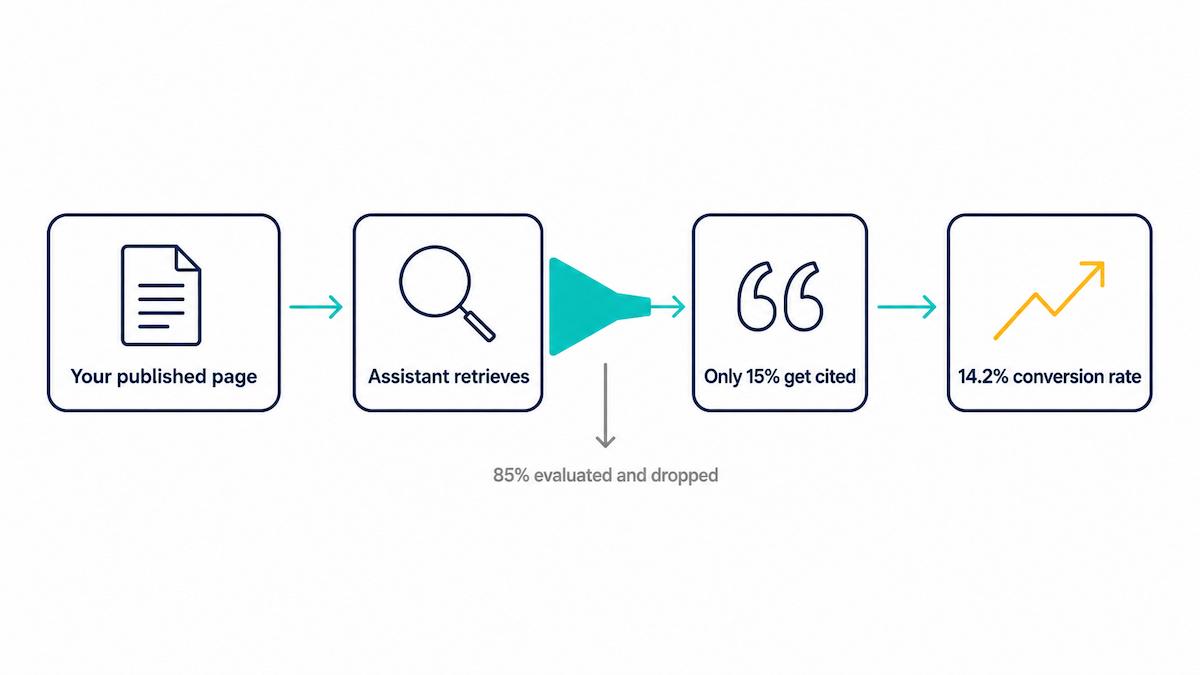
This is the widest gap between opportunity and effort in crypto marketing right now. Research across 230,398 citations from crypto prompts found that crypto is one of the rare verticals where a brand’s own content wins citations directly, and only 22% of marketers actively track AI visibility at all.
The conversion data is why it matters. AI search traffic converts at 14.2% against Google’s 2.8%, with Claude referrals converting highest at 16.8%.
Write for extraction
ChatGPT cites roughly 15% of the pages it retrieves while researching an answer. The other 85% get evaluated and dropped. Pages with clear claims, named sources, and dated figures survive that filter.
Answer the comparison and alternative queries
Assistants pull heavily on comparison content. Pages covering one option against another, or listing genuine alternatives, get cited far more than category overviews.
Put the number in the sentence
A sentence containing a figure, a date, and a named source is extractable. A paragraph of positioning language is not.
Measure citations as their own metric
AI referral traffic is still around 1% of total visits for most sites. The citation itself carries brand value even when the user never clicks.
3. Sybil-resistant quests replaced flat airdrops
The economics here are settled. Between 50% and 70% of airdropped tokens are sold within the first 30 days according to 2025 data aggregated by Coinlaw, and academic work cited by Coinbound puts 60% to 80% of tokens from poorly designed airdrops in the hands of farmers who dump immediately.
Quest-based campaigns requiring multiple verifiable on-chain actions, combined with Sybil filtering, produced retention above 73%. Standard giveaways produced 11%.
|
73%+ Retention from Sybil-resistant quest campaigns |
14.2% AI search conversion rate against Google’s 2.8% |
40% Of Linea claimants filtered as Sybil wallets |
Require actions that cost something
Bridging funds or providing liquidity filters farmers better than any wallet-age heuristic.
Use graduated penalties
The 2026 standard moved away from binary cuts. Wallets with Sybil indicators received 50% or less of their accrued share, while batch-created wallets with identical funding patterns were zeroed entirely.
Publish the filtering rules before the snapshot
Projects that announced criteria in advance took less community damage at distribution than projects that filtered quietly afterwards.
Budget for the second campaign
Retention is measured at 60 and 90 days. A single distribution with no follow-up programme reverts to giveaway numbers.
|
Is your campaign built on channels you actually control? We audit your current mix and show you which parts survive the next platform policy change. |
4. Micro-KOL portfolios outperformed single mega placements
With rates up 2.5 times and fraud running above the 15% cross-industry baseline, one large placement became a concentrated bet on unverified reach. Creators in the 10,000 to 100,000 follower band consistently delivered better engagement quality in 2026.
Spread the same budget across 12 to 20 creators
Portfolio maths applies. One post underperforming inside twenty is a data point. One post underperforming out of one is the whole campaign.
Audit audience quality before payment, not after
Request audience geography, engagement distribution, and follower growth curves. A 400,000-follower account with 0.2% real engagement costs the same as a genuine one.
Pay for a sequence, not a single post
Three touches from the same creator over four weeks outperforms one post at launch, because crypto audiences discount first mentions.
Add 25 to 40 percent to every quote
Quoted rates exclude coordination, content review, and reshoot cycles. Budget the real number at the planning stage.
5. On-chain attribution replaced impression reporting
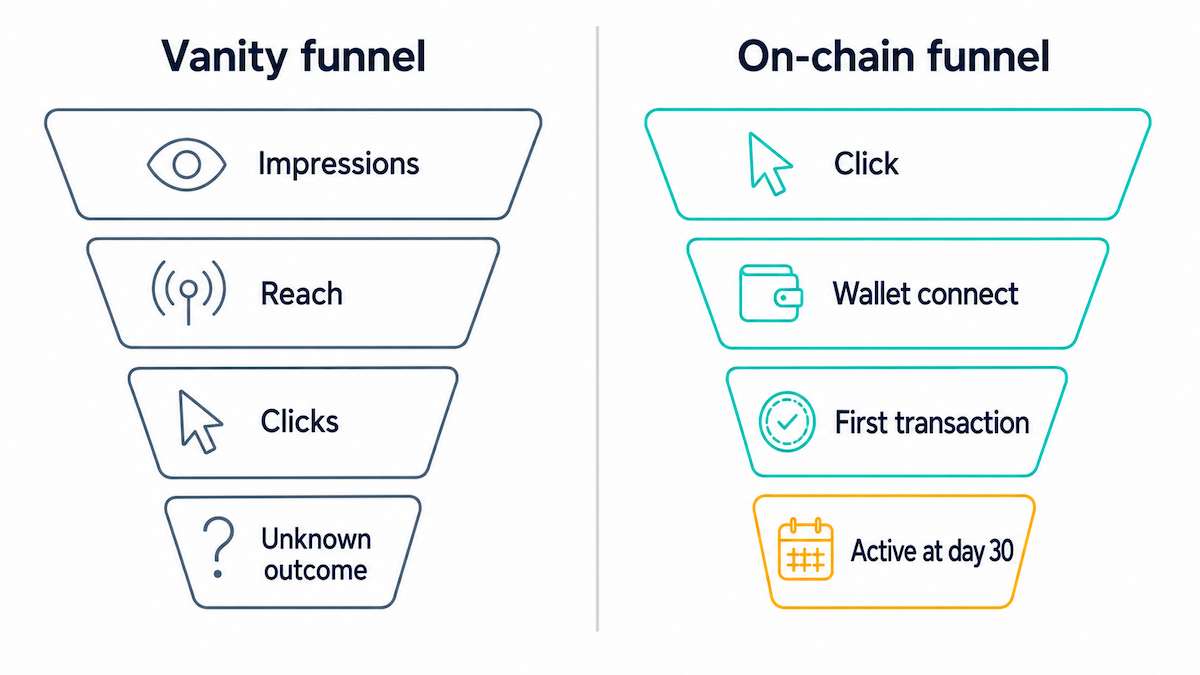
Impressions, reach, and views are inputs. In 2026, the teams that cut wasted spend were the ones connecting campaign activity to wallet-level outcomes.
Instrument the full path
Click to wallet connect, wallet connect to first transaction, and first transaction to day-30 activity. Each step drops volume, and the drop tells you which channel sent tourists.
Compare cost per retained wallet
Cost per click flatters paid social. Cost per wallet still active after 30 days usually reorders the entire channel ranking.
Tag creator campaigns individually
Unique landing paths per KOL turn a vague reach number into a per-creator return figure you can renegotiate against.
Report at 90 days
Launch-week metrics are the easiest numbers in marketing to inflate. The 90-day view is where campaigns get judged honestly.
6. Owned community infrastructure became platform-risk insurance
January proved the thesis in one news cycle. Telegram groups, Discord servers, and email lists kept working while API-dependent channels went dark.
The 2026 benchmark for a healthy crypto Discord is a 15% to 25% daily-to-monthly active user ratio, with daily quest mechanics doing most of the work.
Move people to channels you own early
Every campaign should have a capture step. Reach without a destination expires the moment the platform changes its rules.
Design for the post-launch trough
Communities built on launch incentives empty out at week six. Communities built on governance participation or product utility hold.
Run quests as retention, not acquisition
Quest platforms integrated with Discord produced retention uplifts above 80% in 2025 research from CoinGecko Labs and RZLT.
Measure activity, not membership
A 40,000-member server with 300 daily actives is a smaller asset than a 6,000-member server with 1,200.
|
A channel that can be switched off by someone else’s product decision was never a channel. It was a rental with no notice period. |
7. Compliance-aware messaging started converting
Compliance moved from a legal cost to a conversion asset in 2026. Advertising rules for financial products differ sharply between the EU, the US, the UAE, and South Korea, and campaigns written once for all markets underperformed in each of them.
MiCA set the clearest bar in the post-regulation era. Marketing communications must be identifiable as marketing, must be fair, clear, and not misleading, and must stay consistent with the published crypto-asset white paper. National authorities can order an issuer to stop or amend a campaign that fails those tests.
Teams that wrote those rules into the creative brief shipped faster than teams that sent finished copy to legal at the end.
Put audit and legal documentation above the fold
Buyers evaluating a token look for security proof before they look at the roadmap. Burying it costs conversions.
Match risk disclosure to benefit disclosure
MiCA requires risk to carry the same prominence as the upside claim, in the same medium, in language the audience will understand. A footnote under a yield figure fails that test.
Review claims market by market
A yield claim that clears review in Dubai may fail in Frankfurt. Translation without regulatory review creates exposure in both markets.
Review creator scripts too
Disclosure obligations attach to paid promotion, and marketing communications from an issuer’s agents have to stay consistent with the white paper. A creator’s phrasing becomes the project’s regulatory problem.
Document the review
Exchanges and institutional partners increasingly ask for the compliance trail during listing conversations.
8. Multi-assistant optimisation replaced ChatGPT-only GEO
A strategy built around one assistant now reaches a shrinking share of the AI audience. ChatGPT sits near 53% of generative AI web traffic, Gemini holds over a quarter, and Claude converts highest of the three at 16.8%.
Test the same query across four assistants
Answers diverge sharply. Run your core commercial queries through ChatGPT, Gemini, Claude, and Perplexity monthly and log which sources each cites.
Chase the sources the assistants trust
If an assistant repeatedly cites three domains for your category, coverage on those domains is the fastest path into the answer.
Structure pages for retrieval
Clear headings, direct answers near the top, and named data points get pulled. Long preamble does not.
Track share of citations as a KPI
Only 25.7% of marketers plan to build content specifically for AI citations. Early movers in crypto are still uncontested on most commercial queries.
9. Builder-audience content outperformed retail hype
Ecosystem projects that targeted developers produced better downstream numbers than projects chasing retail impressions. NEAR Protocol’s ecosystem visibility campaign produced 5.2 million impressions with 210,000 builder reach inside ten weeks. Builder attention tends to convert into integrations. Retail attention tends to convert into exit liquidity.
Write for people who read code
Technical explainers, integration guides, and honest tradeoff discussions travel further in developer communities than announcement threads.
Sponsor the work, not the post
Hackathon support and grant programme visibility outperform paid placement when the audience is builders.
Publish real usage numbers
Transaction counts, active integrations, and uptime records are the proof points this audience checks.
Expect a longer measurement window
Developer campaigns pay off over quarters. Judging them on launch-week metrics kills programmes that were working.
How to sequence these in 90 days
Running all nine at once is how budgets get wasted. This order front-loads the assets that keep producing after the spend stops.
|
Days 1-30 |
Instrument and audit Set up on-chain attribution, baseline your citation share across four assistants, and audit existing creator relationships for audience quality. |
|
Days 31-60 |
Publish and capture Ship comparison and alternative content built for extraction, launch the micro-KOL portfolio, and add a capture step to every campaign touchpoint. |
|
Days 61-90 |
Retain and reallocate Run quest-based retention against the wallets you acquired, then reallocate budget using cost per retained wallet instead of cost per click. |
Where to start
Pick the two strategies that address your actual constraint. A project with 40,000 holders and unclear positioning gets nothing from a KOL portfolio. A project with a strong product and no distribution gets nothing from another positioning workshop.
Most teams underinvest in the same two places: AI citation content, because the tracking is unfamiliar, and on-chain attribution, because it exposes which campaigns were never working. Both compound. Both are still uncontested in most crypto categories.
Executing this well takes distribution you own and measurement that goes past launch week, which is where an experienced partner changes the maths. Blockchain App Factory has run 500-plus Web3 marketing campaigns since 2013, launched 80-plus tokens, and helped client projects raise over 1 billion dollars collectively, with a 90% launch success rate across 40-plus countries. The distribution sits in-house: 140-plus crypto media partners, a vetted network of 3,500-plus creators with combined reach above 2.2 billion, and cumulative community reach past 380 million. Campaign work for NEAR, Hedera, and Polygon produced 240% visibility growth and 9,100 sign-ups inside comparable ten to twelve week windows, and every campaign gets a jurisdiction-specific compliance review backed by ISO/IEC 27001 and SOC 2 Type II certification. For teams that want new age crypto marketing built on assets they keep, that combination is the practical starting point.
|
Which of these nine strategies should your project run first? Tell us your stage and we will map the two that move your numbers fastest. |
Frequently asked questions
What is the most effective crypto marketing strategy in 2026?
AI citation content produced the widest gap between effort and return this year. AI search traffic converts at 14.2% against Google’s 2.8%, and only 22% of marketers track AI visibility at all, so most crypto categories are still uncontested on commercial queries.
Do crypto airdrops still work as a growth strategy?
Flat claim airdrops retained 11% of participants and saw 50% to 70% of tokens sold inside 30 days. Quest-based campaigns requiring multiple verifiable on-chain actions, paired with Sybil filtering, retained more than 73%.
How much should a crypto project budget for KOL marketing?
Mid-tier creators with 25,000 to 100,000 followers quote 1,000 to 5,000 dollars per post in 2026, and rates rose roughly 2.5 times year on year. Add 25 to 40 percent to quoted rates for the realistic all-in figure.
What happened to Kaito Yaps and mindshare campaigns?
Kaito shut down Yaps and its incentivised Yapper Leaderboards on 15 January 2026 after X revoked API access for apps paying users to post. Kaito now runs Kaito Pro, Kaito Studio, a Capital Launchpad, and Attention Markets built with Polymarket.
How do you measure crypto marketing ROI properly?
Connect campaign activity to wallet outcomes: click to wallet connect, wallet connect to first transaction, then first transaction to day-30 activity. Cost per retained wallet at 90 days usually reorders the channel ranking that cost per click produced.

Vimal J is the Head of Sales at Blockchain App Factory, with 10+ years of experience in sales, client strategy, and Web3 business growth. He helps startups, enterprises, and project founders choose the right blockchain solutions for their goals, bringing a practical market perspective to topics like token development, crypto launches, and Web3 adoption.