On July 7, 2026, Binance did something that looked like routine housekeeping. It added ten tokenized stocks, including Alphabet, Coinbase, Qualcomm and the SPDR S&P 500 ETF, to its margin collateral list. Eight days later it opened ten more bStocks spot pairs, then ten more the week after that. Gate had already shipped gStocks with fifteen tokenized securities and moved fast to layer lending, yield, leverage and dividends on top.
Read those moves together and the signal is clear. Issuing a tokenized stock is no longer the hard part. Making it do something useful inside a live financial system is.
The numbers explain the urgency. Spot trading of tokenized stocks grew 256.7% across fifteen months, rising from $5.42 billion at the start of 2025 to $19.32 billion as of March 31, 2026. The category’s aggregate market cap crossed $1 billion with more than 185,000 holders in March 2026, up from roughly $20 million and fewer than 1,500 users in December 2024. Kraken’s xStocks line has passed $25 billion in cumulative transaction volume since launching in June 2025.
This guide breaks down how Binance and Gate actually built their platforms, where the two models diverge, and what it takes to launch your own.
- Binance and Gate both vertically integrated issuance instead of renting it, taking control of custody, minting and redemption rather than depending on a third-party issuer.
- The real differentiator is no longer the token, it is collateral eligibility. Tokenized stocks that can back margin, lending and yield capture far more capital than ones that only trade.
- Your regulatory perimeter decides your architecture, not the other way around. Choose the jurisdiction first, because it determines your chain, your custody model and your addressable users.
The market context nobody put in a press release
Tokenized equities are the fastest growing slice of real world assets, but they are still small. On-chain distributed value across all RWA categories sat around $33.5 billion in early July 2026, with Treasuries and private credit taking the largest share. Equities are the tail, not the head. That is exactly why the category is attractive right now.
|
$19.32B tokenized stock spot volume, |
185,000+ holders of tokenized stocks, |
$25B cumulative xStocks volume |
It is also concentrated to an unhealthy degree. Through Q1 2026, three providers, Ondo, Backed Finance and Securitize, controlled more than 90% of on-chain equity value, with Ondo alone holding roughly 51%. Backed’s xStocks accounted for 68% of the top twenty-five tokenized stocks by unique holders as of mid-February 2026. When one issuer sets the terms for most of a market, every exchange downstream inherits that issuer’s asset list, fee structure and jurisdictional limits.
Binance and Gate both looked at that dependency and decided against it. Binance issues bStocks through BTech Holdings Limited, a group affiliate, with underlying shares purchased through Nest Trading Limited, its own broker-dealer entity. Gate built gStocks the same way, as an in-house product rather than a reseller arrangement. That single decision, own the issuance layer or rent it, is the first fork in the road for anyone building in this space.
bStocks and gStocks: two roads to the same destination
Both platforms hit the market within weeks of each other and both promise 1:1 backing with 24/7 trading. Underneath, they optimize for different things. Binance built for composability and self-custody. Gate built for capital efficiency inside a closed account system.
| Dimension | Binance bStocks | Gate gStocks |
| Issuer model | In-house via BTech Holdings, shares bought through Nest Trading | In-house issuance, 1:1 reserve against native shares |
| Regulatory anchor | ADGM FSRA approved prospectuses | Multi-jurisdiction compliance track, including MiCA recognition |
| Self-custody | Yes, withdrawable to BNB Chain wallets and usable in DeFi | Primarily platform-held inside the unified account |
| Collateral use | Ten bStocks eligible as margin collateral from July 7, 2026 | Native collateral in unified account, isolated and cross margin |
| Yield and lending | Via external DeFi integrations | Built in: USDT lending against positions, yield on idle holdings, auto dividends |
| Asset coverage | US equities and ETFs, expanding weekly in batches of ten | 58+ assets across US equities, Korean stocks, ETFs and private markets |
| Entry point | Fractional from around $5, zero fee 1:1 conversion | Fractional, integrated with existing spot balances |
Notice what neither of them is competing on. Not the number of tickers. Not the fee. Both are competing on what happens to the token after purchase.
The five layers you actually have to build
Strip away the marketing and a tokenized stock platform is five systems that have to agree with each other constantly. Get any one wrong and the whole thing breaks, usually in public.
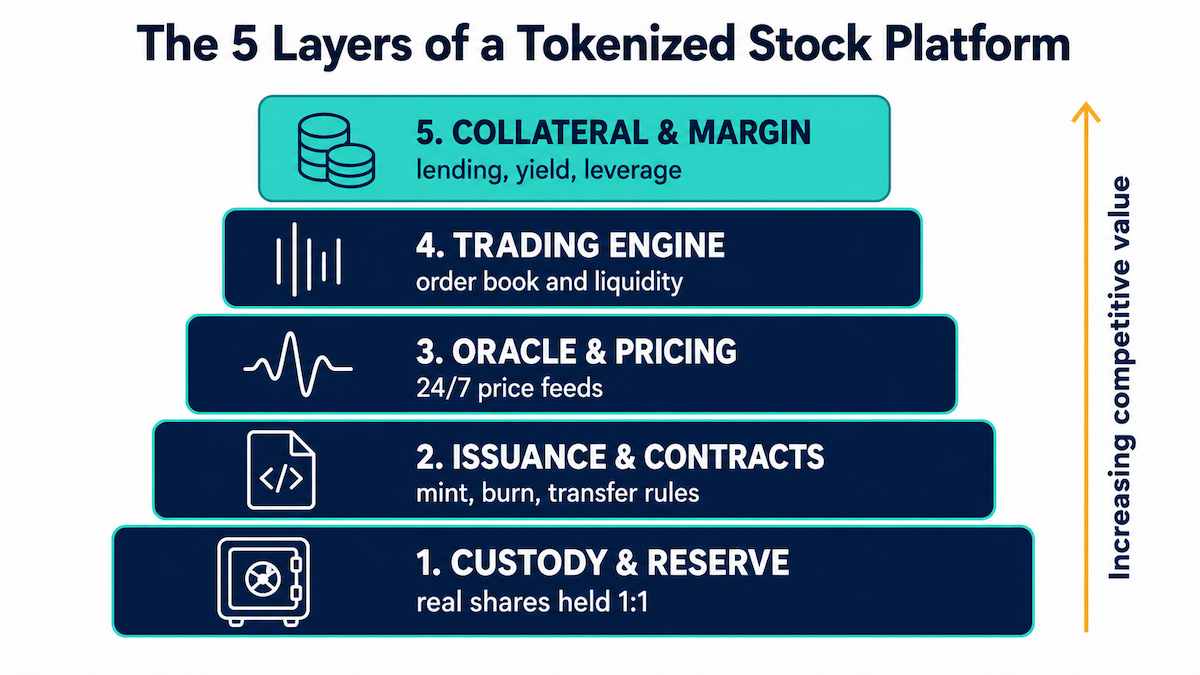
1. Custody and the reserve engine
This is where trust lives. Every token in circulation must map to a real share sitting with a regulated custodian, and you need to prove it continuously rather than quarterly.
- A licensed broker-dealer relationship to acquire and hold the underlying equities, which is exactly the role Nest Trading plays for Binance.
- Segregated client accounts so reserves are legally insulated from your operating balance sheet.
- Automated reserve attestation, ideally with a published proof-of-reserve endpoint rather than a PDF nobody reads.
- A redemption path that works under stress, not just on paper. Binance offers zero-fee 1:1 conversion between real shares and bStocks, which is a strong signal precisely because it is expensive to fake.
2. Issuance and smart contract layer
The token contract is the simplest component technically and the most dangerous legally. It carries your compliance logic.
- Mint and burn controlled by the reserve engine, never by a discretionary admin key.
- Transfer restrictions encoded at the contract level, since tokenized securities usually cannot move to unverified wallets or blocked jurisdictions.
- Corporate action handling for splits, mergers and dividends. Gate automated dividend distribution to eligible positions, which removes a large manual burden.
- Upgradeability with a timelock, because securities rules change faster than smart contracts do.
3. Oracle and pricing infrastructure
Your token trades 24/7. The underlying stock does not. That gap is the single most underestimated engineering problem in this category.
- Licensed market data feeds during exchange hours, with redundancy across at least two providers.
- A defined weekend and after-hours pricing policy, whether that is last close, a synthetic mark or a widened band.
- Circuit breakers tied to underlying halts, so a trading suspension on Nasdaq propagates to your book instead of leaving traders exposed.
- Deviation alerts that flag when your on-chain price drifts too far from the reference price.
4. Matching engine and liquidity
A tokenized stock with no liquidity is a screenshot. Both Binance and Gate solved this by listing against USDT rather than fiat, keeping settlement inside the crypto rails they already dominate.
- Central limit order book with USDT quote pairs, plus market maker agreements before launch, not after.
- Inventory hedging so your market makers can offset exposure in the real equity market.
- An AMM or liquidity pool option if you want DeFi composability, which is the route Binance opened by making bStocks withdrawable to BNB Chain.
- Realistic depth targets per asset. Ten deep pairs beat a hundred thin ones every time.
5. Collateral and margin
This is the layer that separates a product from a platform, and it is where both exchanges made their most deliberate moves in July 2026.
- Risk parameters per asset, since a semiconductor bull 3x ETF and an S&P 500 tracker cannot carry the same haircut.
- Liquidation logic that accounts for closed markets, because you may need to liquidate a position at 3am on a Sunday when the underlying cannot be sold.
- Unified account architecture so users do not shuffle assets between wallets to access leverage, the approach Gate took explicitly.
- Lending against positions, letting holders draw stablecoin liquidity without selling.
|
Anyone can mint a token that tracks Tesla. Very few can build the collateral engine that lets someone borrow against it at 3am on a Sunday. |
Pick your regulatory perimeter before you pick your stack
Founders usually approach this backwards. They choose a chain, build a prototype, then ask a lawyer what is possible. The order should be reversed, because your jurisdiction dictates your custody model, your user base and your feature set.
Binance anchored bStocks in ADGM, where the Financial Services Regulatory Authority approved the issuer’s prospectuses. Under ADGM law tokenized securities are treated as Digital Securities and fall under securities and fund regulation rather than virtual asset rules. That is a meaningful choice. It means a prospectus, an approved issuer and ongoing disclosure obligations, but it also means the product is unambiguously legitimate.
In the EU the picture is different again. MiCA’s transition period closed with crypto-asset service providers required to hold a full licence by July 1, 2026, but MiCA Article 2 explicitly excludes anything that qualifies as a transferable security under MiFID II. Tokenized stocks therefore sit under MiFID II and the EU Prospectus Regulation, not MiCA. Teams that assumed a MiCA licence covered tokenized equities have found out otherwise.
Three practical rules follow from this.
- There is no passport. As of April 2026 no mutual recognition arrangement existed between the major frameworks, so each jurisdiction has to be satisfied on its own terms.
- US retail is almost always excluded at launch. Both bStocks and gStocks restrict eligibility, and the compliant US path runs through accredited investor structures rather than open access.
- Geo-fencing belongs in the smart contract and the KYC layer together. Front-end blocking alone will not survive a regulator’s review.
For teams researching this properly, the ADGM FSRA rulebook, the EU Prospectus Regulation text and Dubai’s VARA rulebook are the primary sources worth reading directly rather than through summaries.
|
Not sure which jurisdiction fits your tokenized stock platform? Get a side-by-side breakdown of ADGM, VARA and EU routes mapped to your target users and timeline. |
The launch sequence that actually works
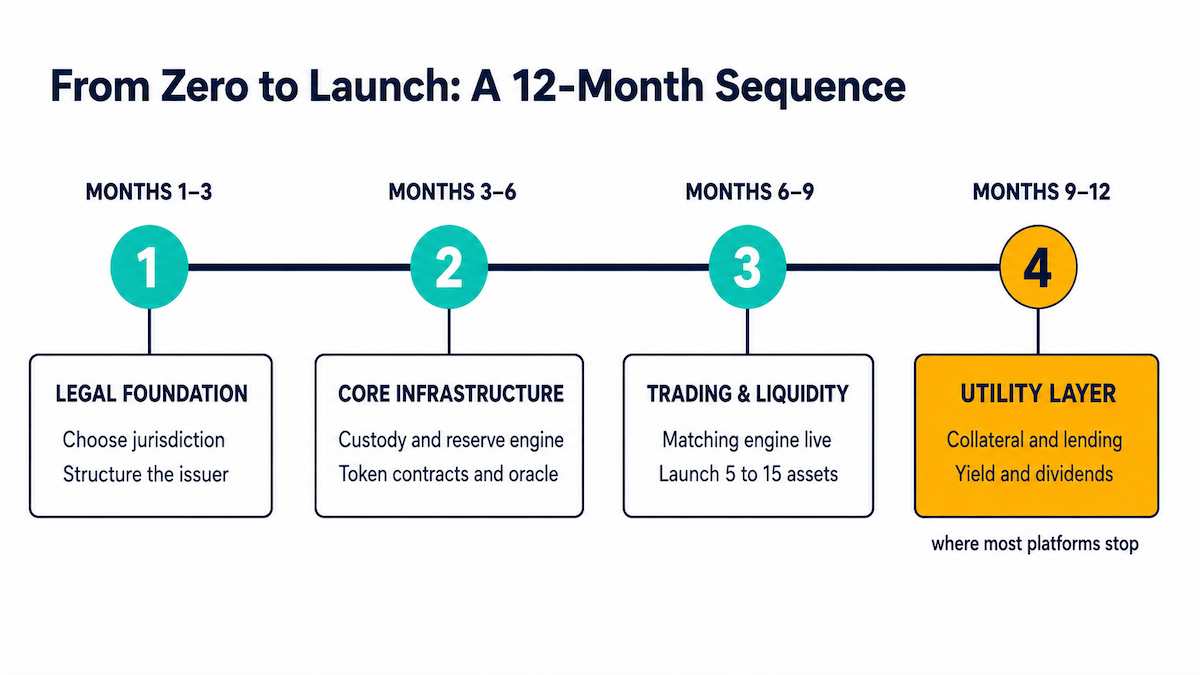
Trying to build all five layers at once is how projects run out of money at 70% complete. Sequence it so each phase produces something testable.
|
Legal foundation Select your jurisdiction, incorporate the issuing entity, appoint or acquire a broker-dealer relationship, and begin the prospectus or exemption process. Nothing technical should block this phase. |
|
|
Core infrastructure Build the custody integration, reserve engine and token contracts. Ship the oracle layer with a documented after-hours policy. Audit everything twice, since a reserve bug here is existential rather than embarrassing. |
|
|
Trading and liquidity Stand up the matching engine, sign market makers, and launch with a narrow list of five to fifteen highly liquid names. Binance opened with five. Gate opened with fifteen. Neither started with hundreds. |
|
|
Utility layer Add collateral eligibility, lending, yield and dividend automation. This is the phase that turns holders into repeat users, and it is where both exchanges spent their July 2026 announcements. |
Where new platforms lose
The failure modes in this category are consistent and avoidable. Most of them are commercial rather than technical.
Launching too broad
A hundred tickers with no depth reads as ambition and trades as a ghost town. Kraken reached 100 xStocks only after starting with roughly 60 and building demand first. Depth compounds, breadth does not.
Treating the weekend as an edge case
Round-the-clock trading is the headline benefit and the biggest operational risk. Spreads widen, oracles drift and liquidations trigger when the underlying market cannot absorb them. Design for the weekend on day one.
Underfunding compliance
Prospectus approval, ongoing disclosure, KYC vendors and jurisdictional monitoring are recurring costs, not a one-time line item. Teams that budget compliance as a project rather than a function stall shortly after launch.
Skipping the collateral layer
Both exchanges moved to collateral within weeks of listing, which tells you how they think about retention. A tokenized stock that only trades competes on fees. One that backs a loan, earns yield and pays dividends competes on utility.
What this means for anyone building now
The window here is genuinely open. Tokenized equities represent a small fraction of a roughly $33.5 billion on-chain RWA market, three issuers still control most of the supply, and the two largest exchanges have only just demonstrated what a complete product looks like. That combination, proven demand plus concentrated supply, is exactly the setup that rewards well-executed entrants.
What has changed is the bar. Eighteen months ago a wrapper and a price feed counted as a product. Today users compare your platform against a system that offers 1:1 zero-fee redemption, self-custody, DeFi composability, cross-margin collateral and automatic dividends. You do not have to match all of it at launch, but you do have to have a credible path to it.
Blockchain App Factory works with exchanges, brokerages and fintech teams building exactly this. Our stock tokenization services cover the full stack, from issuer structuring and custody integration through token contracts with built-in transfer restrictions, oracle and after-hours pricing design, matching engine deployment and the collateral and lending modules that turn a listing into a business. We have delivered tokenization platforms across jurisdictions including ADGM, VARA and the EU, which means the regulatory sequencing is built into the engineering plan rather than bolted on after the fact.
The exchanges that moved in July 2026 did not invent anything new. They simply executed the full stack while most of the market was still arguing about whether tokenized stocks would matter. That question is settled. The only one left is who builds the next platform worth using.
|
Ready to build a tokenized stock platform that can actually compete with bStocks and gStocks? |
Frequently Asked Questions
What is the difference between Binance bStocks and Gate gStocks?
Both are 1:1 backed tokenized US equities issued in-house by the respective exchanges. bStocks are issued through BTech Holdings under ADGM approval and can be withdrawn to BNB Chain wallets for DeFi use. gStocks are optimized for capital efficiency inside Gate’s unified account, with built-in lending, yield, leverage and automatic dividends across a broader 58-plus asset list.
How long does it take to build a tokenized stock platform?
Roughly nine to twelve months for a compliant launch, with legal structuring and regulatory approval consuming the first three to four months in parallel with early engineering. Platforms that skip formal issuer structuring can move faster but usually cannot list meaningful assets or serve users in regulated markets.
Do I need a broker-dealer licence to launch tokenized stocks?
You need a regulated entity that can buy and custody the underlying shares, either your own or a partner’s. Binance uses its own broker-dealer entity, Nest Trading Limited. Most new entrants partner initially and acquire or build the capability later once volume justifies the cost.
Can tokenized stocks be used as collateral?
Yes, and this has become the main competitive frontier. Binance made ten bStocks eligible as margin collateral in July 2026, and Gate integrated gStocks directly into its unified account for isolated and cross margin. Collateral eligibility requires per-asset risk parameters and liquidation logic that works while the underlying market is closed.
Why do most tokenized stock platforms exclude US users?
US securities rules require registration or a valid exemption, and open retail access to tokenized equities generally does not qualify. Platforms therefore launch in jurisdictions such as ADGM or under EU MiFID II and Prospectus Regulation rules, and serve US participants only through accredited investor structures if at all.

Vimal J is the Head of Sales at Blockchain App Factory, with 10+ years of experience in sales, client strategy, and Web3 business growth. He helps startups, enterprises, and project founders choose the right blockchain solutions for their goals, bringing a practical market perspective to topics like token development, crypto launches, and Web3 adoption.