



Open three crypto PR quotes side by side and you will see three completely different definitions of the same word. One promises eight guaranteed articles. One promises 500 plus placements. One promises a single publication and charges more than both. Every one of them calls it distribution.
That is the problem this article is built to solve. The numbers on a crypto PR package are not comparable to each other, because they count different things. A guaranteed article on a crypto news site your buyers read is a different unit from an auto-republished copy on a regional aggregator, and both are different from a journalist deciding your funding round is worth writing about. Priced per unit, the cheapest option often looks strongest.
What follows compares the actual distribution routes available to crypto teams in 2026, using pricing and policy published by the providers and publishers themselves, plus Google’s own documentation on how syndicated and paid content is treated in search.
- Distribution count and meaningful media reach are not the same thing. Eight guaranteed articles on outlets your buyers read can outperform several hundred syndicated copies.
- Indexing has to be checked at URL level after the campaign. Google’s own documentation shows why syndicated duplicates are frequently filtered rather than indexed and ranked independently.
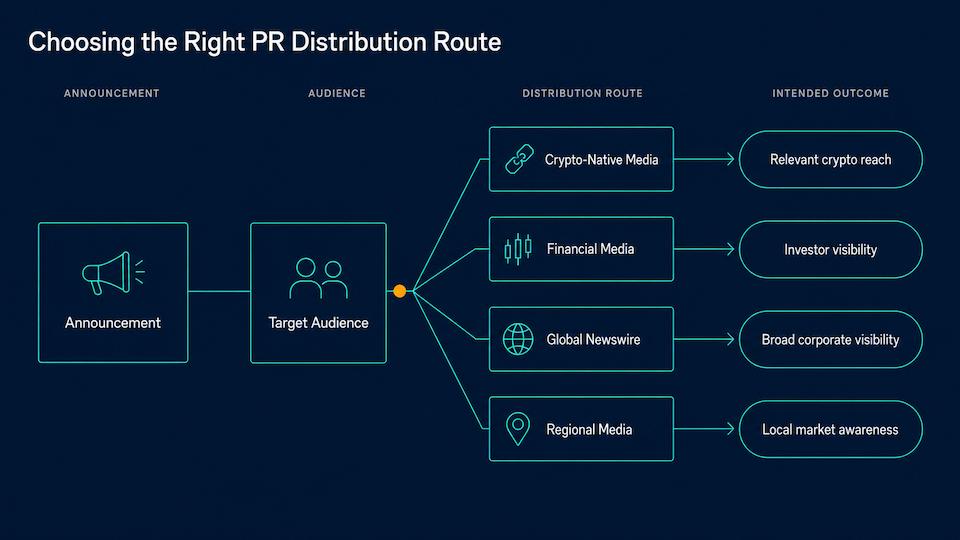
- The right route depends on the announcement, the audience, the geography and the outcome you need. There is no single best crypto press release distribution service.
What Are You Actually Buying With Crypto Press Release Distribution?
Most packages bundle several distinct services under one price. Separating them is the first step in comparing quotes honestly.
- Writing or editing. Some providers include editorial review and formatting suggestions. Others charge separately or expect a finished draft.
- Guaranteed publication. Paid placement on a defined list of sites, subject to editorial guidelines. This is the core of most crypto packages.
- Syndication. Automated republication across a network of partner sites, aggregators and feeds.
- Premium placement. A named tier-one outlet, usually priced as an add-on or a separate purchase.
- Journalist outreach. Actual pitching to reporters. Rarely included in a distribution package and usually an agency service.
- Targeting. Crypto-specific, financial, geographic or language circuits.
- Translation. Localised versions for regional crypto media.
- Reporting. Live URLs, publication status and estimated audience figures.
The distinction that matters most: distribution buys placement, not judgement. A publisher agreeing to host your announcement is not the same as a newsroom deciding it is news.
Crypto Press Release Distribution Cost Compared
Published pricing in this market is uneven. Some providers list rates openly. The largest global wires do not publish a rate card at all, which is why any single figure quoted for them online should be treated as a reconstruction rather than an official price.
The figures below were taken from provider pricing pages reviewed in September 2026 and can change without notice.
According to the EIN Presswire pricing page reviewed in September 2026, a single release is $149, with bundles of five for $499 and fifteen for $999, bringing the effective per-release cost under $70 at the highest volume. ACCESS Newswire publishes its rates openly: $475 for its Budget tier, $865 for National, $1,205 for US Premium and $599 for state-targeted distribution, with unlimited word count and images included and international or global distribution quoted on request.
On the crypto-native side, the Chainwire pricing page reviewed in September 2026 lists four tiers: Lite at $1,399 for eight guaranteed published articles, Standard at $2,499 for twenty, Premium at $6,499 for 75 plus crypto outlets alongside 500 plus mainstream articles, and Gold at $10,799 for 100 plus crypto outlets, 500 plus mainstream articles and distribution to trading terminals.
PR Newswire, Business Wire and GlobeNewswire operate on quote-based pricing. Premium crypto media placements sit in the same category. Cointelegraph routes commercial enquiries through Cointelegraph Media Group, its in-house PR and marketing agency, and CoinDesk maintains separate sponsored content and press release sections alongside an advertising contact. Neither publishes a public rate card, so any price you see quoted by a reseller is that reseller’s price, not the publisher’s.
| Distribution Option | Typical Cost Model | Crypto Reach | General News Reach | Placement Type | Indexing Potential | Best For |
| Low-cost syndication network | Per release from $149; volume bundles lower the unit cost | Low and incidental | Wide but shallow | Automated syndicated copies | Varies heavily by URL | Routine updates, minimal budgets |
| Crypto-native distribution | Tiered packages, roughly $1,399 to $10,799 | High and targeted | Limited at entry tiers | Guaranteed paid publication | Named URLs, verifiable individually | Token launches, listings, Web3 products |
| Mid-market business wire | Published per-release tiers, roughly $475 to $1,205 | Low unless added | Strong financial and news coverage | Wire syndication plus terminals | Varies by partner site | Corporate news on a controlled budget |
| Major global wire | Custom quote, no public rate card | Low without a crypto circuit | Very high, including investor channels | Wire distribution and financial feeds | Varies by partner site | Funding, regulatory and IR announcements |
| Premium crypto media placement | Custom quote, priced per publication | Very high on a single outlet | Low | Labelled sponsored or press release section | Commonly discoverable, still verify | Flagship moments needing a credibility anchor |
| Managed crypto PR campaign | Custom quote or retainer | Depends on outreach quality | Depends on the story | Paid placement plus pitched coverage | Mixed, measured per placement | Sustained narrative and earned media |
Why Reach Numbers Need More Context
Almost every reach figure in PR is a potential figure. It describes how many people could theoretically encounter a page, not how many did. Publishers report their own traffic, distributors sum those reports across a network, and the resulting total is presented as campaign reach.
Even accurate publisher data is measured at site level, not at article level. Cointelegraph’s own media page, reviewed in September 2026, describes more than 9.5 million monthly visits across 11 languages. CoinDesk’s ethics page cites an audience of five million monthly website visitors. Both figures describe entire publications. Neither tells you how many people opened one press release in a section clearly marked as paid content.
There is also an honest limitation the better distributors state openly. Chainwire’s own FAQ notes that because releases are published on outlets it does not own, exact page views and clicks on those properties cannot be tracked, and recommends UTM parameters for measuring clicks back to your site. That is the correct answer, and it is worth more than a confident impressions total with no methodology attached.
A press release living on 500 URLs is not automatically worth more than one living on five publications your buyers actually read.
Which Crypto Press Release Sites Actually Get Indexed?
Indexing is decided per URL, not per network. Two copies of the same release, distributed in the same batch, can end up in different states depending on how each publisher handles duplicate content, canonical tags, robots directives, section-level indexing rules and crawl priority.
Google’s own canonicalisation troubleshooting documentation, updated in August 2026, is direct about this. It states that the canonical link element is not recommended for avoiding duplication by syndication partners, and that the most effective solution is for partners to block indexing of the syndicated content. In other words, correctly configured syndication is designed to produce copies that Google does not index separately. A large syndication footprint and a large indexed footprint are different outcomes by design.
That is why a permanent indexed or not indexed list of crypto publications is misleading. A more useful framing is a set of expectations you verify after the fact:
- Commonly discoverable in Google. Established crypto publications with their own press release or sponsored sections, where individual pages are typically findable by exact headline.
- Indexing varies. Mid-tier and regional sites where some pages surface and others do not.
- Syndicated copies may not all be indexed. Aggregators and feed-based republication, where duplicate handling frequently applies.
- Requires URL-level verification. Everything else, which in practice means everything.
Verification is straightforward and takes minutes per campaign:
- Search your exact headline inside quotation marks and record which domains return the release.
- Run a site-restricted search on each publisher domain combined with a distinctive phrase from your release.
- Open every live URL in the distributor’s report and confirm the page is live rather than removed or redirected.
- Note which pages carry a sponsored or press release label, because that shapes how readers and journalists weigh them.
- Recheck after a reasonable crawl window. Google notes that pages can be held in a duplicate cluster for up to two weeks, so a same-day check tells you very little.
You cannot inspect another company’s Search Console property, so URL Inspection is unavailable for third-party publications. Search operators and the distributor’s own reporting are what you have.
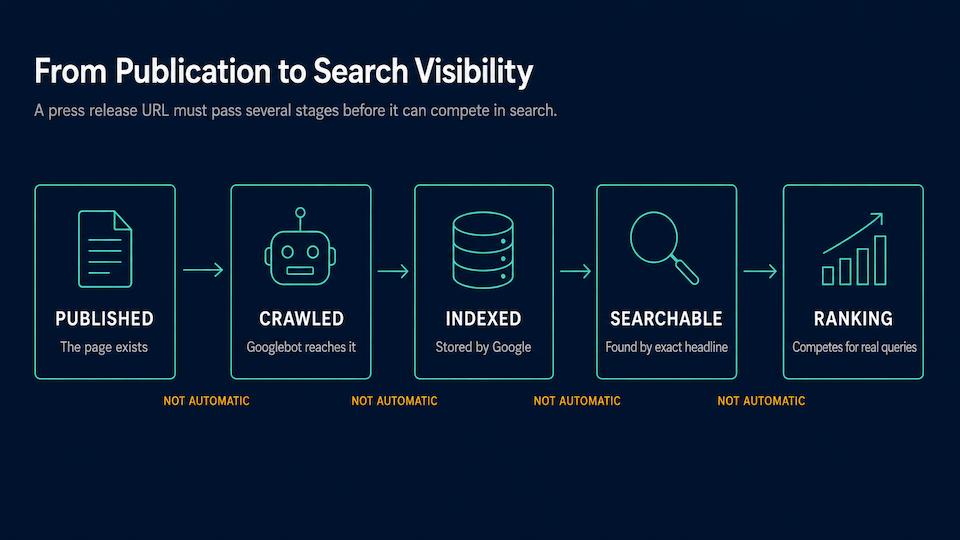
Indexed, Searchable and Ranking Are Three Different Things
Published means the page exists. Crawlable means Googlebot can reach it. Indexed means Google has stored it. Discoverable means someone searching your exact headline or brand name can find it. Ranking means it competes for a query people actually type. Each stage is a filter, and plenty of press release URLs stop at stage two or three.
The most common reason a release is indexed but invisible is competition. A page that repeats the same 600 words as forty other pages, sits in a section labelled as paid content and has no independent reporting attached to it is rarely the strongest candidate for a competitive keyword. It can still perform well on branded queries, which is a genuine benefit, but it is a different benefit from ranking for a category term.
Freshness matters too. Press release URLs often surface strongly for a few days around an announcement, then fade as the news cycle moves on. That short window is frequently the real value of the campaign, and it is worth planning around rather than pretending it does not exist.
Syndication Is Not an SEO Shortcut
Google’s spam policies name this scenario explicitly. Under link spam, the documentation lists advertorials and native advertising where payment is received for articles containing links that pass ranking credit, along with links using optimised anchor text in articles, guest posts or press releases distributed on other sites. The stated remedy is qualifying those outbound links with rel=”nofollow” or rel=”sponsored”.
Reputable publishers apply that attribute to paid placements. Ask your provider directly which link attribute each outlet uses, and treat a provider that promises follow links from paid placements as a risk rather than an advantage.
It is worth noting that Google’s site reputation abuse policy explicitly lists wire service and press release service sites among the examples it does not consider inconsistent with that policy. Distribution itself is not being treated as abuse. What is being discounted is the attempt to buy ranking credit through it.
The realistic value of distribution sits elsewhere: branded search coverage around a launch, entity signals that help search engines and AI systems associate your project with the right category and people, discoverability for journalists researching you later, referral traffic from readers who click through, and a documented public record of what you announced and when.
Crypto-Native Distribution Versus Mainstream Newswire Distribution
Crypto-Native Distribution
The advantage is context. Readers on a crypto publication already understand what a TGE is, why a Layer 2 sequencer matters or what a listing means for liquidity. Your release does not have to explain the category before it explains the news. Crypto-native distributors also publish guaranteed outlet counts and named placements, which makes verification easier.
The limits are real too. Entry tiers reach a small number of outlets. Crypto media audiences skew toward existing crypto participants, which is a poor fit if you are trying to reach institutional allocators, enterprise buyers or regulators. And paid placement on a crypto site does not carry the credibility of that site’s newsroom, which those publishers are increasingly explicit about.
Mainstream Newswire Distribution
Global wires exist for a different job: reaching financial media, analyst and broker terminals, regional newsrooms and investor channels with a formally structured announcement. For funding rounds, corporate restructuring, licensing and regulatory milestones, that infrastructure is the appropriate route, and it comes with distribution records that satisfy compliance and IR expectations.
The limitation is discovery within crypto. A release on a general wire may never reach the crypto publications your community actually reads, and a crypto-literate reader is unlikely to encounter it. Many teams running significant announcements use both, deliberately and for different audiences.
What a Good Crypto PR Distribution Report Should Show
A report is the only evidence you have that you received what you paid for. A usable one shows, per placement:
- The live publication URL, clickable and current
- The publication name and type, crypto, financial, mainstream or aggregator
- The date published
- Whether the placement was standard syndication or a premium or guaranteed outlet
- The geographic market and language version
- Live or pending status
- Any audience figure, with the source of that figure stated
- Indexed or searchable status where you have measured it
- Referral traffic attributed through your own UTM parameters
A screenshot showing a single large potential reach number is not a report. It is a headline. Ask for the URL list before you buy, not after.
Three Numbers Worth Looking at After Distribution
|
01 Live Placements Count only URLs that resolve to a live page carrying your release. Pending and removed placements do not count. |
02 Searchable URLs Of those live pages, how many are findable in Google by exact headline after a reasonable crawl window. |
03 Referral and Branded Search Sessions arriving from tagged links, plus movement in branded query impressions in the days after launch. |
Which Distribution Option Fits Your Announcement?
Token Launch or TGE
Crypto-native distribution carries this. Your audience is already in crypto media, and timing matters more than volume. Sequence the release so it lands alongside exchange communications and community channels rather than days apart.
Exchange or Product Launch
Technical credibility and search discoverability both matter. Crypto publications reach the users who will actually trade or build, and a well-timed release gives you a searchable record when people check whether the launch is real.
Funding or Institutional Announcement
This is where a global wire or a financial-focused newswire earns its cost. Investors, analysts and business reporters live on those channels, and a formally distributed funding announcement is easier for a journalist to verify and reuse.
Partnership Announcement
Audience overlap decides the route. If both parties serve crypto audiences, crypto-native distribution plus coordinated amplification from your partner will outperform a wide wire drop. Agree on the wording and the timing before either side buys anything.
RWA or Tokenisation Announcement
These need a split audience: crypto media for the technical story, and fintech, finance or sector-specific outlets for the asset side. A crypto-only package will miss the institutional half of the audience entirely.
Regulatory or Corporate Update
Formal wire distribution is usually the safer choice. Licensing, registrations and structural changes benefit from the compliance-friendly infrastructure and the distribution record that wires provide.
A Practical Crypto PR Distribution Decision Framework
|
01
|
Define the Announcement State plainly what happened and why anyone outside your team would care. If that sentence is hard to write, no distribution budget will fix it. |
|
02
|
Define the Audience Crypto users, traders, developers, institutional investors, regional buyers or journalists. Naming them narrows the channel list immediately. |
|
03
|
Choose the Distribution Mix Crypto-native, financial, mainstream, regional or a combination. Not every campaign needs every channel, and most do not. |
|
04
|
Verify the Placement Terms Which outlets are guaranteed, which are optional, what is labelled sponsored, which link attributes are applied, how long pages stay live and what the report will contain. |
|
05
|
Measure Search and Referral Visibility Check live URLs, run indexing checks after a crawl window, watch branded search impressions, track tagged referral traffic and log any journalist replies or follow-up coverage. |
|
Unsure Which Crypto PR Distribution Route Fits Your Launch? Compare media reach, publication quality, indexing potential and campaign goals before committing your PR budget. |
When Paying More for Distribution Makes Sense
Higher spend is justified when the announcement itself carries weight and a wider audience changes the outcome. A significant funding round, an institutional partnership, an exchange listing, a major product release, entry into a new regulated market or a licensing milestone all benefit from broader reach, because the people who need to see them sit outside your existing community.
The opposite is equally true. A routine feature update, a minor integration or a community milestone does not become more important because it appeared on 500 sites. For those, a smaller crypto-native package plus your own channels typically produces better value per dollar, and it preserves budget for the announcement that genuinely deserves the larger campaign.
Red Flags to Check Before Buying a Crypto PR Package
- No named publication list, only categories or logo walls
- Guaranteed tier-one media with no conditions, no editorial review and no exclusions stated
- Very large reach figures with no explanation of how they were calculated
- No distinction drawn between syndicated placement and independent editorial coverage
- No live URL reporting, only summary screenshots
- Any promise of Google rankings, which no distributor can control
- Traffic numbers that cannot be traced to a publisher’s own reporting
- Publisher logos displayed without confirming whether that outlet is included in your tier
- Unclear labelling policy for sponsored or paid content
- No clarity on whether premium placements cost extra on top of the package price
How to Judge ROI From Crypto Press Release Distribution
Backlink counts are the least informative measure available, partly because paid placements should carry sponsored or nofollow attributes anyway. A more useful framework looks at whether the campaign changed anything.
- Coverage on publications your target audience genuinely reads
- Search visibility for your brand and product names during and after the announcement window
- Qualified referral traffic from tagged links, measured against your normal baseline
- Journalist replies, follow-up questions or subsequent earned coverage
- Investor, partner or business development enquiries that reference the announcement
- Community growth and social amplification around the launch window
- Cost per meaningful placement rather than cost per URL
Attribution has limits worth stating plainly. Press releases influence people who never click a tracked link, and announcements rarely run in isolation from paid media, community activity and partner amplification. Treat the numbers as directional evidence, not proof, and look at the pattern across several campaigns rather than one.
Choosing a Crypto PR Distribution Strategy That Matches the Campaign
There is no universally best crypto press release distribution service, and any provider claiming otherwise is describing their own catalogue rather than your situation. The right choice follows from the announcement type, the audience you need to reach, the geographies that matter, the quality of the publications involved, your budget, the search visibility you want and the timing of the campaign. Above all it follows from what you are trying to achieve: syndication footprint, credibility, referral traffic, investor awareness or genuine earned media are four different goals and they do not share a route.
For teams that need more than bulk syndication, Blockchain App Factory can help shape the press angle, prepare the announcement and campaign messaging, identify suitable crypto and Web3 media channels, coordinate press release distribution, and connect PR activity with the wider token, exchange, RWA or blockchain marketing programme so that individual announcements build on each other instead of standing alone.
|
Need a Crypto PR Distribution Plan Built Around Your Launch? Map the announcement, the audience and the media route before the budget is committed, then measure what the campaign actually returned. |
Frequently Asked Questions
How much does crypto press release distribution cost?
It ranges from under $200 to five figures per campaign. Pricing pages reviewed in September 2026 show low-cost syndication starting around $149 per release with EIN Presswire, published business wire tiers of roughly $475 to $1,205 with ACCESS Newswire, and crypto-native packages from $1,399 to $10,799 with Chainwire. Major global wires and premium crypto publications quote individually and do not publish rate cards, so treat any figure attributed to them online as an estimate.
Do crypto press releases get indexed by Google?
Many published URLs can be indexed, but indexing is decided per URL and is never guaranteed by distribution alone. Google’s documentation recommends that syndication partners block indexing of republished content, which means large parts of a syndication footprint are not intended to be indexed separately. Verify each live URL with an exact-headline search after a crawl window rather than assuming.
Does press release distribution help crypto SEO?
Indirectly, yes. It supports branded search visibility, gives search engines and AI systems consistent information about your project, creates a public record journalists can find, and can drive referral traffic. It does not work as a link-building tactic. Google’s spam policies specifically cite paid press release links that pass ranking credit as link spam, and reputable publishers apply sponsored or nofollow attributes to paid placements.
What is the difference between crypto press release distribution and crypto PR?
Distribution is a transaction: you pay, and your announcement is published on a defined set of sites. Crypto PR is media relations: developing a narrative, building relationships with reporters, pitching stories and earning coverage you did not pay for. Distribution guarantees placement. PR pursues judgement from a newsroom, which cannot be bought and, at publications with clear ethics policies, explicitly is not for sale.
Is crypto-specific PR distribution better than a general newswire?
Neither is better in the abstract. Crypto-native distribution wins when your audience already lives in crypto media and the announcement is a token, protocol, listing or product story. General newswires win for funding, regulatory, corporate and investor-facing announcements that need financial media and formal distribution records. Substantial launches often use both, aimed at different audiences.

Vimal J is the Head of Sales at Blockchain App Factory, with 10+ years of experience in sales, client strategy, and Web3 business growth. He helps startups, enterprises, and project founders choose the right blockchain solutions for their goals, bringing a practical market perspective to topics like token development, crypto launches, and Web3 adoption.
Article Reviewed by:
Arun Kamala Santhanath
Marketing Head, Blockchain App Factory


