


A founder finishes a demo day with 60 new contacts, a Telegram group of 40,000 people, and a deck that gets compliments. Six weeks later there are plenty of second calls and no signed documents. Nothing in the campaign was wrong, exactly. It was built to create interest rather than to move a specific kind of buyer through a specific decision.
That gap matters more in a concentrated market. CryptoRank counted 4.99 billion dollars of venture capital across 218 crypto rounds in the second quarter of 2026, with the average disclosed round rising to 22.9 million dollars from 18.8 million a year earlier. Galaxy Research, using its own methodology, reported that first quarter 2026 capital fell roughly 50 percent from the fourth quarter of 2025. Fewer rounds, larger cheques, and slower diligence all reward projects that can prove something before they promote anything.
The Market Your Raise Is Competing In
Capital has not disappeared. It has clustered. Larger rounds go to a smaller number of companies, and those companies tend to arrive with revenue, users, or a working product rather than a roadmap. For a marketing team, the practical reading is that a campaign now has to survive contact with diligence, not just with a timeline feed.
|
$4.99B Venture capital committed to crypto and blockchain startups across 218 rounds. Excludes debt financing, acquisitions, and public equity raises. CryptoRank, Q2 2026 (April to June 2026) |
$22.9M Average disclosed venture round size, up from 18.8 million dollars in the same quarter a year earlier. Bigger rounds, spread across fewer companies. CryptoRank, Q2 2026 compared with Q2 2025 |
57% Share of invested capital that went to later-stage companies, which accounted for roughly a quarter of all deals counted that quarter. Galaxy Research, Q1 2026 (January to March 2026) |
Read those numbers as context, not as a forecast for your round. Research firms count different things. CryptoRank separates venture rounds from debt and acquisitions, and Galaxy Research applies its own deal definitions, so the totals are not interchangeable. What both descriptions share is a market where a smaller set of companies absorbs most of the money.
Match The Campaign To The Round You Are Actually Raising
Most fundraising marketing goes wrong at this step. Teams build one campaign and point it at every audience. An institutional equity round, a private token round, and a community offering ask different people to make different commitments under different rules.
Three outcomes worth separating
- Interest is anyone who reacts. A reply, a follow, a saved post, a request for the deck.
- Qualified participation is someone who can legally and practically take part. An investor with a mandate that fits your stage and geography, or a community member who clears eligibility checks for the offering.
- Committed capital is money under a signed document.
Campaigns that report on the first number while the round depends on the third produce confident reporting and disappointing outcomes.
| Decision point | Institutional or private round | Community offering |
|---|---|---|
| Audience you need | A short, named list of funds, angels, and strategic partners | A wide pool of eligible participants who understand the product |
| Evidence that carries weight | Cohort retention, revenue quality, security review history, team record | Working product access, clear token terms, published vesting schedule |
| Role of creators | Reputational context around a project allocators already screen | Education and reach into segments the team cannot address alone |
| Main legal question | Whether general solicitation is permitted for the exemption you rely on | Whether your promotional material and participant eligibility satisfy each target jurisdiction |
| Common failure | Public messaging that contradicts the numbers in the data room | A large audience assembled by giveaways that leaves before the sale |
Jurisdiction shapes all of this. In the European Union, MiCA requires marketing communications for in-scope crypto-assets to be clearly identifiable as marketing, fair, clear, and not misleading, consistent with the published white paper, and not distributed before that white paper exists. In the United Kingdom, since October 2023 a cryptoasset financial promotion aimed at consumers must be communicated or approved through one of a small number of permitted routes, with prescribed risk warnings and a cooling-off period for first-time investors. In the United States the picture is still moving: the SEC proposed a token offering framework in August 2026 that would exempt qualifying sales from registration, but that is a proposal open for comment rather than a rule in force, and the CLARITY Act remains pending in the Senate. Rules for stablecoins, securities offerings, and general token promotion are not the same rules, and a platform, an offshore entity, or a KYC step does not by itself make a raise compliant. Get jurisdiction-specific advice before the campaign is built, not after.
Evidence Comes Before Promotion
Promotion amplifies whatever is already there. If the underlying case is thin, more distribution mostly increases the number of people who notice that it is thin. The work that pays off happens before any creator is briefed. This preparation is equally important when promoting an ICO, where credible project information and transparent communication help build investor confidence.
What a reviewable case contains
- A problem someone pays to solve. Name the user, the current workaround, and the cost of that workaround.
- Differentiation you can demonstrate. “Faster and cheaper” is a claim. A benchmark with stated conditions is evidence.
- Product proof. A live deployment, an audit report with the findings and the fixes, integration partners who will confirm the relationship.
- Traction described honestly. Separate incentivised activity from organic usage. Give the period, the definition, and the method behind every number.
- Use of funds with milestones. What the money buys, by when, and what evidence will show it worked.
Consistency matters as much as content. Diligence teams read your website, your X account, your documentation, and your data room, and they notice when the growth chart on the landing page does not match the cohort table in the deck. One reconciled set of numbers, with the definitions written down, prevents most of these problems. Claims that project price, return, or valuation belong nowhere in the campaign.
Choosing KOLs For The Audience You Actually Need
Key opinion leaders do one useful thing well. They put a considered message in front of a group that already trusts them on a subject. That is valuable when the group contains people who can act, and close to worthless when it does not.
Screening questions before you pay anyone
- Who is actually in the audience? Ask for geography splits and engaged-follower data, then sanity check it against reply quality on recent posts.
- Do they cover your subject? A creator known for perpetual futures commentary is a poor fit for a compliance-focused infrastructure raise, whatever the follower count.
- What is their track record? Look at the projects they promoted 12 to 24 months ago and what happened next. That history follows you.
- What conflicts exist? Existing token positions, advisory seats at competitors, and prior paid work with rivals all need to be on the table.
- What are the deliverables? Specify format, count, timing, review process, factual accuracy standards, and the disclosure language, in writing.
Disclosure is not optional and not cosmetic. The FTC’s Endorsement Guides, revised in 2023, require material connections between a brand and an endorser to be disclosed clearly and prominently, and place responsibility on the advertiser to brief and monitor the people acting on its behalf. Where the asset is a security, US Securities Act Section 17(b) separately prohibits promoting it for consideration without disclosing the source and amount of that consideration. A paid post presented as an independent opinion is a legal problem before it is a reputational one.
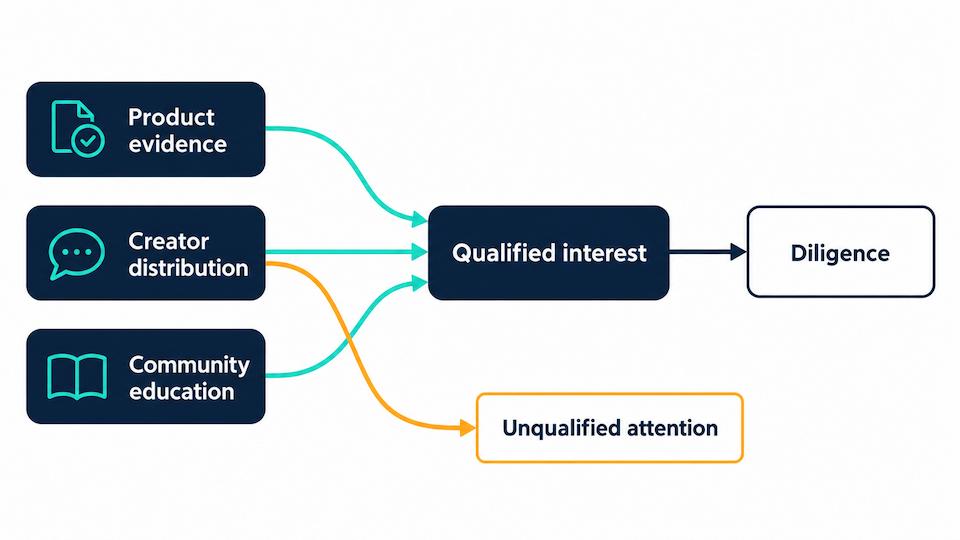
A creator’s audience tells you how far a message will travel, not whether anyone in it can write a cheque. Treat creator activity as distribution and education, and keep the qualification work on your own side.
|
A creator’s audience tells you how far a message will travel, not whether anyone in it can write a cheque. |
|
Not sure your creator list matches your investor list? A short review of audience fit, disclosure terms, and deliverables usually costs less than one misplaced campaign. |
Community Readiness Beats Community Size
A community that can explain your product to a newcomer is an asset during a raise. A community assembled through giveaways is a cost. The difference shows up in the two weeks before a sale opens, when questions get specific.
What readiness looks like in practice
- Education that lands before the ask. Documentation, short explainers, and a written FAQ covering token terms, vesting, and what the raise funds.
- Founder access on a schedule. Regular sessions where hard questions get answered by name, not deflected to a moderator.
- Support that answers within hours. Slow responses during a sale window read as disorganisation, and people say so publicly.
- Eligibility handled early. If the offering restricts participation by jurisdiction or investor status, publish that at the start rather than after people have queued.
- Milestone updates that continue after the money lands. Post-close silence is the fastest way to lose the goodwill a raise created.
One reliable signal of readiness costs nothing to check. Ask three members to describe what your product does. If the answers differ wildly, the community is not ready to carry a fundraising message, however large it looks.
Coordinating PR, Founder Content, And Creator Activity
These channels fail when they run on separate calendars. They work when each does the job it is suited to and they point at the same evidence.
Dividing the work
- Announcements carry facts. Amount, lead investor, participants, stage, and what the capital funds. Confirm every name with the party involved before publication.
- Founder commentary carries judgment. A view on where the category is heading is more persuasive to an allocator than a company milestone post.
- Educational content answers the questions your sales conversations keep hitting. It is also the material creators can reference without inventing claims.
- Community updates keep existing holders and users informed so they are not learning about your round from a stranger’s timeline.
Two mistakes recur. The first is announcing early. A round teased before documents are signed can spook a lead investor and looks worse if terms change. The second is treating paid placement as editorial endorsement. Sponsored articles and paid creator posts should be labelled as what they are, and a communications plan should never assume coverage that no journalist has agreed to write.
Measuring What Actually Matters
Fundraising measurement is not campaign measurement with different labels. The useful metrics sit close to the decision you need someone to make.
Metrics worth reporting
- Qualified inbound. Inquiries from investors whose stage, cheque size, and geography fit the round.
- First meetings booked and the share that reach a second conversation.
- Diligence progression. Data room access requests, reference calls arranged, technical reviews started.
- Eligible participation for community offerings, meaning verified participants rather than registrations.
- Attributable conversions where a tracked path genuinely exists, reported separately from everything else.
Be honest about the limits. Investor journeys run through private group chats, forwarded documents, and conversations you will never see. Self-reported source fields on a contact form are usually the most accurate signal available, and they are still rough. Mindshare rankings and attention indexes describe how much a project is being discussed, which is a different thing from whether anyone is preparing to invest. Report them as visibility, if at all, and never as demand.
A Phased Plan You Can Adapt
The timings below are illustrative planning guidance, not a benchmark. Adjust them to your round size, jurisdiction, and how much of the evidence base already exists.
|
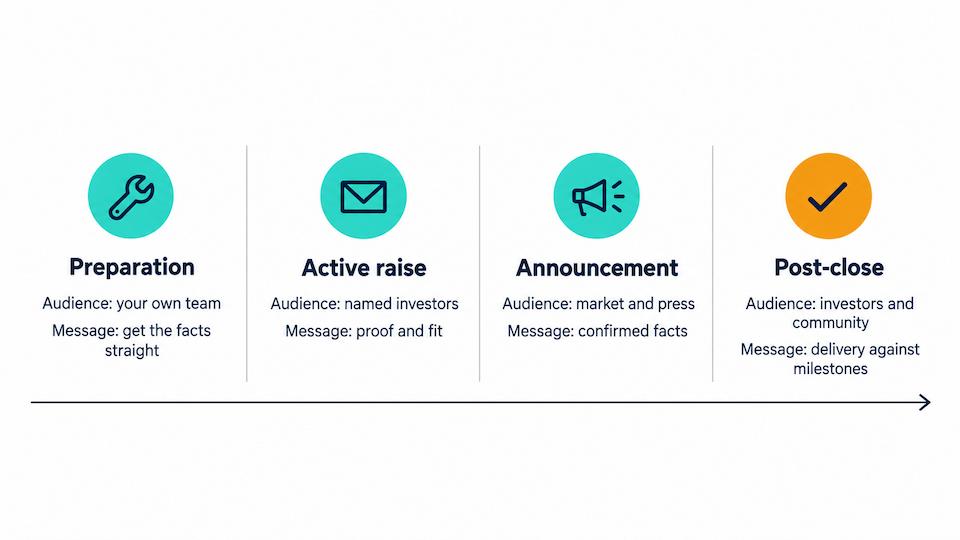
PHASE 1 Preparation Roughly 8 to 12 weeks out |
Reconcile every public and private number. Finish audits and publish findings. Settle jurisdiction and eligibility questions with counsel. Build the creator shortlist and disclosure terms. Readiness check: your website, deck, and documentation state the same facts. |
|
PHASE 2 Active raise Outreach window |
Run founder content and educational material. Keep the round itself quiet where general solicitation is restricted. Track qualified inbound and diligence progression weekly. Readiness check: you can name the objection that stalls most second calls. |
|
PHASE 3 Announcement After documents are signed |
Publish the release with confirmed participant names. Brief creators with the same approved facts and required disclosures. Hold a community session the same week. Readiness check: every claim in the release traces to something you can show. |
|
PHASE 4 Post-close Ongoing |
Report against the milestones you funded. Keep hiring, product, and partnership news moving. Maintain the investor update cadence you promised. Readiness check: the next raise starts from a public record of delivery. |
Where To Focus First
If you only have time for one thing before your next raise, spend it reconciling your evidence. Take every number you publish, write down its definition and period, and check that the data room agrees. That single exercise removes the most common reason a promising second call goes quiet, and it makes everything downstream easier to brief. Creators can only repeat what you gave them. Communities can only defend what they understand.
Teams that want outside support on the execution side often need the same set of capabilities. Blockchain App Factory works with Web3 projects on fundraising-adjacent marketing, including go-to-market and narrative planning, content and educational material, Telegram and Discord community management with investor AMAs, coordinated KOL and influencer campaigns with creator selection and performance tracking, and crypto PR covering founder interviews and announcement distribution. The value of that kind of support depends entirely on the evidence you hand it, so treat preparation as the first deliverable rather than a step to compress.
Marketing does not produce investment, higher valuations, or regulatory approval. It decides whether the people who could say yes ever see an accurate version of what you built.
|
Raise opening in a quarter and no campaign plan yet? |
Frequently Asked Questions
How early should fundraising marketing begin?
Begin when the evidence is ready rather than on a fixed date. Most teams need several weeks to reconcile metrics, finish audits, and settle jurisdiction questions. Starting outreach before that work is done usually means repairing the story mid-round.
Do KOLs help with institutional rounds?
Indirectly. Funds run their own sourcing and diligence, so creator posts rarely originate an institutional cheque. They can shape the reputational context an allocator encounters while screening you. Choose credibility and subject relevance over reach for this purpose.
Does a paid KOL post need a disclosure?
Yes. The FTC’s Endorsement Guides require clear, prominent disclosure of material connections, and advertisers are expected to brief and monitor their endorsers. Where the promoted asset is a security, additional US requirements on disclosing compensation apply. Confirm the wording with counsel for your jurisdictions.
Can we announce a round before it closes?
It is rarely worth the risk. Terms change, participants withdraw, and early publicity can complicate a lead investor’s process. Some exemptions also restrict general solicitation. Wait for signed documents and confirm every named participant before publishing.
Are mindshare scores useful for fundraising?
They measure how much a project is being discussed, which is a visibility signal rather than evidence of investment intent. Use them to sense whether your message is circulating. Judge campaign performance on qualified inquiries, diligence progression, and eligible participation instead.

Vimal J is the Head of Sales at Blockchain App Factory, with 10+ years of experience in sales, client strategy, and Web3 business growth. He helps startups, enterprises, and project founders choose the right blockchain solutions for their goals, bringing a practical market perspective to topics like token development, crypto launches, and Web3 adoption.
Article Reviewed by:
Arun Kamala Santhanath
Marketing Head, Blockchain App Factory


