



A free, citable dataset of crypto advertising rules in 37 jurisdictions, with a primary source behind every verified row.
Crypto Advertising and Promotion Rules by Country is an open dataset of 58 advertising and promotion rules for crypto-assets across 37 jurisdictions, released as version 1.0 in November 2026. Across the dataset, the common pattern is that crypto firms may advertise only once they hold the right licence or registration, so the first question for any campaign is who is legally allowed to run it.
The newest rule in the set is only weeks old. In November 2026 New York’s financial regulator told licensed crypto firms to back every ad claim with evidence and to vet the third parties who promote them, and gave them until May 2027 to update their policies. Rules move that fast. So each row carries its own source and check date.
- Most jurisdictions in the dataset allow crypto ads only from licensed or registered firms.
- Outright bans on crypto promotion are rare, and none of the bans in v1.0 could yet be confirmed from a primary source.
- The UK, New York and Thailand set the most conditions on a single ad.
- Influencer duties appear in Europe, the Americas, Asia-Pacific and Africa.
- Limits on sign-up bonuses and referral rewards are still uncommon.
- The full data is free to reuse under CC BY 4.0.
This page is for compliance teams, researchers, journalists and crypto marketers who need a starting point for each country (it is information, not legal advice).
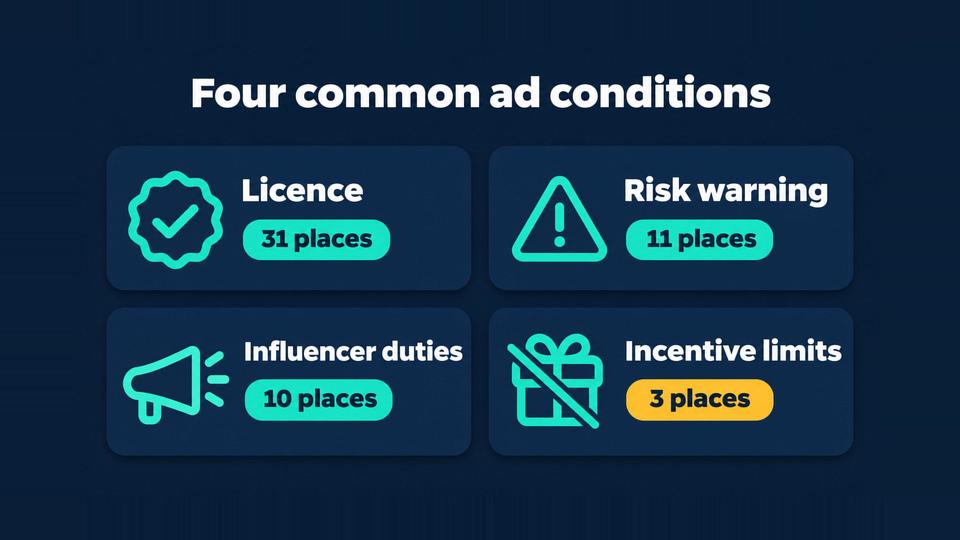
- Licensing comes first: in most jurisdictions covered, an unlicensed firm cannot lawfully advertise crypto services to local users.
- Europe sets the most conditions per rule, mostly through MiCA and the UK’s financial promotions regime.
- Every row links to its source and says whether it was verified, so you can check a rule before you rely on it.
|
10 jurisdictions set specific duties for influencers or paid promoters Source: BAF dataset v1.0 |
6 rules adopted or proposed but not yet in force Source: BAF dataset v1.0 |
39 rows verified against a regulator, gazette or legislature Source: BAF dataset v1.0 |
Which countries restrict or ban crypto advertising?
Of the 50 rules currently in force, 45 restrict crypto ads. Three ban them, and two set no crypto-specific advertising rule.
In most places “restricted” means the same thing in practice: a licensed firm may advertise, usually with set wording or a warning, and an unlicensed one may not.
The three bans in force are in China, Russia and Qatar. We could not check any of them against a primary text yet, so all three are marked unverified.
Mexico and South Korea are the two “no specific rule” rows. Mexico’s central bank limits what banks and licensed fintech firms may offer to the public; Korea’s 2024 user protection act deals with deposits and unfair trading and says nothing specific about ads, at least in the regulator’s English summaries.
What does the data show about crypto advertising rules?
Licensing decides who may advertise. Everything else sits on top of it.
Europe has the highest share of rules that set two or more conditions, with 11 of its 18 rows, and most of that comes from MiCA’s marketing articles and the UK’s financial promotions regime. If you are planning a retail launch across several markets, start your review with the UK and Singapore: the UK sets the most conditions on a single ad, and Singapore rules out the public channels most launch plans depend on.
- Risk warnings or set disclaimers are required in 11 jurisdictions, from the EU and the UK to India, Thailand and Kenya.
- Only the UK, France and Singapore limit sign-up bonuses, referral rewards or trading incentives.
- The UK, New York and Thailand each have a single rule that combines a licence, a warning and influencer duties.
- Hong Kong, the Philippines, Vietnam, Kenya and New York all added rules in 2025 or 2026.
Middle East rows show the fewest stated conditions. Treat that as a gap in our coding. Dubai’s VARA regime is detailed, but several of its fields stay “unclear” until we confirm each condition in the rulebook text itself.
How do the major crypto advertising regimes compare?
These eight regimes come up most often in launch plans. Each row here is verified from a primary source.
| Jurisdiction and rule | Licence needed | Risk warning | Influencer duties | Incentive limits |
|---|---|---|---|---|
| United Kingdom: FCA cryptoasset promotions regime | Yes | Yes | Yes (FG24/1) | Yes |
| European Union: MiCA Article 7 and Article 66 | Yes | Yes | No | No |
| Singapore: MAS public marketing guidelines | Yes | Not confirmed | Yes | Not confirmed |
| Hong Kong: AMLO advertising offence | Yes | Not confirmed | Not confirmed | Not confirmed |
| Dubai: VARA Marketing Regulations | Yes | Not confirmed | Not confirmed | Not confirmed |
| India: ASCI guidelines on virtual digital assets | No | Yes | Yes | Not confirmed |
| Thailand: SEC digital asset advertising rules | Yes | Yes | Yes | Not confirmed |
| New York: NYDFS advertising guidance | Yes | Yes | Yes | Not confirmed |
How to read this table: “Yes” means the source states the condition. “Not confirmed” means the source we checked does not settle the point, so it stays an open question. India’s rules come from ASCI, a self-regulatory body, and apply through its industry code.
|
Launching a campaign across several countries? Talk to our team about planning creative that fits each market’s rules. |
How can I find the rules for one country?
Open a region to see its rules. To jump to one country, use your browser’s find (Ctrl+F or Cmd+F).
Each row links to the source we used. Rows marked “unverified” stay in on purpose; the downloadable file’s notes column says what we could not confirm and why.
Europe (17 rules)
Americas (9 rules)
Asia-Pacific (16 rules)
Middle East (5 rules)
| Jurisdiction | Rule and status | Ads | Licence | Risk warning | Influencers | Incentives | Check |
|---|---|---|---|---|---|---|---|
| United Arab Emirates: Dubai (VARA) | Regulations on the Marketing of Virtual Assets and Related Activities 2024 In force |
Restricted | Yes | Not confirmed | Not confirmed | Not confirmed | Verified |
| United Arab Emirates: Abu Dhabi Global Market (ADGM) | FSRA Conduct of Business Rulebook (COBS) Chapter 3 financial promotion rules as applied to Virtual Assets (COBS 17), and Guidance on Regulation of Virtual Asset Activities in ADGM In force |
Restricted | Yes | Not confirmed | Not confirmed | Not confirmed | Verified |
| United Arab Emirates: federal (onshore) | CMA Decision No. 4/R.M/2026 on virtual asset activities and service providers In force |
Restricted | Yes | Not confirmed | Not confirmed | Not confirmed | Unverified |
| Saudi Arabia | Standing committee warnings that virtual currencies are not regulated in the Kingdom and no party is licensed to deal in them In force |
Restricted | No | Not confirmed | Not confirmed | Not confirmed | Verified |
| Israel | Supervision of Financial Services (Regulated Financial Services) Law, 2016: licensing of financial asset service providers including virtual currency In force |
Restricted | Yes | Not confirmed | Not confirmed | Not confirmed | Unverified |
Africa (5 rules)
| Jurisdiction | Rule and status | Ads | Licence | Risk warning | Influencers | Incentives | Check |
|---|---|---|---|---|---|---|---|
| Nigeria | Amendments to the SEC Rules on Digital Assets Issuance, Offering Platforms, Exchange and Custody (2024), including advertisement, marketing and promotion In force |
Restricted | Yes | Not confirmed | Yes | Not confirmed | Verified |
| Nigeria | Proposed Rules on Digital and Virtual Assets Operations, Custody and Markets Proposed |
Restricted | Yes | Not confirmed | Not confirmed | Not confirmed | Verified |
| South Africa | Declaration of crypto assets as a financial product under the FAIS Act (General Notice 1350 of 2022) In force |
Restricted | Yes | Not confirmed | Not confirmed | Not confirmed | Verified |
| Kenya | Virtual Asset Service Providers Act, 2025 (Act No. 20 of 2025) In force |
Restricted | Yes | Not confirmed | Not confirmed | Not confirmed | Verified |
| Kenya | Virtual Asset Service Providers Regulations, 2026 In force |
Restricted | Yes | Yes | Not confirmed | Not confirmed | Unverified |
Which rules apply to crypto influencers?
Paid crypto promotion by influencers is covered by a specific rule in the UK, the US, France, Singapore, India and five other jurisdictions in the dataset.
The approaches are far apart. Singapore asks crypto firms not to use third-party influencers at all, while the US lets them run and relies on disclosure of the paid relationship.
- In the US, the SEC’s anti-touting rule requires paid promoters of crypto securities to disclose the payment, and the FTC’s endorsement guides apply the same idea to all paid endorsements.
- France’s 2023 influencer law bars paid influencers from promoting digital assets unless the advertiser holds the required French registration or authorisation.
- The UK FCA’s social media guidance warns that an influencer who shares an unapproved crypto promotion may be committing an offence.
- India’s ASCI code asks celebrities and influencers to check a crypto advertiser before they endorse it.
For campaign data, see our analysis of influencer-led crypto campaigns.
How was the dataset built and checked?
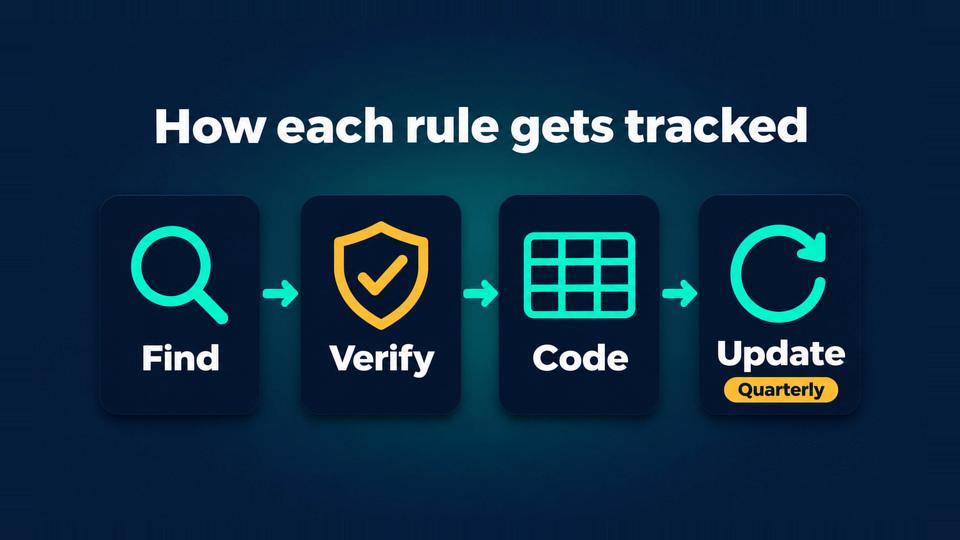
We found each rule through regulator websites, official gazettes, legislatures and central banks, then checked it against the primary text before marking it verified.
Law firm and news trackers helped us find rules. They never verify one on their own. When secondary coverage was all we could find, the row went into the file as unverified with a note on what is missing, because a flagged row is more useful to a reader than a silent gap.
- The yes or no fields are set only when the source states the point; otherwise they read “unclear”.
- Effective dates are left blank when we could not confirm them.
- Summaries are written in our own words, and no regulator or statute text is copied into the data.
- A validation script checks allowed values, date formats, country codes and duplicate IDs before each release.
|
“Before a campaign goes live, we check the rules of every market it targets, and we leave out markets where the client cannot legally advertise. We kept looking up the same rules for each launch, so we put them in one file that anyone can check.” Arun Kamala Santhanath, Marketing Head, Blockchain App Factory |
Limitations you should know about
- Version 1.0 covers 37 jurisdictions, so many countries are not in the file yet.
- EU member state rows describe the national MiCA framework, while the marketing content rules sit in the EU-level rows.
- Some sources are only in the local language and were read through official summaries or translations.
- General consumer law and ad platform policies also apply in most markets, and they are outside the scope of this file.
This dataset is information, not legal advice. Check the linked source and get advice from a qualified local lawyer before you rely on any row.
How do I download and cite the dataset?
The dataset is free under CC BY 4.0. Reuse it for any purpose, including commercial work, as long as you credit Blockchain App Factory.
| Download CSV |
The download includes the data file, a codebook with every column’s allowed values, a README and a changelog.
Kamala Santhanath, A. (2026). Crypto Advertising and Promotion Rules by Country (Version 1.0) [Data set]. Blockchain App Factory. https://www.blockchainappfactory.com/blog/crypto-advertising-rules-by-country/
@dataset{kamala_santhanath_2026_crypto_ads,
author = {Kamala Santhanath, Arun},
title = {Crypto Advertising and Promotion Rules by Country},
year = {2026}, version = {1.0},
publisher = {Blockchain App Factory},
url = {https://www.blockchainappfactory.com/blog/crypto-advertising-rules-by-country/}
}
What should a team check before advertising crypto in a new country?
Start with the licence question. If the answer is no, the rest of the list does not apply in that market.
- Confirm whether your firm, or the firm you promote, holds the licence or registration the target market requires.
- Check whether the market lets unlicensed firms advertise at all, including offshore firms that target local users.
- Look up any mandatory risk warning and its exact wording or format.
- Check whether ads must be filed with or approved by a regulator before they run.
- Review the rules for influencers and paid promoters, including disclosure wording.
- Remove sign-up bonuses, airdrops-for-signup and referral rewards in markets that limit them.
- Check the status column for rules that are adopted but not yet in force.
- Read the source behind any “unverified” row before you act on it.
- Record the date you checked each market, and recheck before every new campaign.
For the product side of launch compliance, see our compliance checklist for crypto project developers.
Red flags in a campaign plan
- The plan targets a market where the project holds no licence and the market bars unlicensed promotion.
- Influencer briefs leave out disclosure wording.
- Creative promises returns or calls a token safe.
- A referral bonus runs in every market with no country exclusions.
When will the dataset be updated?
Every quarter. Each release gets a new version number and a changelog entry, and the plan below is our current order of work.
| 2026-Q4 |
Version 1.0 First release covering all Tier 1 jurisdictions. Next decision: which Tier 2 countries come first. |
| 2027-Q1 |
Version 1.1 Every source rechecked, with pending rules in the US, Japan and Australia reviewed. Next decision: which unverified rows can be upgraded. |
| 2027-Q2 |
Version 1.2 Remaining EU and EEA states added. Next decision: how far to extend into Latin America and Africa. |
| 2027-Q3 |
Version 1.3 More Tier 2 regions added. Next decision: when to start the Tier 3 sweep of remaining UN member states. |
Corrections are welcome at [email protected]. Each fix is credited in the changelog.
How can you use these rules in your next launch?
Use the dataset to shortlist markets before anyone writes creative, then confirm each market with local counsel. Referral bonuses deserve a separate look, since they often live in the product and never pass through ad review. For channel planning once the market list is set, see our guide to crypto marketing strategies.
Blockchain App Factory maintains this dataset and runs a crypto marketing agency that plans campaigns and checks creative against the rules of each target market. It is not a law firm and does not give legal advice.
|
Want your next campaign checked market by market? We plan creative around each market’s rules before anything goes live. |
Frequently asked questions
Which countries ban crypto advertising?
China, Russia and Qatar have the bans recorded in this dataset. China treats crypto business as illegal financial activity, Russia’s advertising law bars digital currency ads, and Qatar does not license virtual asset services. All three rows are still waiting on a primary-source check.
Do crypto influencers have to disclose paid promotions?
Yes, in most jurisdictions with a specific rule, and some go further. The US requires disclosure of payment, France bars paid promotion of unregistered firms, and Singapore asks crypto firms not to use influencers at all.
What are the UK rules for crypto ads?
UK crypto promotions must be made or approved by an authorised firm, or come from a registered cryptoasset business. They need a set risk warning and a 24-hour cooling-off period for new investors, and refer-a-friend bonuses are banned.
Does MiCA require approval of crypto marketing?
No, MiCA does not require prior approval of marketing communications. It does require ads to be identifiable, fair and consistent with the white paper, and they may not run before a required white paper is published.
Can I use this dataset in commercial work?
Yes, the dataset is licensed under CC BY 4.0, which allows commercial reuse. You need to credit Blockchain App Factory and link to the dataset.
A note on this guide
This page is for compliance teams, researchers, journalists and crypto marketers who need a starting point for each country’s advertising rules. Every row was checked on 24 November 2026. The main regulatory sources are linked, and none of the rules or figures were audited by a third party. Rows we could not confirm from a primary source are labeled unverified in the data. Blockchain App Factory sells the crypto marketing services described on this page.
Sources
Regulators and official sources: FCA, ESMA and EUR-Lex, MAS, Hong Kong Government Gazette, VARA, SEC Thailand, NYDFS, SEC (United States), Federal Register (FTC), French Ministry of Economy, CONSOB, BaFin, AFM, Irish Statute Book, CSA, Banco de México, CNV Argentina, OJK, SEC Philippines, SC Malaysia, SEC Nigeria, FSCA, Kenya Law, SAMA.
Self-regulatory and secondary sources used to find rules: ASCI, CMS, Baker McKenzie, Clyde & Co, Legal 500, Al Tamimi & Co, PwC Kenya, The Block, People’s Daily.

Vimal J is the Head of Sales at Blockchain App Factory, with 10+ years of experience in sales, client strategy, and Web3 business growth. He helps startups, enterprises, and project founders choose the right blockchain solutions for their goals, bringing a practical market perspective to topics like token development, crypto launches, and Web3 adoption.
Article Reviewed by:
Arun Kamala Santhanath
Marketing Head, Blockchain App Factory


