
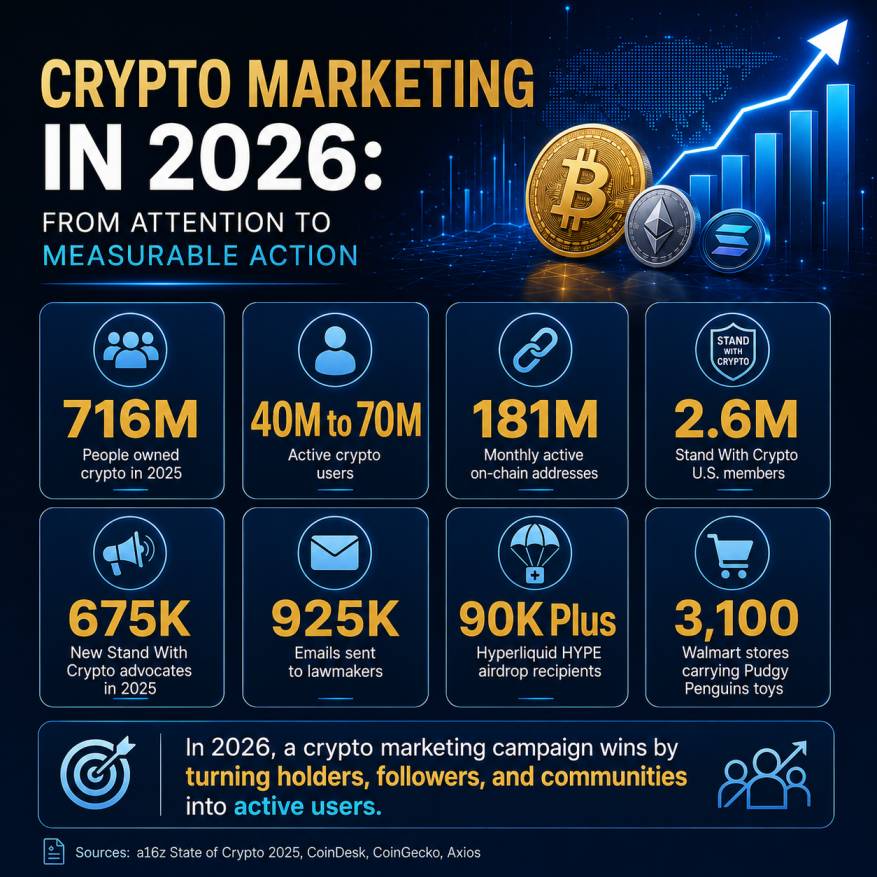
Crypto marketing in 2026 has moved far beyond token launch noise, exchange listings, and short social bursts. The market still rewards speed, but it now punishes empty claims faster. a16z estimated that 716 million people owned crypto in 2025, but only 40 million to 70 million were active crypto users. It also tracked about 181 million monthly active on-chain addresses. That gap creates the main challenge for every crypto marketing campaign: turn passive holders into active users. Retail users now compare projects through dashboards, wallets, X threads, Discord chats, and real product usage. Institutions look for compliance, custody, reporting, and audited partners. Developers judge ecosystems by grants, tooling, liquidity, and user demand.
This shift has made crypto marketing more measurable. A strong campaign now connects brand trust with real action. Coinbase’s Stand With Crypto reached 2.6 million U.S. members and 50 state chapters by early 2026, with 675,000 new advocates in 2025 and 925,000 emails sent to lawmakers. Hyperliquid’s HYPE airdrop reached more than 90,000 users on November 29, 2024, and rewarded traders who already used the product. Pudgy Penguins expanded from 2,000 to 3,100 Walmart stores, with QR codes linking toys to Pudgy World. These examples show the new rule clearly. A crypto marketing campaign wins in 2026 when it turns attention into action, community trust, and measurable product use.
What Makes a Crypto Marketing Campaign Successful in 2026?
A successful crypto marketing campaign in 2026 starts with trust. Users have seen failed tokens, fake communities, paid influencer noise, and weak roadmaps. They now want to know who built the product, what problem it solves, and where proof appears. A campaign must answer those points before it asks users to join, mint, stake, trade, or invest.
Trust comes from proof, not claims. The strongest campaigns use public data, visible partners, real users, and clear risk language. A DeFi launch should show trading volume, active wallets, TVL, fees, and retention. A gaming campaign should show player counts, session data, streamer reach, and repeat play. A Layer-2 campaign should show developer activity, transactions, apps, and grants. Base’s Onchain Summer gives a strong example. Base backed the campaign with more than 600 ETH in prizes, grants, and gas credits. Its buildathon drew over 7,500 builders and more than 1,250 project submissions. The message was simple. Build on Base, get support, and show real work.
Community depth is the next marker of success. A large audience can look good on screenshots, but shallow communities rarely convert. Strong communities ask questions, create content, test products, host spaces, translate updates, and defend the brand during market stress. Stand With Crypto used petitions, scorecards, state chapters, and badge minting to turn users into active members. That kind of participation creates better memory than a paid ad alone.
Channel mix matters too. Crypto users do not follow one path. They see a project on X, check Telegram, read a blog, compare token data, search Reddit, watch a YouTube review, and inspect a wallet activity chart. A strong campaign links these channels with one message. Paid ads create reach. SEO builds long-term discovery. KOLs create social proof. PR builds authority. Community teams answer doubt. On-chain data confirms action.
In 2026, the best campaigns separate hype from measurable growth. Memes still matter. Airdrops still attract users. Influencers still move attention. The difference is the follow-up. Did users return after the reward? Did they trade, play, build, stake, vote, or refer others? Did the campaign reduce acquisition cost? Did it create holders with strong conviction? These questions decide campaign quality.
AI has changed campaign execution, but it cannot replace clear strategy. Teams now use AI for audience research, wallet segmentation, support bots, ad testing, and performance reports. The risk is sameness. AI-generated posts can sound generic. The projects that win use AI for speed, then add human judgment, product facts, and community context.
A crypto campaign succeeds in 2026 when it ties attention to action. The best examples share one pattern. They give users a role, show proof, measure behavior, and keep the story alive after launch day. That is the standard for success stories in the new market cycle.
Ready to Turn Your Crypto Project into the Next Success Story?
Partner with experts to drive visibility, engagement, and growth for your crypto project.

Real Time Case Studies
1. Coinbase’s Stand With Crypto – Exchange Growth Through Advocacy
Campaign type: Exchange growth + trust-building campaign
Story:
Coinbase did not market only trading features or signup offers. Through Stand With Crypto, it built a large advocacy campaign that turned crypto users into policy supporters. The campaign used on-chain participation, petitions, lawmaker scorecards, state-level chapters, and email actions to make users feel part of a bigger movement.
Objective:
Build trust in crypto, mobilize users around regulation, and strengthen Coinbase’s brand as a leader in the U.S. crypto ecosystem.
Strategy:
Instead of pushing a pure acquisition campaign, Coinbase created a category-level advocacy movement. The campaign gave crypto users a clear action path: join the movement, mint a badge, contact lawmakers, sign petitions, and participate in local advocacy.
Channels used:
Website, Coinbase ecosystem, email, social media, on-chain NFT minting, policy events, local chapters, and PR.
Community tactics:
Shield NFT minting, petitions, lawmaker scorecards, email-your-representative actions, local community chapters, and public supporter counts.
KPIs / result:
Stand With Crypto reported 675,000 new signups in 2025, reaching 2.6 million U.S. members, and said supporters sent 925,000 emails to lawmakers in 2025. Coinbase also reported that its inaugural shield NFT had been minted over 160,000 times and that the campaign raised over $215,000 for advocacy organizations.
Lesson for 2026:
The best exchange marketing campaigns are not only about fee discounts or referral bonuses. In 2026, trust, regulation, user education, and community mobilization can become powerful acquisition channels.
2. Hyperliquid – DeFi Growth Through Product-Led Airdrop Marketing
Campaign type: DeFi launch + points-to-airdrop campaign
Story:
Hyperliquid became one of the strongest examples of DeFi marketing because it did not rely only on hype. It built a high-performance perpetuals exchange, rewarded early users through points campaigns, and converted active traders into community advocates through the HYPE airdrop.
Objective:
Attract real traders, grow liquidity, increase trading volume, and build a loyal DeFi-native community before and after token launch.
Strategy:
Hyperliquid used a product-first + community-first approach. Instead of launching a token before usage, it created demand through actual trading activity, points seasons, and a highly discussed airdrop model.
Channels used:
Product-led growth, trader communities, X, Discord/Telegram discussions, airdrop tracking dashboards, DeFi influencers, and word-of-mouth among active traders.
Community tactics:
Points seasons, active-user rewards, community allocation narrative, transparent airdrop eligibility discussions, and trader-led content.
KPIs / result:
CoinGecko described HYPE as the largest airdrop in crypto history, distributed to more than 90,000 users on November 29, 2024. Hyperliquid’s public analytics also show major traction, with DefiLlama listing billions in TVL and very large cumulative perpetuals trading volume.
Lesson for 2026:
Airdrop campaigns work best when they reward meaningful behavior. For DeFi projects, trading volume, liquidity, retention, fees, and active wallets matter more than simple social tasks.
3. Pudgy Penguin’s PENGU + Retail IP Flywheel – Meme Marketing With Brand Utility
Campaign type: Memecoin / NFT / consumer IP campaign
Story:
Pudgy Penguins is a strong real-life example because it turned a crypto-native NFT brand into a mainstream consumer IP brand. Its growth was not based only on token speculation. The project combined toys, retail distribution, NFT community identity, Pudgy World, and the PENGU token to create a wider brand ecosystem.
Objective:
Expand from NFT holders to mainstream consumers, increase brand visibility, and connect Web2 audiences with Web3 experiences.
Strategy:
Pudgy Penguins used an IP-first marketing strategy. Physical toys introduced the brand to retail audiences, while QR codes and Pudgy World helped bring users into the digital experience. The PENGU token then became part of the broader community and brand flywheel.
Channels used:
Walmart retail distribution, social media, memes, Pudgy World, token airdrop, NFT community channels, exchanges, and creator-led content.
Community tactics:
NFT holder identity, licensing opportunities, token airdrop, “Huddle” community language, browser-based Pudgy World access, and social-first meme content.
KPIs / result:
Axios reported that Pudgy Penguins expanded its Walmart footprint from 2,000 to 3,100 stores, with QR codes connecting toys to Pudgy World. CoinMarketCap’s PENGU launch overview also noted that 25.9% of token supply was allocated to the Pudgy community airdrop.
Lesson for 2026:
Memecoin-style campaigns are stronger when they are backed by real brand distribution, community identity, and user experience. However, token price volatility should be mentioned honestly, because brand success does not always equal token price success.
4. Base’s Onchain Summer – Layer-2 Ecosystem Marketing
Campaign type: Layer-2 ecosystem growth campaign
Story:
Base’s Onchain Summer turned a technical Layer-2 ecosystem into a cultural campaign. Instead of talking only about scalability and low fees, Base positioned on-chain activity as something creators, brands, builders, and everyday users could join.
Objective:
Onboard users, creators, developers, and brands into the Base ecosystem.
Strategy:
Base used a seasonal campaign format with creator drops, buildathons, on-chain experiences, grants, gas credits, and ecosystem-wide participation. The campaign made Base feel like a movement rather than just infrastructure.
Channels used:
Base blog, Coinbase ecosystem, X, Farcaster, creator campaigns, NFT mints, Devfolio, partner communities, and developer programs.
Community tactics:
Buildathons, creator rewards, ecosystem grants, on-chain awards, open participation, smart wallet onboarding, and brand collaborations.
KPIs / result:
Base said Onchain Summer 2024 included more than 600 ETH in prizes, grants, and gas credits. Its buildathon attracted over 7,500 builders and more than 1,250 project submissions. Devfolio’s 2025 Onchain Summer Awards also tracked metrics such as repeat users, new users, transaction volume, Base app sessions, and Farcaster engagement.
Lesson for 2026:
Layer-2 campaigns should not market only speed or gas fees. The winning approach is to create repeatable ecosystem events with measurable on-chain participation.
5. Off The Grid – GameFi User Acquisition Through Mainstream Gaming
Campaign type: GameFi user acquisition campaign
Story:
Off The Grid became a useful 2026 case study because it approached Web3 gaming differently. Instead of leading with tokenomics, it led with gameplay, console access, streamer visibility, and mainstream gaming distribution.
Objective:
Acquire real gamers, not only crypto users.
Strategy:
The campaign used a crypto-optional gaming approach. It focused on free-to-play access, high-quality gameplay, Twitch/streamer visibility, and Epic Games Store distribution while keeping blockchain elements less intrusive.
Channels used:
Epic Games Store, PlayStation/Xbox ecosystem, Twitch, YouTube, X, streamer partnerships, gaming media, and social clips.
Community tactics:
Streamer-led discovery, gameplay clips, player communities, creator campaigns, and competitive gameplay conversations.
KPIs / result:
CoinMarketCap reported that Off The Grid became a top free-to-play title on Epic Games Store and attracted 148,000 Twitch viewers on a Friday. The Defiant also reported strong early user and address activity, while Blockworks later noted that wallet metrics should not be treated as the same thing as player counts.
Lesson for 2026:
GameFi marketing should lead with game quality, creators, and retention. Wallets, transactions, and NFTs are useful KPIs, but they should not replace real gaming metrics such as daily players, session length, and retention.
6. Virtuals Protocol – AI + Crypto Product Launch Campaign
Campaign type: AI + crypto launch campaign
Story:
Virtuals Protocol became one of the most visible AI-crypto examples by connecting AI agents with tokenization, co-ownership, and on-chain commerce. Its Genesis mechanism helped position AI agent launches as a participatory crypto-native product category.
Objective:
Turn AI agents into tokenized, community-owned digital assets and attract users to agent launches.
Strategy:
Virtuals built its campaign around the narrative of AI agents as economic actors. Its messaging focused on agent tokenization, fair access, co-ownership, on-chain coordination, and revenue-generating AI agents.
Channels used:
X, Base ecosystem, AI-crypto communities, launch platform, whitepaper, research coverage, DEX/CEX market visibility, and analyst threads.
Community tactics:
Genesis participation, agent launches, tokenized ownership, contributor-based access, and AI-agent community narratives.
KPIs / result:
DWF Labs noted that Virtuals’ Genesis mechanism was introduced in April 2025 to provide fairer access to AI agent tokens. Bitstamp reported that Virtuals launched in October 2024 and crossed $1 billion in market cap in December 2024. Messari later reported that AI agents launched on Virtuals had a combined market cap north of $500 million as of September 9, 2025.
Lesson for 2026:
AI + crypto campaigns should not depend only on the AI narrative. They need proof of agent usage, revenue, autonomy, and stakeholder alignment. A 2026 arXiv paper warned that many AI-agent crypto projects still lack clear evidence of autonomous execution and that token holders in its sample collectively lost significant value.
7. BlackRock BUIDL – Tokenized RWA Marketing Through Institutional Trust
Campaign type: Tokenized real-world asset campaign
Story:
BlackRock’s BUIDL is a strong RWA marketing example because it does not use traditional crypto hype. Its campaign strength comes from institutional credibility, transparent on-chain fund data, treasury exposure, and the BlackRock/Securitize ecosystem.
Objective:
Build confidence in tokenized treasuries and prove that institutional-grade assets can exist on-chain.
Strategy:
BUIDL’s marketing is based on trust-first positioning: regulated structure, institutional brand recognition, on-chain transparency, yield-bearing treasury exposure, and measurable fund data.
Channels used:
Institutional PR, Securitize ecosystem, RWA data dashboards, media coverage, blockchain ecosystem partners, and fund analytics platforms.
Community tactics:
This is not a typical retail community campaign. Its “community” is made up of institutions, fund participants, ecosystem partners, and RWA-focused DeFi integrations.
KPIs / result:
RWA.xyz listed BUIDL with about $2.43 billion in total asset value, 108 holders, a 3.40% 7-day APY, and about $1.46 billion in monthly transfer volume at the time checked. CoinGecko also tracked BUIDL as one of the largest tokenized RWA products, though liquidity and trading activity should be interpreted carefully.
Lesson for 2026:
RWA marketing is not about virality. It is about credibility, compliance, transparency, liquidity, holder quality, and institutional trust.
Crypto Marketing Campaign Framework for Startups
Crypto startups need a clear campaign system before they spend on ads, creators, or PR. The market now rewards proof. Users check token pages, wallet data, Discord chats, X threads, audits, founder history, and product activity. A weak campaign collapses fast, since users can test claims in minutes.
The Step-by-Step Crypto Marketing Campaign Flow
A strong crypto marketing campaign follows a simple path:
Research: Study Users Before Planning the Campaign
Research comes first. A startup must know who it serves, what users already use, and what pain point still feels unsolved. A DeFi project should study trading behavior, liquidity gaps, fee pain, and user risk concerns. A GameFi project should study gamers before it studies token buyers. Off The Grid gained attention by leading with gameplay, console access, and streamer reach. It did not ask mainstream players to care about wallets on day one.
Positioning: Build a Clear Market Claim
Positioning turns research into a clear market claim. A project should explain what it does in one short line. The claim must pass a basic test: can a user repeat it after one visit? Coinbase’s Stand With Crypto passed that test. The campaign asked users to defend crypto policy rights. It gave them a role, not just a brand message. That helped the group reach 2.6 million U.S. members and 50 state chapters.
Community Building: Create Trust Before Launch
Community building starts before launch. Many startups treat Telegram and Discord as support rooms. Strong teams treat them as research labs, trust centers, and launch engines. Members ask hard questions, test product flows, report bugs, host spaces, translate updates, and share proof. The goal is not a large group count. The goal is repeat action.
Content: Turn the Campaign Message Into Searchable Assets
Content gives the campaign depth. A startup needs explainers, founder notes, product tutorials, SEO pages, case studies, threads, videos, and comparison pages. Search content matters more in 2026, since AI search tools pull structured answers from clear pages. A page that defines the problem, shows use cases, cites data, and answers buyer questions has higher value than a thin announcement post.
Influencers: Use KOLs After the Core Message Is Clear
Influencers and KOLs work best after the message is clear. Paid posts can create fast reach, but poor fit harms trust. Crypto users know the difference between real product users and paid promoters. Hyperliquid gained stronger market attention through traders, airdrop trackers, DeFi creators, and product talk. Its HYPE airdrop reached more than 90,000 users, and the story spread through users who cared about trading performance.
PR: Build Third-Party Proof Around Real Milestones
PR gives third-party proof. A startup should use PR to support major moments: funding, audits, launch, grants, exchange listing, product milestones, or user growth. PR without substance fades fast. PR linked to data gives the market a reason to pay attention.
Paid Ads: Send Users to Strong Landing Pages
Paid ads work after trust assets exist. Ads should send users to strong landing pages, not vague homepages. The campaign should split traffic by intent. New users need simple education. Traders need fees, liquidity, and execution data. Developers need docs, grants, and tooling. Institutions need compliance, custody, reporting, and risk controls.
On-Chain Growth: Turn Attention Into Wallet Activity
On-chain growth gives crypto campaigns their strongest proof layer. Quests, mints, staking, trading, swaps, votes, referrals, and liquidity actions show real behavior. Base used Onchain Summer to turn its Layer-2 campaign into measurable activity. It backed the event with more than 600 ETH in prizes, grants, and gas credits. Its buildathon drew more than 7,500 builders and over 1,250 submissions.
Analytics: Track the Metrics That Prove Real Growth
Analytics connect every channel to outcomes. Startups should track active wallets, acquisition cost, conversion rate, referral source, TVL, holder quality, churn, repeat use, and revenue. Social metrics still matter, but they should not lead the report. A campaign with 500 loyal users can beat one with 50,000 passive followers.
Retention: Keep Users Active After Launch Week
Retention closes the loop. Launch week creates attention. Retention turns attention into value. Teams should plan post-launch education, feature drops, governance updates, reward cycles, and community calls before the campaign starts.
10 Proven Crypto Marketing Strategies Behind Successful Campaigns
Community Building
Community building sits at the center of every strong crypto campaign. Users trust active communities more than polished ads. A good community manager answers doubt, shares product updates, stops spam, collects feedback, and guides new users through first actions.
KOL Marketing
KOL marketing adds reach and social proof. The best KOLs match the project category. A DeFi trader brings value to a perp exchange. A gaming streamer brings value to a Web3 game. A policy voice brings value to an advocacy campaign. Poor KOL fit wastes budget and creates distrust.
SEO
SEO builds long-term discovery. Crypto buyers search before they act. They compare fees, tokenomics, audits, chains, grants, risks, and reviews. Strong SEO pages answer these searches in plain language. They attract users after the paid campaign ends.
PR
PR builds authority. Startups should pitch clear news, not broad claims. A funding round, audit, user milestone, mainnet launch, or major partner gives journalists a reason to cover the story.
Telegram Growth
Telegram growth still matters for many token launches. It gives users a direct place to ask questions. Growth must stay clean. Fake members, bot comments, and copied replies damage trust fast.
X Marketing
X marketing drives public conversation. Crypto news breaks on X, and users follow founders, traders, analysts, and project accounts there. Strong posts use charts, product clips, founder comments, and clear campaign updates.
Quest Campaigns
Quest campaigns turn attention into action. Good quests reward product use, not empty clicks. A DeFi quest can reward swaps or liquidity. A game quest can reward playtime. A Layer-2 quest can reward app use.
Wallet Targeting
Wallet targeting helps teams reach users by behavior. A project can segment traders, NFT holders, bridge users, stakers, or DAO voters. This creates better campaign timing and cleaner offers.
AI Marketing Automation
AI marketing automation speeds up research, support, content drafts, segmentation, and reporting. It works best with human review. Crypto users reject generic posts fast.
Growth Analytics
Growth analytics bring the campaign back to facts. The strongest teams review cost, conversion, retention, wallet quality, revenue, and community activity each week. Then they adjust spend, content, rewards, and channel focus. That discipline separates real growth from short-term noise.
Data points used for this section come from Stand With Crypto, Base, Hyperliquid, and Pudgy Penguins campaign references. Stand With Crypto reached 2.6 million U.S. members. Base offered more than 600 ETH in Onchain Summer prizes, grants, and gas credits. Hyperliquid reached more than 90,000 users through the HYPE airdrop. Pudgy Penguins expanded to 3,100 Walmart stores.
Ready to Scale Your Crypto Brand with Winning Marketing Strategies?
Crypto Marketing Campaign Checklist 2026
A crypto marketing campaign in 2026 needs more than a launch post, a Telegram group, and a few paid creator mentions. Users now check proof before they act. They read token pages, compare on-chain data, search founder history, review audits, and scan X conversations. A campaign must give them clear reasons to trust the project.
This checklist gives startups a practical way to plan each campaign stage. It covers brand position, search, PR, community, paid growth, wallet activity, AI tools, and retention. Each part should support one goal: move users from awareness to real action.
Brand Positioning: Define the Campaign Promise
Brand positioning comes first. A project must explain what it offers in one clear line. Users should understand the product, target audience, and main benefit within seconds. A vague promise weakens every channel that follows.
Coinbase’s Stand With Crypto shows the power of a clear promise. The campaign asked users to support crypto policy rights in the United States. That message gave users a public role. It helped the group reach 2.6 million U.S. members and 50 state chapters. The campaign worked since users knew exactly what action to take.
Website SEO: Build Pages That Answer Buyer Questions
Website SEO gives the campaign long-term reach. A crypto startup needs pages that answer search intent, not only brand claims. These pages should explain the product, token model, roadmap, risks, use cases, and user steps.
Strong SEO pages support AI search visibility too. AI tools often extract clean answers from structured content. Pages with clear headings, facts, short definitions, FAQs, charts, and source links stand a better chance of being cited. A crypto marketing checklist, pricing guide, case study, or comparison page can attract users long after the launch campaign ends.
PR: Use News Only for Real Milestones
PR works best with facts. A funding round, mainnet launch, audit, exchange listing, grant pool, user count, or major partner gives media outlets a reason to cover the project. Broad claims do not travel far.
Base used real numbers to support Onchain Summer. The campaign offered more than 600 ETH in prizes, grants, and gas credits. Its buildathon drew more than 7,500 builders and over 1,250 submissions. These facts made the campaign easier to report and easier to trust.
Community: Turn Members Into Active Participants
Community remains one of the strongest growth channels in crypto. A healthy community does more than react to announcements. Members ask questions, test products, report issues, join spaces, create memes, translate updates, and guide new users.
Telegram and Discord need active moderation. Fake members, bot replies, and copied answers damage trust. A smaller group with real discussion has more value than a large silent channel. The best teams train community managers to answer product, token, security, and roadmap questions with clear facts.
Influencers and Paid Ads: Buy Reach After Trust Exists
Influencer marketing and paid ads can bring quick attention. They work best after the brand message, landing page, and community channels are ready. Paid traffic sent to a weak page burns budget.
KOL selection should match the campaign category. A DeFi trader fits a perpetual exchange. A gaming creator fits a Web3 game. A policy analyst fits an advocacy campaign. Poor fit creates doubt. Hyperliquid gained attention from traders, airdrop trackers, and DeFi creators. Its HYPE airdrop reached more than 90,000 users, and the story spread through people who used the product.
Analytics and Wallet Growth: Track Real User Behavior
Crypto campaigns should measure more than views, likes, and followers. Teams need to track active wallets, conversion rate, TVL, trading volume, holder quality, staking activity, referrals, revenue, churn, and repeat use.
Wallet growth gives stronger proof than surface-level social reach. A quest campaign should reward product actions, not empty clicks. A DeFi quest can reward swaps, deposits, or liquidity. A gaming quest can reward playtime. A Layer-2 quest can reward app activity across partner projects.
Email Automation and On-Chain Tracking: Keep Users Moving
Email still matters in crypto marketing. It helps teams educate users, send launch reminders, share security updates, and bring inactive users back. Email flows should match user behavior. A new wallet user needs onboarding. A trader needs product data. A token holder needs governance, staking, or reward updates.
On-chain tracking adds another layer of campaign proof. Teams can study wallet cohorts, repeat activity, drop-off points, claim rates, mint behavior, and referral paths. This helps them fix weak steps before spend rises.
AI Tools: Speed Up Work Without Losing Human Judgment
AI tools can support research, segmentation, support replies, content drafts, ad testing, and reporting. They save time, but they do not replace product knowledge. Crypto users reject generic posts fast. Teams should review every AI-assisted message for accuracy, tone, risk language, and market context.
AI works best with clear inputs. A team should feed it campaign goals, user data, audience groups, approved claims, product documents, and compliance rules. That keeps the output close to the project’s real value.
Quick 2026 Campaign Checklist
- Brand Positioning
- Website SEO
- PR
- Community
- Influencers
- Paid Ads
- Analytics
- Wallet Growth
- Email Automation
- On-chain Tracking
- AI Tools
Conclusion
Crypto marketing in 2026 rewards proof, clarity, and repeat user action. The strongest campaigns do not chase attention alone. They guide users toward a specific action, then prove the result through data. A startup should begin with a clear promise, support it with SEO, PR, community, KOLs, paid traffic, and on-chain activity, then measure wallet quality, retention, revenue, and product use.
For startups that want to build a results-focused crypto marketing campaign, Blockchain App Factory brings the right mix of Web3 strategy, community growth, influencer outreach, PR, paid marketing, SEO, and on-chain campaign planning. Our team helps crypto brands shape clear market messages, reach the right users, and turn campaign attention into measurable growth. The best crypto campaigns give users a reason to care, a simple path to act, and proof that the project can deliver.

Vimal J is the Head of Sales at Blockchain App Factory, with 10+ years of experience in sales, client strategy, and Web3 business growth. He helps startups, enterprises, and project founders choose the right blockchain solutions for their goals, bringing a practical market perspective to topics like token development, crypto launches, and Web3 adoption.