Key Insights
- ERC-3643 suits tokenized assets that require verified investors, permissioned transfers, wallet recovery, freezes, and issuer-controlled actions across the asset lifecycle.
- ERC-1400 partition model supports separate investor classes, tranches, lock-ups, transfer conditions, document references, and controller actions within one security.
- Projects should define investor rights, eligibility rules, transfer limits, redemption terms, issuer powers, and infrastructure needs before selecting ERC-3643 or ERC-1400.
In asset tokenization, minting a token is probably the easiest step. But that changes the moment real investors start using it. Someone wants to transfer, another investor no longer qualifies, or a wallet gets lost. According to DTCC, its July 15, 2026 initiative used DTC-tokenized assets in live trades with more than 30 firms, showing how quickly these issues move from theory into real financial activity.
After that, the RWA token standard becomes more than just a development option. It decides who can hold the asset, when ownership can move, what happens if a rule is broken, and how much control the issuer keeps. For RWA tokenization, those decisions follow the asset long after issuance, from investor onboarding to secondary transfers and recovery.
ERC-3643 and ERC-1400 approach those needs from different directions. Both support regulated token models, but they handle identity, ownership conditions, transfer rules, and issuer control differently. In this blog, we compare both through real asset scenarios and show where each standard actually fits.
What This Blog Answers
- How do ERC-3643 and ERC-1400 differ for asset tokenization projects?
- Which token standard is best for real-world asset tokenization today?
- How should you choose between ERC-3643 and ERC-1400 for RWAs?
What Should You Look for in an Asset Tokenization Standard?
Before you compare ERC-3643 with ERC-1400, start with your asset itself. Ask what investors will be actually allowed to do after they buy it, because that is where the token standard earns its place. From who can hold the token to what happens when ownership changes, these rules should be decided before development, not patched in later.
What are ERC-3643 and ERC-1400? How Do They Operate?
ERC-3643:
ERC-3643 is a permissioned security token standard designed to control who can hold a token and whether a transfer is allowed. Before tokens move, it checks whether the recipient is verified and whether the transaction follows the issuer’s rules. Additionally, it supports agent-controlled transfers throughout the token lifecycle as well as freezes, stops, recovery, minting, and burning.
How ERC-3643 works:
Wallet → Identity verified → Compliance checked → Transfer approved or blocked.
ERC-1400:
ERC-1400 is a security token framework designed for assets whose ownership can carry different rights, restrictions, or states. Its partition model can separate balances by class or condition, while related interfaces cover transfer checks, issuance and redemption, document references, and controller actions such as forced transfers when required.
How ERC-1400 works:
Balance or partition → Conditions checked → Transfer, issuance, or redemption proceeds.
Real Estate Tokenization in Practice: ERC-3643 vs ERC-1400
A real estate tokenization project should not begin with, “Which ERC should we use?” Take it a step further: what precisely will the token stand for? A building, an SPV share, a fund interest, or a contractual claim can give investors very different rights, so that answer should come before choosing how the token handles ownership, transfers, and compliance.
1. What Exactly Is the Investor Buying?
Start with the asset itself. If a commercial property is held through an SPV and the token represents shares in that SPV, the legal documents need to spell out what those shares give the investor. That could include economic rights, voting rights, distributions, or redemption terms. The smart contract can enforce agreed rules, but it does not create those legal rights on its own.
2. Who Is Allowed to Hold the Token?
Determine who is permitted to engage after the ownership model is defined. With ERC-3643, the receiving wallet must be linked to a verified on-chain identity with the required claims, and every transfer must pass the applicable compliance checks. With ERC-1400, investor restrictions can be enforced through on-chain rules, approved signed data, or a mix of both.
3. Do All Tokens Carry the Same Rights?
If sponsors and outside investors hold interests in the same property but have different lock-ups, rights, or transfer conditions, the token model needs to reflect that. ERC-1400 can separate balances into partitions, allowing different portions of the same security to follow different rules. ERC-3643 is more direct when the main requirement is controlling ownership through verified investor identities and transfer eligibility.
4. What Happens When Someone Wants to Sell?
This is where the token model gets tested in practice. ERC-3643 allows a transfer to verify the buyer’s identity, whether either wallet is frozen, whether there are enough tokens available, whether transfers are halted, and whether the transaction complies with compliance regulations. Prior to the tokens moving, ERC-1400 can additionally verify the transfer and impose limitations associated with the pertinent partition.
5. What Happens When Something Goes Wrong?
The project also needs a plan for exceptions. An investor may be subject to a court order, lose access to a wallet, or lose their ability to possess the asset. Wallet recovery, freezes, pauses, and forced transfers are all supported by ERC-3643. Controller features in ERC-1400 can facilitate intervention in situations like fraud, misplaced keys, or court-mandated activities.
How to Choose the Best Token Standard for Your Real-World Asset Tokenization Project?
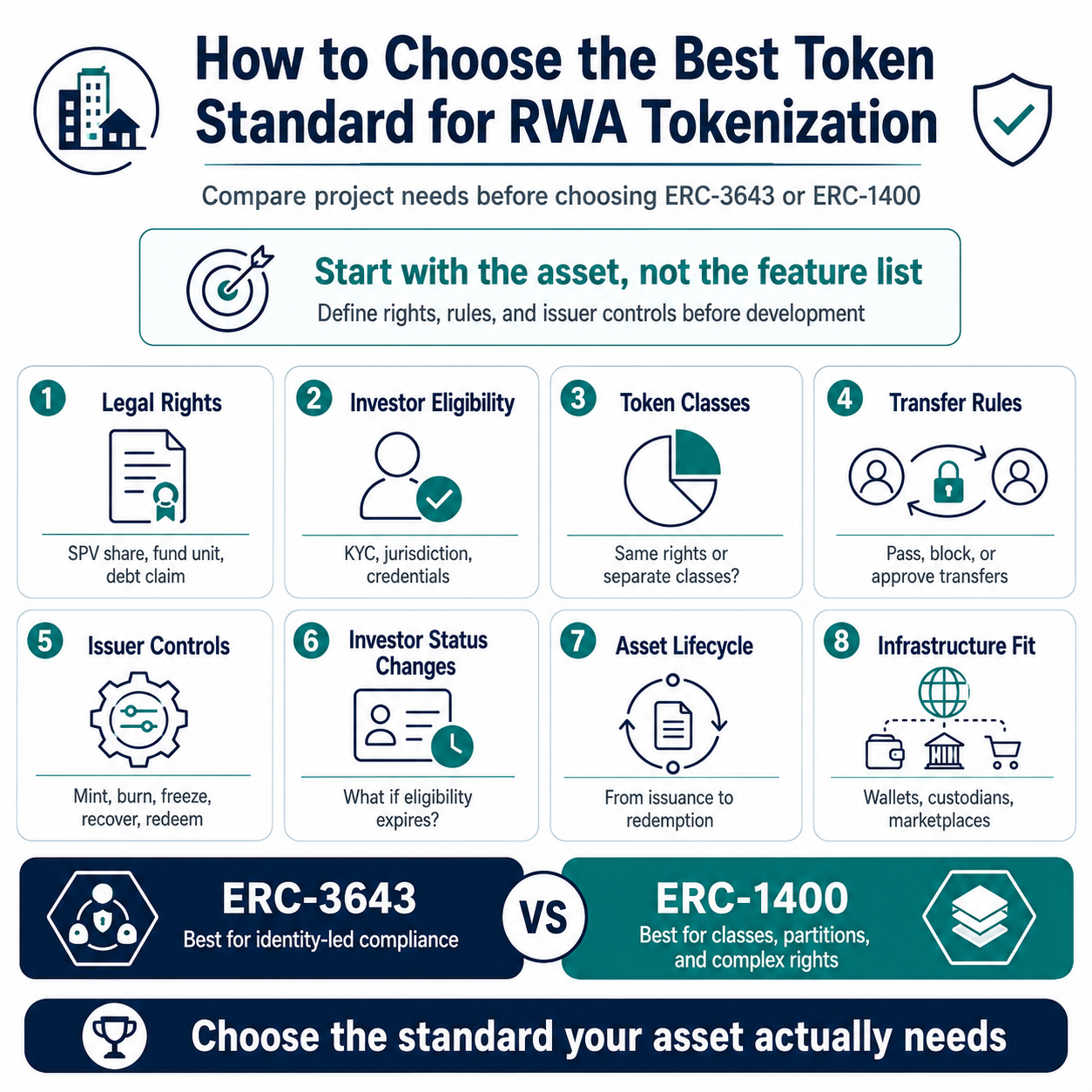
Do not pick a RWA token standard because its feature list looks longer. Write down what the asset represents, who may hold it, how a sale can fail, and what the issuer must be able to do. Those answers are far more useful when comparing ERC-3643 vs ERC-1400.
✓ Legal Rights Behind the Token
- Name the right: SPV share, fund unit, debt claim, or another interest.
- Confirm the legal documents give investors that right.
- Note voting, distributions, transfers, redemption, and holding conditions.
- Neither ERC creates those legal rights for the project.
✓ Investor Eligibility Rules
- List the eligibility rules for every buyer and receiving wallet.
- Decide how KYC, jurisdiction, investor status, and credentials are confirmed.
- ERC-3643 uses on-chain identities, trusted claims, and an Identity Registry.
- ERC-1400 can apply identity-related restrictions without requiring one identity system.
✓ Token Classes & Holding Conditions
- Check whether every unit carries the same rights and restrictions.
- Flag separate classes, lock-ups, issuance groups, or transfer conditions.
- ERC-1400 partitions can keep those balances distinct within one security.
- If partitions solve nothing specific, do not add them without a reason.
✓ Transfer Approval Rules
- Write every reason a sale should pass, fail, or need approval.
- ERC-3643 checks verification, freezes, available balance, pause status, and compliance.
- ERC-1400 supports pre-checks, failure reasons, partitions, and signed external data.
- Test those rules against the secondary trades investors may actually make.
✓ Issuer Powers & Controls
- Decide who may mint, burn, freeze, recover, redeem, or force transfers.
- ERC-3643 defines owner and agent roles for issuer actions.
- ERC-1400 includes redemption functions and controller operations when enabled.
- Set who holds each power and when it may be used.
✓ Changes in Investor Status
- Decide what happens when a credential expires or eligibility changes.
- Set who updates that status and when restrictions take effect.
- ERC-3643 rechecks required identity claims when a recipient receives tokens.
- Decide whether existing holdings stay, face restrictions, or need issuer action.
✓ Full Asset Lifecycle
- Follow issuance, holding, transfers, corporate events, and redemption.
- ERC-1400 covers issuance, redemption, partitions, documents, and controller functions.
- ERC-3643 covers minting, burning, transfers, freezes, recovery, and batch actions.
- Choose functions the project will actually use, not the longest list.
✓ Infrastructure Compatibility
- Confirm support across wallets, custodians, identity services, and secondary venues.
- Check whether they support the chosen transfer and permission model.
- Review how compliance updates and investor records move between systems.
- Test planned integrations before committing the token contract to production.
Which Real-World Asset Type Fits ERC-3643 & ERC-1400 Best?
Asset type helps narrow the choice, but it does not pick the standard for you. The same real estate deal, fund, or bond can need very different rules depending on who may invest, how ownership can move, and whether different holdings carry different rights. Hedera currently supports both standards, which shows why asset category alone is not enough.
Real Estate Interests
ERC-3643: A practical choice for property interests limited to approved investors, with identity checks and compliance rules applied as ownership changes.
ERC-1400: More relevant if the same deal contains separate investor classes, lock-ups, or rights that need distinct partitions.
Check first: SPV rights, resale restrictions, investor categories, and limits attached to secondary transfers.
Private Equity
ERC-3643: Useful for private shares that may move only between eligible wallets, plus issuer powers such as freezes, recovery, minting, burning, or forced transfers.
ERC-1400: Useful for equity with separate share classes, different transfer conditions, document references, or controller actions across the security lifecycle.
Check first: Voting rights, vesting, shareholder classes, transfer approvals, and future recipients.
Bonds & Private Debt
ERC-3643: A solid option for permissioned bond ownership where buyers must stay eligible and transfers must pass the issuer’s compliance rules.
ERC-1400: Particularly relevant for debt split into tranches or balances carrying different restrictions, with issuance and redemption functions available.
Check first: Maturity, redemption, transfer limits, investor eligibility, and tranche treatment.
Tokenized Fund Interests
ERC-3643: Fits fund units tied to verified investor status, jurisdiction, holding limits, or controlled secondary transfers.
ERC-1400: Lets fund managers separate unit classes or holdings that carry different rights, restrictions, or transfer conditions.
Check first: Subscription rules, redemption terms, unit classes, and changes to investor eligibility.
Asset-Based Securities
ERC-3643: Useful for offerings that need verified holders and compliance checks tied to jurisdiction, concentration limits, or other investor conditions.
ERC-1400: Relevant to receivable-backed or pooled-asset securities with separate classes, repayment positions, or restrictions that need distinct balances.
Check first: Holder eligibility, repayment rights, class priority, transfer restrictions, and controller authority.
Conclusion
ERC-1400 and ERC-3643 address distinct aspects of tokenized real-world assets. Projects requiring verified holders, permissioned transfers, compliance checks, and issuer control integrated into the token structure are well suited for ERC-3643. ERC-1400 suits securities that need partitions, distinct holder conditions, document references, and controller actions. For asset owners, that difference affects how the offering operates long after issuance.
Put the ERC names aside and examine the deal itself. What rights do investors receive? Which transfers should pass or fail? Are there different classes, lock-ups, or redemption terms? What authority will the issuer need later? These answers determine whether the token can support the offering without extra workarounds when investors, custodians, and secondary-market activity enter the process.
Before contract development begins, align the legal model, investor onboarding, custody setup, transfer logic, and post-issuance activity with the chosen standard. Blockchain App Factory helps businesses assess these requirements, select the right token structure, and develop compliant RWA tokenization solutions based on the asset, investor model, and lifecycle needs. This early planning can reduce contract changes, integration issues, and operational gaps after launch.

Vimal J is the Head of Sales at Blockchain App Factory, with 10+ years of experience in sales, client strategy, and Web3 business growth. He helps startups, enterprises, and project founders choose the right blockchain solutions for their goals, bringing a practical market perspective to topics like token development, crypto launches, and Web3 adoption.