
Between January 2024 and June 2026, 18.67 million tokens launched on Pump.fun. According to CoinGecko’s analysis, 12.8 million of them, 68.67 percent, recorded their final bonding-curve trade on the same day they went live. Around 850,000, or 4.55 percent, survived past day 90.
That is the market Web3 marketers are working inside right now. Attention is abundant and close to worthless. Distribution costs almost nothing. What is scarce is a user still holding and still using the product three months later.
Compare that with 2021. NFT sales volume hit 24.9 billion dollars that year. OpenSea’s daily trading peaked at 405 million dollars in August 2021. Animoca Brands co-founder Yat Siu told CoinDesk in January 2026 that monthly NFT sales have fallen from more than a billion dollars at the peak to roughly 300 million. The Block’s 2026 outlook puts annualised NFT trade volume near 5.5 billion dollars.
The 2021 web3 marketing strategies worked because attention converted into capital almost automatically. That link broke. What replaced it is slower, more measurable, and considerably less fun.
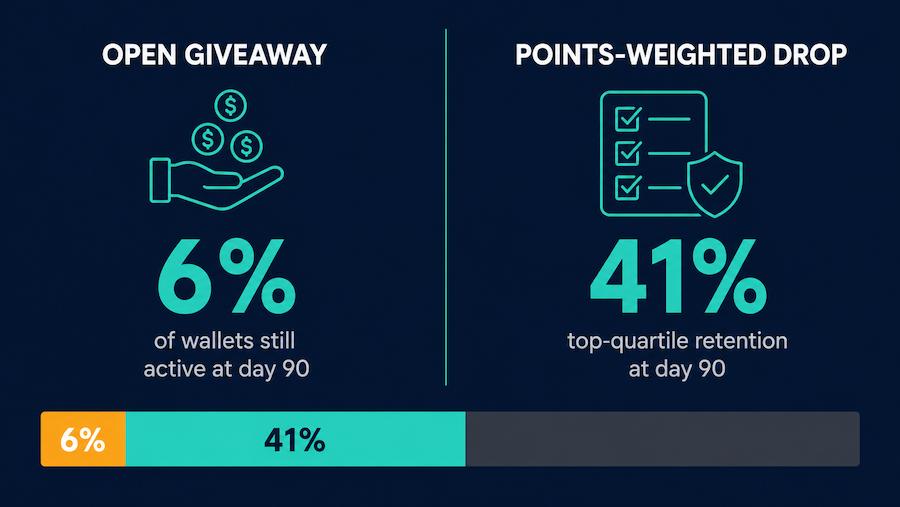
- Reach metrics stopped predicting outcomes. A Q1 2026 audit of 21 token-issuing protocols found median day-90 airdrop retention of 6 percent against 41 percent for the top quartile, a 6.8x gap driven by campaign design instead of budget.
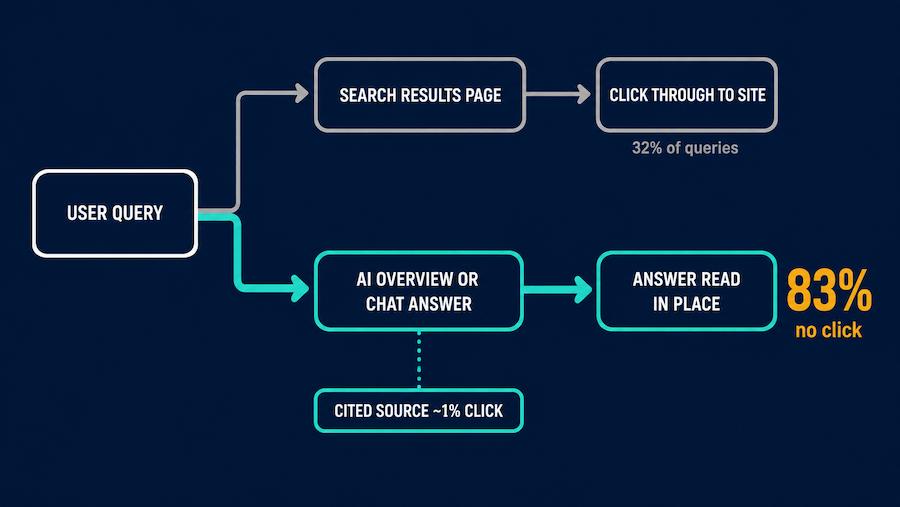
- Search visibility now means citation, not ranking. Google zero-click searches reached 68 percent of US queries in early 2026, and when an AI Overview appears, users click a cited source about 1 percent of the time.
- Compliance moved from legal review into the growth plan. MiCA hits full EEA enforcement on 1 July 2026 with no extension from ESMA, and the FCA issued more than 1,700 alerts about unauthorised crypto promotions in the first year of its regime.
Four tactics that stopped paying
Most Web3 marketing budgets still contain line items designed for a 2021 market. Most are mispriced, and they get bought at the wrong point in the funnel.
Hype-first launches
Launching loud with no product and no retention mechanic used to work because buyers were early and indiscriminate. CoinGecko’s Pump.fun data ends that argument. More than 80 percent of tokens failed within two days. Launch-day noise now buys a spike in wallet count and nothing behind it. Narrative still matters, but it has to be attached to something a user can verify.
NFT drops as a growth channel
An NFT mint was once a legitimate top-of-funnel campaign for a non-NFT project. With average NFT prices around 54 dollars in late 2025 and OpenSea daily volume down near 5 million dollars, a mint is now a product decision. It no longer works as an acquisition channel. Projects that still use NFTs successfully use them for access control and loyalty tiers.
Mega-KOL buys
HypeAuditor’s 2026 data puts fraud signals on roughly 41 percent of influencer accounts, and 37.2 percent of influencer followers register as fake or suspicious. Influencer fraud cost brands an estimated 4.8 billion dollars worldwide in 2026. The more interesting finding for budget holders is that accounts in the 50,000 to 250,000 follower range consistently return around 30 percent higher ROI than accounts above a million followers, at a fraction of the fee.
Community headcount as a KPI
Telegram has roughly 87 million active crypto users, which makes it easy to buy a big number and hard to buy a real one. A group with 50,000 members and three people talking has bought members. It does not have a community. The metric that survives scrutiny is the ratio of daily active participants to total members, tracked over time.
| Budget line | The 2021 assumption | What 2026 data says |
| Token launch | Launch loud, sort out utility later | 68.67 percent of Pump.fun tokens died on launch day |
| Airdrop | Distribute widely to seed holders | 78 percent of recipient wallets sold within 24 hours |
| Influencer spend | Buy the biggest account you can afford | 50K to 250K accounts return around 30 percent higher ROI |
| SEO | Rank page one, collect the clicks | 68 percent of US searches end without any click |
| Compliance | A legal review at the end of the process | MiCA enforcement is unconditional from 1 July 2026 |
Airdrops became a retention problem
The airdrop is the clearest example of a 2021 tactic that survived into 2026 with its economics inverted. It was designed as an acquisition tool. It is now a retention test that most projects fail before they run it.
A Q1 2026 audit of 21 token-issuing protocols found a 6.8x spread between median and top-quartile day-90 retention. The median cohort held on to 6 percent of recipient wallets. The top quartile held 41 percent. Same mechanic, wildly different design.
|
78% of airdrop recipient wallets sold within the first 24 hours |
803,093 Sybil addresses filtered by LayerZero in a single June 2024 sweep |
73% retention reported for task-based drops against 11 percent for open giveaways |
Three design choices separate the top quartile from everyone else.
- Points programmes that run for months before any distribution, so allocation can be weighted by real activity instead of wallet count.
- Sybil filtering built during the campaign instead of bolted on at snapshot. LayerZero’s approach combined IP clustering, wallet graph analysis and timing correlation, and it removed over 800,000 addresses.
- Vesting tied to continued use instead of a calendar, so the incentive to sell on day one is structurally weaker.
Airdrop services grew into a 427 million dollar market in 2025 at a 38 percent CAGR, with premium agencies charging 50,000 to 150,000 dollars per campaign. That is a lot of money to spend on a mechanic where the median outcome is a 6 percent retention rate.
Search stopped being about clicks
This is the change most crypto marketing teams have not budgeted for yet.
Google zero-click searches reached roughly 68 percent of US queries in early 2026, up from 58.5 percent in 2024. AI Overviews appear on more than 20 percent of searches, and on those queries the zero-click rate climbs to 83 percent. When an AI Overview shows, users click a cited source link about 1 percent of the time. In Google’s AI Mode the zero-click rate reaches 93 percent. Informational queries, which is most of what a crypto content programme targets, run at 74 percent zero-click.
The traffic that does arrive from AI surfaces behaves differently. ChatGPT reached around 900 million weekly active users by February 2026 and drives 87.4 percent of all AI referral traffic. That traffic is still only about 1.08 percent of total website visits, but it converts at roughly 4.4 times the rate of organic search, because the user arrives having already been recommended.
|
Ranking first is now the consolation prize. Getting quoted is the win. |
What this changes in practice:
- Every page needs a direct, self-contained answer in the first 60 words, written so it can be lifted without surrounding context.
- Entity consistency across CoinGecko, CoinMarketCap, Crunchbase, GitHub and your own docs matters more than another 2,000 words on your blog, because those are the surfaces language models read.
- Third-party mentions carry the citation. Being named in a comparison piece on someone else’s domain does more for AI visibility than a self-published listicle.
- Measurement shifts from rank tracking to prompt-set auditing. Pick 40 buying-intent prompts, run them monthly across ChatGPT, Perplexity, Gemini and AI Overviews, and record whether you appear.
|
Does ChatGPT mention your project when someone asks for options? We audit 40 buying-intent prompts across four AI engines and show you where you appear and where a competitor appears instead. |
Attention became a priced asset
Influencer marketing in crypto spent five years without a market price. You paid an invoice and hoped. That changed quickly over the past year.
Kaito sunset its Yaps post-to-earn programme in January 2026. On 15 January, X’s head of product Nikita Bier announced the platform would no longer allow apps that pay users to post, and API access was revoked for InfoFi projects including Kaito and Cookie. That did not end the category. It moved it. Kaito now runs through Kaito Pro, Kaito Studio and a Capital Launchpad, and it partnered with Polymarket on attention markets.
Two pilot mindshare markets went live on 11 February 2026. One of them, a wager on Polymarket’s own mindshare ranking by 31 March, drew more than 1.3 million dollars in volume almost immediately. Polymarket’s head of crypto has said dozens more were planned for March, scaling toward thousands across AI, finance, entertainment and world events by year end.
The practical consequence for a marketing team is that mindshare has a public number attached to it. You can benchmark against competitors, and so can your investors. Campaign briefs that once ended with impressions now end with a mindshare target.
Compliance moved into the growth plan
MiCA reaches full enforcement across the European Economic Area on 1 July 2026, and ESMA has confirmed there will be no extension. Article 7 governs marketing communications for crypto-asset service providers on grounds of fairness, clarity and not being misleading. National regulators including BaFin, the AMF and the AFM are already running supervisory reviews and spot checks.
The UK runs a stricter regime. Financial promotions sit under section 21 of FSMA and the FCA Handbook, with a standardised risk warning and a cooling-off period. In the first 12 months the FCA issued more than 1,700 alerts about unauthorised crypto promotions and worked with social platforms to remove content. It has since opened investigations into section 21 approvers who were signing off promotions without applying real judgement.
Teams that treat this as a legal gate at the end of the process lose two weeks per campaign. Teams that treat it as a design constraint at the start move faster and get better placements, because compliant copy is the only copy that survives platform review on Google, Meta and X.
- Build an approved claims library once, then let writers assemble from it instead of drafting fresh language every time.
- Geo-gate at the campaign level. A promotion that is legal in Dubai and illegal in Frankfurt should not share a targeting group.
- Put disclosure into KOL contracts as a payment condition, not a request.
A launch sequence that reflects the current market
Most of the failures in the Pump.fun data come from sequencing. Projects run acquisition before they have anything worth retaining.
|
DAY -90 |
Proof before promotion Audit published and docs complete, with entity data consistent across CoinGecko, CoinMarketCap and Crunchbase. Nothing goes out until a stranger can verify the claims. |
|
DAY -60 |
Points before promises Open a points programme with wallet-graph scoring running from day one. You are building the allocation model and the Sybil filter at the same time. |
|
DAY -30 |
Mid-tier seeding Seed 15 to 25 accounts in the 50K to 250K range on staged payments. Pitch reporters a data story instead of an announcement. |
|
DAY +90 |
The number that matters Report the percentage of recipient wallets still active. Anything under the 6 percent median means the design failed, whatever the launch-week charts looked like. |
Metrics that survive a board meeting
Reach numbers are still reported because they are easy to produce and impossible to disprove. They have almost no predictive value. Four measures do.
- Cost per retained wallet at day 90, calculated across the whole campaign instead of per channel. This is the only figure that connects spend to a surviving user.
- Sybil rate at snapshot, reported as a percentage of filtered addresses. A campaign that filters nothing has not looked.
- Share of AI citations, audited monthly against the same fixed prompt set so the comparison holds over time.
- Community depth, measured as daily active participants divided by total members. The trend line matters more than the ratio itself.
Getting these numbers requires instrumentation that most projects do not have at launch, which is usually the point at which an outside team earns its fee. Blockchain App Factory works with token projects, exchanges, DeFi protocols and launchpads on exactly this stack, from Web3 go-to-market planning and KOL vetting through to community operations, crypto SEO and AI visibility work. The teams that hire us in month one tend to spend less than the teams that hire us in month six, because the second group has usually already paid for a launch that produced wallets and no users.
The 2021 market rewarded speed. The 2026 market rewards evidence. Build something a sceptical stranger can verify, then spend the budget telling them where to look.
|
Who builds a Web3 launch plan that still works at day 90? Go-to-market, community operations, KOL vetting, crypto SEO and AI visibility, run by one team. |
Frequently asked questions
Is Web3 marketing still worth the budget if most tokens fail?
Yes, but the allocation changes. Spending on retention design, proof assets and search visibility outperforms spending on launch-week reach. The Pump.fun failure data reflects projects with no product, not projects with no marketing.
How much should a token project spend on KOLs?
Crypto KOL rates run from a few hundred dollars to over 200,000 for tier-one accounts. Accounts between 50,000 and 250,000 followers return around 30 percent higher ROI, so most budgets do better spread across 15 to 25 mid-tier accounts than concentrated in one large one.
What is a realistic airdrop retention rate?
The Q1 2026 audit of 21 protocols found a median of 6 percent of recipient wallets still active at day 90, and 41 percent for the top quartile. Anything above 20 percent puts you well ahead of the field.
Does SEO still matter when most searches end without a click?
It matters differently. With 68 percent of US searches ending click-free, the value of a ranking page is increasingly the citation it earns inside an AI answer. Traffic that does come through from AI engines converts at roughly 4.4 times the rate of organic search.
What changes for marketing teams after 1 July 2026?
MiCA applies in full across the EEA with no transitional relief. Any crypto-asset service provider marketing into the EU needs its communications to meet Article 7 standards, and national regulators are already running spot checks ahead of the deadline.

Vimal J is the Head of Sales at Blockchain App Factory, with 10+ years of experience in sales, client strategy, and Web3 business growth. He helps startups, enterprises, and project founders choose the right blockchain solutions for their goals, bringing a practical market perspective to topics like token development, crypto launches, and Web3 adoption.