
Key Insights
- Smart contracts manage lending, borrowing, swaps, liquidity pools, rewards, and liquidations through code.This helps DeFi platforms reduce manual work and process transactions faster.
- DeFi lending helps users earn yield, borrowing gives access to crypto-backed loans, and liquidity pools support token swaps.
- DeFi smart contracts need audits, trusted oracles, collateral limits, and live monitoring.Strong security planning protects user funds and supports stable platform growth.
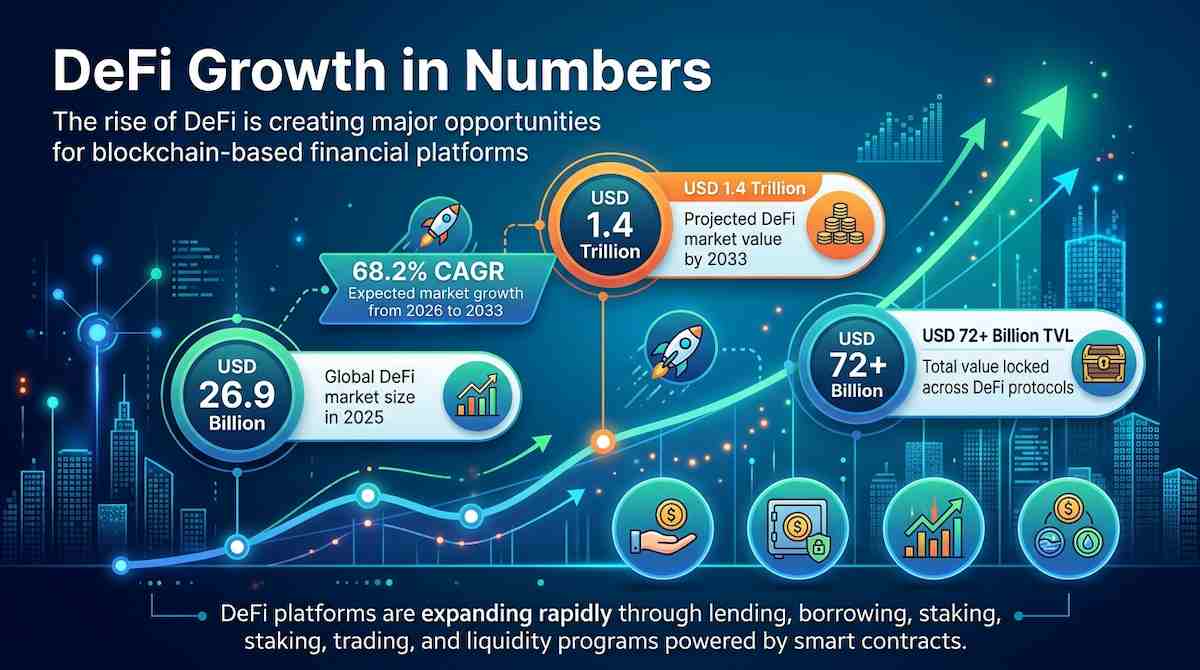
Decentralized finance, or DeFi, has changed how digital finance works by giving users direct access to lending, borrowing, trading, staking, and yield programs through blockchain-based platforms. The global DeFi market was valued at USD 26.9 billion in 2025 and is projected to reach USD 1.4 trillion by 2033, growing at a 68.2% CAGR. DeFi protocols also hold more than USD 72 billion in total value locked, showing the rising adoption of blockchain-based financial services. The main difference is simple: users do not need banks, brokers, or payment processors to approve each action.
Smart contracts power this model by running the rules of a DeFi platform. They manage deposits, loans, collateral, rewards, swaps, and liquidity pools once a user confirms a transaction from a crypto wallet. For businesses, this creates faster, more transparent ways to build financial products and open revenue streams through lending markets, trading fees, staking systems, and liquidity programs. Strong DeFi smart contract development is essential because it helps protect user funds, support high transaction volume, and reduce risks such as hacks, failed transactions, price errors, and liquidity issues.
What Are Smart Contracts in DeFi?
Smart contracts in DeFi are blockchain-based programs that run financial actions through code. They follow fixed rules written by developers. Once deployed, the contract executes those rules after the user meets the required conditions.
For example, a lending contract can accept a user’s crypto deposit, add it to a lending pool, and calculate interest. A borrowing contract can check collateral value, approve a loan, and track repayment. A liquidity pool contract can accept two tokens, issue pool shares, and process swap fees.
These contracts replace manual approval steps. A bank loan often needs forms, credit checks, branch teams, and internal review. A DeFi loan works through wallet approval, collateral checks, price data, and smart contract logic. The process runs on-chain and records each step.
Smart contracts also reduce central control. The platform owner does not approve every transaction by hand. The contract handles deposits, loans, swaps, staking, rewards, and liquidations based on its code. This creates a more open financial system where users interact with rules, not gatekeepers.
Common DeFi actions powered by smart contracts include:
Deposits
Users deposit crypto assets into a contract. The contract records the amount and updates the user’s balance.
Loans
Users lock collateral and borrow supported assets. The contract checks collateral value before releasing funds.
Swaps
Users trade one token for another through liquidity pools. The contract calculates the exchange rate and updates the pool.
Staking
Users lock tokens to earn rewards. The contract tracks time, amount, and reward rates.
Rewards
Platforms pay users through yield, fees, or incentive tokens. The contract calculates and distributes the rewards.
Liquidations
Borrowed positions get closed if collateral falls below the required level. The contract triggers this based on price data and risk rules.
Why Smart Contracts Matter for DeFi Platforms
Smart contracts give DeFi platforms their core value. They allow users to transact without trusting a central party. The trust shifts from an institution to transparent code on a blockchain.
They also automate financial processes. Lending, borrowing, swaps, liquidity updates, and reward payments run with fewer manual steps. This helps platforms handle more users and more transactions without a large back-office team.
Smart contracts make platform rules visible. Users can inspect the contract logic, review transaction history, and track fund movement on-chain. This builds trust for retail users, institutions, and business partners.
For businesses, smart contracts support faster product launches. A company can build a DeFi lending app, DEX, staking portal, yield platform, or liquidity protocol with programmable financial logic. This helps teams create decentralized finance products that serve users across markets.
How Smart Contracts Work in DeFi
A DeFi smart contract works through a clear transaction flow. The user starts the action, the contract checks the rules, and the blockchain records the result.
The process often begins with a crypto wallet. The user connects a wallet such as MetaMask, Trust Wallet, Coinbase Wallet, or another Web3 wallet. This wallet acts as the user’s account and approval tool.
Next, the user chooses an action. They can lend assets, borrow funds, provide liquidity, swap tokens, stake crypto, or claim rewards. The platform interface sends this request to the smart contract.
The smart contract then checks the required conditions. For lending, it checks the token type and deposit amount. For borrowing, it checks collateral value, loan limits, and risk levels. For swaps, it checks liquidity depth, pool balance, and price impact.
After that, the blockchain validates the transaction. Network validators or miners confirm that the user has enough balance, the wallet signature is valid, and the contract call follows the rules. Once confirmed, the blockchain adds the transaction to a block.
The contract then updates the platform state. Funds move, balances change, collateral gets locked, tokens get released, or rewards get recorded. The user can view the final result in the wallet and on a blockchain explorer.
A simple lending flow looks like this:
- The user connects a wallet.
- The user deposits crypto into a lending pool.
- The contract records the deposit.
- The contract issues a receipt token or updates the user balance.
- Borrowers use the pool after locking collateral.
- Interest flows back to lenders based on contract rules.
A borrowing flow works in a similar way:
- The user connects a wallet.
- The user deposits collateral.
- The contract checks the collateral value through a price oracle.
- The user borrows an allowed amount.
- The contract tracks debt and interest.
- The user repays the loan to unlock collateral.
- If collateral value drops too far, liquidation starts.
This coded flow makes DeFi fast and open. Users do not wait for branch hours, manual review, or third-party approval. The smart contract handles the action once all rules are met.
Key Components Behind DeFi Smart Contracts
DeFi smart contracts depend on several technical parts. Each part supports a different function inside the platform.
Wallet Integration
Wallet integration lets users connect to the DeFi platform. The wallet signs transactions, confirms user intent, and sends requests to smart contracts. It also stores tokens, displays balances, and gives users control over their assets.
A strong wallet flow improves user trust. Clear approval screens help users understand what they are signing. This matters in DeFi, where one wrong approval can expose funds.
Token Contracts
Token contracts define the assets used inside a DeFi platform. Most DeFi platforms support token standards such as ERC-20 for fungible tokens. These contracts manage balances, transfers, approvals, and allowances.
For example, a user must approve a lending contract before it can move tokens from the wallet. The token contract records that approval, then the lending contract completes the deposit.
Lending and Borrowing Pools
Lending and borrowing pools hold user funds. Lenders deposit assets into the pool. Borrowers draw funds from the pool after they provide collateral.
The smart contract tracks supply, debt, interest, and collateral. It updates these values after every deposit, loan, repayment, or withdrawal. This creates an automated money market for crypto assets.
Price Oracles
Price oracles bring outside market prices into the blockchain. DeFi platforms use oracles to check collateral value, loan risk, swap rates, and liquidation levels.
For example, a user may deposit ETH as collateral and borrow a stablecoin. The contract needs the current ETH price to decide the safe borrow limit. The oracle supplies that price data.
Bad oracle design can create major risk. A wrong price can lead to unfair liquidations, bad loans, or pool losses. That is why many DeFi platforms use trusted oracle networks and backup checks.
Interest Rate Logic
Interest rate logic controls how much borrowers pay and how much lenders earn. Many DeFi platforms use a rate model tied to pool usage.
If most of the pool is unused, borrowing rates stay lower. If many users borrow from the pool, rates rise. This helps attract more deposits and control demand.
The contract calculates these rates through code. It then updates debt and lender earnings over time.
Liquidity Pool Contracts
Liquidity pool contracts support token swaps and liquidity provision. Users deposit pairs of tokens into a pool. Traders then swap against that pool.
For example, a user can add ETH and USDC to a liquidity pool. The contract issues pool tokens that represent the user’s share. Each swap pays a fee, and part of that fee goes to liquidity providers.
These contracts manage reserves, swap formulas, price impact, fees, and pool shares. They form the base of decentralized exchanges and automated market makers.
Liquidation Mechanisms
Liquidation mechanisms protect lending platforms from bad debt. A liquidation starts if a borrower’s collateral value falls below the required safety level.
The contract checks collateral ratios through price data. If the position becomes unsafe, liquidators can repay part of the debt and receive collateral at a discount. This keeps lending pools healthier and protects lenders from unpaid loans.
Liquidation logic must be precise. Weak rules can hurt borrowers, lenders, or the platform. Strong rules keep the system fair and stable during market swings.
Security Audits
Security audits review smart contract code before launch. Auditors look for bugs, logic errors, access control issues, price manipulation risks, and fund loss risks.
DeFi contracts handle real money, so security cannot be treated as an afterthought. A single flaw can drain a pool within minutes. Audits, testing, formal checks, and bug bounty programs help reduce that risk.
A business building a DeFi platform needs security from the first design stage. Strong smart contract development protects users, supports trust, and helps the platform grow with fewer technical failures.
Ready to Build a DeFi Lending Platform?
Turn your lending, borrowing, and liquidity pool idea into a secure DeFi product with smart contract support from Blockchain App Factory.

Smart Contracts in DeFi Lending
DeFi lending lets users deposit crypto assets into lending pools and earn interest. These pools run through smart contracts. The contract accepts deposits, tracks balances, calculates interest, and handles withdrawals.
Think of a lending pool as a shared vault. Lenders add assets to the vault. Borrowers take loans from it after they lock collateral. The smart contract manages every step through code.
This removes the need for a bank officer or loan desk. The rules sit inside the contract. Users interact with those rules through a crypto wallet.
For businesses, DeFi lending platform development creates a direct way to build lending markets for crypto users. A platform can support stablecoins, native tokens, wrapped assets, or tokenized real-world assets. The contract design decides how deposits, loans, interest, rewards, and risk controls work.
How DeFi Lending Works
DeFi lending follows a simple flow.
Lenders Deposit Assets
A lender connects a wallet and deposits crypto into a lending smart contract. The contract records the deposit and updates the lender’s balance.
Many platforms issue a receipt token. This token represents the lender’s share in the pool. It can track both the original deposit and earned interest.
Borrowers Use the Pool
Borrowers access the deposited assets after they provide collateral. The collateral protects lenders from unpaid loans.
For example, a borrower can deposit ETH and borrow USDC. The smart contract checks the collateral value before releasing the borrowed asset.
Interest Rates Change With Demand
Smart contracts adjust interest rates based on pool activity. High borrowing demand often raises rates. Low demand often lowers rates.
This keeps the pool active. Higher rates attract more lenders. Lower rates can attract more borrowers.
Lenders Earn Yield
Borrowers pay interest on their loans. The smart contract sends part of that interest to lenders. The platform can collect a fee from the same flow.
This creates passive income for users. It also creates a steady revenue model for the platform owner.
Business Value of DeFi Lending Platforms
A DeFi lending platform can serve many business goals. It can attract users, create fee income, and support new crypto finance products.
Platform Fee Revenue
The platform can earn fees from interest payments, loan activity, withdrawals, or premium features. Smart contracts collect these fees based on coded rules.
Passive Income Products
Users like lending products since they can earn yield on idle crypto assets. This helps exchanges, wallets, and fintech brands retain users for longer periods.
Crypto Lending Marketplaces
A business can launch a marketplace where users lend and borrow many assets. Each pool can have its own rate model, collateral rule, and reward plan.
Stablecoin Lending Products
Stablecoin lending appeals to users who want lower price swings. Platforms can support USDT, USDC, DAI, or custom stablecoins.
Institutional Lending Systems
Enterprises can build private or permissioned lending products for funds, traders, and crypto firms. These systems can include identity checks, credit rules, and custom risk controls.
DeFi Lending Platform Development
A strong lending platform needs secure contracts, clear pool logic, oracle support, interest rate models, and liquidation rules. Good DeFi lending platform development turns these parts into a product users can trust.
Smart Contracts in DeFi Borrowing
DeFi borrowing lets users take crypto-backed loans through smart contracts. The borrower locks collateral, and the contract releases a supported loan asset.
Most DeFi borrowing uses overcollateralization. This means the borrower deposits more value than the loan amount. For example, a user can lock $1,500 worth of ETH to borrow $1,000 worth of stablecoins.
Why does DeFi need extra collateral? It protects lenders and keeps the protocol stable. Crypto prices can move fast. Extra collateral gives the contract a buffer during market drops.
Smart contracts manage this risk through rules. They check collateral value, calculate borrowing limits, track debt, add interest, and start liquidation when needed.
How DeFi Borrowing Works
DeFi borrowing has a clear contract flow.
Borrower Deposits Collateral
The borrower connects a wallet and deposits collateral into the borrowing contract. The contract locks that asset until the borrower repays the loan.
Collateral can include ETH, BTC-backed tokens, stablecoins, or approved platform tokens.
Contract Checks Collateral Value
The smart contract uses a price oracle to read the current market price. The oracle helps the contract measure the value of the locked asset.
For example, the contract needs the ETH price before it approves a USDC loan.
Borrowing Limit Is Calculated
The contract calculates how much the user can borrow. This limit comes from the collateral factor set by the platform.
A platform with a 70% collateral factor allows a user to borrow up to 70% of the collateral value. A $1,000 deposit then supports a loan of up to $700.
Loan Assets Are Released
After the contract approves the loan amount, it releases the borrowed asset to the user’s wallet. The transaction gets recorded on the blockchain.
Interest Accrues Through Code
The contract tracks debt and interest over time. Borrowers repay the principal and interest to unlock their collateral.
Liquidation Starts During Risk
A liquidation can occur after collateral value falls below the required level. The contract flags the position as unsafe.
Liquidators repay part of the debt and receive part of the collateral. This protects the lending pool from bad debt.
Why Borrowing Smart Contracts Are Important
Borrowing smart contracts form the base of crypto loan platforms. They replace manual approval with coded checks.
Automated Loan Approvals
The contract approves or rejects a loan based on wallet balance, collateral value, loan limits, and pool liquidity. No loan officer needs to review the request.
Lower Counterparty Risk
The borrower does not rely on one lender. The lender does not rely on one borrower. The contract holds collateral and tracks the loan.
Collateral and Repayment Control
The contract locks collateral, tracks debt, processes repayment, and releases collateral after full payment. This keeps the loan cycle clear and traceable.
Product Development Options
Businesses can use borrowing smart contracts to build crypto loan platforms, stablecoin borrowing apps, margin products, and collateralized lending systems. These products can serve retail users, traders, exchanges, and institutions.
Smart Contracts in Liquidity Pools
Liquidity pools are token reserves locked in smart contracts. They help users trade, lend, borrow, and earn rewards without a traditional order book.
A liquidity pool usually holds two or more assets. For example, an ETH and USDC pool holds both tokens. Traders use the pool to swap ETH for USDC or USDC for ETH.
The smart contract manages the pool balance. It records each provider’s share, calculates swap output, collects fees, and pays rewards.
Liquidity pools support decentralized exchanges, lending protocols, yield farming platforms, and automated market makers. They give DeFi platforms the asset depth needed for user activity.
How Liquidity Pools Work
Liquidity pools work through deposits, usage, fees, and rewards.
Liquidity Providers Deposit Assets
Liquidity providers add assets into a pool. A DEX pool often asks for two tokens of equal value. For example, a user can deposit $500 in ETH and $500 in USDC.
Smart Contracts Record Pool Shares
The contract records the provider’s share. Many platforms issue LP tokens. These tokens represent the provider’s claim on the pool.
Traders or Borrowers Use the Pool
Traders use liquidity pools for token swaps. Borrowers can access pool assets in lending systems. The contract handles the transfer based on platform rules.
Fees Are Collected
Each swap or pool action can create a fee. The smart contract collects the fee during the transaction.
Providers Earn Rewards
Liquidity providers earn rewards based on their share of the pool. Rewards can come from trading fees, borrowing interest, or platform incentive tokens.
Liquidity Pool Risks to Know
Liquidity pools create strong product value, but they carry real risk. Businesses need clear risk controls before launch.
Impermanent Loss
Impermanent loss happens when token prices move after a provider deposits assets. The provider can end up with less value than they held outside the pool.
This risk is common in volatile token pairs. Stablecoin pools often carry lower price movement risk.
Smart Contract Bugs
A contract bug can expose pool funds. Attackers target weak access rules, math errors, and unsafe upgrade controls.
Audits, testing, and bug bounty programs reduce this risk.
Low Liquidity
Low liquidity can create high price impact. A large swap can move the pool price too much. This leads to poor trade results and weaker user trust.
Price Volatility
Fast price moves can affect pool value, lending safety, and user returns. Volatile markets need stronger risk settings.
Oracle Manipulation
Some pools rely on price oracles. Bad price data can trigger wrong swaps, bad loans, or unfair liquidations. Strong oracle design protects the platform.
Business Use Cases for Liquidity Pool Development
Liquidity pool development helps businesses create DeFi products with active asset flow.
Decentralized Exchange Development
DEX platforms need liquidity pools for token swaps. The pool contract replaces the order book and lets users trade straight from their wallets.
Token Launch Liquidity
New token projects need starting liquidity. A project can create a token pair on a DEX and let users trade from day one.
Yield Farming Platforms
Yield farming platforms reward users for adding liquidity. Smart contracts track deposits, calculate rewards, and manage claim rules.
Stablecoin Swap Platforms
Stablecoin pools help users swap assets such as USDC, USDT, and DAI with lower price impact. These pools work well for payments, remittance products, and treasury tools.
Cross-Chain Liquidity Products
Cross-chain liquidity products connect assets across different blockchain networks. Smart contracts and bridge systems help users move value between chains.
A well-built liquidity pool can power swaps, yield, token launches, and lending flows. For businesses, it creates the base for many DeFi revenue models.
DeFi Lending vs Borrowing vs Liquidity Pools
| DeFi Model | Main Purpose | User Role | Smart Contract Function | Business Opportunity |
|---|---|---|---|---|
| Lending | Earn interest from deposited crypto assets | Lender | Manages deposits, tracks balances, and calculates yield | DeFi lending platform development |
| Borrowing | Access crypto-backed loans | Borrower | Manages collateral, loan limits, interest, and repayment | Crypto loan platform development |
| Liquidity Pools | Provide token liquidity for swaps and DeFi activity | Liquidity provider | Manages token pools, pool shares, swap fees, and rewards | DEX development and liquidity pool solutions |
Benefits of DeFi Smart Contracts for Businesses
DeFi smart contracts give businesses a practical way to build financial products on blockchain networks. They run core actions through code, so teams can create platforms that work faster and serve users across borders.
For startups, this means a quicker path to market. For fintech firms, it means new crypto-native products. For exchanges, it means more ways to keep users active. For enterprises, it means programmable finance with clear rules and traceable records.
Automated Financial Operations
Smart contracts handle deposits, loans, swaps, staking, rewards, and withdrawals without manual review. The contract checks each rule and completes the transaction after the user signs it.
This cuts routine work for business teams. It also reduces delays for users. A loan, swap, or reward claim can happen in minutes instead of days.
Lower Dependency on Intermediaries
Traditional finance relies on banks, brokers, clearing houses, and payment processors. DeFi platforms use smart contracts to reduce that chain.
Users interact with wallet-based systems. The contract manages approvals, balances, transfers, and records. This gives the business more control over product rules and user flow.
Global User Access
A DeFi platform can serve users in many countries. Users need a crypto wallet, supported assets, and internet access.
This helps businesses reach new markets without opening local branches. A lending pool, liquidity pool, or staking contract can accept users from different regions through the same on-chain rules.
Transparent Transactions
Blockchain records give users a clear view of platform activity. They can track deposits, pool balances, swaps, loans, and reward claims on-chain.
This level of transparency builds trust. Users can see how funds move and how contracts behave. Business partners can review contract logic and transaction history too.
New Revenue Models
DeFi smart contracts help businesses create several income streams. A platform can earn from trading fees, lending spreads, borrowing fees, withdrawal fees, performance fees, or liquidity programs.
For example, a decentralized exchange can earn a small fee on each swap. A lending platform can earn from borrower interest. A yield platform can charge fees on generated returns.
Faster DeFi Platform Launch
Smart contract modules help teams launch products faster. A business can build lending pools, swap contracts, staking portals, or liquidity systems with tested contract patterns.
Speed matters in crypto markets. A faster launch helps businesses test demand, attract early users, and improve the product based on real activity.
Infrastructure That Supports Growth
DeFi smart contracts can support high transaction volume through clear architecture. Teams can add new pools, tokens, reward models, and protocol features as the platform grows.
This helps fintech firms, exchanges, startups, and enterprises build long-term DeFi products. A strong smart contract base gives the platform room to expand without rebuilding every core feature.
Need Smart Contracts for a Secure DeFi Product?
Best Practices for Building Secure DeFi Smart Contracts
DeFi smart contract development needs careful planning. These contracts manage user funds, so every rule matters. A small code error can create major losses.
A secure DeFi product starts with the business model. Then it needs clean architecture, trusted data feeds, risk controls, audits, and live monitoring.
Define the Business Model and Tokenomics
Start with a clear business model. Decide how the platform earns revenue, who pays fees, how users earn rewards, and how tokens support the product.
Tokenomics should match real platform use. A reward token needs purpose beyond short-term incentives. Poor token design can attract quick deposits and then lose users fast.
Clear token rules help the smart contract team write better logic. They define supply, rewards, fees, vesting, emissions, and governance rights.
Use Modular Smart Contract Architecture
A modular contract design breaks the platform into smaller parts. Each part handles a focused task such as deposits, borrowing, rewards, liquidations, or governance.
This makes the code easier to test and maintain. It also helps teams update one part without touching the full system.
For example, a lending platform can separate pool logic, interest logic, oracle logic, and admin controls. This gives developers cleaner code and safer upgrades.
Integrate Reliable Price Oracles
Many DeFi platforms need live market prices. Lending, borrowing, swaps, and liquidations depend on accurate price data.
A reliable oracle reduces the risk of bad loans, wrong liquidations, and price attacks. Strong oracle design can include trusted data sources, update checks, fallback feeds, and time-weighted prices.
Conduct Smart Contract Audits
A smart contract audit reviews the code before launch. Auditors check logic, access control, math, token handling, oracle usage, and upgrade settings.
Audits do not remove all risk, but they catch many serious issues. Teams should run internal tests before the audit and fix every high-risk finding before launch.
Many DeFi teams also run bug bounty programs after audits. This gives outside researchers a safe way to report issues.
Add Risk Controls
Risk controls protect users and the platform during market stress. Lending and borrowing products need collateral limits, borrowing caps, liquidation thresholds, and reserve settings.
Emergency pause functions can stop risky actions during an attack or price event. Admin permissions need tight limits. Multi-signature wallets can reduce the risk of one account controlling the system.
Improve Gas Fees and User Flow
High gas fees can stop users from completing actions. Smart contract design should reduce wasted computation and keep transactions simple.
User flow matters too. Wallet approvals, deposit steps, loan actions, and reward claims should feel clear. Users need to understand what they sign and what happens next.
Plan Post-Launch Monitoring and Upgrades
Security work continues after launch. Teams need live monitoring for contract activity, pool health, oracle updates, liquidations, and unusual wallet behavior.
Upgrade plans need clear rules. Some platforms use governance voting. Some use admin-controlled upgrades with time delays. Each model should protect users from rushed or hidden changes.
A strong post-launch plan helps the platform respond fast to bugs, attacks, market shocks, and user growth.
Conclusion
Smart contracts make DeFi lending, borrowing, and liquidity pools faster, clearer, and easier to run at scale. They remove manual steps, manage funds through code, and give users direct access to crypto-based financial products. For businesses, this creates a strong path to launch lending markets, borrowing apps, liquidity platforms, and yield products with global reach. Blockchain App Factory provides smart contract development for defi services for startups, fintech firms, exchanges, and enterprises that want to build secure, feature-rich, and revenue-ready DeFi products

Vimal J is the Head of Sales at Blockchain App Factory, with 10+ years of experience in sales, client strategy, and Web3 business growth. He helps startups, enterprises, and project founders choose the right blockchain solutions for their goals, bringing a practical market perspective to topics like token development, crypto launches, and Web3 adoption.