


PONS became one of the most watched names on Robinhood Chain after some market trackers briefly placed its valuation above $30 million during its July 2026 breakout. The headline number is not the interesting part. What traders were buying was not a meme coin. It was the platform that manufactures meme coins.
Pons is a token launch and trading application on Robinhood Chain. Connect a wallet, name a token, pay a small launch fee, and a tradable market opens within minutes. By early September 2026, CoinDesk reported users paying roughly $5.95 million in fees through Pons in a single 24 hour window, ranking it fourth among protocols tracked by DefiLlama, ahead of Pump and of Robinhood Chain itself.
Speculation has moved from individual tokens to the infrastructure that launches them. A meme coin needs attention on one ticker. A launchpad earns from every launch, every trade, and every failed experiment in between. That is the business opportunity, and it raises a practical question: what would it take to build a Robinhood Chain launchpad with functionality similar to Pons?
- PONS is trending because the market repriced it from a meme coin into an infrastructure bet, after Pons became Robinhood Chain’s busiest launch venue and one of crypto’s largest fee generators.
- Launchpad infrastructure earns across thousands of launches rather than one narrative, which is why Robinhood Chain launchpad development is now a real business category.
- A competitive launchpad needs a token factory, launch and pricing contracts, DEX integration, an event indexer, discovery and analytics, anti spam controls, and audited contracts. Not just a creation form.
Why Is PONS Trending on Robinhood Chain Right Now?
PONS is trending because Pons became the dominant token launch venue on a young, fast growing chain, and the market began pricing the platform token as exposure to that activity. Robinhood Chain reached public mainnet on July 1, 2026. Within two months, user created tokens rather than tokenized stocks were generating the network’s heaviest usage.
The $30 Million Milestone in Context
When MEXC published “PONS Breaks $30 Million as Robinhood Chain Launchpad Competition Heats Up” on July 21, 2026, some trackers showed the token’s fully diluted value briefly above $30 million. That was a snapshot, not a permanent valuation. MEXC flagged the inconsistency at the time: OpenSea showed roughly $31 million and about 9,700 holders while CoinGecko’s crawl showed less.
The picture has changed since. As of September 4, 2026, CoinGecko listed PONS near $0.69 with a market capitalization around $493 million and 24 hour volume above $155 million, after an all time high of $0.7391 on September 3. Circulating supply sits near 712 million following roughly 288 million tokens sent to the burn address. Figures still vary by source, because trackers differ on pool selection, quote asset mapping, burn accounting, and update frequency.
Rapid Token Launch Activity
The progression is the story. ChainCatcher reported Pons issuing more than 11,000 tokens in a single day around the July coverage, and Pons analytics at the time of MEXC’s report showed roughly 20,000 launches, more than $120 million in all time paired asset volume, and over 1 million trades.
More recent data reads differently. CoinDesk, citing Dune dashboards, reported nearly 25,000 tokens launched on September 2, 2026 alone, 24 hour volume of $544 million, and more than 167,000 unique creator addresses active since July. Cumulative launch totals differ across dashboards depending on whether legacy and v2 factories are counted together, so treat any single total as one methodology. One figure deserves equal billing: reported graduation rates sit near 1%.
Robinhood Chain Launchpad Competition
Pons did not arrive into an empty market. Noxa held early first mover share before halting new launches in mid July 2026, redirecting deployment traffic. Flap, Hood.fun, FoxyHood and others competed for the same creators. Then Uniswap Labs launched pools.trade on August 5 with a lower trading fee and no protocol take, briefly outpacing Pons on daily token count.
Pons answered with product rather than price, shipping v2 in early August with bonding curve pricing, quote assets beyond ETH including stablecoins and tokenized stocks, and creator payouts in the pairing asset. On September 4, Pons announced Uniswap Labs had purchased PONS tokens as part of a longer term partnership, without disclosing size, price, timing, or the holding address.
From Meme Coin Speculation to Infrastructure Speculation
Instead of guessing which meme token catches fire, market participants started watching the venues that make continuous token creation possible. A launchpad does not need any individual token to succeed. It needs the launch machine to stay busy. That is why launchpad tokens trade differently from the assets launched on them, and why Robinhood Chain launchpad development became a category worth entering.
|
$30M+ Valuation zone reported on some trackers during the July 2026 breakout (MEXC, July 21, 2026) |
~25,000 Tokens launched through Pons in a single day (Dune data via CoinDesk, September 2, 2026) |
~$5.95M Fees paid through Pons in 24 hours, ranking fourth on DefiLlama (CoinDesk, September 3, 2026) |
Why the PONS Trend Matters to Launchpad Founders
Pons proved that one combination of features produces demand: low friction token creation, wallet based deployment, immediate market access, discovery, trading, liquidity, analytics, and a social layer where speculation compounds. No piece is novel alone. Assembled on a chain with cheap execution and a retail audience, they produced tens of thousands of launches a day at peak.
The opportunity is not to copy Pons but to understand why the model works and build different mechanics around it: different fee splits, different token categories, curated launches instead of open ones, stronger discovery, better creator tooling, or liquidity that survives past the first week. Worth saying plainly, the winner in a launchpad market is rarely the first mover. Noxa was.
What Is a PONS-Like Robinhood Chain Launchpad?
A PONS-like launchpad is a non custodial web application plus on chain contracts that let any wallet deploy a token and trade it immediately, with discovery and analytics on top. Pons publishes its protocol design, contract addresses, and integration surface. It does not publish its front end source, backend architecture, or indexing stack, so anything written about those would be inference.
How Pons Works Today
The following comes from the official Pons documentation at docs.ponsfamily.com, which covers two protocol versions that both remain documented. Pons runs on Robinhood Chain, chain ID 4663, with ETH as the native asset and Blockscout as the explorer. Every launch and trade is a transaction the user’s own wallet approves.
In v1, creating a launch deploys the token and its pool in one transaction with liquidity locked automatically. Each launch uses a fixed supply of one billion tokens, a 1% pool fee, and a 0.0005 ETH launch fee, trading against WETH in its own Uniswap V3 pool. There is no bonding curve and no migration. Graduation happens when paired WETH reaches a threshold, documented default 4.2 ETH, and trading continues in the same pool. Launch protection limits the opening: only the creator’s initial buy executes on the launch block, and each wallet can then hold at most 5% of supply until the window closes.
Trading fees accrue in both the token and WETH, split between creator and protocol, snapshotted at launch and never changed. The current factory applies 70/30 creator/protocol; legacy factory tokens keep 90/10. Pons states 80% of protocol fees fund an automated TWAP buyback of PONS sent to the burn address, with 20% covering infrastructure and team.
The v2 design changes the launch curve. Full supply mints to a bonding curve, and once the curve sells out the launch graduates automatically into a Uniswap v4 pool with permanently locked liquidity managed by a singleton hook. Launches can be paired against approved quote assets other than ETH. A snipe tax starting at 99% of a buy decays to zero across five seconds and applies only to buys. Bought back tokens are locked in a vault and released over five years rather than burned. Pons states v2 is under review by three independent security teams and should be treated as unaudited until those reports publish.
Core Features Needed to Build a Robinhood Chain Launchpad Like PONS
| Feature | What it has to do |
| Wallet connection | Detect the chain, prompt a switch to Robinhood Chain, read balances, hand every transaction to the wallet. No password, no session, no custody. |
| No-code token creation | Name, symbol, description, image, links, launch parameters. Images to IPFS. Symbol collisions and impersonation arrive through this form, so validate hard. |
| Token factory | One standard implementation for every token: predictable gas, verifiable bytecode, one address for indexers, no custom logic from creators. |
| Launch mechanism | Set initial pricing, open trading against a curve or a pool, seed and lock liquidity, charge the launch fee. |
| Trading interface | Live quotes, price impact, slippage controls, fee disclosure, previews. The quoted number must match the settled number. |
| Token discovery | New launches, trending by recent buys or volume, market cap, graduation progress, holders, price changes. Weak discovery loses users after one visit. |
| Graduation mechanism | Mark a token crossing a liquidity threshold. A milestone, not a quality guarantee, and the interface should say so. |
| Liquidity integration | A real DEX venue, which on Robinhood Chain means Uniswap. Liquidity locking separates a credible launchpad from a rug factory. |
| Analytics | Volume, trades, holders, price history, liquidity depth. Also the layer that separates real activity from automated noise. |
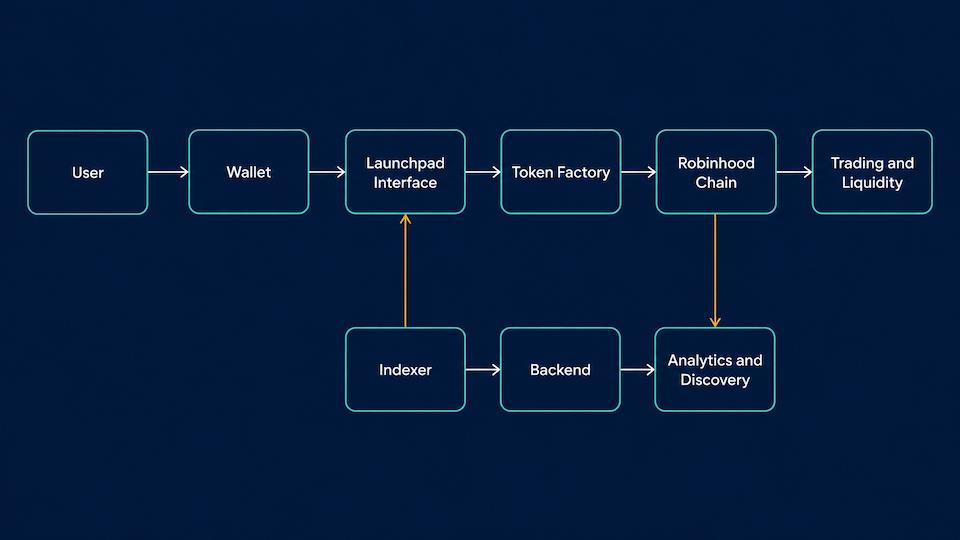
Architecture of a Robinhood Chain Launchpad Like PONS
- Front-end. Next.js, React, TypeScript: creation forms, trading, discovery, analytics, wallet state.
- Wallet and Web3. Provider integration, RPC config, chain switching, signing, contract reads and writes via viem or ethers. Pons notes the public Robinhood Chain RPC times out on wide log queries, a real constraint.
- Smart contracts. Factory, token implementation, launch controller, pricing, fee manager, liquidity manager, locker, treasury. Pons v2 documents a comparable set plus a Uniswap v4 hook, fee escrow, and buyback vault.
- Robinhood Chain. Execution and settlement: chain ID 4663, ETH for gas, Blockscout for verification.
- Liquidity. Uniswap pools, position management, locking, based on what is deployed on the chain rather than mainnet assumptions.
- Indexing. Listeners for launches, swaps, transfers, graduation state. Pons is explicit that on chain events are the authoritative source of truth.
- Backend. APIs, metadata, rankings, search, analytics computation, notifications, moderation.
- Database and cache. Thousands of concurrent viewers cannot be served from live RPC calls. Indexed state in Postgres, hot data in Redis, precomputed rankings.
|
Want to Build the Next Robinhood Chain Launchpad? Design a token creation and trading platform around your own launch rules, liquidity mechanics, and revenue model. |
How a Token Launch Happens on the Platform
- Connect wallet. Detect the chain, prompt a switch, read the balance.
- Enter token information. Validate client side, upload the image to IPFS, hold the URI.
- Configure launch parameters. Supply rules, quote asset, and creator fee settings become the call arguments.
- Approve the transaction. The wallet signs one call to the factory, carrying the launch fee as value.
- Factory deploys the token. Mint fixed supply, create the curve or pool, lock liquidity, emit a launch event.
- Trading opens. The indexer picks up the event, registers the pool, and the token appears in discovery within seconds.
- Trades update state. Swap events stream to the indexer, which recomputes price, volume, holders, market cap.
- Graduation progress. The backend reads paired reserves against the threshold and renders a progress line.
- Liquidity condition met. The contract graduates the launch, seeding a pool or marking the threshold reached.
- Secondary trading continues. The token behaves like any DEX asset and the platform keeps earning fees.
Smart Contracts Needed for a PONS-Like Platform
| Contract | Responsibility |
| Token factory | Deployment entry point and canonical event source for indexers. |
| Token implementation | Standard ERC-20, fixed supply, optional on chain metadata. |
| Launch controller | Holds launch configs: supply, fees, thresholds, pool parameters. |
| Pricing mechanism | A bonding curve, or the pool itself when launching straight into an AMM. |
| Trading mechanism | Router logic for buys and sells, quoting, slippage enforcement. |
| Fee manager | Splits fees between creator, protocol, and buyback, fixed at launch. |
| Liquidity manager | Creates and seeds pools, handles graduation, manages positions. |
| Locker | Permanently holds liquidity positions so they cannot be withdrawn. |
| Treasury | Receives the protocol share, funds operations or buybacks. |
| Referral contract | Optional attribution and reward distribution for growth programs. |
Modular contracts stay testable and replaceable without redeploying everything. Pons notes a related constraint: because its hook binds permanently to one factory, a new version ships as a whole new address set rather than an in place upgrade.
Bonding Curve vs Direct AMM vs Fixed-Price Launch
| Factor | Bonding Curve | Direct AMM | Fixed Price |
| Price discovery | Formulaic, continuous | Market driven from the first swap | None until the sale closes |
| Initial liquidity | Curve reserves, none needed from creator | Seeded at launch, must be locked | Added manually after the sale |
| Complexity | High: curve math plus graduation | Moderate: pool creation and locking | Low |
| User experience | Always a counterparty, any size | Familiar swap from block one | Predictable entry, no immediate exit |
| Graduation | Native: sellout triggers the pool | Threshold milestone, no migration | Manual listing step |
| Best use case | High volume open launches where sniping is the threat | Fast launches on a cheap gas chain | Curated or allowlisted sales |
| Main risk | Curve bugs, stranded launches | Launch block sniping, thin liquidity | Post sale dump, no locked liquidity |
Pons has used both of the first two models. v1 launches tokens directly into a locked Uniswap V3 pool against WETH. v2 prices launches on a bonding curve that graduates into a permanently locked Uniswap v4 pool. That progression is itself a signal: the direct AMM model shipped faster, and the curve model arrived to solve launch day sniping and liquidity seeding.
Why Launchpad Infrastructure Can Be More Valuable Than a Single Meme Coin
The flywheel runs like this: ecosystem attention brings creators, creators produce launches, launches attract traders, traders generate volume, volume produces fees, fees fund visibility and buybacks, and visibility brings creators back to the top of the loop.
A meme coin needs one story to survive. A launchpad only needs the stories to keep coming.
PONS illustrates the mechanism. It is the platform token, not one of the tokens launched through the platform, and its documented buyback routes a share of protocol fees into open market purchases. That ties demand to launch and trade throughput rather than to a single narrative, which is why the market repriced it once fee data placed Pons among crypto’s largest fee generators.
How a PONS-Like Launchpad Can Generate Revenue
A launchpad makes money from creation fees and a share of trading fees, with everything else layered on top. Pons documents a 0.0005 ETH launch fee in v1 and a 1% pool fee split 70/30 creator to protocol on the active factory, with 80% of the protocol share funding buybacks.
- Creation fees. Small per launch charges that scale with volume, not value.
- Trading fees. The dominant revenue line for any active launchpad.
- Protocol share of liquidity fees. Accrued in locked positions, claimed periodically.
- Featured listings. Paid placement in discovery feeds, clearly labeled as paid.
- Premium creator tools. Vanity addresses, advanced configs, bundled buys, creator analytics.
- Analytics and API access. Data products for traders, bots, third party interfaces.
- Referrals. Revenue sharing that turns traders into distribution.
One caution: headline fee charts often mix fees paid by users with protocol revenue. Creators take the larger share in the Pons model, so what reaches the protocol is smaller than a fee leaderboard implies.
Backend Infrastructure for High Token Launch Volume
When a platform processes tens of thousands of launches in a day, as Pons did in early September 2026, the backend becomes the product constraint.
- RPC load. Public endpoints throttle and time out on wide log queries. Dedicated nodes become necessary quickly.
- Indexing. Event listeners for launches, swaps, transfers, with bounded backfills and reorg handling.
- Queues. Decoupled ingestion and processing, so a burst of launches does not stall trade indexing.
- Databases and cache. Relational storage for canonical state, in memory cache for hot reads, precomputed leaderboards.
- WebSockets. Live price, trade, and launch feeds. Polling collapses at this scale.
- Search. Symbol and name search across hundreds of thousands of tokens, with duplicate handling.
- Analytics computation. Rolling volume, holders, and graduation progress computed on schedules, not per request.
- Metadata and CDN. IPFS pinning with gateway fallbacks and cached image delivery.
- Rate limiting and monitoring. API quotas, abuse detection, alerting on indexer lag.
Security Risks a PONS-Like Launchpad Must Handle
- Smart contract vulnerabilities. Independent audits, full test coverage, invariant testing, bug bounty. Pons has three audits in progress on v2 and calls it unaudited until they close, which is the right posture to copy.
- Malicious creators. Factory deployed tokens remove the ability to inject transfer restrictions or mint functions.
- Impersonation. Names and symbols are trivially copied. Show contract addresses prominently, flag duplicates, never imply verification you do not have.
- Bots and snipers. Time decaying buy taxes, per wallet caps in an opening window, creator exemptions fixed at creation.
- Front-running. Enforced slippage limits, deadlines, and quote pinning so terms cannot shift between reading and signing.
- Liquidity manipulation. Permanent locks and transparent reserve reporting.
- Spam launches. Launch fees, per address rate limits, ranking that weights real trading over raw launch counts.
- Fake metadata and links. Server side URL validation, image scanning, a reporting flow with human review.
- Admin privilege risk. Multisig control, timelocks, minimal admin surface. Publish what the platform can and cannot do.
- Front-end attacks. Strict content security policy, subresource integrity, registrar locks, lookalike domain monitoring.
- API abuse. Authentication, quotas, anomaly detection on read endpoints.
PONS Growth Also Shows the Risks of Launchpad Metrics
Read the Pons numbers critically rather than as a target to beat. PANews reported signs of bot like activity, including addresses creating large volumes of tokens and running highly standardized buy and sell patterns. That inflates launch counts, transaction counts, and short term volume without adding users.
Other pressures are visible in the data. Graduation rates near 1% mean the overwhelming majority of launches never reach a pool. Most tokens have thin liquidity and short lifespans. And the Robinhood Chain gas waiver that made mass deployment nearly free from July 1 is reported to lapse around the end of September 2026, changing the unit economics of high frequency launching.
A competing platform should optimize for real wallet participation, quality liquidity, discovery that surfaces genuine trading, anti spam systems, transparent analytics, audited contracts, and fee revenue that persists. Launch count is the easiest metric to inflate and the least useful to own.
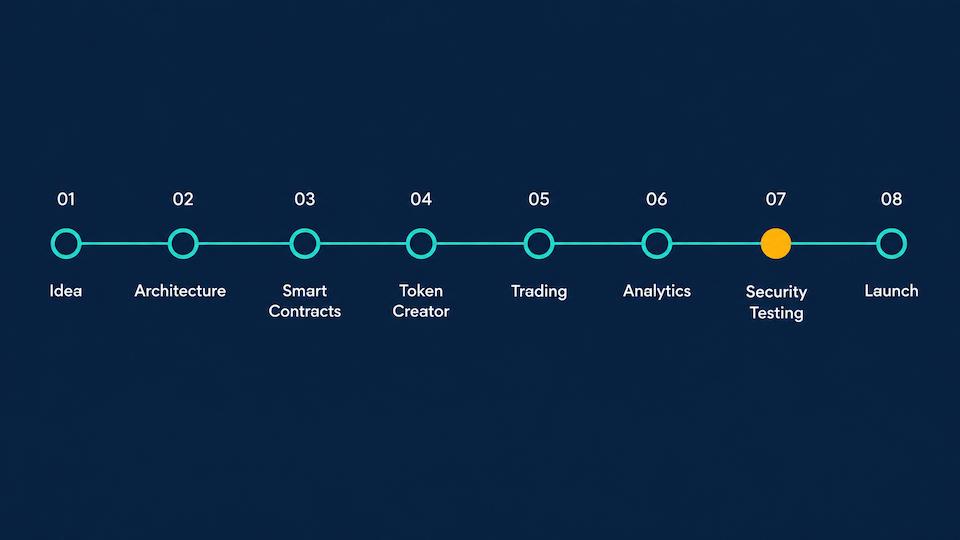
Development Process for Building a Robinhood Chain Launchpad
| PHASE 1 | Analyze the model and define differentiation. Target users, token categories, launch mechanics, fees, graduation rules, trading model, discovery. Copying Pons feature for feature means competing on brand against an incumbent with distribution. |
| PHASE 2 | Design the architecture. Contract boundaries, wallet layer, RPC strategy, indexer, backend services, database schema, API contracts, analytics pipeline. |
| PHASE 3 | Develop smart contracts. Factory, token, launch controller, pricing, fees, liquidity, locker, with unit, fork, and invariant tests on every path. |
| PHASE 4 | Build the launch interface. Creation flow, metadata upload, wallet connection, chain switching, transaction states. |
| PHASE 5 | Add trading and liquidity. Quoting, buy and sell execution, slippage controls, fee display, seeding, locking, graduation logic. |
| PHASE 6 | Build discovery and analytics. Trending feeds, recent launches, market data, graduation progress, holders, trading activity. |
| PHASE 7 | Security testing and audit. Internal review, static analysis, fuzzing, and independent audits before any value is at risk. |
| PHASE 8 | Testnet deployment. End to end launch and trade flows, indexer accuracy checks, load testing against realistic bursts. |
| PHASE 9 | Mainnet deployment. Blockscout verification, published addresses, monitoring, staged rollout with caps before opening fully. |
| PHASE 10 | Monitor and improve. Track real wallet participation, liquidity quality, graduation rates, creator retention, fee durability, then iterate. |
PONS Clone vs Custom Robinhood Chain Launchpad
A PONS-like launchpad means using a proven product model as inspiration. It does not mean copying proprietary code, branding, trademarks, UI assets, or private infrastructure. Pons documentation itself asks third parties not to imply partnership or official status without a written agreement.
Following the model helps with proven market behavior, faster MVP planning, and a launch flow users recognize. Building custom is where the advantage lives: unique fee mechanics, different token categories, custom graduation systems, community specific functionality, advanced creator tools, alternative liquidity models, and a brand that does not read as derivative.
What the PONS Trend Means for Web3 Founders
The headline was PONS crossing the $30 million zone in July. The larger development is the competition to own the token launch infrastructure layer on Robinhood Chain, and it is far from settled. Noxa led first and stepped back. Uniswap Labs entered in August with a zero protocol fee product and briefly out launched the incumbent. Pons answered with a new protocol version and, in September, a token purchase by Uniswap Labs.
Watch launch volume, real wallet participation, volume quality, revenue net of creator payouts, graduation rates, liquidity depth, creator retention, and market share stability across weeks rather than days. The winner will probably not be whoever launches the most tokens. It will be whoever keeps creators returning, traders trading, liquidity intact, and market data trustworthy after the current wave of attention moves on.
Building With Blockchain App Factory
The Pons story makes one thing clear: a token launchpad is not a factory contract with a form in front of it. Entering this market means smart contract engineering, wallet integration, pricing mechanics, DEX connectivity, indexing that keeps up with launch bursts, analytics traders trust, security controls that survive adversarial users, and backend systems that hold at volume.
Blockchain App Factory works with businesses on crypto launchpad development, token creation platforms, meme coin launchpad development, smart contract and token factory development, Web3 wallet integration, DEX integration, blockchain analytics, crypto trading platform development, and post launch support. For teams looking at Robinhood Chain, that means a platform designed around their own launch rules, fees, liquidity mechanics, and user experience rather than a copy of someone else’s. Blockchain App Factory is not affiliated with, partnered with, or endorsed by Pons or Robinhood.
Conclusion
PONS drew attention in July when trackers briefly showed it above $30 million, and far more by September when Pons was generating close to $6 million in daily fees and CoinGecko listed the token near a $493 million market cap. That progression shows the Robinhood Chain opportunity widening beyond individual tokens. The launch venues themselves have become part of the speculation, the infrastructure, and the business story.
For founders, the opening is not to duplicate Pons screen for screen. It is to build better infrastructure around token creation, trading, discovery, liquidity, analytics, security, and community activity, on a chain where the competitive set is still forming. Blockchain App Factory can help businesses exploring that opportunity move from concept to a working, audited, production ready PONS like launchpad.
|
Ready to Turn the Robinhood Chain Opportunity Into a Platform? From smart contracts and indexing to trading, analytics, and security, we build launchpads that hold up at volume. |
Frequently Asked Questions
Why is PONS trending on Robinhood Chain?
PONS is trending because Pons became the busiest token launch venue on Robinhood Chain and one of crypto’s largest fee generators. CoinDesk reported roughly $5.95 million in Pons fees over 24 hours in early September 2026, ranking fourth on DefiLlama. Traders treat PONS as exposure to launch activity rather than as a standalone meme coin.
What is a PONS-like Robinhood Chain launchpad?
It is a non custodial platform on Robinhood Chain where any wallet can create a fixed supply token in one transaction and trade it immediately, with discovery feeds, liquidity mechanics, graduation thresholds, and analytics on top. The model is inspiration, not a copy of Pons code or branding.
How can you build a launchpad like PONS?
Define your differentiation first, then design the layers: smart contracts for the token factory, launch, pricing, fees, and liquidity locking; a wallet and RPC layer; DEX integration; an event indexer; a backend with database and cache; and discovery and analytics interfaces. Audit the contracts, test on testnet, then deploy to mainnet with monitoring.
What features are required for a Robinhood Chain token launchpad?
Wallet connection, no code token creation, a token factory contract, a launch and pricing mechanism, a trading interface with quotes and slippage controls, token discovery feeds, a graduation mechanism, DEX liquidity integration, and analytics covering volume, holders, price, and liquidity.
How does a PONS-like token launchpad make money?
Primarily through token creation fees and a protocol share of trading fees. Pons documents a 0.0005 ETH launch fee and a 1% pool fee split between creator and protocol. Additional revenue can come from featured listings, premium creator tools, analytics subscriptions, API access, and referral programs.

Vimal J is the Head of Sales at Blockchain App Factory, with 10+ years of experience in sales, client strategy, and Web3 business growth. He helps startups, enterprises, and project founders choose the right blockchain solutions for their goals, bringing a practical market perspective to topics like token development, crypto launches, and Web3 adoption.
Article Reviewed by:
Arun Kamala Santhanath
Marketing Head, Blockchain App Factory


