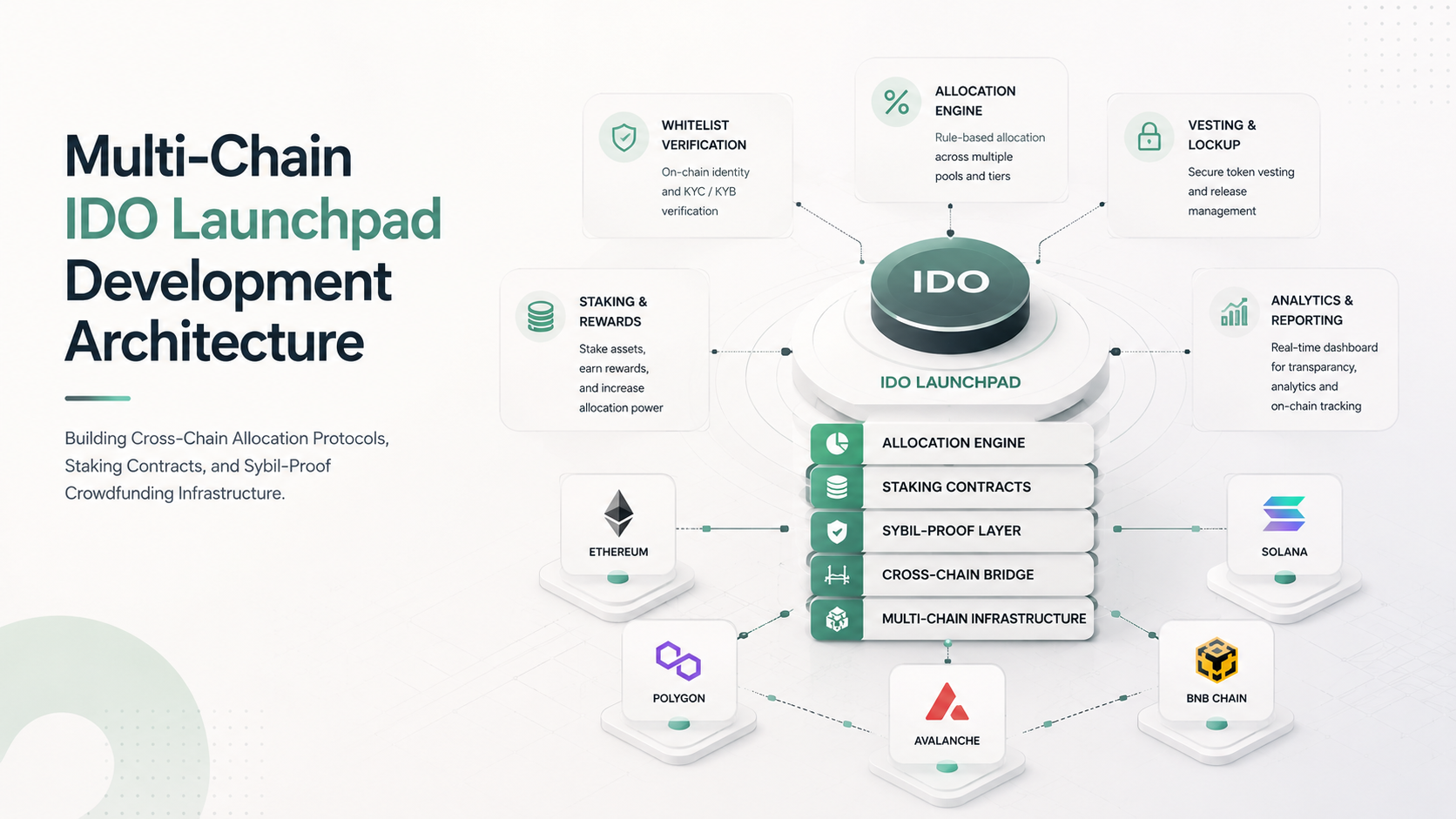

In the Web3 ecosystem, capital coordination has evolved from centralized funding to permissionless crowdfunding. Initial DEX Offerings (IDOs) are now the primary method for early-stage projects to raise capital, distribute tokens, and bootstrap liquidity. A successful launchpad connects vetted projects with a global network of participants.
However, decentralized fundraising standards have matured. Simple, single-chain sale contracts are no longer sufficient. Modern platforms require secure cross-chain integrations, automated KYC, and allocation formulas that reward long-term community members. Building such systems requires robust IDO Launchpad Development frameworks.
Building secure fundraising infrastructure requires specialized experience. Attempting to build without verified standards results in locked capital and contract vulnerabilities. Working with an experienced IDO launchpad development company helps projects design modular token-locks and oracle pricing. Partnering with a specialized IDO launchpad development services firm ensures code meets auditing standards, while a crypto launchpad development agency provides the cross-chain integration needed to launch projects across multiple networks.
The Evolution of Decentralized Crowdfunding
Early token fundraising, through Initial Coin Offerings (ICOs), was unregulated and prone to security exploits. Projects raised capital directly via simple smart contracts, but users lacked guarantees of token delivery. In 2019, Initial Exchange Offerings (IEOs) introduced exchange-mediated launches, adding security but re-centralizing the process.
The current model utilizes Initial DEX Offerings (IDOs) to restore decentralization. The launchpad uses smart contracts to manage fundraising pools, lock user stakes, and distribute tokens. Furthermore, launchpads now operate across multiple chains, letting projects raise capital on Ethereum while distributing tokens on lower-fee networks like Arbitrum or Solana, requiring secure cross-chain staking systems.
Cross-Chain Staking and Allocation Protocol
To participate in IDOs, launchpads require users to stake the platform’s native token. Users are categorized into tiers based on their stake size, which determines their allocation rights. In a cross-chain platform, staking and allocation verification occur across different networks using secure messaging.
Cross-Chain IDO Staking & Allocation Verification Flow
User locks native launchpad tokens in the staking smart contract on the source network.
Secure messaging transmits staking parameters cross-chain.
Target sale contract verifies eligible staking tier and assigns allocation rights.
User triggers token claim transaction and receives allocated pool tokens natively.
Figure 5.1: Process flow showing how cross-chain messages verify staking allocations.
Deep Dive Case Study: Protocol V’s Multi-Chain Launch
To examine modern launchpad deployment, consider the launch of Protocol V, a gaming ecosystem. The team ran their IDO across Ethereum, Polygon, and Arbitrum to optimize gas costs while accessing Ethereum’s capital pools.
Using single-chain contracts would require users to bridge staking tokens, incurring high fees. To simplify the experience, the launchpad implemented Chainlink CCIP message routing:
- Unified Staking Pool: Users staked launchpad tokens solely on Ethereum, earning multipliers.
- CCIP State Synchronization: When the IDO launched on Arbitrum, the Ethereum contract routed parameters to Arbitrum, registering eligibility.
- Native Claims: Over 8,000 users claimed allocations directly on Arbitrum and Polygon with low fees, avoiding bridging steps.
The campaign demonstrated the efficiency of cross-chain synchronization, providing a smooth experience while securing $8.2M within 24 hours.
Designing Allocation Tier Formulas
A critical component of launchpad development is designing the allocation tiers. Launchpads must balance lottery models (which give smaller holders a chance to win allocations) with guaranteed models (which reward large stakers).
The guaranteed allocation formula computes a user’s share based on their staking weight:
User Allocation = (User Staked Tokens * Duration Multiplier) / (Total Staked Tokens in Tier * Tier Weight)
By using duration multipliers (e.g. locking tokens for 12 months increases the allocation weight by 2x), the platform incentivizes long-term holders, building community stability.
Legal Compliance & Geographic Restrictions in Token Sales
Decentralized fundraising must operate within regulatory frameworks. Launchpad platforms integrate security layers to manage compliance:
- KYC/AML Integrations: Whitelist smart contracts interact with digital identity verification partners, ensuring only verified accounts can participate.
- Geographic IP Geofencing: Platforms restrict participation from restricted jurisdictions (such as the United States or China) to comply with local securities laws.
- Accredited Investor Whitelisting: For private sale stages, contracts enforce checks, verifying that wallets are associated with accredited investors.
The Staking and Allocation Roadmap
Building a launchpad requires coordinating multiple structural components. Projects manage the execution across specific development milestones:
Automated Escrow and Participant Protection Safeguards
To protect users from sudden project failures or immediate token price drops, modern launchpads implement automated safeguard policies. Raised funds are held in escrow contracts and only released to the launching project if the token’s market price remains above a specific threshold. If the price collapses or the team violates agreements, users can trigger refunds natively on-chain. This structural mechanism reduces participation risks and builds trust in decentralized capital markets.
To prevent bots from front-running users during token claim stages, launchpads deploy Merkle Tree whitelisting models. The root hash of the eligible allocations is stored on-chain, and users submit cryptographically signed proofs to claim their tokens. This allows claims to occur gas-efficiently without public listing transaction blocks that front-running searchers could intercept, ensuring fair distributions.
Developing a secure platform requires partnering with a dedicated IDO launchpad development company. The development team builds the primary staking contracts, locks platform tokens, and defines allocation tiers. Working with a specialized IDO launchpad development services firm ensures that smart contracts are audited and compliant. In addition, a professional crypto launchpad development agency provides the cross-chain integration and automated distribution networks needed to support successful token launches, establishing a solid foundation for decentralized ecosystems.
In addition to refund locks, security checks are performed to verify the listing token’s liquidity ratio. Escrow smart contracts verify that the project team locks a pre-agreed percentage of the raised capital into the primary Automated Market Maker (AMM) pool before allowing general capital claims. This protection prevents immediate liquidity draining post-launch, ensuring a stable trading environment for participants and protecting the platform’s credibility.
Why Launchpad Operators Partner with Specialists
Building launchpad infrastructure is a high-stakes engineering process. Contracts hold substantial user deposits and handle token distributions for third-party projects. Even a minor vulnerability in staking pools or vesting code can result in immediate loss of capital.
Working with an established development partner provides projects with pre-audited token-lock mechanisms, gas-optimized allocation code, and cross-chain integrations. These solutions protect user deposits, reduce transaction costs, and establish long-term trust in Web3 networks.
Launch Your Fundraising Platform
From core staking logic and allocation formulas to cross-chain messages and security reviews, our engineers deliver highly secure launchpad platforms.