Key Insights
- Airdrops perform best with rewards linked to user actions. Track staking, voting, liquidity, referrals, and repeat dApp use, not just claim counts.
- Strong wallet checks protect the token budget. Use wallet scoring, activity history, fraud filters, and referral checks to keep bots and Sybil wallets out.
- Retention starts after the claim. Guide users into onboarding, product tasks, community roles, and loyalty rewards so token holders stay active.
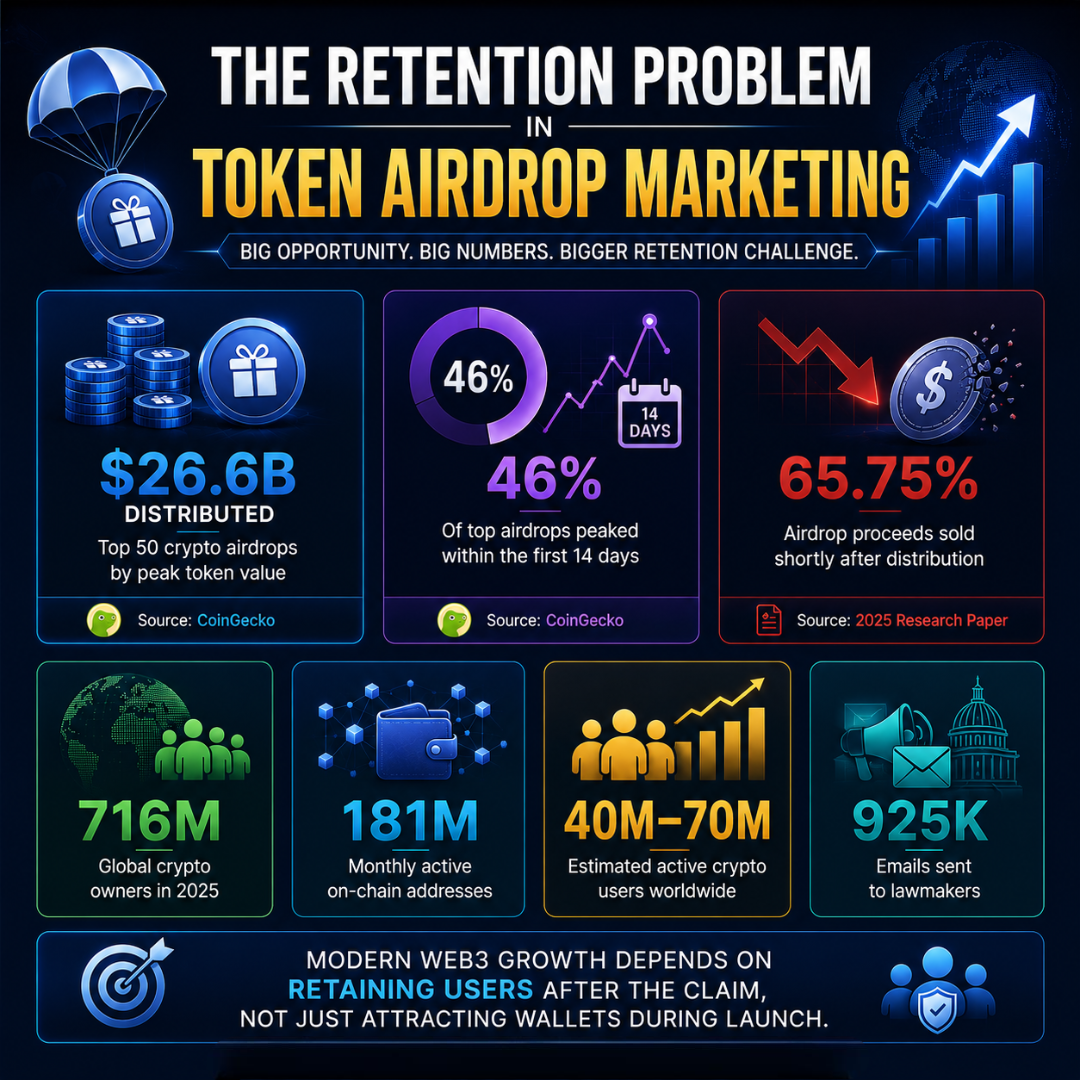
Token airdrop marketing has evolved from a simple token giveaway into one of the most effective growth channels for Web3 brands. The scale is massive. CoinGecko reported that the 50 largest crypto airdrops distributed more than $26.6 billion in token value at peak prices, while global crypto ownership crossed 716 million users in 2025. Blockchain engagement is also rising fast, with 181 million monthly active on-chain addresses and an estimated 40 million to 70 million active crypto users worldwide. These numbers show why token incentives continue to attract attention across the Web3 ecosystem.
However, attention alone does not create sustainable growth. CoinGecko found that 46% of the top 50 airdrops reached their peak token price within just 14 days, showing how quickly many recipients claim, sell, and exit. A 2025 research paper further revealed that airdrop proceeds sold through exchanges reached as high as 65.75% shortly after distribution. This is why modern token airdrop campaigns are shifting toward retention-focused strategies that reward repeat product use, staking, governance participation, referrals, and community contribution. In 2026, successful crypto marketing is no longer about generating claims alone. It is about turning claimants into active users, loyal communities, and long-term contributors.
What Is Token Airdrop Marketing?
Token airdrop marketing is the planned distribution of crypto tokens to selected users, communities, or wallet segments. A Web3 project can use it to reward early action, attract new users, and build demand before a token launch. Strong campaigns do not give tokens to random wallets. They connect each reward to user value, including app usage, trading history, staking, content work, referrals, or governance activity. This turns airdrops into a real Web3 growth channel, not a free token drop.
How Token Airdrops Fit Into the Web3 Growth Funnel
A token airdrop campaign can support every stage of the Web3 growth funnel. At the awareness stage, it sparks social buzz, PR coverage, and community talks on X, Discord, and Telegram. At the acquisition stage, it drives wallet signups, dApp visits, and claim activity. At the activation stage, it pushes users toward staking, voting, liquidity supply, swaps, gameplay, or other product actions. At the retention stage, it keeps users active through repeat transactions, community roles, rewards, and ecosystem participation.
Why Businesses Use Token Airdrop Campaigns
Businesses use token airdrop campaigns to turn attention into measurable action. Airdrops reward early adopters, bring in new users, and increase protocol activity during key launch phases. They also help distribute token ownership across a wider user base, which supports governance and community trust. For token launch marketing, airdrops give teams a clear way to build demand, test user interest, and guide users into the product before and after launch.
Why Most Crypto Airdrop Campaigns Fail to Drive Retention
Many crypto airdrop campaigns look strong on launch day. Claim pages get traffic, wallet counts rise, and social channels fill with screenshots. The problem starts after the claim. Users take tokens, sell them, or leave the product untouched. A campaign built only for claims measures noise, not loyalty.
-
High Claim Rates Do Not Equal Real User Growth
A high claim rate shows token pickup, not user quality. One wallet can claim tokens in less than a minute and never touch the product again. That creates a false growth signal for founders and marketing teams. The campaign looks active, but app usage stays weak. Real Web3 user growth needs repeat swaps, votes, deposits, gameplay, referrals, or community work.
-
Airdrop Farmers and Sybil Wallets
Airdrop farmers chase rewards across many projects. Sybil users take this further by creating many wallets under one real person or group. These wallets often complete simple tasks, claim tokens, and exit fast. They drain token supply from real users and weaken campaign data. Your dashboard may show 100,000 wallets, but many of them may add no long-term value.
-
Weak Token Utility
Users need a clear reason to hold, use, or earn more tokens. Weak utility turns the token into a short-term cash reward. Strong utility gives users practical reasons to stay. The token can support governance, staking, access rights, fee rewards, discounts, game perks, creator rewards, or ecosystem benefits. The clearer the use case, the stronger the chance of retention.
-
No Post-Claim Engagement Strategy
The claim page should not mark the end of the user path. It should start the next action. Users need simple steps after they receive tokens. That can include product onboarding, staking guides, governance prompts, learning content, quests, Discord roles, or wallet-based follow-ups. Without that next step, the campaign leaves users at the door and expects them to walk in alone.
What Makes a Retention-Focused Airdrop Campaign Different?
A retention-focused airdrop does more than distribute tokens. It rewards the actions that matter to the business. The goal is not just a bigger wallet count. The goal is more active users, stronger community ties, and better product usage after the campaign ends.
Rewarding Valuable User Behavior
A strong token airdrop campaign rewards users who create real value. That includes repeat product use, governance votes, liquidity support, referrals, content work, bug reports, and ecosystem activity. Simple one-time tasks attract quick reward seekers. Deeper actions attract users who understand the product. The best campaigns pay for behavior that proves interest.
Aligning Token Rewards With Business Goals
Token rewards should match the company’s growth targets. A DeFi protocol can reward liquidity and repeat swaps. A gaming project can reward real gameplay and asset use. An NFT marketplace can reward trading, listing quality, and creator activity. A DAO can reward voting and proposal work. This keeps token distribution tied to TVL growth, transaction volume, app usage, marketplace activity, or community output.
Turning Token Claimants Into Active Users
A claim should guide users into a clear next step. After users receive tokens, send them toward staking, voting, product use, quests, referrals, or community roles. Make the action simple and useful. Airdrop marketing works best when the campaign feels like the start of membership, not a one-time payout.
Ready to launch a token airdrop that keeps users active?
Build a token airdrop plan with wallet checks, reward tiers, claim flow, and post-claim user campaigns.

How to Design a Token Airdrop Marketing Campaign That Drives Retention
A strong token airdrop marketing campaign starts with one clear question: what should users do after they claim? The answer shapes the whole plan. A claim alone means little. The real goal is repeat use, stronger community activity, and clear business value.
Step 1: Define Clear Campaign Objectives
Start with a clear business goal. A token airdrop campaign can support user growth, product adoption, liquidity, governance, community reach, or ecosystem work. Match each goal with a KPI. This keeps the team focused on users who add value, not wallets that only chase rewards.
- User acquisition: Track new wallet signups, claim volume, and first product actions after claim.
- Product adoption: Measure swaps, mints, trades, gameplay, deposits, or app sessions.
- Liquidity growth: Track TVL, pool depth, deposit duration, and repeat liquidity actions.
- Governance decentralization: Measure votes, delegation, proposal activity, and voter return rate.
- Community expansion: Track Discord joins, Telegram activity, referrals, roles, and event turnout.
- Ecosystem development: Measure builder signups, integrations, grants, tools, content, and partner activity.
Step 2: Identify and Segment the Right Users
Good airdrop marketing starts with user quality. Segment wallets by behavior, past activity, contribution level, and community role. A single list rarely works. Early users, traders, creators, gamers, developers, and liquidity providers show different intent. Each group needs a reward that matches its value.
- Early adopters: Reward users who joined before public hype and tested the product early.
- Power users: Give higher value to wallets with repeat actions across many days or weeks.
- Liquidity providers: Reward users who add liquidity and keep funds active for a set period.
- Developers: Target builders who create tools, apps, docs, contracts, or ecosystem projects.
- Creators: Reward content, tutorials, reviews, videos, and community education work.
- Gamers: Focus on real gameplay, asset use, quests, wins, levels, and session count.
- Traders: Track repeat trades, volume quality, fee activity, and use across product pairs.
- Governance participants: Reward voters, delegates, proposal writers, and active DAO members.
Step 3: Create Behavior-Based Eligibility Criteria
Eligibility rules decide campaign quality. Reward actions that prove real interest. A wallet that uses the dApp once should not get the same reward as a repeat user. Build criteria around actions that connect to retention, product value, and user trust.
- Repeat dApp usage: Reward users who return often and complete real product actions.
- Multi-week activity: Give more weight to wallets active across several weeks, not one busy day.
- Liquidity provision: Reward deposits that stay active across a fixed period.
- Governance voting: Give value to users who vote, delegate, or discuss proposals.
- Staking: Reward users who stake tokens and keep them locked for set time frames.
- Referrals: Count referred users only after they complete a real product action.
- Quest completion: Use quests to teach users and guide them into core product features.
- Community contribution: Reward guides, support work, bug reports, events, and useful feedback.
Step 4: Build Anti-Sybil and Fraud Protection
Airdrop farming can drain a token budget fast. Use wallet scoring, transaction pattern checks, wallet clustering, allowlists, and risk filters. Look for wallets funded from the same source, copied actions, fake referrals, and sudden bursts of activity. Strong filters help real users get fair rewards.
Step 5: Design Tiered Token Rewards
Tiered rewards make the campaign fairer. Basic users can receive a small allocation. Repeat users and strong contributors can earn more. This structure gives users a reason to stay active. It also protects the project from giving equal rewards to low-value wallets and loyal users.
- Basic eligible users: Give a small reward to wallets that meet the entry criteria.
- Repeat users: Increase rewards for users who return across days, weeks, or product stages.
- High-value contributors: Reward users who add clear value through usage, support, or content.
- Ecosystem builders: Give higher rewards to teams and developers who expand the project.
- Governance participants: Reward voters and delegates who take part in key decisions.
Step 6: Connect the Claim Process to the Next Action
The claim page should guide users into the next step right away. Do not leave users with tokens and no direction. Add clear prompts after claim. Send users to staking, voting, product use, liquidity pools, community channels, referrals, or learning tasks.
- Staking: Invite users to stake tokens and earn rewards tied to longer participation.
- Governance delegation: Guide token holders to delegate voting power or vote on proposals.
- Product usage: Send users to one clear feature, such as swap, mint, play, lend, or trade.
- Liquidity provision: Show users how to add liquidity and track rewards in simple terms.
- Community onboarding: Move users into Discord, Telegram, roles, guides, and event updates.
- Referral programs: Reward users who invite real users who complete product actions.
- Educational quests: Teach token utility, product steps, safety rules, and community roles.
Step 7: Use Vesting or Milestone-Based Unlocks
Instant token distribution can create quick sell pressure. Milestone-based unlocks give users a reason to stay. A project can release part of the reward at claim, then unlock the rest after staking, voting, product use, or a 30-day activity target. This model ties rewards to behavior.
Step 8: Launch Post-Airdrop Retention Campaigns
Airdrop marketing needs follow-up. Use email, Discord, Telegram, wallet messages, quest platforms, and community channels to keep users active. Send tutorials, staking prompts, governance updates, referral tasks, and bonus rewards. The best campaigns treat the claim as day one, not the finish line.
Technical Elements of a Successful Token Airdrop Campaign
A token airdrop campaign needs strong planning and clean tech execution. The strategy can bring users in, but the technical setup decides trust, safety, and retention. Every wallet check, claim step, and data point should support one goal: turning token claimants into real product users.
-
Wallet Analytics and User Scoring
Wallet analytics help teams find users with real value. Study wallet age, transaction history, activity frequency, protocol use, and past contribution. A wallet with steady activity over 90 days shows stronger intent than a wallet created yesterday. User scoring ranks wallets by quality, so the campaign rewards users who trade, stake, vote, build, refer, or take part in the community.
-
Smart Contract and Claim Portal Development
The claim system must be simple, safe, and clear. Smart contracts handle token claims, eligibility checks, claim limits, and reward distribution. Merkle proofs help verify eligible wallets with lower gas costs. The claim portal should support major wallets, show the exact token amount, explain gas fees, and guide users through each step. Clear claim flows build trust and reduce drop-offs.
-
Anti-Sybil Infrastructure
Anti-Sybil infrastructure protects the token supply from bots and fake wallets. Teams can use fraud checks, wallet clustering, referral checks, and manual reviews. The system should flag wallets funded from the same source, copied transaction patterns, fake referrals, and sudden bursts of activity. This keeps more rewards in the hands of real users and gives the team cleaner campaign data.
-
Campaign Landing Page and User Experience
The landing page should answer user questions fast. It needs campaign details, an eligibility checker, token utility, claim rules, FAQs, deadlines, and safety warnings. Users should know what they can claim, why they qualify, and what to do next. A clear page reduces confusion and helps move users from interest to action without extra support tickets.
-
Analytics and Reporting Dashboard
A reporting dashboard shows what happens after the claim. Track claim rate, active wallets, token holding, staking, governance votes, repeat product use, referrals, and retention cohorts. Teams should review 7-day, 30-day, and 90-day activity. These numbers reveal user quality and show whether the airdrop campaign drives real business growth.
Token Airdrop Marketing Framework for Businesses
A token airdrop campaign needs structure. Teams need clear goals, clean wallet data, fair reward rules, and a post-claim plan. The R.E.T.A.I.N. Framework gives Web3 businesses a simple model to plan each stage. It keeps the campaign focused on real users, not random claims.
The R.E.T.A.I.N. Framework
- Research: Study the audience, competitor airdrops, wallet behavior, user intent, and ecosystem gaps. This helps the team spot users with real interest.
- Eligibility: Set clear rules for users who qualify. Reward repeat actions, real usage, useful referrals, and community work. Block fake wallets early.
- Tokenomics: Match token supply, utility, vesting, and reward size with business goals. This keeps rewards fair and limits quick sell pressure.
- Activation: Move users from claim to action. Guide them toward staking, voting, product use, quests, liquidity pools, or community roles.
- Integrity: Add anti-Sybil checks, security reviews, scam alerts, and legal review. This protects users, token supply, and brand trust.
- Nurture: Keep users active after the claim. Use email, Discord, Telegram, wallet messages, quests, and loyalty rewards to build repeat action.
How the Framework Improves Campaign ROI
- Cuts wasted token distribution: Strong wallet filters send rewards to users who show real value. This protects the token budget and improves campaign quality.
- Raises user quality: Behavior-based rules attract users who trade, stake, vote, refer, build, or join the community with clear intent.
- Increases product adoption: A clear claim path moves users into product actions. More users test features, return later, and build stronger habits.
- Strengthens governance participation: Reward rules can push users toward voting, delegation, and proposal work. This gives the project a more active token base.
- Builds long-term community value: Post-claim campaigns turn claimants into members. The brand gains active users, better feedback, and stronger word-of-mouth growth.
Want real users from your token airdrop?
Types of Token Airdrop Campaigns
Token airdrop marketing is not one fixed playbook. Different campaign types serve different business goals. A DeFi protocol needs a different reward plan than a gaming project or DAO. The right model depends on user behavior, token utility, and the action you want after the claim.
Retroactive Airdrops
Retroactive airdrops reward users for past activity. This type works well for projects with clear wallet history. A protocol can reward early swaps, deposits, mints, votes, testnet use, or app sessions. Users see it as fair, since it values work they already completed. It also builds trust with early adopters who helped the project grow before wider market attention.
Quest-Based Airdrops
Quest-based airdrops use tasks to teach users and guide product actions. Users qualify by completing steps such as wallet setup, swaps, staking, gameplay, content sharing, or learning modules. This format works well for onboarding. It helps new users understand the product before they claim rewards. It also gives teams cleaner data on user intent and feature interest.
Liquidity-Based Airdrops
Liquidity-based airdrops reward users who add funds to pools, lending markets, or DeFi products. These campaigns work best for DEXs, lending platforms, yield products, and new chains. Strong rules should track deposit size, holding period, pool type, and repeat activity. This stops short-term deposits from draining rewards without adding lasting value.
Governance Airdrops
Governance airdrops reward users who take part in decisions. Projects can reward voting, delegation, proposal writing, forum comments, and working group activity. This model helps DAOs build a more active token holder base. It gives tokens to people who care about the project’s direction, not only short-term price gains.
Referral-Based Airdrops
Referral-based airdrops help projects grow through user invites. A strong referral campaign rewards users only after the invited wallet completes a real action. That action can be a trade, stake, deposit, quest, or app session. Fraud checks matter here. Fake invites, duplicate wallets, and reward loops can damage the campaign fast.
Developer and Ecosystem Airdrops
Developer and ecosystem airdrops reward builders who expand the project. Recipients can include app teams, tool makers, open-source contributors, grant winners, content creators, and partner projects. This type works well for Layer 1, Layer 2, DePIN, AI crypto, and infrastructure brands. It turns token rewards into fuel for long-term ecosystem growth.
Conclusion
A token airdrop should do more than place tokens in wallets. It should guide users toward real product actions, fair rewards, safer claims, and steady community activity. The best campaigns start with clear goals, strong wallet checks, useful token design, and post-claim follow-ups that keep users involved after launch. For Web3 businesses, this turns token distribution into a growth channel that supports users, liquidity, governance, and long-term brand trust. Blockchain App Factory provides Token Airdrop Marketing Services for projects that need strategy, campaign planning, community reach, claim flow support, fraud checks, and retention marketing under one team.

Vimal J is the Head of Sales at Blockchain App Factory, with 10+ years of experience in sales, client strategy, and Web3 business growth. He helps startups, enterprises, and project founders choose the right blockchain solutions for their goals, bringing a practical market perspective to topics like token development, crypto launches, and Web3 adoption.