Key Insights
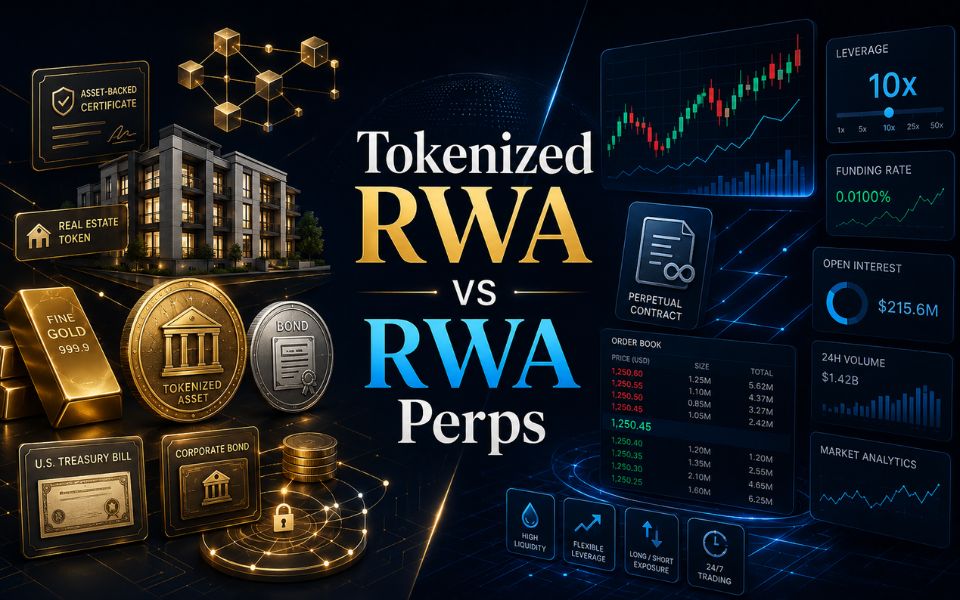
- Tokenized RWAs focus on asset-linked ownership, income rights, and long-term investment value. RWA perps focus on price exposure, leverage, and short-term trading activity.
- The choice between tokenized RWAs and RWA perps affects compliance, liquidity, revenue, user onboarding, and backend systems. A wrong fit can confuse users and weaken product growth.
- Exchange owners need to review users, legal readiness, technical setup, and liquidity sources before choosing a model. A hybrid model works only when both products have separate rules, risk systems, and user flows.
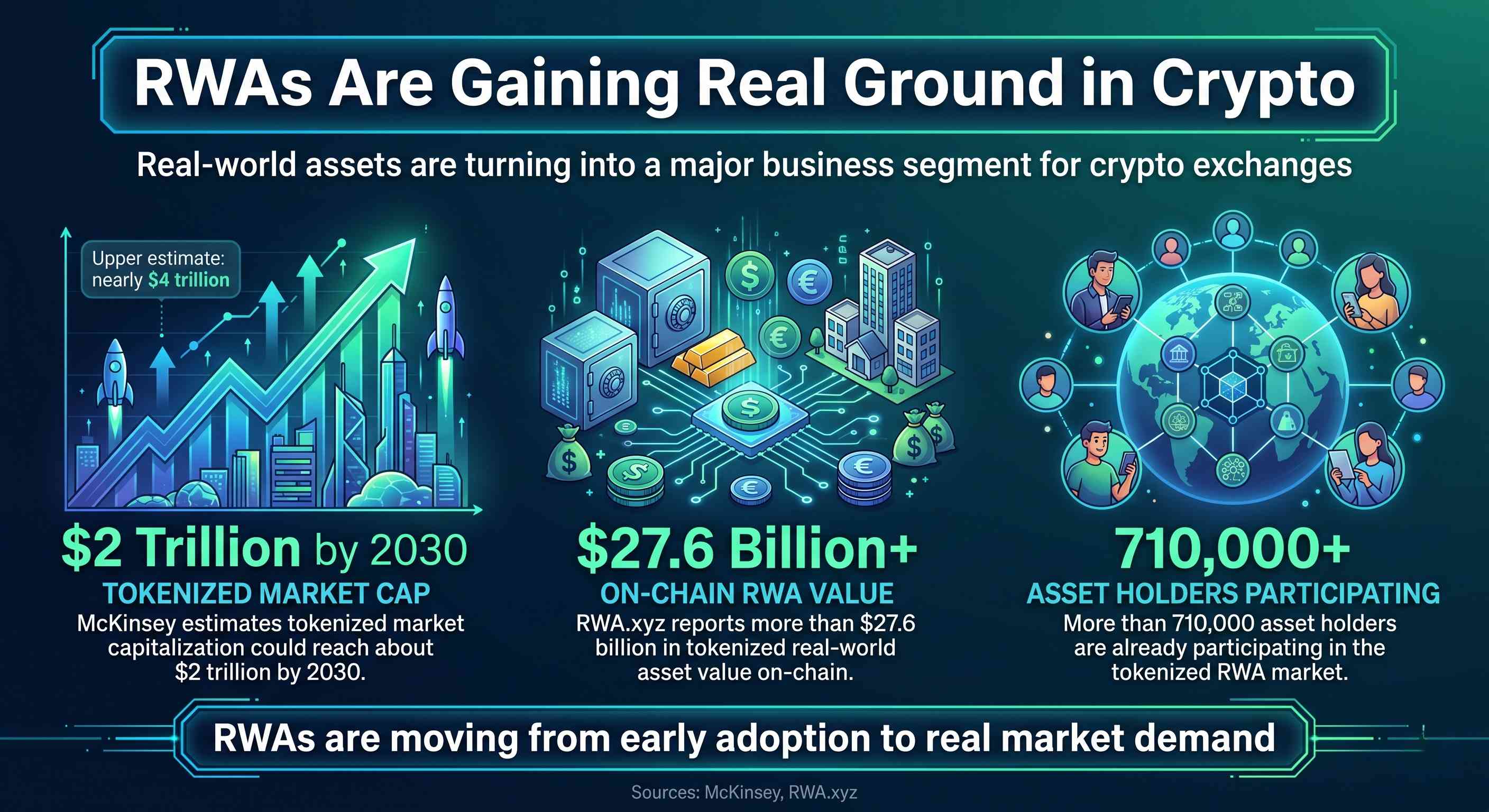
Real-world assets, or RWAs, are getting serious attention from crypto exchange owners. They connect blockchain markets with assets people already understand, such as real estate, gold, bonds, treasury products, invoices, and private credit. The business case is getting harder to ignore. McKinsey estimates that tokenized market capitalization could reach about $2 trillion by 2030, with an upper estimate of nearly $4 trillion. RWA.xyz reports that tokenized real-world assets already account for more than $27.6 billion in on-chain value, with over 710,000 asset holders. These numbers show that RWAs are no longer a side topic in crypto. They are becoming a real product category with visible demand.
Many users now want more than short-term coin trading. Some want asset-backed exposure. Some want income-linked products. Some want access to traditional markets through a crypto platform. This shift gives crypto exchange developers a practical chance to serve both investors and traders with RWA-based products.
Why the RWA Product Choice Matters
An exchange cannot treat every RWA product in the same way. Tokenized RWAs and RWA perps sound similar, but they serve different users. Tokenized RWAs focus on asset-linked ownership. RWA perps focus on price movement without ownership.
This choice affects the full exchange plan. It changes user onboarding, legal review, compliance checks, liquidity planning, revenue, trading tools, and backend systems. Investors need asset records, custody details, and trust. Traders need speed, accurate pricing, and fast order execution. A platform that mixes both needs without proper planning can confuse users and weaken growth.
What This Guide Covers
This guide explains Tokenized RWA vs RWA Perps for crypto exchange developers, founders, and Web3 businesses. It explains how both models work, who they serve, and what each model demands from a platform.
The guide covers ownership, price exposure, compliance, revenue, liquidity, technical setup, and launch planning. It helps exchange owners decide whether tokenized RWAs, RWA perps, or a mixed RWA model fits their business plan.
Understanding Tokenized RWAs and RWA Perps
What Are Tokenized RWAs?
Tokenized RWAs are blockchain-based tokens linked to real-world assets. These assets include real estate, gold, treasury bills, bonds, funds, invoices, and private credit. The token acts as a digital unit connected to an asset or financial product.
A tokenized RWA can represent ownership rights, income rights, redemption rights, or another asset-linked claim. For example, a real estate token can give users fractional access to property income. A treasury-linked token can give users exposure to returns from government debt instruments.
This model works well for exchanges that want to attract long-term investors, institutions, and users who prefer asset-backed products. These users care about asset value, legal terms, custody, records, and return potential. They are not only looking for fast price movement.
Tokenized RWA exchange development needs more than token creation. The platform needs asset verification, custody support, KYC, AML screening, investor records, transfer rules, smart contracts, settlement tools, and reporting systems.
What Are RWA Perps?
RWA perps, or RWA perpetual contracts, are derivative trading products. They let users trade the price movement of real-world assets without owning the asset itself. A trader can go long or short on gold, oil, stock indices, forex pairs, or commodities from a crypto exchange account.
The user does not buy the real asset. The user trades a contract tied to the asset price. This makes RWA perps more suitable for active traders who want leverage, margin, quick entry, quick exit, and frequent trading chances.
RWA perps need a trading-focused backend. The exchange needs a matching engine, price oracles, margin rules, funding rate logic, liquidation systems, collateral controls, and risk checks. Each part must work with accuracy, since leveraged trades leave little room for pricing mistakes.
Poor oracle data can trigger wrong liquidations. Weak margin rules can create losses for traders and the platform. For this reason, RWA perps suit exchanges with deep knowledge of derivatives trading and real-time risk control.
The Main Difference Between Both Models
The main difference is simple. Tokenized RWAs focus on ownership. RWA perps focus on price speculation. One gives users asset-linked participation. The other gives users a contract to trade market movement.
Tokenized RWAs suit investors who care about asset backing, records, and long-term value. RWA perps suit traders who care about price action, liquidity, leverage, and execution speed.
This difference affects the whole crypto exchange development plan. It changes the sign-up flow, compliance process, product design, revenue model, liquidity source, and technical system. An exchange must know this difference before it enters the RWA market.
Tokenized RWA vs RWA Perps: Main Comparison
Ownership or Price Exposure
Tokenized RWAs give users a digital token linked to a real-world asset. That token can carry ownership rights, income rights, redemption rights, or another asset-linked claim. This makes tokenized RWAs more suitable for investment products. The user is not only looking at a price chart. The user wants to know what stands behind the token.
RWA perps work in a different way. They give users price exposure through a trading contract. A trader can profit from the rise or fall of an asset price, but the trader does not own the asset. For example, a user can trade gold price movement without holding physical gold or a gold-backed token. This makes RWA perps more suitable for active trading.
Investor Audience or Trader Audience
Tokenized RWAs usually attract investors. These users care about asset value, legal terms, yield potential, issuer records, and redemption rules. They want proof that the asset exists and that the token has a proper link to it. Their goal is often long-term access to real asset value, not quick entry and exit.
RWA perps attract traders with a different mindset. These users care about charts, leverage, liquidity, fees, funding rates, and order speed. They want to open positions fast and close them fast. They are less focused on asset ownership and more focused on market movement.
Compliance Load
Tokenized RWA platforms need more ownership-based compliance work. The exchange must manage KYC, AML checks, user eligibility, jurisdiction limits, custody records, legal papers, and asset details. The platform must show how the asset is held, who manages it, and what rights users receive.
RWA perps need compliance planning around derivatives trading. The exchange must manage leverage rules, location-based access, user risk warnings, trading permissions, and market conduct rules. The product does not involve asset ownership, but trading risk remains high.
Revenue Potential
Tokenized RWAs can bring revenue from asset issuance fees, listing fees, management fees, custody-related fees, trading spreads, redemption fees, and institutional access plans. The revenue can grow at a steadier pace as serious investors and asset issuers join the platform.
RWA perps can bring faster fee income through trading activity. The exchange can earn from trading fees, funding fees, liquidation fees, market maker programs, premium trading tools, and API traders. This model relies on market depth, regular trader activity, and proper risk control.
Technical Demands
Tokenized RWA exchange development needs asset tokenization, custody links, compliance checks, investor onboarding, smart contracts, settlement tools, transfer rules, and reporting systems. The product connects technology with legal records and real asset management.
RWA perps exchange development needs a trading engine, price oracles, margin rules, funding rate logic, liquidation tools, collateral tracking, and live risk checks. The main concern is speed and pricing accuracy. One wrong price feed can harm traders and the exchange.
Launch Time
Tokenized RWAs often need more time before launch. The exchange must work with asset partners, legal teams, custody providers, and compliance vendors. User documents, asset records, and redemption terms must be ready before trading starts.
RWA perps can reach the market faster for exchanges that already run derivatives products. The trading system still needs careful testing. Price feeds, margin levels, liquidation settings, and liquidity support must work properly before users place real trades.
Tokenized RWAs suit exchanges that want asset-backed investment products. RWA perps suit exchanges that want trading activity around real-world asset prices. The better choice comes from the user base, legal plan, technology stack, liquidity plan, and revenue goal.
Who Should Choose Tokenized RWAs?
Best for Institutional and Long-Term Investors
Tokenized RWAs fit exchanges that want to attract serious investors. These users include institutions, family offices, asset managers, fintech firms, and high-net-worth clients. They look for products linked to real economic value. They care less about daily price swings and more about asset backing, income potential, and trusted records.
This model works well for users who think in months or years. They want digital access to assets like real estate, treasury products, commodities, bonds, private credit, or fund units. A tokenized RWA exchange gives them a familiar investment idea through a blockchain-based platform.
Right Fit for Asset-Backed Products
Tokenized RWAs make sense for exchanges that want to offer products backed by real-world value. These products can include property-backed tokens, gold-backed tokens, invoice-backed assets, tokenized treasury products, or yield-linked credit products.
For example, a user does not need to buy a full property to access property income. A tokenized real estate product can offer fractional exposure. A user does not need a traditional broker flow for treasury-linked access. A blockchain-based platform can present the product in a simpler digital format.
Needs Legal, Custody, and Compliance Support
Tokenized RWAs need more than token issuance. The exchange must handle legal structure, custody, investor checks, asset records, and compliance workflows. These areas matter since the token links to a real asset or financial product.
Users will ask direct questions. Who holds the asset? What rights does the token give? How does redemption work? How are returns paid? The platform must answer these questions through documents, dashboards, contracts, and records. Weak planning can damage trust before the product gains traction.
Creates Long-Term Revenue
Tokenized RWAs do not always bring fast trading volume like derivatives. They can still create steady business value. Exchanges can earn through asset listing fees, issuance fees, management fees, custody-related charges, trading spreads, redemption fees, and institutional access plans.
This model fits businesses that prefer durable revenue over short bursts of volume. Reliable asset issuers and long-term investors can make tokenized RWAs a valuable part of an exchange. The focus stays on asset quality, user trust, and repeat participation.
Who Should Choose RWA Perps?
Best for Trading-First Exchanges
RWA perps fit exchanges that already serve active traders. A platform with spot trading, futures, margin products, or fast order execution has a natural base for RWA perpetual contracts. These products let users trade real-world market prices without holding the actual asset.
A trader can take exposure to gold, crude oil, stock indices, forex pairs, or commodities from the same account used for crypto trading. The exchange does not manage asset ownership like a tokenized RWA platform. It still needs tight control over trading risk, price feeds, margin, and liquidations.
Fits Retail and Crypto-Native Traders
RWA perps attract users who enjoy fast market action. Retail traders and crypto-native users often prefer long and short positions, leverage, quick entries, and quick exits. They do not plan to hold a real-world asset for years. They want to trade price movement during market activity.
This makes RWA perps useful for exchanges that want more trading volume. Volatile markets create more position changes, more strategy shifts, and more capital movement across assets. RWA perps add new markets beyond regular crypto pairs, so users get more reasons to trade on the same platform.
Needs a Dependable Trading Engine and Oracle Setup
RWA perps look simple on the screen, but the backend carries heavy work. The exchange needs a matching engine, price oracle system, margin logic, liquidation process, funding rate model, collateral controls, and live risk checks. Each part has to work fast, since leveraged trades leave little room for pricing errors.
Price data matters most in RWA perps. Users trade contracts tied to real-world market prices, so the platform needs accurate and timely feeds. A wrong oracle update can trigger unfair liquidations or incorrect profit and loss. Trust drops fast after a pricing failure.
Creates Revenue From Trading Volume
RWA perps create revenue through user activity. Exchanges earn from trading fees, funding fees, liquidation fees, market maker programs, premium trading tools, and API-based trading. Higher trading activity brings more fee income.
This model can bring faster revenue than tokenized RWAs. It still carries more pressure. The platform has to manage leverage, liquidity gaps, market imbalance, and sudden price swings. RWA perps work best for exchanges that treat risk control as part of daily operations, not as a backend task.
Ready to Build Your RWA Exchange With the Right Tokenization Model?
Launch your tokenized RWA platform with Blockchain App Factory’s Real World Asset Tokenization Services, covering asset token development, smart contracts, compliance flow, and exchange-ready infrastructure.

Infrastructure Requirements
Tokenized RWA Exchange Infrastructure
A tokenized RWA exchange needs systems that connect real assets with digital trading. The process starts with asset tokenization. Real-world assets become blockchain-based tokens that represent ownership rights, income rights, redemption rights, or another asset-linked claim.
Custody support plays a major role in this model. The platform needs custodians, trustees, issuers, or asset managers who hold and verify the underlying asset. Users need proof that the asset exists and that the token has a proper link to it.
KYC and AML checks sit inside the user flow. Tokenized RWAs cannot work like open crypto tokens in many cases. The exchange needs identity checks, user eligibility rules, jurisdiction filters, transaction monitoring, and transfer controls.
Smart contracts manage token issuance, transfers, restrictions, settlement, and yield distribution in some cases. The exchange needs trading and settlement tools as well. Users should be able to buy, sell, hold, or redeem tokenized assets based on platform rules and asset terms.
RWA Perps Exchange Infrastructure
An RWA perps exchange needs systems made for fast trading and risk control. The trading engine sits at the center of the platform. It processes orders, matches buyers and sellers, tracks positions, and updates balances. Even a small delay can hurt trader confidence in active markets.
Oracle integration plays a major role too. RWA perps depend on outside price feeds for gold, oil, indices, forex, and commodities. The platform needs trusted data sources, backup feeds, stale price checks, and price deviation limits to reduce wrong pricing.
The margin and liquidation system handles collateral, margin ratios, liquidation prices, and open positions in real time. Leveraged trading needs close tracking. A risky position has to be reduced or closed before losses spread across the platform.
Funding rate logic helps keep perpetual contract prices close to reference market prices. The exchange also needs position limits, open interest caps, volatility checks, insurance funds, and emergency controls. Without these systems, an RWA perps exchange can attract traders fast but fail during market stress.
Compliance and Risk Considerations
Tokenized RWAs Need Ownership-Based Compliance
Tokenized RWAs deal with real assets, so compliance must sit inside the product plan from day one. A user who buys a tokenized real-world asset can receive ownership rights, income rights, redemption rights, or another asset-linked claim. That makes the product different from a normal crypto token listing.
A tokenized RWA platform needs KYC checks, AML screening, investor review, jurisdiction rules, custody records, legal papers, and reporting tools. Users want to know who holds the asset, how rights are recorded, how returns are paid, and how redemption works. Weak records can damage trust before the product gains traction.
RWA Perps Need Derivatives and Trading Controls
RWA perps carry a different type of responsibility. Users trade contracts based on price movement, not asset ownership. The exchange must manage leverage rules, margin safety, liquidation logic, funding rates, oracle pricing, and trading limits.
A wrong price feed can create unfair liquidations. A loose leverage policy can increase losses during sharp market moves. RWA perps need careful product rules, accurate market data, and live risk checks. Traders move fast, so the platform must respond fast.
KYC and Jurisdiction Rules Matter
Both RWA models need user access controls, but each one needs them for a different reason. Tokenized RWAs need identity checks for asset ownership, investor eligibility, and transfer rules. RWA perps need access limits for derivatives trading, leverage exposure, and regional rules.
A crypto exchange should handle legal planning before product design. The team must know who can use the product, where it can be offered, what risk notices users need, and how trading activity gets monitored. Late legal planning can slow launch and create costly changes.
Legal Planning Protects Trust
Legal planning gives the product structure. It defines user rights, asset claims, trading rules, dispute handling, access limits, and platform duties. It also helps users understand what they are buying or trading.
Technology alone cannot build trust in the RWA market. Trust comes from verified records, reliable partners, fair trading rules, and steady operations. Tokenized RWAs and RWA perps both need compliance built into the product, not added later as a patch.
Liquidity and Revenue Models
How Tokenized RWAs Build Liquidity
Tokenized RWA liquidity comes from asset quality, investor demand, transfer rules, redemption terms, and secondary market activity. These products do not always trade like open crypto tokens. Some assets are limited to verified users or selected investor groups.
This can make early liquidity slower. Still, a well-structured asset can bring serious capital. A treasury-linked product or income-backed real estate token can appeal to users who prefer steady value over daily market swings. The exchange needs issuer support, market access planning, redemption rules, and user education.
Revenue Streams in Tokenized RWAs
Tokenized RWA exchanges can earn from asset issuance fees, listing fees, management fees, custody-related fees, trading spreads, redemption charges, and institutional access plans. Each revenue line connects to the asset lifecycle.
This model often grows through long-term investor activity. It may not produce fast trading volume at the start, but it can create steady income. Reliable issuers, quality assets, and repeat investor participation matter more than short market bursts.
How RWA Perps Build Liquidity
RWA perps get liquidity from active traders, market makers, collateral depth, open interest, and order book activity. More trading activity helps users enter and exit positions with better pricing.
These products suit short-term and leveraged trading. Traders can move between gold, oil, indices, forex, or commodities based on price action. Poor liquidity can create slippage, wrong liquidations, and weak user experience. The exchange must manage market depth before trade volume grows.
Revenue Streams in RWA Perps
RWA perps can earn through trading fees, funding fees, liquidation fees, market maker programs, paid analytics, and API-based trading. Revenue rises with user activity, so this model can bring faster fee income during active markets.
The pressure is higher too. The exchange must maintain price accuracy, healthy margin rules, and enough liquidity. A perps platform can earn quickly, but only with tight control over risk and market depth.
Comparing Revenue Quality
Tokenized RWAs can bring slower, steadier revenue through asset-backed products and institutional users. RWA perps can bring faster fee income through trading volume. The income can rise or fall with market activity.
The better model comes from the business goal. Tokenized RWAs fit exchanges that want long-term investor relationships. RWA perps fit exchanges that want frequent trading activity around real-world market prices.
Choosing the Right Strategy
Start With the Users You Want to Serve
The RWA model should match the people your exchange wants to attract. A platform made for institutions, family offices, asset managers, and long-term investors will need a product with asset backing, legal records, custody details, and income terms. Tokenized RWAs fit this group better, since these users want real asset exposure through a digital format.
A platform made for active traders needs a different product setup. Crypto-native traders care about charts, margin, price movement, liquidity, funding rates, and fast trade execution. RWA perps fit this group better, since they let users trade real-world asset prices without owning the assets.
Review Your Compliance Capacity
Tokenized RWAs need ownership-related checks. The exchange needs legal agreements, custody partners, investor verification, transfer rules, jurisdiction filters, and reporting. These parts take time, but they help the platform serve asset-backed investment products with more trust.
RWA perps need a different compliance plan. The exchange must handle derivatives rules, leverage limits, location-based access, risk notices, and trader protection. A team with futures or margin trading experience will find this model easier to manage from a product planning view.
Check Your Technology Readiness
A tokenized RWA exchange needs systems for asset tokenization, custody links, compliance checks, smart contracts, settlement, investor records, and user dashboards. The product connects real assets with digital ownership or asset-linked participation.
An RWA perps exchange needs a trading engine, oracle feeds, margin tools, funding rate logic, liquidation systems, collateral checks, and live risk monitoring. The product depends on speed, price accuracy, and market safety. A derivatives-ready exchange can add RWA perps with less friction than a platform starting from zero.
Plan Liquidity Before Launch
Liquidity should not be treated as a launch-day task. Tokenized RWAs need investor demand, issuer support, redemption terms, and secondary market planning. Some assets need time before buyers and sellers become active.
RWA perps need market makers, order book depth, collateral support, and open interest limits. Thin liquidity can cause poor pricing, higher slippage, and unfair liquidations. The exchange must know where liquidity will come from before the first market goes live.
Match the Model With Revenue Goals
Tokenized RWAs suit exchanges that want long-term revenue from asset-backed products. Income can come from listing fees, issuance fees, management fees, redemption charges, trading spreads, and institutional access plans. This model fits a platform that wants investor relationships and steady product demand.
RWA perps suit exchanges that want fee income from active trading. Revenue can come from trading fees, funding fees, liquidation fees, market maker programs, paid tools, and API traders. This model fits a platform that wants high user activity around real-world asset prices.
Know Where a Hybrid Model Fits
A hybrid model can work for exchanges with enough legal, technical, and financial capacity. One part of the platform can serve investors through tokenized RWAs. Another part can serve traders through RWA perps.
The two products should not share one confusing user flow. Tokenized RWA users need asset information, custody records, compliance steps, and redemption details. RWA perp users need charts, margin tools, risk notices, position controls, and fast execution. A hybrid exchange needs separate rules, separate risk systems, and separate product messages.
The right RWA strategy comes from the users, legal plan, technology stack, liquidity source, and revenue target. Tokenized RWAs work better for asset-backed investment products. RWA perps work better for trading activity around real-world market prices.
Conclusion
Tokenized RWAs and RWA perps serve two different goals in crypto exchange development. Tokenized RWAs suit platforms that want asset-backed investment products, long-term users, and revenue linked to real-world value. RWA perps suit exchanges that want active trading, price exposure, leverage-based markets, and higher trading volume. The right choice should match your users, compliance plan, liquidity source, technical setup, and revenue target. For businesses planning to enter this market, Blockchain App Factory provides Real World Asset Tokenization Services that help create asset-backed digital products with token development, smart contracts, compliance flow, asset lifecycle support, and exchange-ready infrastructure.

Vimal J is the Head of Sales at Blockchain App Factory, with 10+ years of experience in sales, client strategy, and Web3 business growth. He helps startups, enterprises, and project founders choose the right blockchain solutions for their goals, bringing a practical market perspective to topics like token development, crypto launches, and Web3 adoption.