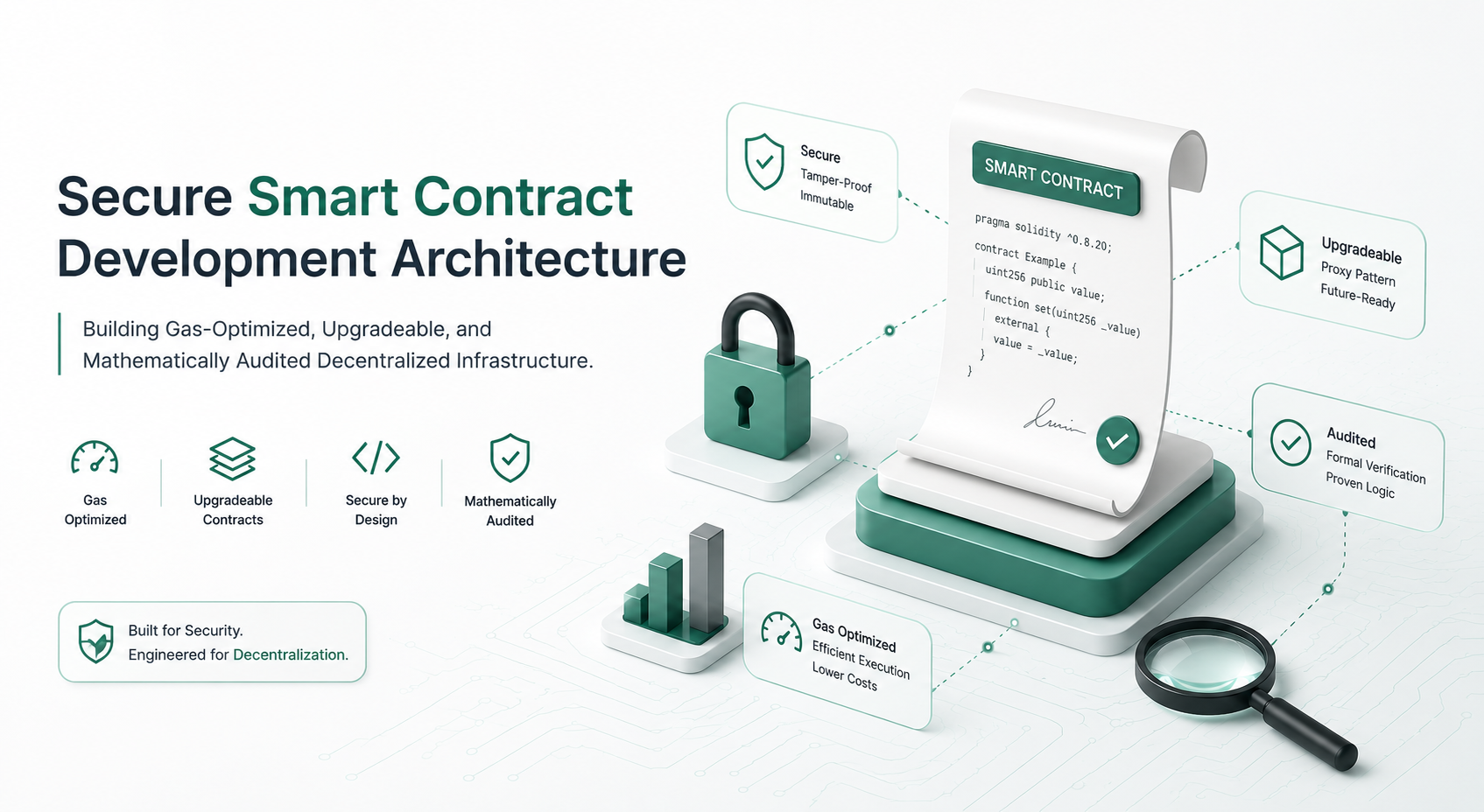

In the decentralized economy, code is immutable law. Once a smart contract is deployed to a public blockchain, it becomes an independent financial vault. Unlike traditional software where bugs can be patched on a remote server within minutes, a smart contract exploit is permanent and often results in immediate asset loss.
Let’s address the technical reality: copy-pasted code and untested contract logic are major liabilities. In a composed Web3 ecosystem, a minor reentrancy bug or integer mismatch can lead to a protocol exploit. To scale successfully, protocols require professional Smart Contract Development incorporating rigorous testing, gas optimization, and upgradeability patterns.
Building secure protocols requires engineering experience. Attempting to build without verified standards leads to high gas fees and vulnerabilities. Working with a dedicated smart contract development company helps projects design modular systems and proxy patterns. Partnering with a specialized smart contract development services firm ensures code meets auditing standards, while a smart contract development agency provides the verification tools needed for secure execution.
The Evolution of Contract Upgradeability
Early smart contract systems were static. To introduce features or fix bugs, developers had to deploy a new contract, migrate user databases manually, and update all external integrations. This process was inefficient and disruptive to users.
To solve this, developers introduced Proxy Patterns (like ERC-1967). The user interacts with a constant gateway contract (the Proxy) holding the storage layout. The Proxy uses a delegatecall transaction to execute logic from an implementation contract. Upgrades update only the implementation address in the Proxy’s storage, maintaining user records at the same contract address.
Advanced Modular Architecture: The Diamond Proxy Pattern (ERC-2535)
For complex protocols, the standard 24-kilobyte smart contract size limit on Ethereum poses a challenge. The Diamond Proxy Pattern (ERC-2535) solves this by routing functions to multiple implementation contracts called Facets, using a single consistent storage layout.
ERC-2535 Diamond Proxy Architecture
Diamond Proxy Contract (0xDIAMOND…)Fallback delegatecall Router
transfer() → TokenFacet
stake() → StakingFacet
vote() → GovernanceFacet
Figure 4.1: Diamond architecture showing selector routing to isolated logic facets executing in proxy storage.
Using Diamond Proxy architecture, projects can scale functional code sizes without encountering compiler limitations. This modular layout also allows developers to upgrade individual facets independently without re-deploying the entire protocol architecture.
Deep Dive Case Study: Protocol W’s Diamond Proxy Migration
Consider the development of Protocol W, a Web3 gaming network launching in 2026. The developers initially built a monolithic contract combining player assets, staking, marketplace trades, and admin functions in a single file.
As features were added, the team hit the EVM 24KB contract size limit, blocking updates. Additionally, the large file size resulted in high gas costs during player interactions.
To resolve this, the network partnered with a specialized agency to migrate to the ERC-2535 Diamond Proxy standard. The monolithic contract was split into five facets (Player, Market, Rewards, Admin, and Token) interacting with a single Diamond Proxy. This resolved the size limit, enabling unlimited game modes, and optimized transaction gas by 35% using Yul assembly logic.
Common EVM Exploits: Technical Mechanics
Modern smart contract engineering requires protecting contracts from advanced attack vectors:
- Read-Only Reentrancy: Traditional guards protect state-modifying functions, but read-only reentrancy targets view functions. An attacker updates state, calls a contract reading the unbalanced state mid-transaction, and uses the false price to borrow assets.
- Signature Malleability: If signature verification does not check for duplicate usages or malformed s-values, an attacker can alter signature bytes to generate a different valid signature, executing withdrawals multiple times.
- Flash Loan Manipulation: Attackers borrow large capital, dump it to skew pool ratios, and borrow funds from lending protocols reading prices from that single pool. Prevention relies on TWAP or Chainlink price feeds.
Security Hardening: The Baseline Standard
Writing smart contracts requires rigorous engineering disciplines. Unlike Web2 applications where testing checks normal user paths, Web3 testing must check edge cases and potential malicious inputs.
Technical Implementation Pattern: ReentrancyGuard
abstract contract ReentrancyGuard {
uint256 private constant _NOT_ENTERED = 1;
uint256 private constant _ENTERED = 2;
uint256 private _status = _NOT_ENTERED;modifier nonReentrant() {
require(_status != _ENTERED, “ReentrancyGuard: reentrant call”);
_status = _ENTERED;
_;
_status = _NOT_ENTERED;
}
}
Example: Modifier pattern prevents nested contract execution calls, neutralizing reentrancy attacks.
The Smart Contract Security Checklist
Professional development processes enforce a strict verification checklist prior to mainnet deployment:
$ cat reentrancy_guard.sh
Adding guards to functions interacting with untrusted contracts, following the checks-effects-interactions pattern.
$ check oracle_manipulation.py
Integrating decentralized pricing systems (e.g. Chainlink CCIP/Data Feeds) to prevent flash loan exploits.
$ set access_control.conf
Implementing role-based access to limit admin actions and protect contract variables.
$ verify code_audit.log
Completing code verification checks, followed by two independent audits and immunefi bug bounties.
Mathematical Formal Verification and Testing Frameworks
Writing secure contracts requires going beyond standard unit tests. While unit testing checks expected inputs, Web3 environments require checking edge cases and potential exploits. Engineers utilize mathematical formal verification to prove contract correctness.
Formal verification defines invariants: absolute rules that must always remain true, such as “total token supply must equal the sum of all balances.” Testing frameworks run automated fuzzers that execute millions of random transaction paths to identify any state that breaks the rule. Partnering with a specialized smart contract development services firm ensures that these mathematical checks are built into the development pipeline.
Additionally, professional teams secure multiple audits from independent security teams and establish bug bounty programs. These layers of validation protect user deposits and limit execution vulnerabilities. Working with an established smart contract development company helps projects implement role-based access controls and secure multi-signature administration, ensuring secure execution on public networks.
Yul assembly optimizations are also applied to reduce storage slot read/write costs, protecting users from high gas fees. A specialized smart contract development agency provides the formal verification tools and gas optimization frameworks needed to deploy institutional-grade smart contracts, establishing a solid foundation for decentralized networks.
Furthermore, invariant development requires identifying core properties that must remain true under any state transition, regardless of the sequence of contract calls. Engineers write specialized assertions checking contract logic rules during fuzzer execution. Combined with Certora Prover or Slither static analysis, this continuous security pipeline reduces compiler-level logic anomalies. Utilizing these mathematical verifications is the industry standard for deploying resilient decentralized applications that handle institutional capital pools.
Why Institutional Projects Partner with Specialists
Writing gas-efficient, secure contract architectures is a specialized engineering discipline. Small oversights can result in high transaction execution costs or lock up protocol funds.
Working with an established development agency provides projects with verified design patterns, gas-optimized compilation, and formal verification frameworks. These systems protect user deposits, limit execution overhead, and build long-term trust in Web3 networks.
Deploy Mathematically Proven Code
From custom DeFi primitives and proxy upgrades to cross-chain messages and security reviews, our engineers build robust, audited contracts.