Key Insights
- They help founders automate payments, ownership transfers, rewards, claims, and approvals with clear blockchain records.
- Founders should define user roles, permissions, payment flows, data sources, risks, and audit needs before development starts.
- Audits, access control, monitoring, legal review, and post-launch maintenance reduce launch risk and protect user trust.
A smart contract is business logic written into blockchain code. It stores rules, tracks activity, and runs approved actions after set conditions are met. For a founder, that means a process can run without constant manual checks. A buyer can pay into escrow, a seller can ship the product, and a verifier can confirm delivery. Then the contract can release payment under the rules already written into code. The same idea works for tokens, royalties, rewards, insurance claims, supplier payments, and digital ownership.
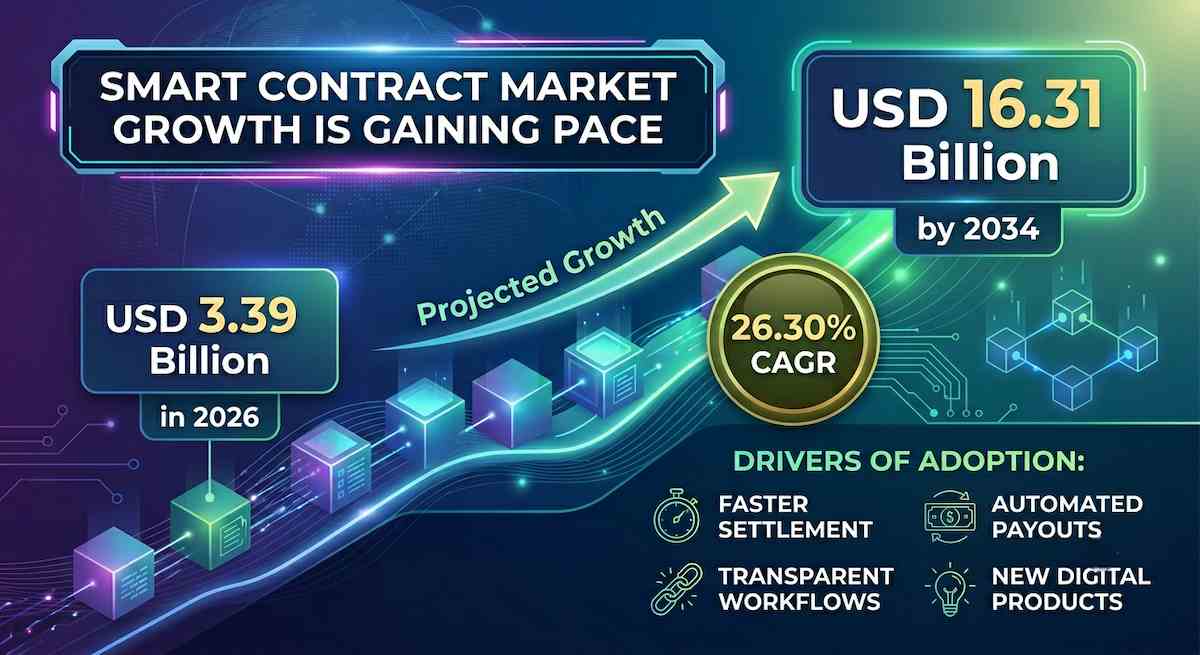
Smart contracts matter for modern businesses because they turn trust-heavy workflows into programmable workflows. They can speed up settlement, reduce middle layers, create clear records, automate payouts, and support new digital products. Market growth shows why founders are paying attention. Fortune Business Insights projects the global smart contracts market to grow from USD 3.39 billion in 2026 to USD 16.31 billion by 2034, at a 26.30% CAGR. Non-technical founders do not need to write every line of Solidity or Rust, but they do need to understand business logic, user roles, costs, risks, and launch stages. Poor planning can expose funds, block users, fail an audit, trigger legal friction, or force a rebuild. This guide explains how to write a smart contract from a founder’s point of view, from idea to launch.
What Is a Smart Contract?
A smart contract is code deployed on a blockchain. It stores rules, tracks state, and runs functions through signed transactions. Once deployed, users interact with the contract through wallets, apps, dashboards, or other blockchain tools.
Here is a simple example. A buyer sends payment to a smart contract. The contract locks the payment. A delivery source confirms that the product arrived. The contract releases funds to the seller and sends the platform fee to the business wallet.
That is a smart contract explained in business terms. It acts like a shared rulebook with built-in execution. It does not need a clerk to approve each step. It does not need every party to maintain a separate record. The blockchain records approved actions.
A blockchain smart contract differs from a traditional contract. A traditional contract states duties in legal text. People, courts, banks, or admins enforce the terms. A smart contract turns selected rules into software. The code performs actions after approved inputs arrive.
This does not mean smart contracts replace legal agreements. Many products still need terms of service, commercial contracts, risk disclosures, and dispute rules. The smart contract handles execution. The legal documents handle rights, duties, liability, and enforcement outside the blockchain.
For founders, this distinction matters. The contract should match the business agreement, but it cannot explain every legal duty by itself. A strong product pairs clear code with clear documents.
When Should a Business Use a Smart Contract?
A smart contract works best in workflows with several parties, clear rules, repeated actions, and a need for shared records. It fits products where money, ownership, status, or access must change under known conditions.
Good use cases include escrow, automated payouts, tokenized assets, loyalty points, NFT ownership, staking rewards, trade finance, supply chain records, and parametric insurance. These workflows have measurable actions and clear trigger points.
A smart contract fits well after these conditions appear:
Trust gaps
Several parties need one shared record, but no single party should control the whole process.
High-value actions
Payments, asset transfers, ownership records, or claims need clear proof.
Repeated workflows
The same rules run many times across users, partners, or transactions.
Tokenized ownership
The product uses NFTs, ERC-20 tokens, real-world asset tokens, or digital rights.
Programmable payments
Funds move through escrow release, revenue split, royalty payout, claim payout, or staking reward logic.
A smart contract does not suit every workflow. Some businesses only need a normal app, payment processor, or private database. A smart contract can add cost and risk without enough benefit.
Avoid blockchain for processes that need frequent human judgment, private data on every transaction, unclear legal rules, or no real need for decentralization. Public blockchains expose activity. Sensitive data should stay off-chain.
A useful readiness question is simple: do you need blockchain, or do you only need automation? Many founders want speed and lower admin work. A normal software system can deliver that. A smart contract makes sense after shared trust, asset control, and verifiable records matter.
Common Smart Contract Use Cases
Smart contracts appear across finance, real estate, supply chain, insurance, gaming, and enterprise operations. Each sector uses the same base idea: rules run through code, and the blockchain records approved actions.
DeFi and Fintech
DeFi and fintech smart contracts manage deposits, withdrawals, loans, staking, liquidity pools, decentralized exchange trades, escrow, collateral, and interest. A lending contract can hold collateral, track a loan, calculate risk, and trigger liquidation after a set threshold breaks.
A staking contract can record token deposits and calculate rewards. A decentralized exchange contract can let users trade from their wallets. An escrow contract can hold funds until delivery, approval, or dispute review.
The commercial value is fast settlement, programmable products, transparent records, and new revenue models. These contracts can control large funds, so testing and smart contract audit services belong in the core budget.
Real-World Asset Tokenization
Real-world asset tokenization converts economic rights into blockchain tokens. Assets can include real estate, private equity, commodities, invoices, bonds, loyalty points, or intellectual property.
An asset tokenization smart contract can manage token issuance, ownership transfers, investor restrictions, lockups, and revenue distribution. A property platform can issue 10,000 tokens linked to one asset. Investors can hold tokens in wallets. The contract can record transfers and support rental income payments.
This work often needs token development services, legal review, wallet design, investor onboarding, and admin dashboards. Transfer restrictions matter for regulated assets.
Supply Chain and Trade Finance
Supply chains involve buyers, suppliers, carriers, banks, insurers, and auditors. Each party often tracks its own records. Smart contracts can create a shared process for purchase orders, shipment updates, delivery proof, invoice approval, and milestone payment.
A supplier can receive payment after delivery data is verified. A buyer can reduce invoice matching work. Partners gain a clearer audit trail.
The contract should not trust weak data. Delivery proof should come from approved systems, IoT devices, carrier updates, or verified partner records.
Insurance and Claims
Insurance smart contracts work well for simple claims tied to measurable events. Parametric insurance is a strong example. A weather data source confirms drought. A flight data source confirms delay. An IoT device reports machine downtime. The contract triggers a payout under the policy rule.
These products need oracles. An oracle sends trusted off-chain data to the blockchain. The contract then uses that data to decide the payout. Wrong data can create wrong payments, so oracle design matters.
Gaming, NFTs, and Digital Ownership
NFT and gaming contracts record ownership of digital items. These can include art, memberships, tickets, game assets, badges, land, skins, or certificates. A marketplace contract can manage minting, listings, purchases, fees, and creator royalties.
The commercial value comes from digital scarcity, user-owned assets, and secondary-market revenue. A token alone does not create demand. The product still needs audience, utility, and a strong user experience.
Enterprise Workflow Automation
Enterprise smart contracts can support procurement, partner settlement, loyalty programs, B2B contracts, compliance workflows, and shared audit trails. A procurement contract can record approval, delivery, invoice status, and payment release. A partner settlement contract can divide revenue after each sale.
Enterprise products need privacy planning. Many records should stay off-chain. The smart contract should store proof, status, or control logic, not full private documents.
Technical Concepts Founders Should Know
Founders do not need to code, but they should understand the concepts that shape cost, user experience, security, and vendor selection.
Blockchain, Wallets, and Addresses
A blockchain is a shared ledger. It records transactions across many computers. A smart contract lives on that ledger and responds to signed transactions.
Users access contracts through wallets. A wallet controls a blockchain account. A public address works like an account number. A private key proves control over that address. The user signs a transaction, the network checks it, and the smart contract runs the function.
Wallet design can decide adoption. Lost keys can lock users out. Weak key storage can expose funds. A founder should choose the wallet path early: MetaMask, WalletConnect, embedded wallets, account abstraction, or enterprise custody.
On-Chain and Off-Chain Data
On-chain data lives on the blockchain. Token balances, ownership records, contract settings, and event logs often sit on-chain.
Off-chain data lives outside the blockchain. This includes bank data, delivery status, identity checks, price feeds, enterprise databases, weather reports, and IoT device events. Smart contracts need oracles or trusted inputs to use this data.
A delivery escrow contract needs proof of delivery. That proof can come from a courier system, buyer approval, or verified logistics record. The smart contract then releases payment after it receives the approved update.
Gas Fees and Transaction Costs
Gas is the fee paid to run blockchain transactions. Users pay gas to mint NFTs, transfer tokens, claim rewards, trade assets, or call contract functions.
Gas costs depend on the network, contract complexity, storage use, and network demand. High fees can hurt low-value transactions. A product with small payments can fail after costs rise.
Chain choice affects cost. Ethereum offers strong security and deep liquidity. Polygon, Arbitrum, Optimism, BNB Chain, Avalanche, Solana, and private networks offer different fee and speed profiles.
Immutability and Upgradeability
A deployed smart contract can be hard to change. Some contracts stay permanent. This builds trust, but it limits fixes. Upgradeable contracts use patterns that let a team update logic under controlled rules.
Proxy patterns are common on EVM chains. A proxy keeps the contract address stable. A logic contract can change after the approved upgrade process.
Upgradeability creates trade-offs. It helps teams fix bugs and add features. It creates admin risk too. Users need to know who controls upgrades, how approvals work, and what limits protect them.
Tokens and Standards
Token standards help wallets, marketplaces, and apps read token data. Common EVM standards include ERC-20 for fungible tokens, ERC-721 for NFTs, and ERC-1155 for multi-token systems.
A Solidity smart contract should use trusted libraries for common standards. Developers should not rebuild ERC-20 or NFT logic from zero without a strong reason. Custom work should focus on product rules, fees, access, payout logic, and restrictions.
Need a smart contract that is built for real business use?
Blockchain App Factory helps startups and enterprises plan, develop, audit, deploy, and maintain smart contracts for DeFi, NFTs, token platforms, asset tokenization, supply chain, and enterprise products.

How to Write a Smart Contract as a Non-Technical Founder
Writing a smart contract starts with business rules, not code. A founder should define the problem, users, permissions, flows, data, chain, security model, and launch plan before developers begin.
Define the Business Problem
Start with one workflow. What should the smart contract automate? Examples include escrow release, token issuance, royalty payment, investor distribution, or claim payout.
A clear objective sounds like this: “Automate escrow payments between buyers and sellers after delivery is verified.” This statement tells the team what action matters, who participates, and what event triggers execution.
Map Users and Permissions
List every role in the product. Common roles include founder admin, buyer, seller, investor, operator, verifier, auditor, oracle, treasury signer, and support user.
Then define what each role can do. Buyers can deposit funds. Sellers can request payout. Verifiers can confirm delivery. Admins can pause the contract. Treasury signers can approve fund movement. Auditors can view records.
Sensitive actions need extra control. Pause, upgrade, withdraw, mint, burn, change fees, and change oracle sources should use role limits and multisig approval.
Document Requirements
Write plain-English requirements before code starts. Include inputs, outputs, user actions, payment flows, token rules, access controls, fees, error cases, compliance rules, and upgrade rules.
A smart contract product requirements document helps vendors quote the work. It helps engineers build the right system. It helps auditors compare business rules against code.
Strong requirements reduce scope drift, audit delays, and rebuild costs.
Choose the Blockchain
The blockchain should match the product. Ethereum suits high-value assets and DeFi products that need deep liquidity. Polygon works well for consumer apps, NFTs, and loyalty products with lower fees. Arbitrum and Optimism suit Ethereum-aligned products with lower transaction costs. BNB Chain suits retail-facing token products. Avalanche offers EVM support and subnet options. Solana offers high throughput and low fees with a different development stack.
Private or permissioned networks can suit enterprise workflows that need controlled access and partner-only participation.
Use security, fees, speed, wallet support, developer talent, ecosystem, and compliance needs to guide the decision.
Choose the Language and Framework
Solidity is the main language for Ethereum and EVM-compatible chains. Rust is common for Solana and some other environments.
Development frameworks help teams build and test contracts. Hardhat supports Solidity development, testing, debugging, deployment, and verification. Foundry supports fast Solidity tests, fuzz testing, scripting, and deployment. Anchor supports Solana development with Rust.
The founder does not need to pick tools alone. The development team should explain the stack in plain English.
Create the Architecture
Architecture shows how the system fits together. It should show core contract logic, token contract, access control, payment contract, oracle link, upgrade mechanism, admin dashboard, and dApp front end.
A simple diagram helps founders, developers, auditors, and legal teams. It should show users, wallets, contracts, off-chain systems, data feeds, admin tools, and monitoring services.
Write the Code
Developers now write the actual smart contract. The code includes state variables, functions, events, access checks, modifiers, constructor or initializer logic, and error handling.
A founder can review pseudo-code before full development. For escrow, the pseudo-code can say: buyer deposits funds, contract locks payment, verifier confirms delivery, contract pays seller, platform wallet receives fee, dispute pauses payout, reviewer decides refund or release.
This simple model helps the founder confirm the logic before engineers write production code.
Test Before Deployment
Testing checks normal flows and failure cases. Unit tests check single functions. Integration tests check full user flows. Access tests try unauthorized actions. Payment tests check deposits, fees, refunds, and payouts. Edge-case tests check unusual inputs, repeated actions, and timing problems.
Complex protocols need fuzz testing and invariant testing. Testnet deployment comes before mainnet. Founders should ask for test reports, failed-case notes, and fixes.
Audit the Smart Contract
A smart contract security audit reviews architecture, code, access control, business logic, gas costs, upgrade risks, oracle risks, and external dependencies. It looks for known attack patterns and hidden business logic flaws.
Contracts that handle funds, tokens, or sensitive business rules need audit work before mainnet. The team should fix findings, update tests, and share the final report with key stakeholders.
Deploy, Verify, and Monitor
Deployment moves the contract to the live blockchain. The team should verify source code on block explorers where suitable, set admin roles, secure multisig wallets, connect the dApp, and launch monitoring.
Monitoring should track transfers, claims, admin actions, failed calls, large movements, oracle updates, and pause events. A launch plan should include incident owners, public updates, support workflows, and recovery steps.
Want expert guidance before your smart contract launch?
Smart Contract Development Framework for Founders
A founder blueprint turns the business idea into clear build instructions. It should cover the problem statement, user roles, business rules, transaction flows, data sources, blockchain platform, security model, compliance needs, timeline, audit plan, and launch plan.
The PRD should include project overview, target users, user stories, functional rules, non-functional needs, admin controls, events, tokenomics or fee model, security assumptions, and acceptance criteria.
For example, a user story can read: “As a buyer, I can deposit funds into escrow.” A functional rule can read: “The seller receives funds only after verified delivery.” An acceptance rule can read: “All high-risk audit findings must close before mainnet.”
Founders should separate a minimum viable smart contract from a production-ready contract. An MVP proves the core rule on a testnet or local chain. It has limited functions and internal testing. A production-ready contract serves real users and real assets. It needs full tests, audit work, monitoring, documentation, admin controls, compliance review, and support channels.
Security Best Practices
Smart contract security starts with simple design. Complex rules create more edge cases. Edge cases create bugs. The first release should focus on the core business rule.
Use trusted libraries for token contracts, access control, pause functions, and upgrade patterns. OpenZeppelin-style libraries are common for EVM projects. They reduce risk in standard code and help auditors review familiar patterns.
Plan access control with care. List every privileged action before development begins. Use role-based permissions. A support operator should not control upgrades. A finance user should not change oracles. A reviewer should not move funds outside the review process.
Use multisig wallets for high-risk actions. A multisig requires several approvals before an action runs. This reduces damage from one lost key or compromised device.
Avoid storing sensitive data on-chain. Public blockchains expose transaction history, events, and contract data. Store personal data, legal files, medical data, trade secrets, and private pricing off-chain. The contract can store a hash, proof, status flag, or reference ID.
Prepare for oracle risk. Use trusted data sources, freshness rules, fallback paths, and monitoring. A stale price feed or wrong delivery update can trigger costly actions.
Add pause controls where they fit the product. A circuit breaker can stop deposits, withdrawals, claims, or minting during an incident. Balance safety with user trust. Too much admin power can raise concern.
Budget for audit, bug reports, monitoring, and maintenance. Security is an operating cost. It does not end after one review.
Tools and Technology Stack
Smart contract development uses a full stack. Hardhat and Foundry support Solidity projects. Anchor supports many Solana projects. Libraries provide tested modules for tokens, access control, governance, and security patterns.
Testing tools cover unit tests, integration tests, static analysis, fuzz testing, formal verification, and manual review. High-value systems need deeper checks.
Deployment tools include testnets, block explorers, node providers, deployment scripts, and source code verification. Monitoring tools track transactions, admin actions, abnormal behavior, oracle issues, and failed calls.
Admin dashboards help approved operators manage the live product. They can show contract status, user activity, pending claims, fee revenue, and risk alerts. Dashboards should respect role limits. A support user should not control treasury movement.
Legal, Compliance, and Risk
Smart contracts automate rules, but they do not remove legal duties. Many products need legal agreements, terms of service, token terms, dispute rules, risk disclosures, and privacy policies.
A smart contract is code. A legal contract defines enforceable rights and duties. Products often need both.
Data privacy needs early planning. Public chains expose activity. Store private records off-chain. Use hashes or proofs where suitable. Permissioned networks can help enterprise teams with controlled access.
Tokens and financial products need legal review. Token launches, revenue-sharing assets, lending, payments, custody, investor restrictions, and insurance products can trigger legal duties. Review can affect wallet checks, transfer rules, user disclosures, market access, and records.
Governance matters after launch. Define who can upgrade contracts, pause systems, change fees, manage treasury assets, and update oracle sources. Clear governance protects users, investors, and the business.
Launch Checklist for Founders
Before development, approve the business case, document requirements, choose the blockchain, start legal review, approve the budget, select a development partner, assign a founder owner, and define launch metrics.
Before audit, complete the code, write tests, prepare documentation, create the architecture diagram, document known limits, deploy to testnet, review admin permissions, test oracle paths, and measure gas costs.
Before mainnet, resolve audit findings, review final code, test deployment scripts, secure admin wallets, configure monitoring, prepare the incident plan, publish user documentation, verify source code where suitable, and approve launch communication.
After launch, monitor events, track user behavior, review gas costs, maintain support channels, plan upgrades with care, schedule security reviews, review admin activity, update documentation, and run incident drills.
A smart contract launch does not end at deployment. The team must watch, support, and improve the system after users arrive.
Cost, Timeline, and Vendor Selection
Smart contract cost depends on scope, risk, chain choice, audit needs, and front-end depth. A basic token contract costs less than a lending protocol, insurance product, or real-world asset platform.
Common cost drivers include contract complexity, number of roles, payment flows, oracle needs, upgrade design, audit depth, and dApp requirements. Ask for a line-item estimate that covers discovery, architecture, development, testing, audit support, deployment, monitoring, and maintenance.
A small proof of concept can take a few weeks. A production build can take several months. A common timeline includes one to two weeks for discovery, one to two weeks for architecture, two to eight weeks for contract development, one to three weeks for testing, two to six weeks for audit, and one week for mainnet deployment.
Choose a smart contract development company with relevant experience. Look for architecture skill, Solidity or Rust development, security testing, token development services, dApp work, oracle integration, audit support, and post-launch support.
Ask direct questions. Which chains do you build on most often? Which libraries do you use? How do you test before audit? How do you handle admin keys? How do you plan upgrades? Who writes the PRD? What happens after launch?
Watch for red flags. A vendor that skips discovery, avoids testing, treats audit work as optional, uses vague ownership terms, or offers no post-launch support can create risk.
Conclusion
Smart contracts give founders a practical way to automate payments, ownership, approvals, rewards, claims, and digital business rules with clear on-chain records. The best products start with plain-English requirements, careful chain choice, strong access control, deep testing, legal review, audit work, and post-launch monitoring. Non-technical founders do not need to become Solidity engineers, but they do need to lead the business logic and risk decisions. Blockchain App Factory provides smart contract development services for token platforms, DeFi products, NFT marketplaces, asset tokenization, supply chain systems, insurance workflows, and enterprise blockchain products. Its team helps convert founder requirements into secure smart contract architecture, audited code, dApp interfaces, deployment support, and maintenance, so startups and enterprises can launch blockchain products with stronger control and lower risk.

Vimal J is the Head of Sales at Blockchain App Factory, with 10+ years of experience in sales, client strategy, and Web3 business growth. He helps startups, enterprises, and project founders choose the right blockchain solutions for their goals, bringing a practical market perspective to topics like token development, crypto launches, and Web3 adoption.