Key Insights
- Cross-chain DEX development helps businesses connect traders, tokens, and liquidity across many blockchain networks from one platform.
- Strong security is critical, since bridges, smart contracts, validators, and oracles all carry risk in cross-chain trading.
- Multi-network trading creates new business value through higher swap volume, deeper liquidity, token listings, and wider market reach.
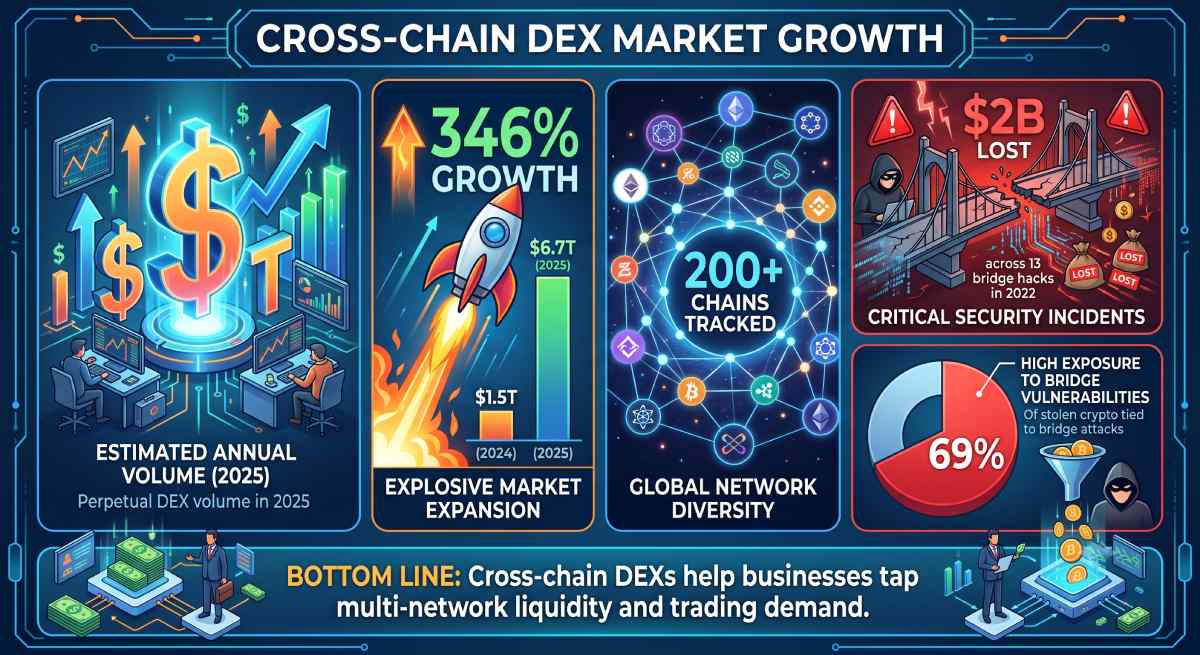
DeFi no longer runs through one chain. Traders now move across Ethereum, BNB Chain, Polygon, Arbitrum, Solana, Base, and other networks. Market demand backs this shift. CoinGecko reported that the top 10 perpetual DEXs processed $6.7 trillion in trading volume in 2025, up 346% from $1.5 trillion in 2024. DeFiLlama tracks DEX trading across 200+ chains and DeFi activity across 500+ blockchains, which shows how broad the market has become.
This growth creates a clear business problem. Liquidity sits in different pools across many networks. A trader may hold USDC on Polygon, want ETH on Arbitrum, and find the best price on Ethereum. A single-chain DEX cannot serve that user well. Cross-chain DEX development solves this gap through multi-network trading. It connects smart contracts, wallets, bridges, routing engines, and liquidity pools into one trading flow. For businesses, this means access to more traders, more trading pairs, and deeper liquidity. It opens new revenue from swap fees, bridge fees, token listings, staking, and DeFi products. Security must stay at the center of this model. Chainalysis reported $2 billion stolen across 13 bridge hacks in 2022, with bridges tied to 69% of stolen crypto funds that year.
What Is Cross-Chain DEX Development?
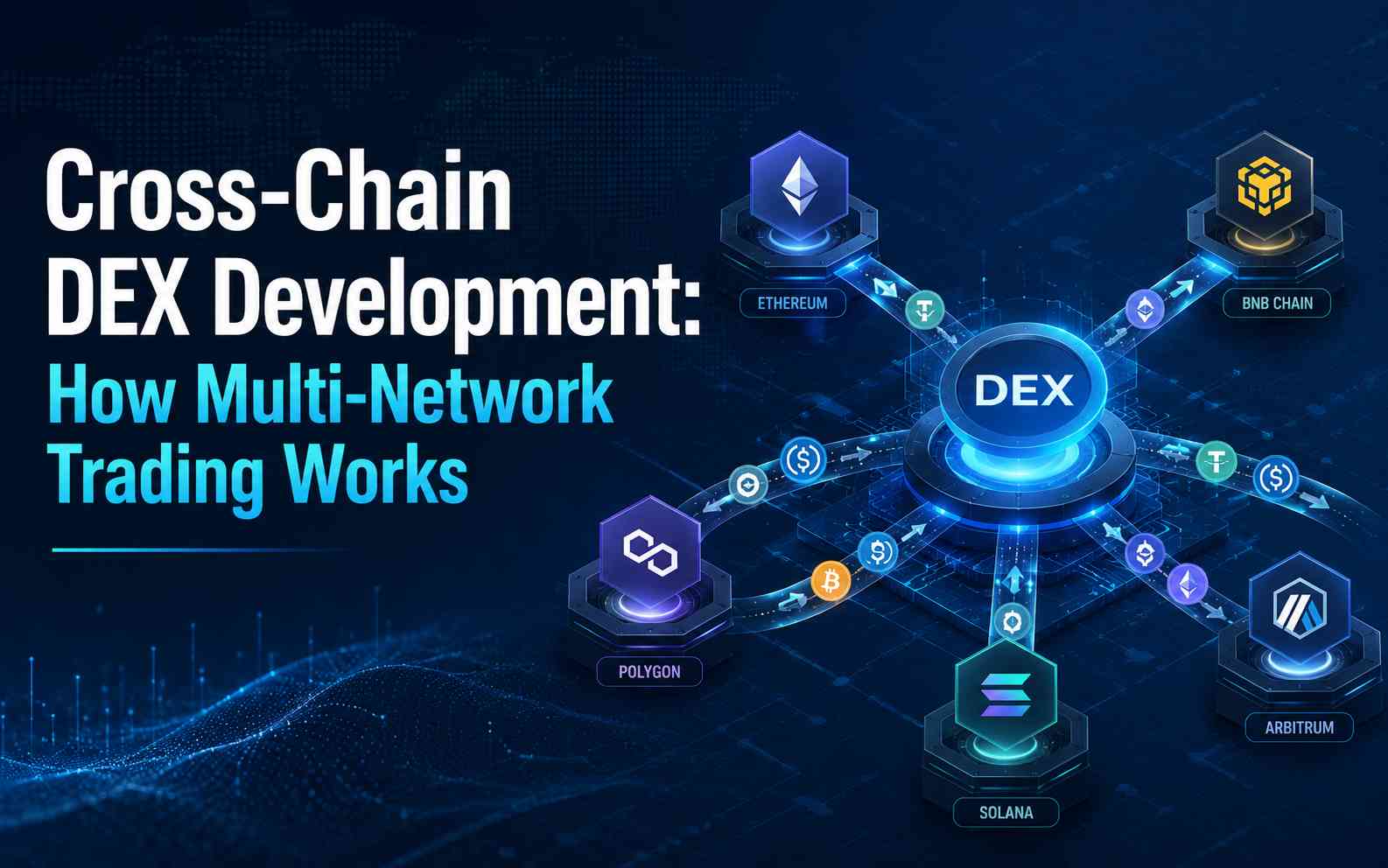
A cross-chain decentralized exchange lets users trade tokens across different blockchains without a central custodian. A traditional DEX often works on one chain. A cross-chain DEX connects many chains through bridges, messaging protocols, and liquidity routing.
The main goal is simple: let users trade across networks from one interface. The platform handles the technical work behind the screen.
For example, CoW Swap launched cross-chain swaps in 2025 with Bungee, which reported more than $22 billion in volume since 2022. This shows real demand for trading flows that connect many networks in one user path.
Why Multi-Network Trading Matters
Multi-network trading removes blockchain silos. It helps users reach better prices, faster routes, and broader token access. It also helps businesses serve more markets without launching separate exchanges for each chain.
Capital use improves too. Liquidity does not sit idle on one network. Routing engines can search across pools and pick stronger trade paths.
How Cross-Chain Trading Works
A cross-chain trade uses several steps. The system checks wallet balances, selects a route, locks or burns the source asset, sends a message to the target chain, then releases or mints the target asset.
Some models use atomic swaps. Others use bridge liquidity or intent-based routing. UniswapX, for example, uses auction-based routing across AMMs and liquidity sources.
For decision-makers, the value is clear. A well-built cross-chain DEX gives users broader access and gives the business a stronger base for DeFi growth.
Why Businesses Are Investing in Cross-Chain DEX Development
Increasing User Acquisition Across Multiple Blockchains
A single-chain DEX limits its audience. Traders now move between Ethereum, Base, Arbitrum, Solana, Polygon, BNB Chain, and other networks based on fees, speed, token access, and yield. Uniswap already promotes trading across 16+ networks, which shows how fast multi-network trading has become a market standard.
Cross-chain DEX development helps businesses reach users where they already trade. A DeFi startup can launch on one chain, then expand access through cross-chain swaps. This lowers the need for users to bridge funds manually or leave the platform.
Unlocking Global Liquidity
Liquidity sits across many chains. DefiLlama tracks DEX trading activity across more than 200 blockchains, including Ethereum, Solana, Base, and Arbitrum.
A cross-chain decentralized exchange connects these pools through routing, bridges, and messaging protocols. This helps traders get better prices. It helps businesses earn more from swaps, token listings, and liquidity provider fees.
Lower Trading Friction
Cross-chain DEXs remove extra steps. Users no longer need to visit a bridge, wait for settlement, switch apps, and then trade. The DEX handles routing in the background.
That simpler flow matters. Fewer steps mean fewer abandoned trades. For a business, that can raise trade volume and improve retention.
Better Capital Efficiency
A multi-chain DeFi platform lets liquidity work across networks. Instead of splitting users into isolated pools, the system routes trades toward the best available path.
This matters for market makers, token projects, and treasury teams. Capital can serve more trades without sitting idle on one chain.
Supporting Enterprise-Grade DeFi Products
Enterprises need controls, reporting, and strong risk checks. Cross-chain DEX architecture can support whitelisted assets, permissioned pools, treasury swaps, stablecoin payments, and tokenized asset trading.
Bridge risk still needs careful design. Chainalysis reported that cross-chain bridge hacks accounted for about $2 billion stolen across 13 attacks in 2022.
Competitive Advantages of Multi-Chain Platforms
Businesses that invest early gain broader reach, deeper liquidity, and stronger product stickiness. A cross-chain DEX development company can help design the right network mix, bridge model, smart contracts, and security layer.
How Cross-Chain DEX Architecture Works
Core Components of a Cross-Chain DEX
A cross-chain DEX uses several parts that work together.
Smart contracts hold swap logic, pool rules, fees, and settlement terms. Liquidity pools supply the assets for trades. Cross-chain bridges move tokens or mirror assets between chains. Validators verify activity. Relayers pass messages. Oracle networks provide price data. Messaging protocols send trade instructions from one chain to another.
Chainlink CCIP supports token transfers, data messaging, and programmable token transfers across blockchains. Axelar GMP lets a contract on one chain call a function on another connected chain.
Multi-Chain Liquidity Aggregation
Liquidity aggregation scans pools across networks. The DEX compares price, slippage, gas cost, route depth, and bridge cost. Then it selects the best route for the trade.
This creates a better trading path for users and stronger fee potential for the business.
Cross-Chain Asset Verification
Asset verification confirms that the source-chain action is real. The system checks token locks, burns, mints, signatures, confirmations, and message validity.
Finality matters here. Chainlink notes that source-chain finality helps prevent funds from being released or minted after a chain reorganization.
Transaction Routing
Routing decides where the trade starts, where liquidity comes from, and where the user receives assets. A smart router can split trades across pools to reduce slippage.
Settlement Mechanisms
Cross-chain settlement completes the trade across both networks. Common models include lock and mint, burn and mint, liquidity network transfers, and native bridge transfers.
Security Layers
A secure architecture uses audits, rate limits, monitoring, access controls, oracle checks, and emergency pause functions. Security must sit inside the product from day one, not after launch.
Key Technologies Behind Cross-Chain DEX Development
Cross-chain DEX development depends on several technical layers. These layers move value, verify data, route liquidity, and protect trades across separate blockchains.
Blockchain Interoperability Protocols
Interoperability protocols let blockchains communicate. Cross-chain messaging lets a smart contract on one network trigger action on another. State verification proves that a transaction took place on the source chain. Consensus synchronization helps the target chain trust that proof.
Cross-Chain Bridges
Bridges move assets between networks. Lock-and-mint bridges lock tokens on one chain, then mint wrapped tokens on another. Burn-and-mint bridges destroy tokens on the source chain, then issue tokens on the target chain. Liquidity network bridges use pooled assets across chains. Native asset bridges move tokens through chain-approved systems.
Cross-Chain Messaging Protocols
Messaging protocols carry instructions between chains. A DEX can use them to confirm swaps, update balances, and route trades across multiple networks.
Atomic Swaps
Atomic swaps support direct wallet-to-wallet trading. They reduce custody risk, since users do not need to hand assets to a central party.
Layer-2 Integration
Layer-2 networks reduce trading costs and speed up settlement. Arbitrum, Optimism, Base, and Polygon help DEX platforms serve high-volume traders.
Zero-Knowledge Proofs
Zero-knowledge proofs verify activity without exposing full transaction details. They can support privacy, lower trust risk, and strengthen cross-chain validation.
Oracle Networks
Oracle networks provide live price data, market feeds, and risk signals. A cross-chain DEX uses them for pricing, slippage checks, and trade execution.
Supported Blockchain Networks
The right blockchain mix shapes liquidity, user reach, fees, and trade speed.
Ethereum
Ethereum remains the main DeFi settlement network. It offers deep liquidity, mature smart contract tools, and strong institutional trust.
BNB Smart Chain
BNB Smart Chain gives low fees and broad retail adoption. It suits DEX platforms focused on frequent small trades.
Polygon
Polygon supports fast trades and lower fees. It works well for Ethereum-linked DeFi products.
Avalanche
Avalanche supports fast finality and strong DeFi activity. It fits trading products that need quick settlement.
Solana
Solana offers high throughput and low transaction costs. It suits apps with active order flow and fast user actions.
Arbitrum
Arbitrum lowers Ethereum trading costs through rollup design. Many DeFi protocols use it for scalable swaps.
Optimism
Optimism supports cheaper Ethereum-based trading. It gives users lower fees without leaving the Ethereum ecosystem.
Base
Base has grown as a consumer DeFi network. It works well for wallet-based trading and app-led growth.
Cosmos Ecosystem
Cosmos supports app-specific chains and native cross-chain communication through IBC. It fits projects that need custom chain design.
Other EVM-Compatible Chains
Other EVM chains can expand market access with less engineering work. Solidity contracts, wallet tools, and developer workflows often transfer across these networks.
Core Features of a Modern Cross-Chain DEX
A modern cross-chain DEX gives traders access to many networks from one interface. It removes the need to switch apps, move funds manually, or compare liquidity across chains. This matters for revenue. CoinGecko reported that Solana held 39.6% of DEX trading volume in Q1 2025, which shows how fast trader demand can shift between networks.
Cross-Chain Token Swaps
Cross-chain token swaps sit at the center of the platform. Users trade assets across Ethereum, BNB Chain, Polygon, Solana, Arbitrum, Base, and other networks. The platform checks balances, sends messages between chains, confirms finality, and settles the trade.
Multi-Chain Wallet Integration
Multi-chain wallet support reduces user friction. Traders connect wallets like MetaMask, WalletConnect, Coinbase Wallet, and Phantom, then trade without leaving the DEX.
Unified Liquidity Pools
Unified liquidity pools help reduce capital gaps between chains. They let the platform route trades through deeper pools, which can lower slippage and improve pricing.
Smart Order Routing
Smart order routing finds the best route across pools. Uniswap’s developer docs describe routing that can use several hops instead of one pool to find a better trade result.
Cross-Chain Yield Farming and Staking Integration
Yield farming and staking help keep users active after a trade. Businesses can reward liquidity providers, token holders, and long-term users through fees, rewards, or governance rights.
Governance Module
A governance module gives token holders a role in fees, listings, upgrades, and treasury use. This builds stronger community ownership.
Real-Time Analytics Dashboard
The dashboard should track volume, slippage, failed trades, wallet growth, liquidity depth, and fee revenue. These metrics help founders and exchange teams make faster product choices.
Token Listing Management, Transaction History, Gas Fee Control, and Fast Trade Execution
Token listing tools help teams add assets with review checks. Transaction history improves user trust. Gas fee controls reduce failed trades. Fast execution keeps active traders from leaving for another DEX.
Step-by-Step Cross-Chain DEX Development Process
A strong build starts with requirement analysis. The team maps user groups, target chains, trade pairs, fee models, compliance needs, and revenue goals.
Blockchain Selection
Blockchain selection comes next. Teams should compare liquidity, fees, user base, developer tools, and bridge risk. Chain choice affects cost, speed, and market reach.
UI/UX Design
UI/UX design must make cross-chain trading simple. Users need clear steps, visible fees, trade status, and risk alerts.
Smart Contract Development
Smart contract development covers swap rules, liquidity pools, fees, staking, rewards, and governance. Each contract must be tested before mainnet launch.
Bridge Integration
Bridge integration needs strict limits, route checks, and accounting controls. Chainalysis reported that cross-chain bridge hacks accounted for about $2 billion across 13 attacks by August 2022, so this layer needs careful review.
Liquidity Pool Development
Liquidity pool development defines pricing curves, pool fees, token pairs, and liquidity rewards. Good pool design protects both traders and liquidity providers.
Oracle Integration
Oracle integration supplies price data for swaps, farming, staking, and risk checks. Chainlink CCIP documentation describes token transfers with data between smart contracts on different chains, which supports more complex cross-chain actions.
Wallet Connectivity, Security Auditing, Testing, Deployment, and Maintenance
Wallet connectivity links users to the platform. Security auditing reviews code, bridge logic, admin access, and oracle use. Testing across networks checks latency, failed swaps, gas spikes, and settlement issues. Deployment should start with limits and monitoring. Maintenance covers upgrades, liquidity changes, new chains, and security patches.
Want to build a cross-chain DEX that connects traders across multiple networks?
Build a DEX that connects users, assets, and liquidity across leading blockchain networks with strong security and smooth trading flows.

Cross-Chain DEX Development Tech Stack
A cross-chain DEX needs more than smart contracts. It needs a product stack that can handle fast trades, many wallets, live price data, bridge activity, and chain-level risk. The right tech stack shapes trade speed, user trust, and long-term revenue.
Frontend Technologies
React works well for trading screens, wallet flows, charts, and token search. Next.js adds fast page loading and better SEO for public pages, such as token listings, fee pages, and liquidity pool pages. TypeScript reduces front-end errors, which matters in DeFi, where one wrong token address can cost money.
Backend Technologies
Node.js fits API services, user activity records, alerts, and admin dashboards. Rust works well for high-speed routing engines and chain watchers. Go is strong for relayers, indexing services, and tools that process large transaction flows. A serious cross-chain decentralized exchange development project often uses more than one backend language.
Blockchain Frameworks
Solidity remains the main choice for EVM smart contracts. Hardhat supports testing, deployment scripts, and local chain work. Foundry adds fast smart contract tests and deeper checks for complex DeFi logic. LayerZero documentation shows that cross-chain apps need endpoint logic for message routing, verification, and fee handling, so smart contract design must match the messaging layer from day one.
Wallet Integrations
MetaMask, WalletConnect, and Coinbase Wallet cover many retail and business users. Wallet flows must show the source chain, target chain, token amount, bridge fee, swap fee, and final output.
Cloud Infrastructure, Monitoring Tools, and Security Frameworks
Cloud infrastructure hosts APIs, indexers, analytics, and admin panels. Monitoring tools track failed swaps, delayed bridge messages, pool imbalance, and abnormal wallet activity. Security frameworks matter most around bridges. Chainalysis reported that bridge attacks accounted for 69% of stolen crypto funds in 2022, with about $2 billion stolen across 13 bridge hacks.
Cross-Chain DEX vs Traditional DEX
A traditional DEX works inside one chain. That model is simpler, but it limits reach. A cross-chain DEX connects traders, tokens, and liquidity across many networks. DeFiLlama tracks DEX volume across Ethereum, Solana, Base, Arbitrum, and more than 200 chains, which shows how spread out trading activity has become.
| Feature | Traditional DEX | Cross-Chain DEX |
|---|---|---|
| Blockchain Support | Single Chain | Multiple Chains |
| Liquidity | Limited | Aggregated |
| Trading Flexibility | Lower | Higher |
| User Reach | Restricted | Global |
| Scalability | Moderate | High |
| Capital Efficiency | Lower | Better |
| Interoperability | No | Yes |
The commercial difference is clear. A single-chain DEX serves users who already hold assets on that network. A cross-chain DEX serves users across several networks, so it can capture more swaps, fees, and liquidity provider activity.
Uniswap shows this shift in practice. Its app supports trading on 16+ networks, including Ethereum, Unichain, and Base. For businesses, that points to a larger market pattern. Users no longer want to move assets manually between chains before every trade. They want one trading interface, clear fees, fast settlement, and strong risk controls.
For founders, exchanges, and Web3 firms, cross-chain DEX development creates a direct path to multi-network trading. It can turn a narrow DeFi product into a broader trading platform with higher volume potential.
Security Best Practices for Cross-Chain DEX Development
Cross-chain DEX development carries more risk than a single-chain exchange. Funds move across smart contracts, bridges, relayers, validators, oracles, and routers. One weak link can drain pooled assets. Chainalysis reported $2 billion stolen across 13 bridge hacks in 2022, with bridge attacks making up 69% of stolen funds at that point.
Smart Contract Audits
Every swap, pool, bridge adapter, and fee contract needs unit tests, fuzz tests, and outside audits. Teams should review upgrade logic, token approvals, slippage checks, and pause controls.
Bridge Security
Bridge design should avoid one custody point. Strong builds use message checks, proof checks, withdrawal caps, and delayed settlement for high-value transfers.
Multi-Signature Wallets
Treasury, admin, and upgrade keys need multi-signature control. A 3-of-5 or 4-of-7 model reduces key-person risk.
Validator Security
Validators need stake rules, rotation, slashing, and uptime checks. Bad validators must lose access fast.
Oracle Security
Price feeds need multiple sources and stale-price checks. The DEX should reject trades tied to broken feeds.
MEV Protection
MEV can hurt users through sandwich attacks and poor trade execution. UniswapX uses competitive fillers and MEV protection for swap execution.
Rate Limiting
Set caps for withdrawals, new pools, rare tokens, and bridge exits. Limits slow attacks and buy response time.
Fraud Detection
Track wallet patterns, pool imbalance, false mint events, and strange bridge messages.
Continuous Monitoring
Security teams need live alerts, runbooks, and incident drills. ERC-7683 warns that cross-chain orders carry risk across the full execution and settlement window.
Want to launch a secure cross-chain DEX for multi-network trading?
Industry Use Cases of Cross-Chain DEX Platforms
Businesses build cross-chain DEX platforms to reach users across many networks. Assets now sit across hundreds of chains. DeFiLlama tracks DeFi activity across more than 500 blockchains, which shows how scattered liquidity has become.
Decentralized Finance (DeFi)
DeFi teams use cross-chain swaps for liquidity routing, loan repayment, yield entry, and collateral movement. This gives users fewer steps and gives platforms more trading volume.
Enterprise Blockchain Systems
Enterprises can move tokenized cash, credits, loyalty points, and settlement assets across partner chains. The business value comes from faster transfers and cleaner asset control.
NFT Marketplaces
NFT platforms can accept payment from several chains. A buyer on Base can pay for an NFT listed on Ethereum through routed settlement.
Gaming Ecosystems
Games use cross-chain DEX rails for item markets, guild treasuries, reward tokens, and in-game asset swaps.
Cross-Border Payments
Payment firms can pair stablecoin liquidity across chains, then settle faster than bank rails.
Institutional Trading
Funds need deeper liquidity, audit trails, access controls, and safer execution. Cross-chain routing gives them wider market access without repeated deposits.
Tokenized Real-World Assets
RWA platforms can connect treasuries, funds, carbon credits, and invoice tokens to wider DeFi demand.
DAO Treasury Management
DAOs can rebalance assets, fund contributors, and spread risk across chains from one control layer.
Conclusion
Cross-chain DEX development gives Web3 businesses a clear path to serve traders across Ethereum, BNB Chain, Polygon, Arbitrum, Base, and other networks from one platform. It brings scattered liquidity into one trading flow, reduces user friction, and opens new revenue from swap fees, liquidity programs, token listings, and enterprise DeFi products. For teams planning a multi-network exchange, security, bridge design, smart routing, oracle checks, and live monitoring must sit at the center of the build. Blockchain App Factory provides Cross-Chain DEX Development for startups, exchanges, and enterprises that need a secure, scalable, and business-ready trading platform built for multi-chain growth.

Vimal J is the Head of Sales at Blockchain App Factory, with 10+ years of experience in sales, client strategy, and Web3 business growth. He helps startups, enterprises, and project founders choose the right blockchain solutions for their goals, bringing a practical market perspective to topics like token development, crypto launches, and Web3 adoption.