Key Insights
- Citi projects tokenized assets could reach $5.5 trillion by 2030, showing why businesses are paying closer attention to RWA tokenization.
- Enterprises can manage tokenized assets, payments, settlements, and records through blockchain-based systems with better visibility and fewer manual steps.
- Assets like treasury bills, bonds, real estate, and private credit can be represented digitally, helping businesses manage liquidity and diversify treasury portfolios.
Enterprise treasury management has changed significantly over the past few years. Businesses are handling larger transaction volumes, cross-border payments, and digital assets while trying to keep capital working efficiently. Traditional treasury systems still play an important role, but they often involve multiple intermediaries, slower settlement times, and manual reconciliation. This has encouraged many organizations to consider blockchain-based treasury solutions that provide better visibility and greater control over financial operations.
The growing interest in this area is reflected in market projections. According to Citi, the value of tokenized assets could reach $5.5 trillion by 2030, with an optimistic estimate of $8 trillion. This expected growth highlights the increasing role of tokenization in institutional finance and enterprise treasury strategies.
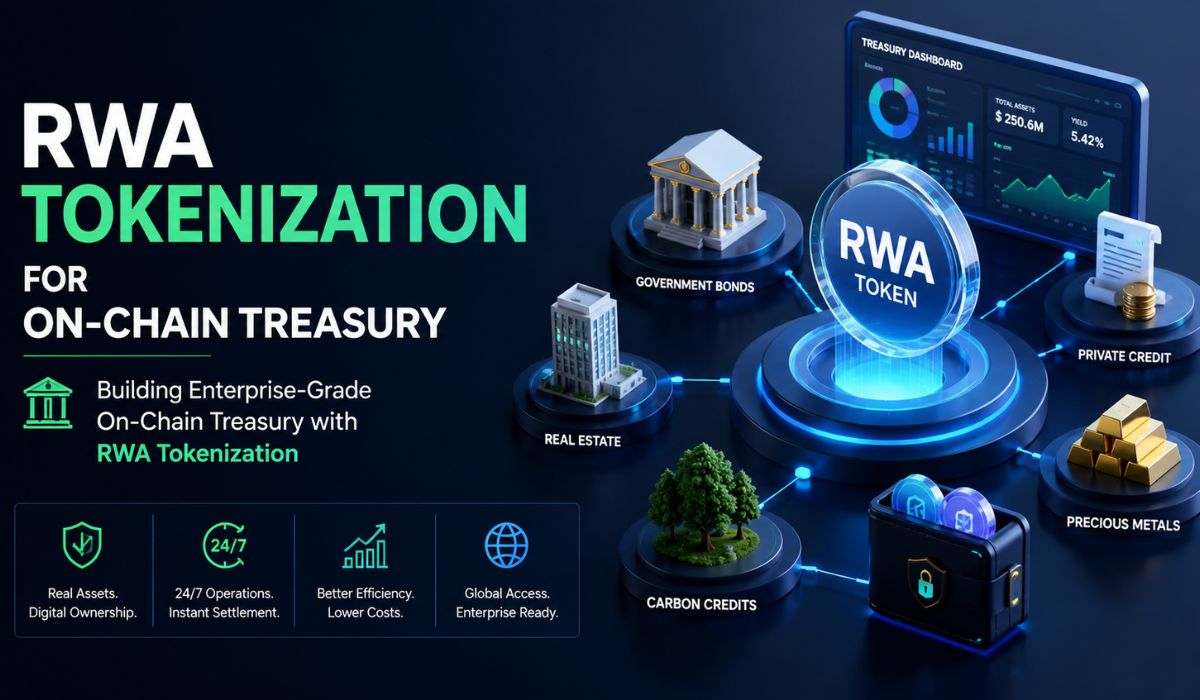
One area receiving significant attention is Real-World Asset (RWA) tokenization. By representing assets such as treasury bills, corporate bonds, real estate, and private credit as blockchain-based tokens, enterprises can manage investments, liquidity, and asset ownership more efficiently. As financial institutions and large organizations continue to evaluate digital asset infrastructure, tokenized RWAs are becoming an important part of modern treasury planning.
In this guide, you’ll learn how enterprise on-chain treasury works, how RWA tokenization supports treasury operations, its business benefits, implementation workflow, compliance considerations, and the technologies that help organizations manage tokenized assets securely.

What Is an Enterprise On-Chain Treasury?
Understanding On-Chain Treasury Management
An enterprise on-chain treasury is a system where a company’s financial assets are managed on a blockchain network. Instead of relying only on banks and traditional financial platforms, businesses can hold, transfer, monitor, and manage tokenized assets through secure digital infrastructure. Every transaction is recorded on the blockchain, making financial activities easier to track and verify.
For enterprises, this approach supports better visibility across treasury operations while reducing dependence on manual processes. It also allows finance teams to monitor multiple asset types from a single platform.
How Digital Treasury Differs from Traditional Treasury
Traditional treasury management mainly depends on banks, payment networks, and accounting systems. Transactions often pass through several parties before settlement, and reconciliation may require additional time and effort.
Digital treasury follows a different approach. Assets exist as digital tokens, and transactions are recorded directly on a blockchain. This allows businesses to monitor asset movement more quickly, automate selected treasury activities through smart contracts, and maintain a consistent record of transactions without relying entirely on manual verification.
Core Components of an Enterprise Blockchain Treasury
A well-designed enterprise blockchain treasury includes several important elements that work together.
- Digital wallets for secure asset storage
- Smart contracts for automated treasury activities
- Tokenized assets such as bonds, treasury bills, or real estate
- Identity verification and compliance checks
- Multi-level approval systems for fund transfers
- Reporting dashboards for monitoring treasury performance
- Integration with ERP and accounting software
Together, these components help organizations manage digital financial assets in a controlled and organized environment.
Why Enterprises Are Transitioning to On-Chain Financial Infrastructure
Many enterprises are adopting on-chain financial infrastructure to improve treasury operations and reduce operational delays. Faster settlement, better asset visibility, and automated transaction workflows are some of the reasons behind this shift.
Another factor is the growing availability of tokenized financial products. Companies can now include digital representations of traditional assets in their treasury strategy while maintaining proper governance and compliance. As enterprise blockchain solutions continue to mature, more organizations are considering them as part of their long-term financial planning.
Understanding Real-World Asset (RWA) Tokenization
What RWA Tokenization Means
Real-World Asset (RWA) tokenization is the process of representing ownership or rights of physical or financial assets as digital tokens on a blockchain. These tokens are backed by actual assets, allowing them to be managed digitally while remaining linked to their real-world value.
For enterprises, tokenization creates new ways to hold, transfer, and manage assets that were traditionally available only through conventional financial systems.
How Physical and Financial Assets Become Blockchain Tokens
The tokenization process starts by identifying a suitable asset and confirming its legal ownership. Once verified, the asset is connected to a blockchain through digital tokens created using smart contracts.
Each token represents a defined share or ownership interest in the underlying asset. Compliance checks, custody arrangements, and regulatory requirements are completed before the asset becomes available for enterprise use or investment. This process creates a digital version of the asset while maintaining its legal connection to the original ownership.
Common Enterprise Assets That Can Be Tokenized
Several asset classes are suitable for enterprise tokenization.
Treasury Bills
Government-issued treasury bills can be tokenized to give enterprises digital access to low-risk investments while improving treasury management.
Corporate Bonds
Businesses can hold or issue tokenized corporate bonds, making ownership records and transfers more efficient.
Real Estate
Commercial buildings, office spaces, and property investments can be divided into digital tokens, allowing fractional ownership and easier portfolio management.
Commodities
Assets such as gold, silver, and other commodities can be represented digitally while remaining backed by physical reserves.
Private Credit
Loans and private lending agreements can be tokenized, giving enterprises additional options for investment and capital allocation.
Invoices
Outstanding invoices can be converted into digital assets, helping businesses improve cash flow and access financing more efficiently.
Trade Finance Assets
Trade-related documents, receivables, and payment obligations can be tokenized to simplify transaction management across global supply chains.
Investment Funds
Fund units can also be issued as digital tokens, making subscriptions, transfers, and ownership management more efficient for institutional investors.
Why Tokenized Assets Are Gaining Enterprise Adoption
Enterprises are showing growing interest in tokenized assets because they offer a practical way to manage financial holdings in a digital environment. Tokenization can improve asset accessibility, simplify ownership tracking, and support quicker settlement compared to many conventional processes.
Another reason is flexibility. Businesses can diversify treasury portfolios by including different tokenized asset classes while maintaining compliance with internal policies and regulatory requirements. As institutional participation continues to increase, tokenized assets are becoming an important part of modern enterprise treasury strategies.
Why Enterprises Need On-Chain Treasury Solutions
Challenges with Conventional Treasury Operations
Conventional treasury systems often depend on banks, spreadsheets, payment providers, and disconnected finance tools. For large enterprises, this can make even simple fund movement feel slow and complex. Teams may need to wait for approvals, reconcile data across systems, and manually verify records before making decisions.
On-chain treasury solutions help businesses manage digital and tokenized assets from a more connected environment. This gives finance teams better control over asset movement, payment tracking, and treasury reporting.
Liquidity Bottlenecks in Legacy Financial Systems
Liquidity is one of the biggest concerns for enterprise treasury teams. In traditional systems, capital may remain locked in accounts, jurisdictions, or financial products for longer than expected. This can make it harder for companies to respond quickly to business needs.
With tokenized assets, enterprises can manage certain holdings in a more flexible way. Assets such as tokenized treasury bills, bonds, invoices, or private credit can be represented digitally, making them easier to track, divide, and transfer under proper compliance rules.
Cross-Border Settlement Delays
Global businesses often deal with payments across different countries, currencies, and banking networks. These transactions can take days to settle, especially when multiple intermediaries are involved. Delays can affect vendor payments, investment movement, and treasury planning.
On-chain treasury can reduce this waiting time by allowing blockchain-based settlement. For enterprises, this means funds and tokenized assets can move more quickly between approved parties, helping finance teams manage global operations with less friction.
High Operational Costs and Manual Processes
Traditional treasury operations often involve repeated manual work. Teams may spend hours matching transactions, preparing reports, checking approvals, and communicating with different financial institutions. Over time, these tasks increase costs and create room for errors.
Blockchain-based treasury systems can automate selected activities through smart contracts and digital workflows. This helps reduce repetitive work, lower administrative effort, and give treasury teams more time to focus on planning and risk management.
Limited Visibility Across Global Treasury Operations
Many enterprises struggle to get a complete view of their treasury position. Funds may be spread across multiple banks, entities, currencies, and investment products. This makes it difficult to understand real-time liquidity and asset exposure.
On-chain treasury provides a shared record of asset movement and ownership. With proper dashboards and reporting tools, businesses can monitor tokenized assets, digital balances, and treasury activity from one place. This supports faster decisions and better financial control.
Ready to build an enterprise-grade on-chain treasury?
Create a secure, compliant, and business-ready treasury platform with Blockchain App Factory’s Real World Asset Tokenization Services. Manage tokenized assets, improve liquidity access, and bring digital finance into your enterprise operations with confidence.

Business Benefits of Enterprise-Grade On-Chain Treasury
24/7 Treasury Operations
Traditional financial systems usually follow banking hours and settlement windows. This can slow down treasury activity, especially for companies operating across multiple time zones. On-chain treasury allows approved transactions to happen at any time. Enterprises can manage digital assets, monitor balances, and process treasury activities even outside standard banking hours. For global businesses, this can be a major advantage.
Near Instant Settlement
Settlement delays can create uncertainty in treasury planning. When transactions take days to complete, finance teams may not know exactly when funds will become available. Blockchain-based settlement can reduce this delay by recording and completing transactions much faster. This helps enterprises manage cash flow, asset transfers, and investment activity with greater confidence.
Fractional Asset Ownership
Some real-world assets are expensive or difficult to divide in traditional markets. Real estate, private credit, and investment funds often require large minimum commitments. RWA tokenization allows these assets to be divided into smaller digital units. This makes ownership more flexible and gives enterprises more options when building treasury portfolios.
Improved Capital Efficiency
Capital efficiency means using available funds in a smarter way. In many traditional treasury setups, money may remain idle because moving it or investing it takes time. With tokenized assets, enterprises can place capital into digital financial products, track performance, and adjust positions more easily. This helps treasury teams make better use of available funds without adding unnecessary complexity.
Automated Cash Flow Management
Cash flow management is a daily concern for every enterprise. Payments, collections, investments, and redemptions need to be tracked carefully. On-chain treasury systems can use smart contracts to automate certain cash flow activities. For example, interest payments, investor distributions, or scheduled settlements can be processed based on predefined rules.
Enhanced Treasury Transparency
Enterprises need reliable financial records for audits, reporting, and internal governance. Traditional systems may require manual checks across several platforms. Blockchain records give treasury teams a verifiable transaction history. This can make reporting easier, reduce confusion, and support better accountability across finance operations.
Reduced Counterparty Risks
Counterparty risk occurs when one party in a transaction fails to meet its obligation. In traditional finance, this risk can increase when settlement takes longer or when several intermediaries are involved. On-chain treasury can reduce some of this risk by using smart contracts, faster settlement, and verified transaction records. This gives enterprises more confidence when dealing with tokenized assets and approved counterparties.
Lower Operational Expenses
Manual treasury work can be expensive, especially for enterprises with global operations. Reconciliation, reporting, compliance checks, and settlement follow-ups all require time and resources. By automating selected processes and reducing dependency on multiple intermediaries, on-chain treasury can help lower operational costs. The result is a leaner treasury workflow with fewer repetitive tasks.
Better Portfolio Diversification
A strong treasury strategy often includes different asset types to balance liquidity, return, and risk. Tokenization gives enterprises access to a wider range of digital representations of real-world assets. Businesses can include tokenized bonds, treasury bills, commodities, real estate, or private credit in their treasury mix. This supports broader portfolio planning while keeping asset activity easier to monitor.
Global Investment Accessibility
Traditional investment access can vary by region, banking partner, and regulatory framework. This can limit how enterprises allocate capital across markets. Tokenized assets can make certain investment opportunities more accessible to approved enterprise participants. With proper compliance controls, companies can take part in global digital asset markets from a more organized treasury environment.
How Enterprise RWA Tokenization Works
Asset Selection and Qualification
The process begins by choosing an asset that has measurable value and business relevance. Enterprises may select treasury bills, bonds, real estate, invoices, private credit, or fund units. Before tokenization, the asset must be reviewed for ownership status, market demand, risk level, and legal suitability. This step helps confirm whether the asset is appropriate for digital representation.
Legal Structuring and Ownership Verification
Legal structuring connects the real-world asset to its digital token. This includes defining ownership rights, investor rights, transfer rules, and redemption terms. Ownership verification is also important. Enterprises must confirm who owns the asset, how it is held, and what rights token holders receive. Without proper legal backing, the token may not carry real business value.
Digital Token Creation
Once the legal structure is ready, digital tokens are created on a blockchain. Each token represents a defined share, claim, or interest linked to the underlying asset. The token can include rules related to transfer limits, investor eligibility, payment rights, and redemption options. This makes the asset easier to manage in a digital treasury environment.
Smart Contract Deployment
Smart contracts are used to manage token activity. They can define how tokens are issued, transferred, held, and redeemed. For enterprises, smart contracts help reduce manual intervention in treasury operations. They can also support automated payments, compliance checks, and ownership updates based on predefined conditions.
Investor Onboarding
Before investors or enterprise participants can access tokenized assets, they must complete onboarding. This usually includes identity verification, documentation, and eligibility review. The goal is to allow only approved participants to buy, hold, or transfer tokens. This is especially important when dealing with regulated financial assets.
Compliance Verification
Compliance verification checks whether a participant meets legal and regulatory requirements. This may include KYC, AML, investor classification, jurisdiction rules, and internal policy checks. By adding compliance controls into the tokenization process, enterprises can reduce regulatory risk and maintain a safer treasury environment.
Asset Distribution
After verification, tokens can be distributed to approved investors or treasury accounts. Distribution may happen through a private platform, enterprise treasury portal, or regulated marketplace. This step records ownership digitally and allows participants to monitor their holdings through blockchain-based systems.
Secondary Market Trading
Some tokenized assets may be traded after initial distribution, depending on legal rules and market structure. Secondary trading can improve liquidity by allowing approved participants to buy or sell tokens. For enterprises, this can make traditionally less liquid assets easier to manage. However, trading must follow compliance rules and approved transfer conditions.
Redemption and Settlement
Redemption is the process of converting tokens back into cash, underlying assets, or another agreed value. Settlement confirms the final transfer of value between parties. In an enterprise RWA tokenization model, redemption rules are usually defined from the beginning. This gives participants a better understanding of how and when they can exit their position.
Enterprise Architecture Behind an On-Chain Treasury
Asset Custody Layer
The asset custody layer protects the digital assets held by an enterprise. It includes secure wallets, private key controls, custody policies, and approval rules. For businesses, this layer is critical because treasury assets must be protected from theft, loss, and unauthorized access. A good custody setup may include cold storage, multi-party approvals, insurance support, and clear internal controls. It works like a digital vault where every movement needs the right permission before anything leaves.
Blockchain Infrastructure Layer
The blockchain infrastructure layer is the base network where tokenized assets and treasury transactions are recorded. Enterprises may use public, private, or hybrid blockchain networks depending on their privacy, cost, and compliance needs. This layer handles transaction recording, asset movement, and network participation. Choosing the right blockchain matters because it affects speed, fees, security, and long-term usability.
Smart Contract Layer
Smart contracts manage the rules behind tokenized treasury activity. They can define how assets are issued, transferred, redeemed, or distributed. For example, a smart contract can process interest payments, restrict transfers to approved users, or update ownership records automatically. This reduces manual work and helps treasury teams follow predefined business rules.
Compliance Engine
The compliance engine checks whether every transaction and participant meets legal and business requirements. It can manage KYC, AML, investor limits, jurisdiction rules, and transfer restrictions. For enterprise treasury, this layer is not optional. It helps businesses work with tokenized assets while reducing regulatory risk and keeping activity within approved boundaries.
Identity Management
Identity management verifies who can access the treasury platform and what actions they can perform. It may include user verification, enterprise account setup, role permissions, and secure login controls. This helps prevent unauthorized access and gives each user the right level of control. A finance manager, auditor, investor, and administrator should not all have the same permissions.
Investor Portal
An investor portal gives approved participants a place to view tokenized assets, complete onboarding, track holdings, and manage subscriptions or redemptions. For enterprises issuing tokenized assets, the portal improves communication and record access. It also gives investors a simple way to understand their positions without depending on long email chains or manual reports.
Treasury Dashboard
The treasury dashboard gives finance teams a central view of digital assets, tokenized holdings, balances, returns, and transaction activity. Instead of jumping between wallets, bank portals, and spreadsheets, teams can view important treasury data in one place. This supports quicker decisions and better day-to-day control.
API Integration Layer
The API integration layer connects the on-chain treasury platform with other enterprise systems. These may include ERP platforms, accounting tools, banking systems, tax software, and reporting applications. Without integration, treasury teams may still need to copy data manually. APIs help move information between systems so records remain consistent and easier to manage.
Data Analytics and Reporting
Data analytics and reporting help enterprises understand treasury performance, asset exposure, liquidity position, and transaction history. This layer turns raw blockchain and financial data into useful business insights. It can support audits, board reporting, compliance reviews, and treasury planning.
Essential Features Every Enterprise Treasury Platform Should Include
Automated Asset Tokenization
Automated asset tokenization helps businesses convert selected real-world assets into digital tokens with less manual effort. It can manage asset details, ownership terms, token rules, and issuance steps from one workflow. This makes the tokenization process more organized and reduces the chance of errors during setup.
Institutional Wallet Management
Institutional wallet management gives enterprises secure control over digital assets. These wallets are designed for business use, not casual individual trading. They usually include user permissions, approval flows, custody options, and transaction limits. This helps treasury teams manage assets safely across departments and entities.
Multi-Signature Authorization
Multi-signature authorization requires more than one approved person to confirm a transaction. This is useful for high-value treasury movements where a single approval may create unnecessary risk. It works like a company cheque that needs multiple signatures before payment. This adds another layer of protection for enterprise funds.
Treasury Portfolio Dashboard
A treasury portfolio dashboard helps businesses track tokenized assets, digital balances, returns, maturity dates, and risk exposure. This gives finance teams a complete view of how treasury assets are performing. It also helps them compare different asset classes and plan future allocations.
Real-Time Asset Monitoring
Real-time asset monitoring allows enterprises to track transactions and holdings as they happen. This is helpful when funds move across wallets, platforms, or markets. With faster access to treasury data, finance teams can respond quickly to unusual activity, liquidity needs, or investment changes.
Automated Yield Distribution
Automated yield distribution helps process returns from tokenized assets such as bonds, treasury bills, private credit, or fund units. Instead of calculating and sending payments manually, smart contracts can distribute returns based on preset rules. This saves time and reduces payment errors.
Digital Asset Custody
Digital asset custody protects tokens, stablecoins, and other blockchain-based holdings. It includes secure storage, recovery planning, and strict access controls. For enterprises, custody must meet institutional standards because treasury assets carry high financial value. A weak custody model can expose the business to major losses.
Risk Management Tools
Risk management tools help enterprises monitor exposure, asset concentration, market movement, counterparty risk, and compliance issues. These tools give finance leaders a better view of possible risks before they become serious problems. In treasury management, prevention is always better than a late reaction.
Audit Trails
Audit trails record every important action taken within the treasury platform. This includes transfers, approvals, user activity, asset issuance, and redemption events. For enterprises, audit trails support internal reviews, external audits, and regulatory reporting. They also help teams investigate any unusual activity with better accuracy.
Role-Based Access Control
Role-based access control gives each user permission based on their role. For example, an analyst may only view reports, while a treasury head may approve transactions. This keeps platform access organized and reduces the risk of mistakes. Not everyone in the company needs full control over treasury assets.
Regulatory Reporting
Regulatory reporting features help enterprises prepare reports related to asset ownership, transactions, investor activity, and compliance checks. Since tokenized assets may fall under financial regulations, proper reporting is important. A platform with reporting support can reduce manual preparation time and help teams stay audit-ready.
Cross-Chain Compatibility
Cross-chain compatibility allows a treasury platform to work with more than one blockchain network. This can be useful when enterprises hold assets across different chains or need access to different tokenized asset markets. It gives businesses more flexibility, but it must be managed carefully to avoid security and compliance issues.
Types of RWAs Suitable for Enterprise Treasury
Government Securities
Government securities such as treasury bills and bonds are among the most suitable assets for enterprise treasury. They are generally viewed as lower-risk instruments and are often used for cash management. When tokenized, these securities can become easier to track, transfer, and include in digital treasury portfolios.
Corporate Debt Instruments
Corporate debt instruments include bonds, notes, and other debt issued by companies. Enterprises can use tokenized corporate debt to access fixed-income opportunities in a digital format. This asset class can support treasury planning by offering predictable returns, depending on issuer quality and market conditions.
Commercial Real Estate
Commercial real estate includes offices, warehouses, retail spaces, and business properties. These assets usually require large investments and can be difficult to sell quickly. Tokenization can divide real estate exposure into smaller units, making it easier for enterprises to manage property-linked investments within their treasury strategy.
Infrastructure Investments
Infrastructure investments include roads, energy projects, telecom networks, ports, and public utility assets. These projects often have long-term cash flows and institutional appeal. Tokenized infrastructure assets can give enterprises access to project-based investment opportunities while keeping ownership records easier to manage.
Precious Metals
Precious metals such as gold and silver are often used as stores of value. Enterprises may include them in treasury portfolios to balance risk during uncertain market conditions. Tokenized precious metals represent claims linked to physical reserves. This allows businesses to manage metal-backed assets digitally while relying on proper custody arrangements.
Carbon Credits
Carbon credits are becoming more relevant as companies focus on sustainability goals. Tokenized carbon credits can help businesses track, transfer, and manage environmental assets more efficiently. For enterprises, this can support both treasury planning and sustainability reporting, provided the credits are verified and meet accepted standards.
Private Equity
Private equity investments are usually long-term and less liquid than public market assets. They can include ownership stakes in private companies or investment funds. Tokenizing private equity interests can make ownership records easier to manage and may improve access for approved institutional participants.
Private Credit
Private credit refers to loans or debt financing provided outside traditional public markets. It has gained attention among institutions looking for income-generating assets. Tokenized private credit can help enterprises manage lending exposure, track repayment rights, and include credit-based assets in treasury portfolios.
Revenue Sharing Assets
Revenue sharing assets are linked to future business income, such as royalties, platform fees, or project revenue. These assets can be tokenized to represent a claim on a defined revenue stream. For enterprises, this model can support new financing structures and investment options, especially where income patterns are measurable.
Supply Chain Receivables
Supply chain receivables include invoices and payment obligations from buyers to suppliers. These assets are often used in trade finance and working capital management. Tokenizing receivables can help businesses improve cash flow planning, reduce paperwork, and make invoice-backed assets easier to manage.
Smart Contracts Powering Treasury Automation
Smart contracts are self-executing programs stored on a blockchain. They carry out predefined instructions automatically when specific conditions are met. In enterprise treasury, smart contracts reduce manual intervention, improve consistency, and help finance teams manage tokenized assets more efficiently.
Automated Interest Payments
Interest payments for tokenized bonds, treasury bills, or private credit can be processed automatically through smart contracts. Once the payment date arrives, the contract calculates the amount due and transfers it to eligible token holders based on predefined rules. This reduces manual calculations and helps maintain a consistent payment schedule.
Compliance Enforcement
Smart contracts can apply compliance rules before a transaction is completed. They can check whether a participant has passed identity verification, belongs to an approved jurisdiction, or satisfies investor requirements. If the conditions are not met, the transaction can be blocked automatically. This helps enterprises follow regulatory requirements without reviewing every transaction manually.
Ownership Transfers
When tokenized assets are bought or sold, smart contracts update ownership records automatically. Every transfer is recorded on the blockchain, creating a reliable history of asset ownership. This process reduces paperwork and helps enterprises maintain accurate ownership records throughout the asset lifecycle.
Dividend Distribution
Enterprises issuing tokenized equity or investment fund units can use smart contracts to distribute dividends. Payments are calculated based on each investor’s token holdings and are transferred according to predefined schedules. This reduces administrative work while giving investors a more consistent payment process.
Treasury Rebalancing
Treasury portfolios often require periodic adjustments to maintain the desired asset allocation. Smart contracts can support rebalancing by following predefined treasury policies or allocation limits. Although human approval may still be required for certain actions, automation can simplify routine portfolio adjustments and reduce manual effort.
Redemption Automation
When investors redeem tokenized assets, smart contracts can verify eligibility, process redemption requests, and update ownership records. If all conditions are satisfied, the redemption process moves forward according to the agreed rules. This helps enterprises manage redemption requests in a more organized and consistent manner.
Governance Execution
Many enterprise treasury platforms include governance rules for approvals and decision-making. Smart contracts can support these processes by recording voting results, applying approval thresholds, or carrying out treasury actions after authorized decisions are made. This creates a structured process while reducing dependence on manual coordination.
Integrating On-Chain Treasury with Enterprise Systems
ERP Integration
Enterprise Resource Planning (ERP) systems manage financial operations, procurement, inventory, and business data. Connecting an on-chain treasury platform with an ERP system allows transaction information to flow between both environments. This reduces duplicate data entry and helps finance teams maintain consistent records across departments.
Banking System Connectivity
Although tokenized assets operate on blockchain networks, enterprises still rely on banking services for many financial activities. Banking connectivity allows treasury platforms to exchange payment information, account balances, and settlement details with traditional financial institutions. This creates a smoother relationship between digital treasury operations and conventional banking services.
CRM Integration
Customer Relationship Management (CRM) systems store information about clients, investors, and business relationships. Connecting the treasury platform with CRM software allows enterprises to maintain accurate investor records and improve communication. This is especially useful for organizations managing tokenized investment products or institutional clients.
Accounting Software Synchronization
Accounting software records financial transactions for reporting and tax purposes. Synchronizing blockchain-based treasury activity with accounting systems reduces manual reconciliation and helps maintain accurate financial statements. Automatic data sharing also minimizes the risk of inconsistencies between treasury records and accounting books.
Treasury Management Systems
Many enterprises already use Treasury Management Systems (TMS) for cash management, forecasting, and liquidity planning. Integrating blockchain treasury platforms with existing TMS solutions allows businesses to include tokenized assets alongside traditional financial instruments. This provides treasury teams with a more complete view of company assets without replacing their existing workflows.
Business Intelligence Platforms
Business Intelligence (BI) platforms help organizations analyze financial data and prepare management reports. Connecting treasury platforms with BI tools allows enterprises to monitor liquidity, asset allocation, transaction activity, and portfolio performance through interactive dashboards. With better reporting capabilities, finance leaders can make more informed treasury decisions using data collected from both traditional and blockchain-based systems.
Enterprise Treasury Workflow from Asset to Settlement
An enterprise on-chain treasury workflow follows a structured path. It starts with planning, moves through asset tokenization and investor participation, and ends with settlement or redemption. Each step helps businesses manage tokenized assets in a more organized and compliant way.
Treasury Planning
Treasury planning begins with defining business goals. The enterprise decides what it wants to achieve, such as better liquidity management, wider asset access, faster settlement, or improved portfolio control. At this stage, finance teams also review risk appetite, asset preferences, compliance needs, and internal approval rules. This planning step helps avoid confusion later in the tokenization process.
Asset Tokenization
Once the treasury plan is ready, the selected asset is converted into a digital token. This may include treasury bills, bonds, real estate, invoices, private credit, or fund units. The asset is reviewed, legally structured, and connected to blockchain-based tokens. Each token represents a defined claim, share, or right linked to the underlying asset.
Investor Subscription
Investor subscription is the stage where approved participants show interest in buying or holding the tokenized asset. They may review offering details, expected returns, risk information, and redemption terms. Before subscribing, investors usually complete identity checks and eligibility verification. This helps maintain compliance and protects the issuer from unauthorized participation.
Token Issuance
After subscription and verification, tokens are issued to approved investors or treasury accounts. The issuance process records ownership on the blockchain and updates the platform dashboard. For enterprises, token issuance creates a digital record of who owns what, how much was issued, and under which conditions the tokens can be transferred or redeemed.
Portfolio Monitoring
Once tokens are issued, treasury teams monitor asset performance, holdings, maturity dates, cash flow, and market activity. This helps them understand whether the portfolio is meeting business goals. A treasury dashboard can make this process easier by showing balances, transaction history, and asset-level data in one place.
Yield Distribution
Some tokenized assets generate yield, such as interest, dividends, rental income, or repayment income. These returns can be distributed to token holders based on ownership percentage and payment schedules. Smart contracts can support this process by calculating and processing distributions under preset rules. This reduces manual effort and improves payment consistency.
Secondary Transactions
Secondary transactions happen when token holders transfer or sell their tokens after the original issuance. This may take place on an approved marketplace or private enterprise platform. These transactions must follow compliance rules, investor restrictions, and transfer conditions. For enterprises, secondary activity can improve liquidity while keeping control over who can participate.
Asset Redemption
Asset redemption is the final stage where tokens are exchanged for cash, the underlying asset, or another agreed value. Redemption terms are usually defined before issuance. This step closes the investment cycle and updates ownership records. A well-planned redemption process gives both enterprises and investors more confidence in the tokenized asset structure.
Common Enterprise Treasury Use Cases
Enterprise on-chain treasury can be applied across many industries and financial organizations. Different users may have different goals, but the common purpose is better asset control, faster settlement, and easier management of tokenized real-world assets.
Corporate Treasury Modernization
Large companies can use on-chain treasury systems to manage digital assets, tokenized cash-equivalent instruments, and global payments. This helps treasury teams reduce manual reconciliation and improve visibility across business units. For corporations with international operations, on-chain treasury can also support faster fund movement and better liquidity planning.
Institutional Investment Funds
Institutional investment funds can use RWA tokenization to issue digital fund units, manage investor records, and process subscriptions or redemptions more efficiently. This approach can make fund administration easier while offering investors a digital way to access traditional asset classes.
Family Offices
Family offices often manage diversified portfolios across real estate, private equity, fixed income, and alternative assets. Tokenized treasury systems can help them track these holdings in a more organized way. They can also use tokenized assets to improve reporting, manage ownership interests, and support long-term wealth planning.
Commercial Banks
Commercial banks can use on-chain treasury infrastructure for settlement, tokenized deposits, digital asset custody, and asset-backed financial products. This allows banks to connect traditional banking services with blockchain-based asset management while maintaining compliance and risk controls.
Insurance Companies
Insurance companies manage large reserves and long-term investment portfolios. On-chain treasury solutions can help them monitor tokenized bonds, government securities, and other income-generating assets. They may also benefit from faster reporting, better asset tracking, and improved control over treasury allocations.
Asset Management Firms
Asset management firms can use tokenization to offer digital access to funds, fixed-income products, real estate portfolios, and private market assets. On-chain treasury tools can support investor onboarding, ownership tracking, yield distribution, and portfolio reporting from a single digital environment.
Private Equity Funds
Private equity funds often deal with long lock-in periods, complex ownership structures, and manual investor administration. Tokenization can help digitize fund interests and simplify ownership records. It can also support more organized reporting and easier transfer management for approved investors.
Government Financial Institutions
Government financial institutions can use tokenized asset systems for public finance programs, digital bonds, treasury operations, and regulated investment products. With proper governance, on-chain treasury can support more efficient financial administration while maintaining oversight and compliance.
Conclusion
Enterprise treasury management is steadily moving toward digital financial infrastructure as businesses look for better ways to manage liquidity, investments, and tokenized assets. By combining on-chain treasury with Real-World Asset (RWA) tokenization, organizations can improve asset management, simplify treasury operations, and gain better visibility across financial activities while maintaining regulatory compliance. As institutional adoption continues to grow, businesses that prepare for this shift will be better positioned to manage modern treasury requirements. If you are planning to adopt tokenized treasury solutions, Blockchain App Factory provides comprehensive Real World Asset Tokenization Services, helping enterprises tokenize real-world assets, develop secure blockchain platforms, and implement compliant solutions that align with their business objectives.

Vimal J is the Head of Sales at Blockchain App Factory, with 10+ years of experience in sales, client strategy, and Web3 business growth. He helps startups, enterprises, and project founders choose the right blockchain solutions for their goals, bringing a practical market perspective to topics like token development, crypto launches, and Web3 adoption.