Key Insights
- A successful TGE in 2026 needs clear token utility, legal readiness, audited smart contracts, and a launch plan that goes beyond token listing.
- Strong tokenomics matter more than hype, with balanced allocation, transparent vesting, controlled unlocks, and real demand loops.
- Businesses must plan community growth, exchange readiness, liquidity, and post-launch execution before announcing the TGE date.
Token Generation Events are entering a more serious phase in 2026.
The market still has strong demand. Chainalysis ranked India first in its 2025 Global Crypto Adoption Index, followed by the United States, Pakistan, Vietnam, and Brazil. That matters for token launches. These markets bring large user bases, active developers, and high retail interest.
The tokenization sector is growing too. RWA.xyz tracked more than $27 billion in distributed tokenized real-world asset value and more than 710,000 asset holders in its global market data. Stablecoins crossed $299 billion in tracked value on the same dashboard.
The message is clear. Tokens are no longer only fundraising tools. They are becoming access rails, incentive systems, governance assets, and settlement layers.
Regulation has changed the launch playbook. MiCA brought stricter white paper and marketing standards in Europe. U.S. platforms are testing new public token sale models. Coinbase launched a token sale platform in 2025, with Monad named as the first project. The platform highlighted one core issue for token issuers: fair distribution to real users.
A successful TGE in 2026 needs more than a token contract.
It needs a business case, clean tokenomics, a safe smart contract stack, legal review, strong community demand, exchange readiness, and post-launch discipline.
Why TGE Planning Looks Different in 2026
The crypto market has matured. Buyers now review token unlocks, audits, treasury controls, and product usage before they join a sale. A glossy website and a large Telegram group no longer carry a launch.
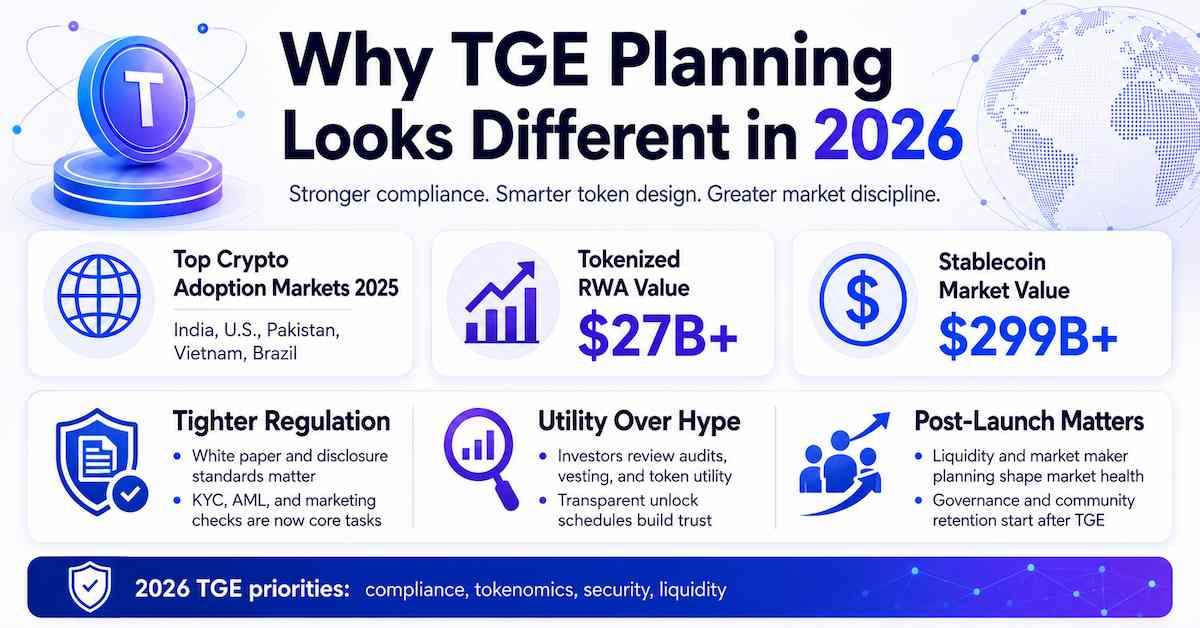
Regulators now expect clearer disclosures. Exchanges expect cleaner documents. Investors expect real utility. Communities expect fair treatment. Founders must plan the TGE as a full market entry campaign, not a single listing event.
The strongest TGEs in 2026 will come from projects that can answer three questions fast:
- Why does the token exist?
- Who uses it after launch?
- What protects the market from short-term sell pressure?
Define the Business Objective Before Creating the Token
A TGE should start with business logic, not token supply.
The token must solve a real problem inside the product. It should support growth, usage, payments, rewards, access, governance, or network security. A token with no product role turns into a short-term trading asset.
That weakens the project before it starts.
Clarify the Token’s Purpose
The token should have a direct use inside the platform.
Strong use cases include:
- Access to platform features or premium tools
- Staking for network security or user rewards
- Governance rights for protocol decisions
- Payments inside a marketplace or app
- Rewards for validators, users, creators, or contributors
The purpose must be simple enough for users to understand. Complex token logic often hides weak utility.
Link Token Utility to Product Demand
A token gains strength from real usage.
For example, a DeFi protocol can use a token to reward liquidity providers. A gaming platform can use it for in-game assets and player rewards. A DePIN network can use it to reward people who provide physical infrastructure. An RWA platform can use tokens to represent access, ownership rights, or settlement functions.
The key question is simple: will users still need the token after the launch week?
If the answer is no, the TGE plan needs work.
Set Commercial Goals Early
A TGE can support several business goals.
Common goals include:
- Fundraising for product development
- Building a user-owned ecosystem
- Attracting liquidity and exchange interest
- Rewarding early adopters
- Creating a governance layer
- Expanding into global crypto markets
Pick the main goal first. Then shape tokenomics, sale design, community campaigns, and exchange plans around it.
Choose the Right Token Model and Legal Structure
Token structure affects everything.
It shapes the sale process, investor access, marketing language, exchange listing path, and long-term governance. A project should not announce token rights before legal review.
Select the Correct Token Category
Most 2026 TGEs fall into one of these groups:
- Utility tokens for access, rewards, or product usage
- Governance tokens for voting and protocol control
- Security tokens for regulated investment rights
- RWA tokens tied to off-chain assets
- Gaming tokens for in-app economies
- DePIN tokens for contributor rewards
Each model carries different risks. A governance token still needs careful design. A utility token can face scrutiny if it is sold mainly as an investment. An RWA token needs legal clarity on custody, ownership, redemption, and reporting.
Plan Jurisdiction and Entity Setup
Jurisdiction matters before the first public announcement.
A serious TGE plan should cover:
- Issuer entity
- Foundation or DAO role
- Tax treatment
- Investor access rules
- KYC and AML checks
- Sanctions screening
- Geo-restrictions
- Marketing review
- Exchange listing standards
Projects that skip this step often face delays during exchange review or launchpad onboarding.
Prepare the White Paper and Disclosures
The white paper is no longer a marketing brochure. It is a trust document.
It should explain:
- Project overview
- Product architecture
- Token utility
- Token allocation
- Vesting schedule
- Roadmap
- Governance model
- Risk factors
- Use of funds
- Legal disclaimers
Keep the language direct. Avoid profit claims. Avoid vague promises. Buyers and exchanges need facts, not hype.
Build Tokenomics That Can Survive Market Pressure
Tokenomics can make or break a TGE.
A launch with poor allocation or aggressive unlocks can face heavy selling pressure. Strong tokenomics protect the market, reward long-term users, and give the treasury enough runway.
Design Supply and Allocation
Start with total supply, then map each token bucket.
Common allocation groups include:
- Community rewards
- Ecosystem incentives
- Treasury
- Team
- Advisors
- Private investors
- Public sale
- Liquidity
- Market making
- Grants
- Airdrops
The launch should not release too much supply at once. Low float can create volatility. High float can create sell pressure. The right structure sits between both risks.
Build Vesting and Unlock Rules
Vesting shows market discipline.
A strong vesting model should include:
- Team cliff periods
- Long-term team vesting
- Investor lockups
- Public unlock calendar
- Controlled early circulation
- Milestone-based ecosystem releases
Founder and investor tokens should not flood the market early. Public buyers notice this. Exchanges notice it too.
Create Real Demand Loops
Demand must come from product activity.
Useful demand loops include:
- Staking for rewards or network access
- Governance participation
- Fee discounts
- Marketplace payments
- Protocol access
- Loyalty rewards
- Liquidity incentives
- Developer grants
- Token burns, where suitable
A demand loop must match user behavior. Forced utility creates friction. Natural utility creates repeat usage.
Stress Test the Model
Tokenomics need pressure testing before launch.
Run clear scenarios:
- Token price drops 50 percent
- Airdrop users sell early
- Liquidity thins after listing
- Investor unlocks start
- Rewards exceed treasury capacity
- User growth slows after TGE
A good token model can survive weak market weeks. A poor model needs constant hype to stay alive.
Planning a TGE in 2026?
Build your token launch with secure smart contracts, clear tokenomics, compliance planning, and exchange-ready execution.

Build the Technical Infrastructure for the TGE
The technical stack must be ready before the market campaign peaks.
A delayed contract audit or claim portal bug can damage months of work. Security, usability, and contract clarity matter as much as tokenomics.
Choose the Right Blockchain
The blockchain should fit the product and users.
Assess each network by:
- Security record
- Gas fees
- Transaction speed
- Wallet support
- Liquidity access
- Developer tools
- Exchange support
- Cross-chain needs
- Compliance tooling
Ethereum works well for high-trust DeFi and institutional projects. Solana suits fast consumer apps and gaming. Base, Arbitrum, Optimism, Polygon, BNB Chain, and Avalanche each serve different cost, speed, and ecosystem needs.
The best chain is the one your users can access without friction.
Select the Token Standard
Most fungible tokens use ERC-20 or an equivalent standard. Solana projects use SPL tokens. Gaming and NFT-heavy projects often use ERC-721 or ERC-1155.
More complex launches need custom contracts for:
- Vesting
- Claims
- Airdrops
- Staking
- Governance
- RWA transfer controls
- KYC-based access
- Treasury management
Custom logic increases risk. That risk must be audited.
Build the Core Smart Contract Stack
A professional TGE often needs more than one contract.
The stack can include:
- Token contract
- Vesting contract
- Claim contract
- Airdrop contract
- Staking contract
- Governance contract
- Treasury multisig
- Liquidity pool setup
- Whitelist contract
- KYC access control
Each contract should have a clear owner, access rule, and emergency plan. Admin keys need strict controls.
Audit Before Launch
No serious TGE should launch unaudited contracts.
The audit process should include:
- Internal code review
- Third-party smart contract audit
- Testnet deployment
- Gas testing
- Admin key review
- Multisig setup
- Attack simulation
- Bug bounty
- Public contract verification
Security is not a launch feature. It is the base layer.
Prepare the TGE Documentation Stack
Documentation sells trust.
Investors, exchanges, launchpads, communities, and market makers all need clear information. Good documents reduce confusion and speed up partner review.
White Paper
The white paper should cover the full business and token model.
Include:
- Market problem
- Product design
- Token purpose
- Tokenomics
- Sale structure
- Roadmap
- Team
- Governance
- Risk factors
- Use of funds
Keep it readable. A white paper that only developers understand will fail with investors. A white paper that only marketers understand will fail with technical reviewers.
Litepaper and Investor Deck
The litepaper should explain the project in a shorter format.
The investor deck should focus on business value:
- Market size
- User problem
- Product traction
- Revenue model
- Token role
- Competitive edge
- Fundraising target
- Token allocation
- Roadmap
- Team background
Decision-makers want speed. Give them the core logic in 10 to 15 slides.
Technical Documentation
Technical reviewers need clear resources.
Prepare:
- GitHub repository
- Contract addresses
- Audit report
- API documents
- Claim portal guide
- Token standard details
- Governance guide
- Developer onboarding notes
This helps developers, exchanges, and ecosystem partners review the project faster.
Marketing Compliance Kit
Marketing should match legal disclosures.
Prepare approved copy for:
- Website pages
- Landing pages
- Social posts
- PR articles
- Influencer briefs
- Community announcements
- Exchange profiles
Avoid guaranteed returns. Avoid passive income claims. Avoid language that makes the token look like a promise of profit.
Build Community and Demand Before Launch
Community should start before the TGE date is public.
A strong community gives the token real distribution. It reduces dependence on paid ads and short-term speculation.
Build Where Your Users Already Spend Time
Pick channels based on user type.
- X for crypto-native awareness
- Telegram for fast community support
- Discord for gaming, developer, and DAO groups
- LinkedIn for enterprise and RWA projects
- Reddit for niche community discussion
- YouTube for explainers and founder updates
- GitHub for developer trust
Do not chase every channel. Pick the ones that match your buyers, builders, and users.
Run Pre-TGE Campaigns
Good campaigns build usage, not just followers.
Use:
- Waitlists
- Testnet campaigns
- Referral programs
- Ambassador programs
- Quest campaigns
- Hackathons
- Developer grants
- NFT badges
- Early access programs
- Airdrop eligibility tasks
Each campaign should collect a useful signal. Wallet activity matters more than follower count.
Track Real Community Quality
Vanity metrics create false confidence.
Track:
- Active wallets
- Testnet users
- Quest completion quality
- Discord activity
- Telegram retention
- GitHub commits
- Organic mentions
- Community-to-holder conversion
A smaller active community often beats a large silent one.
Plan Fundraising, Token Sale, and Distribution
The distribution model shapes market trust.
A TGE can use private rounds, public sale, launchpad sale, exchange-led sale, fair launch, or airdrop distribution. Each path suits a different project stage.
Pick the Right Launch Model
Private sales work for projects that need strategic capital and partner support. Public sales work for strong communities. Launchpads bring visibility and retail access. Exchange-led sales can add trust and distribution. Fair launches suit decentralization-first projects. Airdrops work well for protocols with real user history.
The right model should match:
- Product maturity
- Legal structure
- Community size
- Fundraising target
- Exchange strategy
- Liquidity plan
- User geography
A TGE should not copy another project’s model without checking its own needs.
Set Pricing and Valuation
Token pricing needs discipline.
Plan:
- Initial token price
- Fully diluted valuation
- Circulating market cap
- Private round discount
- Public sale allocation
- Investor lockups
- Liquidity budget
- Market maker terms
A high FDV can create weak post-launch demand. A low float can create price spikes and crashes. The goal is a fair market start.
Use KYC and Whitelisting
KYC and whitelisting help serious projects control access.
They support:
- Investor checks
- Sanctions screening
- Geo-restrictions
- Wallet verification
- Sale limits
- Bot control
- Exchange readiness
Clean distribution helps reduce regulatory and market risk.
Secure Exchange Listings and Liquidity
A TGE does not end after tokens are minted.
Liquidity decides how users enter and exit the market. Poor liquidity creates slippage, volatility, and weak confidence.
DEX and CEX Strategy
DEX listings give fast access and on-chain transparency. They suit crypto-native users and early community trading.
CEX listings can bring:
- Wider retail access
- Better fiat entry
- Higher visibility
- Stronger market trust
- More trading volume
Many projects use both. A DEX launch can start community access. A CEX listing can expand reach after the project proves demand.
Market Maker Planning
Market makers support order book depth and reduce extreme spreads.
Review:
- Liquidity budget
- Exchange pairs
- Spread targets
- Depth targets
- Reporting terms
- Risk controls
- Contract terms
- Lockup rules
Market making is not price control. It supports healthier trading conditions.
Liquidity Pool Setup
DEX liquidity needs careful planning.
Cover:
- Pair selection, such as token and USDC
- Initial liquidity ratio
- Slippage settings
- LP token custody
- Liquidity lock terms
- Treasury controls
- DEX monitoring
Publish official contract addresses. Scammers often attack users during launch week with fake pools and fake claim links.
Real-Life TGE Case Studies and Lessons for 2026
Real launches show what works better than theory.
The best lessons come from projects that handled large communities, complex distribution, and public scrutiny.
Arbitrum: Governance and Community Ownership
Arbitrum’s token launch gave the market a major example of ecosystem-led distribution. The ARB token focused on governance and DAO participation.
Key lessons:
- Governance needs clear voting rules
- DAO treasury plans need open communication
- Community allocation builds ownership
- Token launch success continues after distribution
- Large ecosystems need strong proposal review
Arbitrum showed that a governance token must do more than trade. It must support real decision-making.
Starknet STRK: Airdrop Design and Claim Experience
Starknet’s Provisions Program offered a large-scale distribution case for builders, users, and ecosystem contributors.
Key lessons:
- Eligibility rules must be easy to understand
- Claim portals must resist scams
- Users need clear claim timelines
- Communication must start early
- Community reaction can shape launch sentiment
Airdrops reward early support, but they can create tension. Projects must explain criteria before frustration spreads.
Coinbase and Monad: Exchange-Led Token Sale Revival
Coinbase’s 2025 token sale platform brought public token sales back into focus for U.S. users. Monad was named as the first project on the platform.
Key lessons:
- Exchange-led distribution can improve market access
- Compliance checks matter more than before
- Founder lockups support market trust
- Sale windows and allocation rules affect fairness
- Real user distribution is now a core goal
This model signals a shift. Token sales are returning, but with stricter controls and better user screening.
RWA Tokenization: Utility Beyond Speculation
RWA tokenization has become one of the strongest business use cases for blockchain. Tokenized treasuries, credit products, and asset-backed instruments show how tokens can connect to real economic value.
Key lessons:
- Asset custody must be clear
- Legal rights must be documented
- Transfer rules matter
- Reporting quality affects trust
- Liquidity can remain limited without market design
RWA TGEs need stronger compliance and documentation than most community token launches.
90-Day TGE Launch Timeline
A TGE timeline keeps teams aligned.
Ninety days is tight, but it works for teams with clear product direction and prepared legal support.
90 Days Before TGE
Focus on structure.
Complete:
- Token purpose
- Legal review
- Entity planning
- Blockchain selection
- Tokenomics draft
- Smart contract scope
- White paper draft
- Community channel setup
- Exchange outreach list
This stage sets the foundation. Rushed decisions here create late-stage risk.
60 Days Before TGE
Focus on testing and partner readiness.
Complete:
- Smart contract audit process
- Testnet campaign
- Investor deck
- KYC flow
- Whitelist rules
- Market maker talks
- Launchpad talks
- PR calendar
- Educational content
This is the best time to fix gaps. Waiting until launch week is costly.
30 Days Before TGE
Focus on public clarity.
Complete:
- Tokenomics publication
- Vesting contract review
- Claim portal testing
- Launch date announcement
- Official contract address plan
- Liquidity plan
- Moderator training
- Anti-scam alerts
At this stage, users should know what to expect.
TGE Week
Focus on control and communication.
Execute:
- Final contract deployment
- Contract verification
- Token claim or sale opening
- Liquidity activation
- Exchange announcements
- Community support
- Scam monitoring
- On-chain monitoring
Launch week is not the time for improvisation. Every message should be ready.
First 30 Days After TGE
Focus on retention.
Track:
- Liquidity
- Holder distribution
- Trading volume
- Claim rate
- Staking activity
- Governance activity
- Community sentiment
- Product usage
The market watches post-launch execution closely. Product updates matter more after TGE than before it.
TGE Success Metrics Businesses Should Track
A successful TGE needs clear KPIs.
Price is only one signal. Strong projects track commercial, technical, and ecosystem data.
Commercial KPIs
Measure market and business performance.
Track:
- Funds raised
- Token holder count
- Trading volume
- Liquidity depth
- Treasury runway
- Strategic investor count
- User acquisition cost
- Community-to-holder conversion
These numbers show whether the launch supports business growth.
Technical KPIs
Measure system health.
Track:
- Contract uptime
- Failed transaction rate
- Claim portal speed
- Gas cost
- Wallet distribution
- Security alerts
- Multisig activity
- Contract interaction volume
Technical issues can hurt trust faster than weak marketing.
Ecosystem KPIs
Measure long-term value.
Track:
- Active wallets
- Staked tokens
- Governance votes
- Protocol usage
- Developer activity
- Partner integrations
- DAO proposals
- Revenue or transaction volume
These KPIs show whether the token has life after launch.
Need expert support for your token launch?
Complete TGE Planning Checklist for 2026
Use this checklist before setting a launch date.
Business and Strategy Checklist
- Define the token purpose
- Validate market demand
- Identify target users
- Set fundraising goals
- Plan treasury use
- Build a launch roadmap
- Align founders, advisors, and partners
Legal and Compliance Checklist
- Review token classification
- Choose jurisdiction
- Set entity structure
- Prepare white paper
- Review marketing claims
- Set KYC and AML rules
- Define geo-restrictions
- Prepare risk disclosures
Tokenomics Checklist
- Define total supply
- Set allocation buckets
- Build vesting schedules
- Plan liquidity
- Model emissions
- Test unlock scenarios
- Publish tokenomics clearly
Technical Checklist
- Select blockchain
- Build token contract
- Build vesting and claim contracts
- Set up treasury multisig
- Complete audit
- Test on testnet
- Verify contracts
- Set monitoring tools
Marketing and Community Checklist
- Build social channels
- Launch waitlist
- Run testnet campaigns
- Publish educational content
- Prepare PR plan
- Train moderators
- Publish anti-scam alerts
- Track real engagement
Exchange and Liquidity Checklist
- Shortlist DEXs and CEXs
- Prepare listing documents
- Select market makers
- Allocate liquidity budget
- Confirm trading pairs
- Lock liquidity where needed
- Monitor market health after launch
Final Thoughts
A successful TGE in 2026 is built before launch day.
The strongest projects will not rely on hype. They will show clear utility, clean tokenomics, legal readiness, audited contracts, real community demand, and steady post-launch execution.
A token can help a business raise capital, grow a user base, and create a shared economy. It can also expose weak planning fast.
The difference is preparation.
For businesses planning a Token Generation Event in 2026, the best path is clear: start with token strategy, build secure infrastructure, prepare compliant documents, design sustainable tokenomics, and launch with users who understand the product.
That is how a TGE becomes more than a listing.
That is how it becomes a market entry strategy.

Vimal J is the Head of Sales at Blockchain App Factory, with 10+ years of experience in sales, client strategy, and Web3 business growth. He helps startups, enterprises, and project founders choose the right blockchain solutions for their goals, bringing a practical market perspective to topics like token development, crypto launches, and Web3 adoption.