


Crypto launches have become far more disciplined than they were during the first ICO boom. In June 2026, the global crypto market sits near $2.49 trillion. Stablecoins account for about $316 billion of that value. Tokenized real-world assets have crossed $27 billion in distributed asset value. These numbers show a market with deeper liquidity, sharper user expectations, and heavier scrutiny. Blockchain App Factory’s crypto marketing agency plans campaigns around the TGE date, from pre-launch community to listing day.
A Token Generation Event, or TGE, sits at the center of that shift. It is no longer just a token sale date. It is the point where token design, smart contracts, distribution, liquidity, market access, and community trust meet.
Founders now face a harder question: what happens after the token goes live? A good TGE answers that question early. It gives the token a role, gives users a reason to care, and gives the market enough information to judge the project with confidence.
Why TGEs Matter More in 2026
Crypto buyers have become more selective. They look at token supply, unlock schedules, exchange access, liquidity depth, audit status, and product progress. A project with a catchy ticker can still gain early attention, but weak token design often shows up fast after listing.
Regulation has changed the launch conversation too. MiCA rules in Europe, stricter exchange reviews, KYC rules, and clearer risk disclosures have pushed token teams to treat launch planning with more care. A token event now needs legal review, not only a marketing calendar.
The wider market has matured. Stablecoins support settlement. RWA projects are bringing more asset-backed models on-chain. DeFi, gaming, AI, and infrastructure projects all use tokens in different ways. That means one TGE model cannot fit every launch.
What Does TGE Mean in Cryptocurrency?
TGE stands for Token Generation Event. It is the moment a crypto project creates and releases its token on a blockchain.
The event can include smart contract deployment, token minting, user claims, investor distribution, exchange listing, DEX liquidity, staking access, governance activation, or product usage. The exact format depends on the project.
A TGE is not always the same as a token sale. Projects can sell tokens before the event, distribute them through an airdrop, launch a native token with a mainnet, or open liquidity on a DEX first.
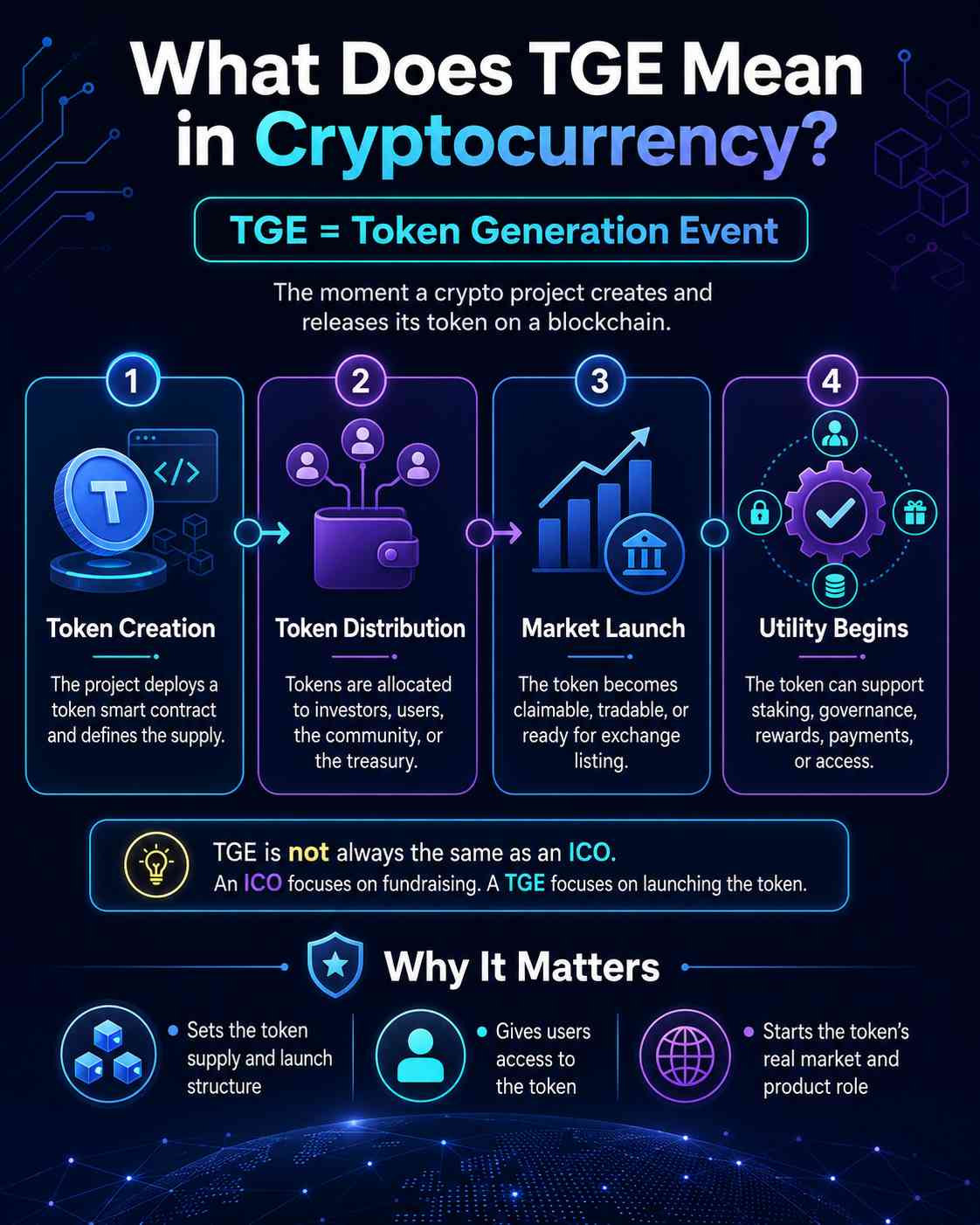
The main point stays the same: the token moves from planning into live market activity.
The Technical Side
The project deploys the token contract, confirms supply rules, sets permissions, and prepares distribution wallets. Security matters here. A small contract error can affect user funds, exchange access, and market trust.
The Market Side
The project prepares users, investors, community members, and liquidity venues. The token needs a clear entry point. People need to know where to claim, buy, trade, stake, or use it.
The Trust Side
The project must explain allocation, vesting, lockups, risks, and utility. A TGE with unclear supply details creates doubt before the market even opens.
Why Token Generation Events Matter
A TGE gives a crypto project its first real public market test. People stop reading only the whitepaper and start judging execution.
The Token Becomes Real
Before the TGE, the token is mostly a plan. After the event, users can hold it, trade it, stake it, govern with it, or use it inside the product.
Distribution Shapes Early Trust
Token allocation tells the market who controls supply. Heavy insider allocation can raise concern. Fair public access can help a project earn more trust.
Liquidity Sets the First Market Experience
A token with weak liquidity faces slippage, unstable pricing, and frustrated users. Good liquidity planning makes the first trading phase easier to follow.
Utility Moves From Claim to Proof
A project can talk about utility for months. After the TGE, users expect that utility to work. Staking, governance, fees, rewards, or access rights must connect with real product use.
How Does a TGE Work?
A TGE follows a chain of decisions. Each one affects the next. Weak planning in one area can damage the whole launch.
Token Utility Planning
The team first defines the token’s role. This role must fit the product, not just the fundraising plan.
Common token roles include:
- Paying platform fees
- Accessing premium features
- Staking for rewards
- Voting on governance proposals
- Incentivizing user activity
- Supporting validator or node participation
A token with no clear role becomes hard to defend after listing. The market will ask why the token exists.
Tokenomics Design
Tokenomics explains how supply enters the market. It covers total supply, circulating supply, vesting, allocation, emissions, burns, rewards, and treasury use.
Strong tokenomics answers three questions:
- Who receives tokens?
- When do tokens enter circulation?
- Why will people hold or use the token?
The unlock schedule deserves careful planning. Large unlocks can create sell pressure. Poor communication around unlocks can damage trust.
Smart Contract Development
The smart contract creates the token and controls its basic rules. A team must choose the right chain, standard, admin setup, and permission model.
For EVM chains, projects often use ERC-20 or BEP-20 style tokens. For Solana, SPL tokens are common. The choice depends on liquidity, user base, product needs, and exchange plans.
Security review should happen early. Audits, testnet deployment, permission checks, and emergency controls all reduce avoidable risk.
Legal and Compliance Review
A TGE can trigger legal questions. The token’s role, sale method, target regions, buyer type, and marketing claims all matter.
Projects need to review:
- Token classification
- KYC and AML needs
- Restricted countries
- Sale terms
- Risk disclosures
- Investor communication
- Exchange listing rules
No project should promise returns, price growth, or guaranteed listings. These claims can create legal and reputational problems.
Community and Market Preparation
A TGE needs education before promotion. Users should understand how to join, what the token does, where to buy, where to claim, and what risks exist.
Useful launch content includes:
- Tokenomics page
- Claim guide
- Wallet setup guide
- Exchange guide
- Risk FAQ
- Vesting calendar
- Community AMA
- Product roadmap
People make better decisions with plain information. Confusion creates support issues and weak launch activity.
Token Distribution
Distribution can happen through private sale, public sale, IDO, IEO, airdrop, rewards, grants, or community claims.
Each format has a different purpose. Private rounds fund early work. Public rounds widen participation. Airdrops reward users. Grants support builders. Rewards increase product activity.
The best format depends on the project category and user base.
Listing and Liquidity Phase
Many users judge a TGE by the first trading venue. The token can list on a DEX, CEX, or both.
DEX launches need liquidity pools and clear contract addresses. CEX launches need review, market support, and user education. Market makers can help with order book depth, but they cannot fix weak demand.
The project must publish official links and warn users about fake contracts.
Post-TGE Growth
A TGE should begin the public phase, not end it. After launch, the team must prove delivery.
Post-TGE activity can include:
- Product updates
- Staking launch
- Governance launch
- User campaigns
- Exchange expansion
- Partner announcements
- Token usage reports
- Community calls
A quiet post-TGE period can hurt confidence. The market expects visible progress.
Ready to Launch Your Token the Right Way?
Plan your Token Generation Event with expert support across tokenomics, smart contracts, launch strategy, and market readiness.

Common Types of Token Generation Events
Different projects use different TGE formats. The right model depends on access, compliance, liquidity, and product stage.
ICO-Based TGE
An ICO-based TGE connects token creation with public fundraising. Buyers purchase tokens during a sale, then receive them at or after the generation event.
This model gives the project direct capital access. It also needs careful legal review, sale terms, and investor communication.
Best fit:
- Early-stage projects with clear token use
- Projects with a global community
- Teams prepared for compliance review
IDO-Based TGE
An IDO launches tokens through a decentralized exchange or launchpad. Users can access the token through pools, whitelist rounds, or launchpad allocation.
The model gives fast market access. It can also create sharp price moves, bot activity, and liquidity pressure.
Best fit:
- DeFi projects
- Community-led token launches
- Projects with DEX-native users
IEO-Based TGE
An IEO runs through a centralized exchange. The exchange handles user access, sale infrastructure, and often listing support.
This model can increase user trust due to exchange screening. The project still needs its own community, product plan, and post-launch work.
Best fit:
- Projects seeking exchange-led access
- Teams with stronger documentation
- Launches targeting retail users
Airdrop-Based TGE
An airdrop-based TGE distributes tokens to users, testers, NFT holders, community members, or early product participants.
This model can reward real activity. Poorly planned airdrops attract farmers who sell fast and leave.
Best fit:
- Protocols with active users
- Projects rewarding early contributors
- Networks seeking wide distribution
Fair Launch TGE
A fair launch reduces private allocation and opens access to the wider market. The goal is to reduce insider advantage.
The model can build trust, but it needs careful protection against bots and whales.
Best fit:
- Community-first projects
- Meme tokens
- DeFi experiments
- Projects avoiding large private rounds
Mainnet or Genesis TGE
A genesis TGE happens at network launch. The native token starts with the chain or protocol.
This model often applies to Layer 1, Layer 2, DePIN, and infrastructure networks. It links the token with security, fees, validators, or resource access.
Best fit:
- New blockchains
- Validator networks
- Infrastructure protocols
- Appchains
TGE vs ICO: What Is the Difference?
A TGE and ICO can connect, but they are not the same. An ICO is mainly a fundraising method. A TGE is the creation and release of the token.
| Factor | TGE | ICO |
|---|---|---|
| Meaning | Token creation and distribution event | Token sale for fundraising |
| Main focus | Launch, usage, supply, access | Raising capital |
| Timing | Can happen before, during, or after sale rounds | Usually before listing |
| Technical role | Token deployment and distribution | Sale participation |
| Market role | Makes the token live | Funds the project |
| Risk area | Contract, liquidity, unlocks, compliance | Sale claims, buyer access, regulation |
A project can run an ICO and later hold a TGE. It can run a TGE without an ICO too.
TGE vs IDO vs IEO vs STO
Token launches use different models based on investor access and legal structure.
| Model | Platform | Access | Compliance Level | Liquidity |
|---|---|---|---|---|
| TGE | Blockchain and project channels | Varies by launch plan | Depends on token type | Depends on listing |
| ICO | Project website or sale portal | Public or restricted | Medium to high | After listing |
| IDO | DEX or launchpad | Wallet-based access | Varies | Fast DEX liquidity |
| IEO | Centralized exchange | Exchange users | Higher screening | Exchange listing support |
| STO | Regulated platform | Verified investors | High | Often restricted |
A TGE is the broad event. ICO, IDO, IEO, and STO are launch or sale models that can sit inside the broader TGE plan.
Benefits of a Token Generation Event
A well-planned TGE gives a project a clear public entry point.
Wider Community Participation
A TGE lets users join the project through claims, sales, staking, trading, or governance. It gives the community a real asset to follow.
Faster Token Distribution
Smart contracts can distribute tokens across many wallets with less manual work. This helps projects manage airdrops, rewards, and sale allocations.
Liquidity Access
The token can enter DEX pools or exchange markets. This gives holders a way to trade, price the asset, and track market activity.
Utility Activation
The token can begin its role inside the product. Fees, voting, staking, rewards, access passes, and validator functions can start after launch.
Market Visibility
A TGE gives the project a public milestone. Media, communities, exchanges, and users all get a reason to pay attention.
Risks of a TGE in Cryptocurrency
A TGE carries real risks. Teams need to address them before launch, not during crisis.
Regulatory Risk
The token can fall under different rules in different markets. Sale structure, buyer access, profit claims, and token rights all affect legal treatment.
Smart Contract Risk
Faulty contracts can expose funds, freeze transfers, mint excess supply, or create admin abuse risks. Audits reduce risk, but they do not remove it.
Token Dumping Risk
Poor vesting can flood the market. Early investors, team wallets, or reward wallets can create pressure when unlocks arrive.
Liquidity Risk
Thin liquidity creates unstable trading. Users face high slippage, price gaps, and poor execution. This can damage the first market impression.
Community Trust Risk
Overpromising breaks trust fast. Users notice delayed features, vague listing claims, hidden unlocks, and weak support.
TGE Tokenomics Checklist for Founders
Tokenomics must be clear enough for users, investors, exchanges, and partners to understand.
Supply and Allocation
Define total supply, initial circulating supply, treasury allocation, team allocation, investor allocation, public sale share, and ecosystem rewards.
Vesting and Unlocks
Set cliff periods, monthly unlocks, linear vesting, claim rules, and public unlock calendars. The market should know when new supply arrives.
Utility and Demand
Explain why people need the token. Utility can include product access, fee payment, governance, staking, rewards, validator participation, or reputation.
Liquidity and Market Support
Plan DEX liquidity, CEX listing needs, market makers, treasury reserves, and liquidity monitoring. Do not leave this for launch day.
Governance and Control
State who controls upgrades, treasury actions, emergency functions, and admin keys. Strong control design reduces fear around misuse.
Legal and Compliance Points Before a TGE
Legal planning protects the project, buyers, partners, and exchanges.
Token Classification
A token can act like a utility token, governance token, payment token, security token, or hybrid asset. The project must assess this early.
KYC and AML
Some launches need identity checks. This is common for public sales, regulated markets, exchange listings, and restricted investor categories.
Jurisdiction Planning
A project may restrict certain countries. This decision must appear in sale terms, website flow, and community communication.
Marketing Claims
Marketing should avoid return promises, price targets, guaranteed listings, and false partnership claims. Safer communication focuses on utility, risks, and roadmap.
Documentation
The project needs a whitepaper, tokenomics page, sale terms, privacy policy, risk notice, and claim guide. Exchange teams often review these materials.
How to Plan a Successful TGE
A strong TGE starts with preparation months before the token goes live.
Start With Real Token Utility
The token needs a reason to exist inside the product. Users should understand what the token does without reading ten pages.
Design Fair Token Distribution
Balanced allocation improves trust. The community will question private rounds, team wallets, advisor shares, and treasury control.
Audit Smart Contracts Early
Audits need time. Teams should test contracts, review permissions, verify supply rules, and publish audit notes before launch.
Prepare Liquidity Before Public Launch
Liquidity planning must cover DEX pools, CEX order books, market support, contract verification, and official trading links.
Educate the Community
Users need simple guides. A wallet guide, claim guide, tokenomics explainer, vesting calendar, and FAQ can reduce confusion.
Communicate Unlocks Clearly
Unlocks should never surprise the market. Publish dates, amounts, wallet categories, and expected circulation changes.
Keep Post-TGE Activity Ready
Plan the first 30 to 90 days after launch. The market needs updates, product usage, community events, and measurable progress.
Real-World TGE Examples
Real TGE examples show how different crypto projects bring tokens into the market. These examples make the idea easier to understand.
Aptos: Layer 1 Token Launch
Aptos launched its mainnet in October 2022, with APT becoming the native token of the network. The token was linked to network fees, staking, validator rewards, and governance activity.
This was a classic Layer 1-style token launch. The token was not only made for trading. It had a direct role in how the network worked from the start.
Main lesson: A Layer 1 TGE works better when the token has a clear network purpose from day one.
Uniswap: DeFi Governance Token Launch
Uniswap introduced UNI in September 2020 and distributed tokens to past users of the protocol. UNI gave holders a role in governance, including voting on protocol changes and treasury-related proposals.
This launch became one of the most referenced DeFi token events because it rewarded early users and gave the community a voice in the protocol’s future.
Main lesson: A DeFi TGE gains more trust when the token connects with real protocol usage and governance rights.
Arbitrum: Airdrop-Led Governance Launch
Arbitrum launched ARB in March 2023 through an airdrop to eligible users and community members. The token gave holders governance power over Arbitrum One and Arbitrum Nova.
This was not just a reward campaign. It marked Arbitrum’s move toward DAO-led decision-making, where token holders could vote on future network changes.
Main lesson: Airdrop-led TGEs work best when they reward real participation and give users a meaningful role after the claim.
Common TGE Mistakes to Avoid
Many token launches fail for avoidable reasons.
Weak Token Utility
A token with no product role becomes a trading object with little reason to hold. Utility must come before market access.
Poor Vesting Design
Large unlocks can create pressure. Vague vesting terms create fear. Clear schedules help users judge supply risk.
Overpromising Exchange Listings
Projects should never claim listings that are not confirmed. Fake or early claims can harm trust and create legal risk.
Ignoring Compliance
Weak legal review can block exchange access, payment support, investor access, and future partnerships.
Launching Without Community Education
Users need guidance before launch. Confused users miss claims, fall for scams, or trade fake contracts.
No Post-Launch Plan
Some teams spend all energy on launch week. Then silence follows. The market reads silence as weakness.
Need Help With Your Token Generation Event?
TGE Launch Checklist
A practical schedule helps teams avoid rushed decisions.
90 Days Before TGE
- Finalize token utility
- Complete tokenomics draft
- Start legal review
- Begin smart contract development
- Prepare whitepaper and website
- Open community education
60 Days Before TGE
- Start audit process
- Confirm sale model
- Prepare claim process
- Plan DEX or CEX route
- Build FAQ and risk pages
- Prepare launch content
30 Days Before TGE
- Test token contracts
- Verify allocation wallets
- Confirm vesting schedules
- Publish tokenomics
- Prepare official contract address plan
- Train community support team
Launch Week
- Deploy or verify token contract
- Open claims or sale access
- Publish official links
- Activate liquidity
- Monitor support channels
- Share launch updates
After TGE
- Track holder growth
- Monitor liquidity
- Publish distribution updates
- Continue product releases
- Run community sessions
- Prepare next listing or utility phase
Is a TGE Good for Every Crypto Project?
Not every crypto project needs a token early. A weak early token can create pressure before the product is ready.
A TGE Makes Sense When
- The product has real token use
- The community needs participation rights
- The network needs rewards or staking
- Governance matters to the project
- Liquidity planning is ready
- Legal review is complete
- Post-launch activity is planned
A TGE Is Too Early When
- The product is only an idea
- Token utility is unclear
- Legal review is missing
- Liquidity planning is weak
- The roadmap lacks proof points
- The team depends only on hype
A delayed TGE can be better than a rushed one. The market respects projects that launch with stronger foundations.
FAQs
What is TGE in cryptocurrency?
A TGE, or Token Generation Event, is the process where a crypto project creates and distributes its token on a blockchain.
Is TGE the same as ICO?
No. A TGE is the token creation and distribution event. An ICO is a fundraising method that can happen before or during a token launch.
What happens after a TGE?
After a TGE, tokens can become claimable, tradable, stakable, usable inside a product, or active in governance.
Is a TGE risky?
Yes. TGE risks include regulation, smart contract bugs, weak liquidity, poor vesting, insider selling, and unclear project delivery.
How do projects prepare for a TGE?
Projects prepare through tokenomics design, smart contract development, legal review, audits, community campaigns, liquidity planning, and listing strategy.
What is the best token standard for a TGE?
The best token standard depends on the chain and token role. ERC-20, BEP-20, SPL, and similar standards are common across major networks.
Can a project launch a TGE without an ICO?
Yes. A project can launch through an airdrop, IDO, IEO, fair launch, mainnet launch, or direct ecosystem distribution.
Why is vesting important in a TGE?
Vesting controls when tokens enter circulation. It reduces sudden supply pressure and gives the market a clearer release schedule.

Vimal J is the Head of Sales at Blockchain App Factory, with 10+ years of experience in sales, client strategy, and Web3 business growth. He helps startups, enterprises, and project founders choose the right blockchain solutions for their goals, bringing a practical market perspective to topics like token development, crypto launches, and Web3 adoption.
Article Reviewed by:
Arun Kamala Santhanath
Marketing Head, Blockchain App Factory


