


Robinhood Chain moved from concept to live infrastructure on July 1, 2026. The public mainnet gives financial product teams an Ethereum-compatible Layer 2 built for real-world assets. Robinhood reports nearly 28 million customers across 38 countries. Its new Stock Tokens reached eligible Robinhood Wallet users in more than 120 countries at launch, subject to local limits.
Buyer demand has a clear base. Robinhood surveyed 6,811 people across 14 EU member states. Fifty-five percent showed at least moderate interest in Stock Tokens after reading a product description. Among informed respondents, interest reached 83 percent. Cost and access drove demand. Forty-nine percent valued flexible trading hours, 45 percent cited lower fees, 40 percent cited fractional exposure, and 35 percent cited near-instant settlement.
For founders and product leaders, the opening is real. The hard part is not deploying an ERC-20 contract. The hard part is creating a lawful financial product, linking it to real assets, pricing it correctly, and running it under strict controls.
Why Firms Are Acting Now
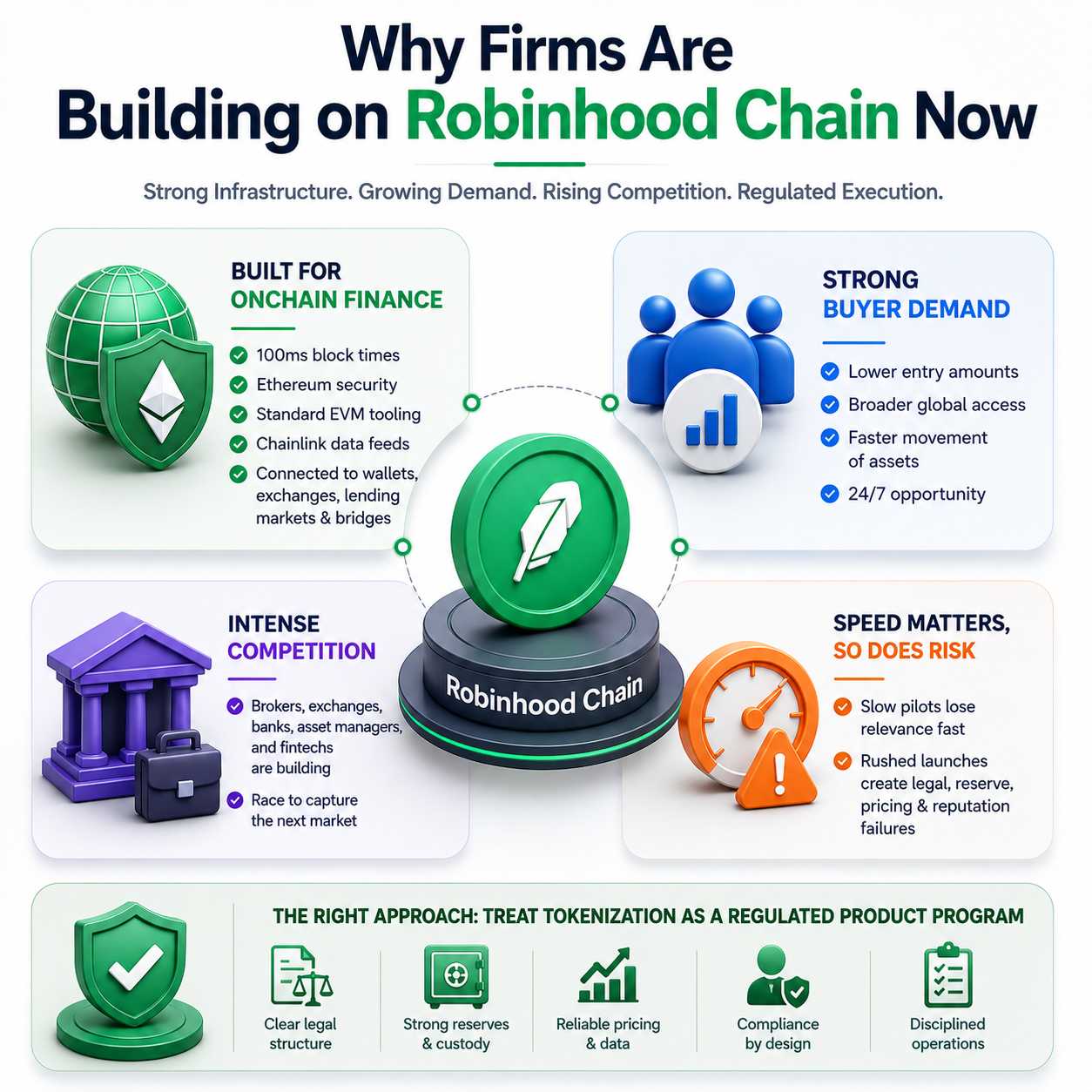
Robinhood Chain joins a wider shift toward programmable securities and onchain financial products. The network offers 100 millisecond block times, Ethereum security, standard EVM tooling, Chainlink data feeds, and links to wallets, exchanges, lending markets, and bridges.
Demand comes from buyers who want lower entry amounts, broader access, and faster movement of assets. Competitive pressure comes from brokers, exchanges, banks, asset managers, and fintech firms building tokenized products.
A slow pilot can lose relevance fast. A rushed launch can create legal, reserve, pricing, and reputation failures.
The right plan treats tokenization as a regulated product program, not a token deployment task.
What Does It Mean to Tokenize Stocks and ETFs on Robinhood Chain?
A tokenized stock or ETF is an onchain instrument tied to an underlying security or fund. The token can represent direct ownership, a custodial entitlement, or synthetic economic exposure. These models create different rights, duties, and risks. US regulators now classify tokenized securities across issuer-sponsored, custodial, and synthetic structures.
Robinhood’s canonical Stock Tokens use standard ERC-20 contracts with 18 decimals. Each token maps to a named stock or ETF. Chainlink feeds publish per-asset prices onchain. An ERC-8056 multiplier handles dividends and stock splits without changing raw balances.
A key distinction matters. Robinhood Chain is permissionless, so third parties can deploy contracts. Yet only contract addresses listed in Robinhood’s official documentation count as canonical Robinhood Stock Tokens. A third-party token with the same ticker is not a Robinhood Stock Token.
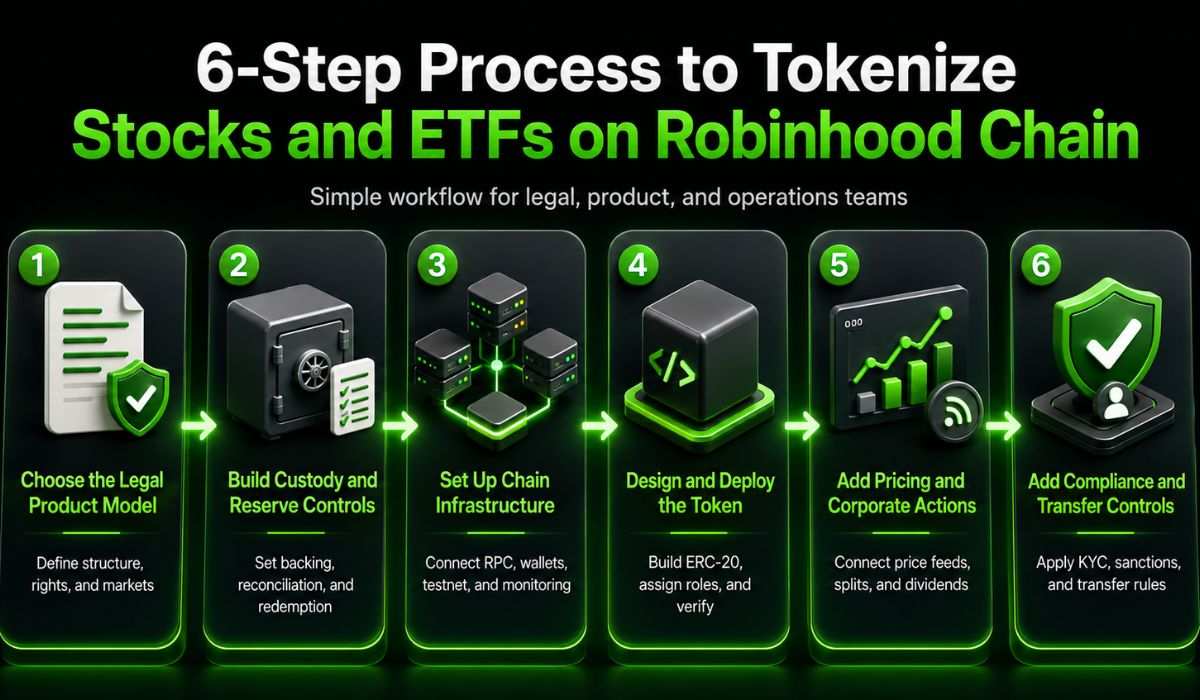
Step 1: Choose the Legal Product Model
This decision sets the rights investors receive and the rules your business must follow. Product, legal, compliance, tax, custody, and finance teams need one written model before code work starts.
Select one of three core structures
- Issuer-sponsored token: The public company or fund issues the security in token form.
- Custodial entitlement token: A third party holds the underlying asset and issues a token tied to that holding.
- Synthetic or linked token: A third party issues its own instrument with returns linked to a stock or ETF.
Robinhood’s Stock Tokens are tokenized debt securities issued by Robinhood Assets (Jersey) Limited. They provide economic exposure to referenced securities. Holders do not receive legal or beneficial rights against the issuer of those referenced securities.
Define investor rights in plain terms
State voting rights, dividend treatment, redemption rights, insolvency rank, fees, transfer limits, market hours, and governing law.
Product screens and legal terms must match. A token described as ownership cannot work like an unsecured debt claim behind the scenes.
Map each target market
Stock Tokens are not available in the United States and face limits in other regions. Build a country matrix covering:
- Offering rules
- Eligible investor types
- Marketing restrictions
- Tax treatment
- Reporting duties
- Secondary transfer limits
Use licensed securities counsel in every target market. A licence in one country does not grant automatic access elsewhere.
Step 2: Build Custody, Reserve, and Reconciliation Controls
A credible token needs a credible asset and cash control model. Smart contracts cannot repair weak custody records or missing reserves.
Set the backing policy
For a custodial model, define the asset held for each token. Set rules for cash, fractional shares, pending trades, dividends, corporate actions, and failed settlement.
For a synthetic model, define hedging rules, issuer capital, counterparty limits, and payout terms. Buyers need a clear view of issuer credit risk.
Create daily reconciliation
Match four records every day:
- Tokens issued and burned
- Underlying shares or ETF units held
- Cash and dividend balances
- Customer and wallet records
Any break needs an owner, a deadline, and an escalation path. Large differences should pause new issuance until operations resolve them.
Plan redemption and wind-down
Document minting, redemption, suspension, delisting, and insolvency steps. A token with no clear exit route creates product and conduct risk.
Set redemption cut-off times, settlement targets, minimum amounts, fees, and rejected-payment procedures. Explain what happens during exchange closures or extreme market events.
Step 3: Set Up Robinhood Chain Infrastructure
Robinhood Chain uses Arbitrum Layer 2 technology. It settles data through Ethereum and uses ETH for gas. Mainnet uses chain ID 4663. Testnet uses chain ID 46630.
Build the base stack
- Connect through a supported RPC provider.
- Add Robinhood Chain to developer wallets.
- Fund test wallets with test ETH.
- Set up Blockscout monitoring and contract verification.
- Create archive access for history and indexer recovery.
Robinhood lists Alchemy as its recommended infrastructure provider. Other listed providers include QuickNode, Blockdaemon, dRPC, and Validation Cloud.
Test on testnet first
Run mint, burn, transfer, pause, redemption, oracle, and admin flows on testnet.
Use separate deployer keys. Store production keys in institutional custody or a hardened signing system. Never keep production keys in source code, shared password tools, or developer laptops.
Plan bridging with care
The canonical bridge links Ethereum and Robinhood Chain. Deposits take about ten minutes. Withdrawals use Arbitrum’s seven-day challenge period.
Faster partner routes reduce transfer time but add provider and liquidity risk. Product disclosures should state which bridge controls each transaction.
Step 4: Design and Deploy the Token Contract
Contract design turns legal terms into enforceable product rules. Every function needs a named business owner and a tested failure state.
Use a clear token standard
Robinhood’s Stock Tokens use ERC-20 with 18 decimals. A third-party issuer can use ERC-20 as a base and add modules for:
- Minting and burning
- Emergency pauses
- Investor allowlists
- Sanctions blocks
- Role control
- Wallet recovery
- Corporate actions
Do not copy a Robinhood ticker or claim canonical status. Use a distinct name, symbol, issuer label, and contract identity.
Separate roles
Create narrow roles for issuer operations, compliance, oracle control, pause authority, upgrades, and redemption.
Use multisignature approval for high-risk actions. Apply time delays to upgrades where product rules permit. No single employee should control minting, treasury transfers, and contract upgrades.
Decide on upgrade rules
An upgradeable contract supports fixes and policy changes. It creates admin risk at the same time.
Publish the upgrade policy, approval threshold, delay, and emergency path. State whether investors can exit before a material contract change takes effect.
Deploy and verify
Robinhood Chain supports Solidity, Vyper, Foundry, Hardhat, ethers.js, viem, and Wagmi.
Deploy to testnet, complete review, then deploy to mainnet. Verify source code on Blockscout so partners can inspect the contract.
Step 5: Add Pricing and Corporate Action Logic
Pricing errors can cause bad trades, undercollateralized loans, and unfair redemptions. Product teams must treat market data as a control system.
Use trusted onchain feeds
Robinhood Chain uses Chainlink price feeds for crypto assets and canonical Stock Tokens. Each feed supports the standard AggregatorV3Interface. Contracts read the current value through latestRoundData().
Check four fields on every read:
- Positive price
- Correct decimal count
- Fresh update time
- Active Layer 2 sequencer
Reject stale, negative, or incomplete data. Hard-coded decimal assumptions create avoidable pricing errors.
Model dividends and splits
Robinhood’s canonical tokens use an ERC-8056 multiplier. The multiplier changes the share-equivalent value without changing the raw token balance.
The price feed already includes this multiplier. Do not apply the multiplier twice. That error overstates token value.
Handle pauses
Corporate actions can pause an oracle. Your app should stop new price-based actions, show a clear status, and resume only after fresh data returns.
Build separate rules for splits, cash dividends, mergers, spin-offs, ticker changes, ETF closures, and delistings.
Step 6: Add Compliance and Transfer Controls
A public chain does not remove securities law, sanctions rules, investor checks, or market conduct duties. The token format changes the record system, not the legal character of the instrument.
Screen users and wallets
Build controls for:
- Identity verification
- Sanctions screening
- Investor classification
- Country restrictions
- Source-of-funds checks
- Wallet risk monitoring
Link wallet addresses to verified customer records under your privacy model. Define a process for lost keys, compromised wallets, and disputed transfers.
Robinhood Chain applies sequencer-level screening. Transactions tied to sanctioned addresses can be excluded. Issuers still need their own controls. Network screening does not replace product-level duties.
Control transfers
Choose the right transfer model:
- Open transfer with offchain holder checks
- Allowlisted transfer between approved wallets
- Restricted transfer by country or investor type
- Forced transfer or freeze under defined legal powers
State these powers before sale. Hidden admin controls damage trust.
Record every decision
Store approval records, screening results, overrides, blocked transfers, redemptions, complaints, and contract changes.
Regulators and commercial partners will ask how the product worked on a given date. Your records must provide that answer.
Step 7: Test, Audit, Launch, and Operate
A production launch needs proof that legal terms, reserves, code, data, and operations work as one system.
Run a full test program
Test:
- Unit and integration logic
- Role misuse
- Oracle failure
- Sequencer outage
- Bridge failure
- Corporate actions
- Wallet recovery
- Redemption queues
- Extreme market moves
- Chain congestion
Test the customer experience too. Users need clear balances, prices, rights, risk notices, and transaction status messages.
Commission independent reviews
Use a smart contract audit, legal review, custody review, penetration test, and operational control review.
Fix high-risk findings before mainnet deployment. Publish completed audit reports or concise security summaries where contracts serve public users.
Launch in stages
Start with a small asset set, narrow user group, low limits, and manual oversight.
Track spreads, failed trades, stale prices, reserve breaks, support cases, and redemption time. Increase limits only after the control data supports that decision.
Operate as a financial product
Set daily controls and named owners. Publish service status. Run incident drills. Review smart contract permissions each quarter.
Reassess each asset after mergers, splits, fund changes, sanctions events, or delisting risk.
Business Value and Cost Factors
Tokenized stocks and ETFs can support fractional access, longer trading hours, programmable collateral, onchain settlement, and new product bundles.
Robinhood Chain gives teams a live network with wallets, trading venues, price feeds, bridges, and lending links. Its official documentation lists portfolio tools, trading interfaces, lending markets, baskets, vaults, and derivatives among supported use cases.
Costs remain broad. Budget for:
- Legal work and licences
- Custody and asset servicing
- Market data
- Smart contract audits
- Liquidity and market makers
- Hedging and issuer capital
- Insurance
- Customer support
- Tax reporting
- Blockchain infrastructure
- Ongoing compliance controls
The best business case starts with one buyer problem and one regulated market. It does not start with a large token list.
Conclusion
Tokenizing stocks and ETFs on Robinhood Chain requires more than smart contract deployment. Businesses need a clear legal structure, secure custody, accurate reserve records, reliable pricing, transfer controls, regulatory compliance, and disciplined post-launch operations. A phased plan helps teams reduce legal, technical, liquidity, and reputational risks while building a product that investors and partners can trust. Companies should begin with a focused asset set, define investor rights, test every contract function, and maintain transparent reconciliation processes. Blockchain App Factory provides RWA Tokenization Development on Robinhood Chain, helping businesses design, develop, test, and launch tokenized asset platforms aligned with their commercial goals and regulatory requirements.
Frequently Asked Questions
Can any company issue stock tokens on Robinhood Chain?
The chain is permissionless, so any team can deploy a contract. Legal issuance still needs the right licences, disclosures, custody, controls, and market permissions.
Are third-party tokens official Robinhood Stock Tokens?
No. Only addresses listed in Robinhood’s official contract documentation are canonical Robinhood Stock Tokens.
Do Robinhood Stock Tokens grant ownership in the referenced company?
No. Robinhood states that its current Stock Tokens are tokenized debt securities. They provide economic exposure but no legal or beneficial rights in the referenced issuer.
What token standard does Robinhood Chain use for Stock Tokens?
Canonical Stock Tokens use ERC-20 with 18 decimals. They use ERC-8056 functions for corporate action multipliers.
How are stock and ETF prices published onchain?
Robinhood Chain uses per-asset Chainlink feeds. Contracts read prices through the standard AggregatorV3Interface.
Can tokenized stocks trade all day?
Robinhood’s new Stock Tokens support 24/7 trading for eligible users through supported venues. Price feeds for stock tokens update 24/5 around underlying market activity, so product rules need controls for off-hours pricing and liquidity.
What should decision-makers review before launch?
Review legal structure, investor rights, custody, reserve records, redemption, oracle design, liquidity, contract security, admin powers, country limits, and incident plans.

Vimal J is the Head of Sales at Blockchain App Factory, with 10+ years of experience in sales, client strategy, and Web3 business growth. He helps startups, enterprises, and project founders choose the right blockchain solutions for their goals, bringing a practical market perspective to topics like token development, crypto launches, and Web3 adoption.
Article Reviewed by:
Arun Kamala Santhanath
Marketing Head, Blockchain App Factory


