Key Insights
- Lead with financial value: fractional access, more trading hours, faster settlement, dividend handling, and wider investor reach, not blockchain hype.
- Build trust through clear investor rights, compliant structures, licensed custody, verified asset backing, risk disclosures, and all redemption terms.
- Support adoption through reliable wallets, liquidity, price feeds, trading venues, custody systems, and practical uses such as lending and collateral.
Tokenized real-world assets now form a measurable financial market. RWA.xyz tracked more than $34 billion in distributed asset value in July 2026, spread across over one million holders. Tokenized stocks had reached close to $1 billion by early 2026 after growing 128% during the second half of 2025.
These figures point to rising buyer interest. They do not prove that every tokenized product will gain adoption. Issuers still need to explain the financial claim, show the backing, meet local rules, create trading access, and give buyers a usable product.
Robinhood Chain offers a timely case study. Robinhood launched the public mainnet on July 1, 2026 as a permissionless, Ethereum-compatible Layer 2 built for tokenized financial assets. Its Stock Tokens connect US stocks and ETFs with self-custody, round-the-clock access, live price feeds, lending markets, and open application development.
The lesson is not that every company needs a blockchain. Institutional-grade adoption requires a complete market system. Product rights, custody, distribution, data, liquidity, compliance, and user access must work together.
Tokenization Is Entering a Commercial Phase
Financial institutions, fintech firms, asset managers, exchanges, and RWA startups now test tokenized funds, bonds, stocks, credit, commodities, deposits, and private assets. Their focus has shifted from technical proof toward distribution, daily operations, and buyer demand.
Buyers can compare tokenized products against familiar brokers, funds, exchanges, and investment apps. A blockchain label offers little value alone. The product must present a better route to access, settlement, income, collateral use, or portfolio management.
Regulators are paying closer attention. The US Securities and Exchange Commission stated in January 2026 that tokenized securities remain securities. Their format does not remove registration, disclosure, or market rules. Accurate product communication now sits at the centre of any RWA marketing strategy.
Why Tokenized Asset Marketing Needs Institutional-Grade Proof
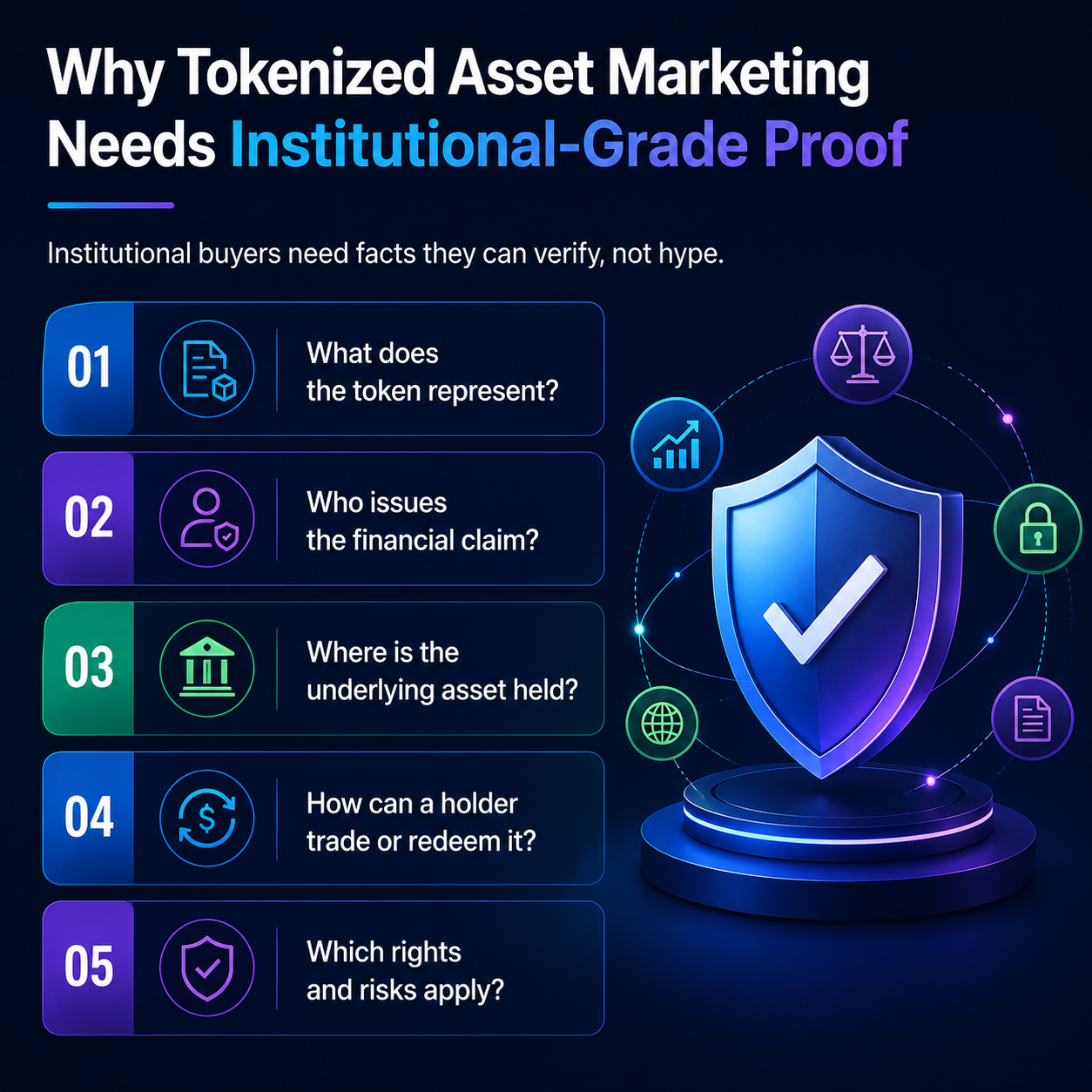
Tokenized asset marketing translates a legal and technical structure into facts that buyers, partners, advisers, and compliance teams can assess.
A credible campaign must answer five questions:
- What does the token represent?
- Who issues the financial claim?
- Where is the underlying asset held?
- How can a holder trade or redeem it?
- Which rights and risks apply?
Token structures vary. One token can record direct ownership. Another can represent a custodial claim. A third can provide price exposure through debt or a derivative.
Robinhood states that its Stock Tokens are tokenized debt securities issued by Robinhood Assets (Jersey) Limited. Holders receive economic exposure to the referenced stock or ETF. They do not receive legal or beneficial rights against the company behind that asset.
That wording protects product accuracy and gives buyers a sound basis for judging value and risk.
What Robinhood Chain’s Tokenization Strategy Includes
Robinhood Chain turns tokenization into an open product and distribution system. The strategy joins a regulated instrument structure with blockchain rails, price data, wallets, trading venues, and third-party applications.
A Chain Built Around Financial Assets
Robinhood Chain is a permissionless Ethereum-compatible Layer 2 built with Arbitrum technology. It uses ETH for transaction fees and works with standard EVM wallets, contracts, and developer tools.
Builders gain access to Solidity contracts, account abstraction, sponsored fees, bridges, public contract addresses, and standard JSON-RPC connections. This lowers integration work for wallets, trading tools, lending markets, and portfolio apps.
Stock Tokens as the Flagship RWA Product
Robinhood Stock Tokens are standard ERC-20 contracts with 18 decimals. Each token links to a named equity or ETF. Chainlink feeds publish reference prices onchain.
Robinhood presents four main buyer benefits:
- Exposure to US stocks and ETFs
- 24/7 access through supported markets
- 1:1 backing by underlying shares
- Self-custody and onchain product use
A licensed custodian holds the shares, and Robinhood reports daily collateral monitoring. Eligible holders can trade through supported wallets and exchanges or seek direct issuer redemption after KYC and AML checks.
Open Distribution Beyond One App
A closed investment app controls the customer path. Robinhood Chain lets standard ERC-20 tokens move between supported wallets and connect with external applications.
Builders can create trading interfaces, lending markets, portfolio tools, and reporting services. The chain becomes a distribution layer, not only a transaction database.
Corporate Actions Within the Token Design
Stocks can pay dividends, split, merge, or change their capital structure. Tokenized products need a method for reflecting those events.
Robinhood uses an onchain multiplier. Cash dividends purchase more underlying shares. The multiplier then changes the effective share quantity represented by each token. This gives investors a defined method for income and stock-split processing.
How to Market Tokenized Assets Using Robinhood Chain’s Lessons
Robinhood Chain shows how companies can present tokenized assets as financial products with programmable access. Six lessons stand out.
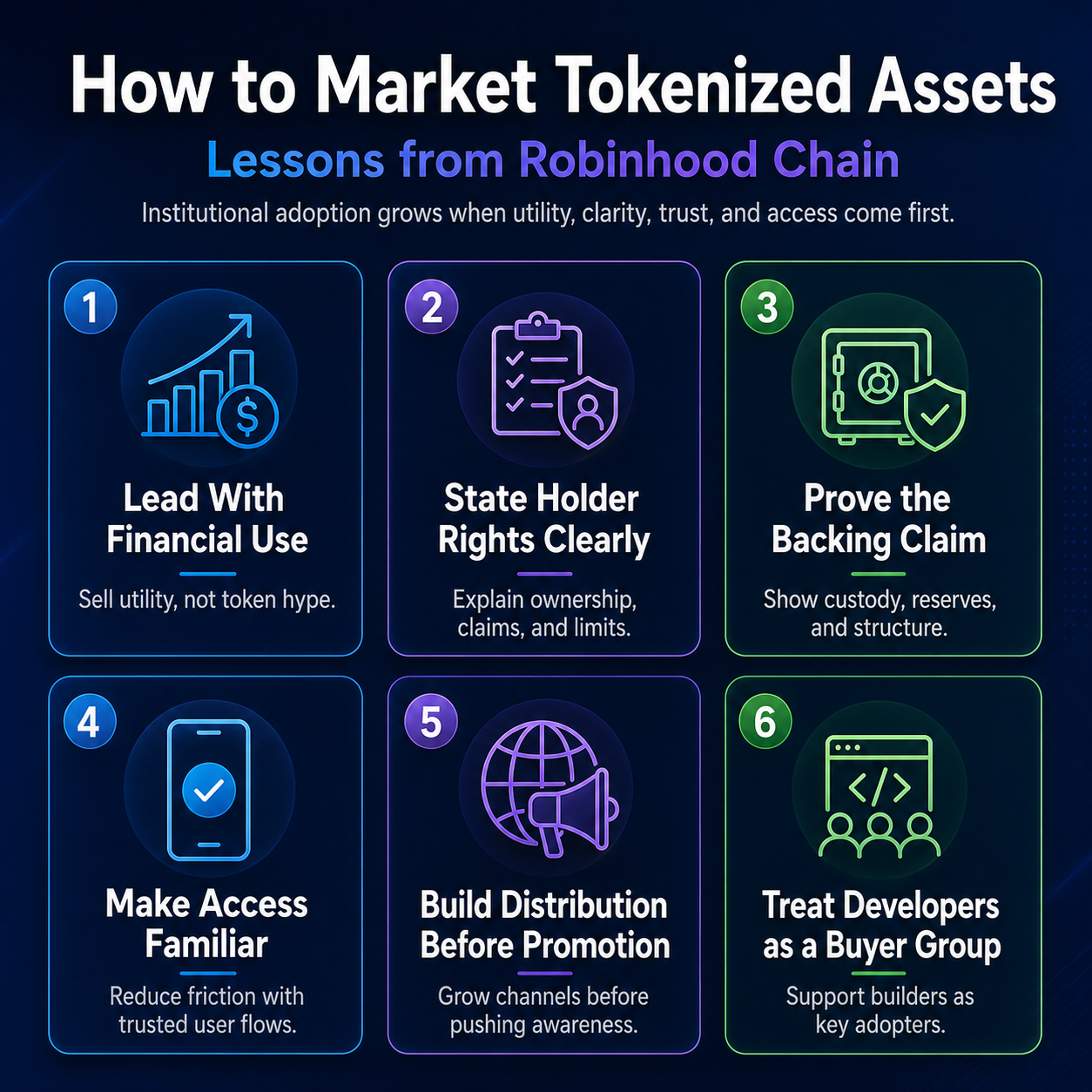
Lead With the Financial Use
Buyers care about access, smaller entry sizes, longer market hours, settlement speed, income handling, and collateral uses.
Start with that value. Explain the blockchain role after the buyer understands the financial product.
A treasury product can lead with cash management. A private credit product can lead with smaller investment units. A real estate product can focus on income rights.
State the Holder’s Rights in Plain Terms
Each product page should state what the holder receives. Use the same wording in sales decks, FAQs, onboarding screens, investor documents, and support content.
Cover the issuer, instrument type, ownership status, income rights, voting rights, transfer limits, redemption terms, and insolvency treatment.
Robinhood does not call its new Stock Tokens direct shares. It states that they are debt securities linked to underlying stocks and ETFs.
Prove the Backing Claim
“Asset-backed” is too broad for serious buyers. The campaign needs evidence tied to custody, reconciliation, and redemption.
State the underlying asset, custody arrangement, collateral ratio, monitoring schedule, issuance controls, redemption process, and insolvency treatment.
Robinhood links its 1:1 claim to underlying shares, licensed custody, daily monitoring, and an independent security agent for an issuer insolvency event.
Make Access Familiar
Self-custody and open markets can widen access, but wallets, gas, bridges, and network settings can block adoption.
Robinhood Chain reduces friction through EVM compatibility, Robinhood Wallet support, account abstraction, sponsored fees, and standard ERC-20 contracts. External EVM wallets can connect too.
Retail users need guided transactions and plain risk language. Professional users need controls, records, APIs, and custody choices.
Build Distribution Before Promotion
Token issuance does not create a market. Distribution needs wallets, venues, market makers, price feeds, bridges, custody partners, and applications.
Confirm where buyers can acquire the token, how prices track the asset, who supplies liquidity, how redemption works, and which regions restrict access. Robinhood Chain connects Stock Tokens with wallets, RFQ trading, exchanges, Chainlink data, and lending tools.
Treat Developers as a Buyer Group
Robinhood Chain markets to investors and builders. Developer material includes contract addresses, token standards, data feeds, RPC details, and integration patterns.
RWA issuers can apply the same practice without owning a chain. Publish contract details, oracle rules, transfer controls, and integration guides.
The TRUST Model for Institutional-Grade Adoption
A tokenized asset campaign needs a test that links each claim to working evidence.
T: Token-Holder Rights
Define the legal claim, economic exposure, income rights, voting rights, transfer rights, redemption rights, and dispute route.
R: Regulatory Structure
Map the instrument class, issuer location, investor eligibility, sales limits, KYC checks, AML controls, sanctions screening, and disclosures for each target region.
U: Underlying Asset Proof
Show how the asset connects to the token supply. Present custody records, asset identifiers, reserve data, valuation rules, insurance terms, and reconciliation practices.
S: Security, Settlement, and Servicing
Explain minting, burning, transfers, settlement, corporate actions, income processing, contract permissions, recovery processes, and incident handling.
T: Trading and Traction
Report venue access, market depth, spreads, active holders, volume, redemptions, and repeat use. Social reach alone says little about market quality.
Technical Foundations Behind the Marketing Claims
Marketing teams need verified facts from legal, technical, operations, security, and finance teams. A claim should not enter a campaign until the business can support it.
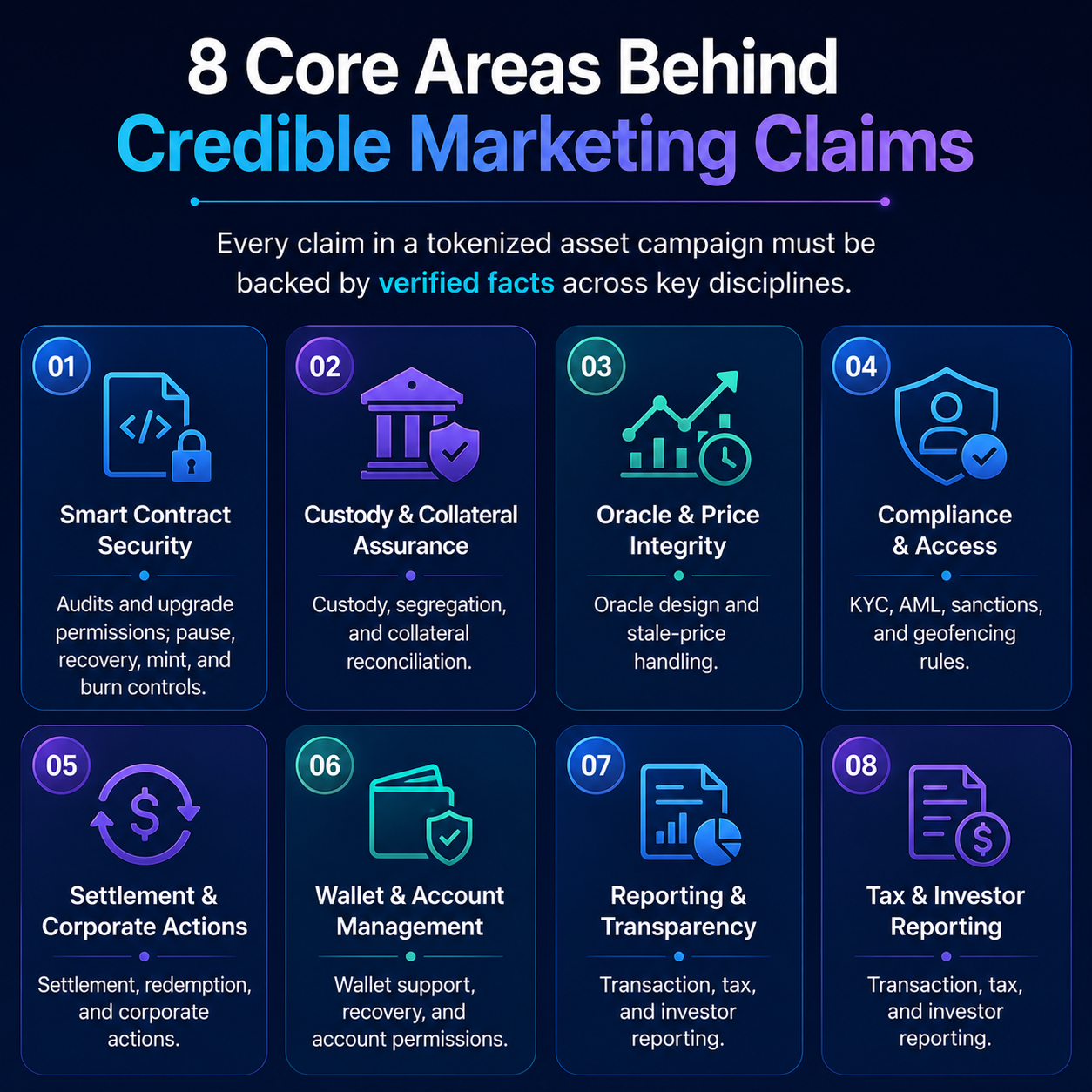
Decision-makers should review:
- Smart contract audits and upgrade permissions
- Pause, recovery, mint, and burn controls
- Custody, segregation, and collateral reconciliation
- Oracle design and stale-price handling
- KYC, AML, sanctions, and geofencing rules
- Settlement, redemption, and corporate actions
- Wallet support, recovery, and account permissions
- Transaction, tax, and investor reporting
Open infrastructure creates external dependencies across wallets, bridges, oracles, markets, and third-party apps. Launch budgets should cover legal work, licences, custody, security reviews, price data, liquidity support, reporting, documentation, and marketing review.
Chain-Led Tokenization vs a Closed Tokenized Product
| Area | Closed Tokenized Product | Chain-Led Tokenization |
|---|---|---|
| User access | One app or platform. | Supported wallets and applications. |
| Distribution | Controlled by the issuer. | Issuer plus external builders. |
| Integration | Custom connections. | Standard contracts and EVM tools. |
| Product use | Trading or holding. | Trading, lending, collateral, and structured products. |
| Data | Platform-controlled feeds. | Public onchain feeds and records. |
| Main risk | Platform dependency. | Wider contract and ecosystem exposure. |
A closed model offers tighter control. A chain-led model offers wider reach and more product uses. The choice rests on the asset class, buyer profile, rules, and operating capacity.
Commercial Use Cases for a Chain-Led RWA Strategy
Robinhood Chain focuses on stocks and ETFs, but the model applies to other assets.
Tokenized Funds, Bonds, and Private Credit
Onchain records can support transfers, income processing, reporting, and controlled distribution. Buyers will expect accurate pricing, custody, redemption access, investor checks, and transfer limits.
Commodities, Real Estate, and Treasury Products
Tokens can represent ownership claims, debt, beneficial interests, or revenue rights. Marketing must state the exact structure. Treasury buyers will assess settlement, issuer risk, redemption speed, and price stability.
How to Choose a Tokenized Asset Marketing Agency
A suitable tokenized asset marketing agency should understand financial products, blockchain systems, and regulated communication. Review its work across investor education, SEO, financial PR, technical content, market entry, and institutional campaigns. Ask how the team checks claims about ownership, backing, custody, income, liquidity, and investor rights. The agency should work with legal and product teams, keep approved wording consistent, and turn complex structures into accurate buyer content. Avoid agencies that treat every RWA campaign like a standard crypto token launch.
Conclusion
Robinhood Chain’s strategy shows that tokenization gains commercial value through the broader system surrounding the asset. A token needs clearly defined rights, verifiable backing, dependable custody, accurate pricing, accessible wallets, active markets, and compliant distribution.
Businesses exploring how to market tokenized assets should begin with buyer proof. Clearly state what the holder receives, identify the issuer, explain the custody structure, and show how pricing, trading, income distribution, and redemption work. Risks should be presented alongside benefits so investors and institutional buyers can make informed decisions.
Open technical access can also turn developers, wallets, exchanges, and lending platforms into valuable distribution partners. However, this opportunity introduces additional responsibilities across security, documentation, monitoring, compliance, and partner due diligence.
Blockchain App Factory provides tokenized asset marketing services designed to help businesses communicate financial utility, asset backing, compliance readiness, and investor value. Its approach can support projects in building credible messaging, reaching relevant institutional and retail audiences, and developing distribution strategies for investors, partners, and developers.
Build the evidence first. Shape the message around genuine financial value. Then bring the product to institutions, investors, partners, and developers through channels aligned with their specific needs.

Vimal J is the Head of Sales at Blockchain App Factory, with 10+ years of experience in sales, client strategy, and Web3 business growth. He helps startups, enterprises, and project founders choose the right blockchain solutions for their goals, bringing a practical market perspective to topics like token development, crypto launches, and Web3 adoption.