


Key Insights
- Prediction market platforms turn real-world events into tradeable contracts.They help users trade on outcomes across sports, crypto, finance, politics, weather, and entertainment.
- A Kalshi-like platform needs strong trading infrastructure, liquidity, compliance, and settlement systems.Features like KYC, order books, wallets, admin panels, and risk controls build user trust.
- This makes prediction market platform development a strong opportunity for fintech, Web3, and sports-tech brands.
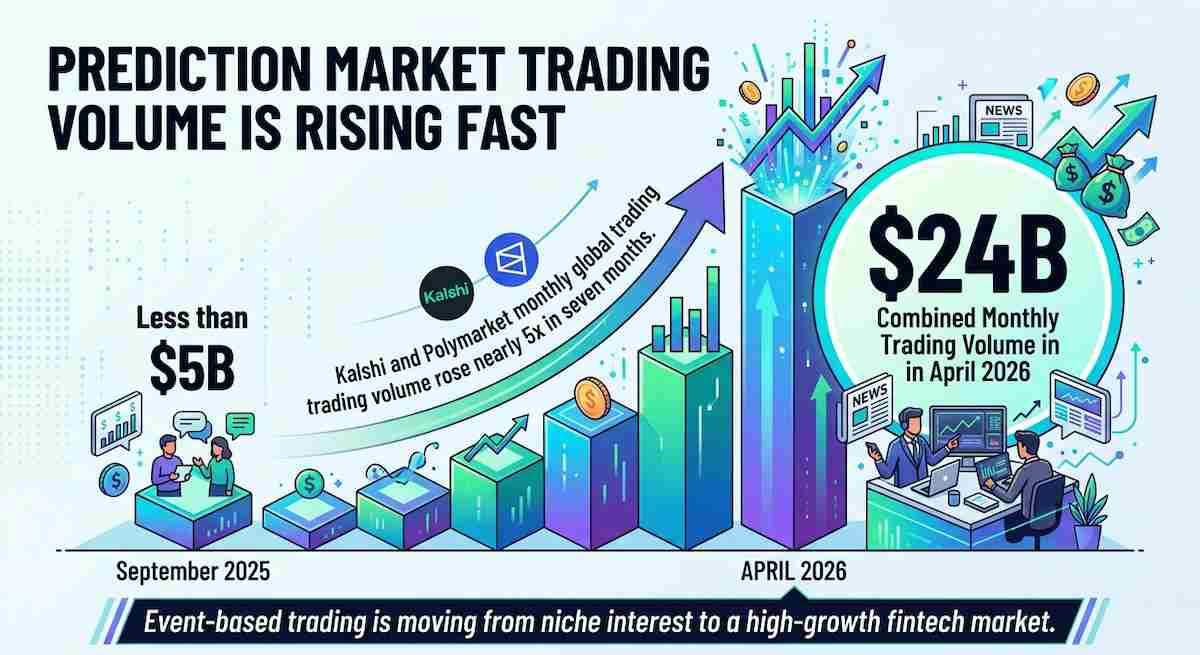
Prediction market platforms let users trade contracts tied to real-world events, such as elections, sports, crypto prices, inflation data, weather, entertainment, and business outcomes. The growth is already clear in trading activity. Combined monthly global trading volume on Kalshi and Polymarket rose from less than $5 billion in September 2025 to about $24 billion in April 2026. This sharp rise shows how fast event-based trading is gaining users, capital, and business attention.
A platform like Kalshi has made event trading easier for mainstream users by combining exchange-style trading, real-money event contracts, live prices, liquidity, settlement, and a clean user experience. For startups, fintech firms, crypto businesses, sports-tech brands, financial institutions, and Web3 companies, this market creates a strong business path. Prediction market platform development can open revenue through trading fees, spreads, premium data, API access, market-making services, and white-label software. A scalable prediction market software product also turns user belief into market data, which can show sentiment, forecast outcomes, and support better business decisions.
What Is a Prediction Market Platform?
Definition of a Prediction Market Platform
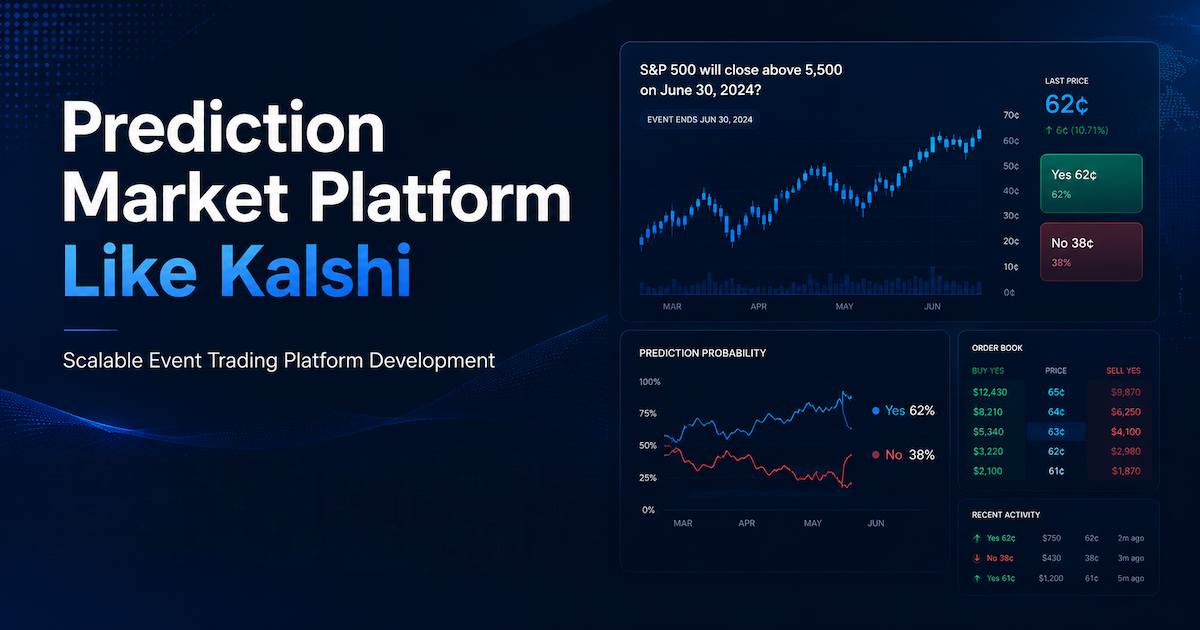
A prediction market platform is an online exchange where users buy and sell outcome-based contracts. Each contract links to a future event. The event has a clear result, and that result decides the contract value.
Users can trade on whether Bitcoin will cross a set price, whether a team will win, whether inflation will hit a target, or whether a movie will win an award. A Kalshi-like platform often includes accounts, market categories, order books, wallets, compliance tools, admin controls, liquidity systems, and event resolution workflows.
How Prediction Markets Work
Prediction markets usually work through binary contracts or multi-outcome contracts. A binary contract has two outcomes: yes or no. A user buys “yes” after expecting the event to happen. A user buys “no” after expecting it not to happen.
Prices often show probability. A contract priced at 60 cents suggests the market gives that result about a 60 percent chance. Multi-outcome markets list several possible results, such as teams, candidates, price ranges, or award nominees.
The platform matches buyers and sellers through an order book, automated market maker, or hybrid model. After the event ends, the platform verifies the result and pays winning contracts.
Why Kalshi Became a Popular Prediction Market Model
Kalshi became a popular model through its focus on event contracts, regulated infrastructure, real-money trading, clear market categories, and simple design. It gives users a familiar exchange-style way to trade real-world outcomes.
A Kalshi-like platform must build trust through clear contract wording, secure accounts, fair pricing, simple withdrawals, and reliable settlement. It must also balance trading depth, legal structure, and user-friendly design.
Why Businesses Are Investing in Prediction Market Platform Development
Rising Demand for Event-Based Trading
Users want to trade on more than stocks, forex, and crypto. Many follow sports, politics, macro data, weather, and entertainment every day. Event-based trading turns that interest into market activity.
A user can take a position, watch prices move, react to new information, and exit before settlement. This creates strong engagement and gives businesses room to build niche or multi-category platforms.
Prediction Markets as a New Fintech Revenue Model
Prediction market platforms can earn revenue through trading fees, maker and taker fees, spreads, subscriptions, API access, premium analytics, market data products, and liquidity services. White-label prediction market software creates another path for providers that serve fintech, sports, media, and Web3 clients.
This model gives businesses more than one revenue stream. It combines trading, data, tools, and access in one platform.
The Role of Prediction Markets in Forecasting and Decision-Making
Prediction markets can act as live forecasting tools. Prices show what users collectively expect. A contract trading at 70 cents shows strong market belief in that outcome.
Businesses can use this data to track sentiment, study demand, measure public reaction, and compare market expectations with polls, reports, or internal data. Communities can use markets to turn group opinion into measurable signals.
Commercial Benefits for Startups and Enterprises
A scalable prediction market platform can improve retention, create new revenue, produce valuable data, and support global reach. Startups can begin with one category and expand later. Enterprises can use prediction markets for private forecasting.
Web3 businesses can add smart contracts, stablecoin payments, token rewards, and on-chain settlement. Regulated fintech firms can use compliance-ready systems to build user trust.
Core Features of a Scalable Prediction Market Platform Like Kalshi
A scalable prediction market platform needs secure onboarding, event creation tools, contract support, live trading, payments, settlement, dashboards, admin tools, risk controls, alerts, and analytics.
User Registration and KYC Verification
The platform should support smooth signup, identity checks, age checks, jurisdiction controls, AML screening, and user risk scoring. User records should store verification status, limits, permissions, and compliance history.
Event Market Creation Module
Admins need tools to create markets across sports, politics, finance, crypto, weather, entertainment, economic data, and custom categories. Each market needs clear wording, contract terms, result source, trading window, settlement date, and payout rules.
Binary and Multi-Outcome Contract Support
The platform should support yes or no markets, multiple-choice markets, range-based contracts, conditional contracts, and advanced event contracts. This helps serve sports fans, crypto traders, analysts, and political watchers.
Real-Time Order Book System
A real-time order book shows bids, asks, price levels, and order depth. It should support market orders, limit orders, order updates, cancellations, partial fills, and fast trade execution.
Automated Market Maker Integration
Automated market makers can support liquidity through pools and pricing formulas. This works well for decentralized or hybrid prediction markets, mainly during early market activity or niche event launches.
Wallet and Payment Integration
A prediction market app should support fiat deposits, bank transfers, card payments, crypto wallets, stablecoins, withdrawals, custodial wallets, and non-custodial wallets. The system must track balances, fees, payouts, refunds, and failed payments.
Market Settlement and Outcome Resolution
Settlement decides who wins and who gets paid. Each market needs trusted result sources, such as official data feeds, sports data providers, financial APIs, government reports, oracle networks, or admin review. A clear dispute process protects users and the business.
Trading Dashboard
The dashboard should show live prices, charts, probability movement, open positions, portfolio value, trade history, market volume, and user performance. Users should see risk and payout details without confusion.
Admin Panel
The admin panel should support market approval, user review, KYC checks, liquidity monitoring, fee settings, payment review, compliance controls, dispute handling, settlement control, and analytics.
Risk Management System
Risk tools should track position limits, exposure caps, suspicious activity, manipulation risk, trading halts, and circuit breakers. The system should flag linked accounts, wash trading, abnormal orders, and sudden liquidity drops.
Notification and Alert System
Notifications can include price alerts, event updates, settlement alerts, new market alerts, trade confirmations, and promotional messages. Users should control alert settings based on their interests.
Analytics and Reporting Tools
Analytics should track user behavior, trading volume, market depth, revenue, conversion, liquidity, retention, and compliance activity. These reports help teams improve markets, user flows, and revenue models.
Technical Architecture of a Kalshi-Like Prediction Market Platform
A Kalshi-like prediction market platform needs a strong technical base that supports live trading, accounts, payments, market creation, settlement, risk checks, and reporting.
Frontend Architecture
The frontend includes the web app, mobile app, market pages, trading dashboard, portfolio pages, account screens, payment flows, watchlists, charts, and secure login. A mobile-first design matters as users often trade during live events.
Backend Architecture
The backend handles users, orders, markets, payments, risk controls, settlement, notifications, and reports. User services manage accounts. Trading services process orders. Payment services track funds. Risk services monitor exposure and suspicious activity.
Matching Engine
The matching engine matches buy and sell orders based on price and time priority. It must process market orders, limit orders, cancellations, partial fills, and trade confirmations with low latency.
Database Design
The database should store user profiles, KYC records, market data, contract details, order history, trade history, wallet balances, deposits, withdrawals, settlements, event outcomes, compliance logs, and admin logs.
API Layer
APIs connect internal modules and external partners. Internal APIs link accounts, trading, payments, settlement, alerts, and reports. External APIs connect market makers, data feeds, banks, KYC vendors, AML tools, crypto wallets, and oracle networks.
Blockchain Integration for Web3 Prediction Markets
Web3 prediction markets use smart contracts for escrow, rules, settlement, payouts, and rewards. Oracle networks bring real-world results on-chain. Stablecoin payments help users trade with a stable unit of value.
Cloud Infrastructure
Cloud infrastructure should support hosting, load balancing, containers, microservices, auto-scaling, backups, monitoring, and disaster recovery. This helps the platform stay stable during traffic spikes.
Security Infrastructure
Security features should include encryption, two-factor authentication, DDoS protection, penetration testing, secure wallet management, role-based access, and audit trails. These controls protect accounts, funds, data, and market records.
Want to Launch a Kalshi-Like Prediction Market Platform?
Build a scalable event trading platform with order books, liquidity tools, KYC, wallets, settlement systems, and admin controls.

Prediction Market Platform Development Process
Building a prediction market platform takes planning, legal review, design, development, testing, launch, and growth work.
Step 1: Business Model Planning
Define target users, supported regions, event categories, revenue model, legal structure, and platform positioning. The platform can serve retail traders, crypto users, sports fans, analysts, media audiences, or enterprise teams.
Step 2: Market and Competitor Research
Study platforms like Kalshi, Polymarket, PredictIt, and other event trading platforms. Review their market types, contract formats, onboarding, payment options, liquidity, fee models, and settlement rules.
Step 3: Regulatory and Compliance Strategy
Plan KYC, AML, age checks, licensing, market restrictions, jurisdiction controls, data privacy, disclosures, and reporting. Legal review should guide product design from the start.
Step 4: Platform Architecture Design
Design the technology stack, user flows, admin workflows, trading logic, matching engine, payment flows, settlement model, reporting modules, and integration plan.
Step 5: UI/UX Design
Design simple market pages, onboarding screens, trading forms, portfolio dashboards, payment flows, and mobile-friendly screens. Users should understand contracts and place trades with limited friction.
Step 6: Core Platform Development
Build user modules, market creation tools, trading systems, payment systems, dashboards, admin tools, analytics, notifications, and risk controls.
Step 7: Smart Contract or Oracle Integration
For blockchain platforms, build smart contracts, integrate oracles, configure escrow, support stablecoin payments, and automate settlement. Smart contract auditing is a key step.
Step 8: Testing and Security Auditing
Test user flows, trading logic, payments, settlement, admin actions, compliance rules, performance, load handling, and security. Web3 platforms also need smart contract audits.
Step 9: Beta Launch
Release the platform to a limited user group. Track liquidity, deposits, settlement timing, mobile performance, bugs, failed payments, user feedback, and support requests.
Step 10: Full Market Launch and Scaling
Launch with stable liquidity, clear market rules, support channels, monitoring, referral programs, and marketing campaigns. Growth should focus on new categories, deeper liquidity, and reliable settlement.
Choosing the Right Business Model for a Prediction Market Platform
The business model affects compliance, onboarding, payments, liquidity, control, and user trust.
Centralized Prediction Market Platform
A centralized platform gives the business full control over users, markets, payments, compliance, settlement, and disputes. It fits regulated event trading, fiat payments, KYC checks, and easier onboarding.
Decentralized Prediction Market Platform
A decentralized platform uses blockchain, smart contracts, crypto wallets, stablecoins, and on-chain settlement. It fits Web3 brands, DeFi platforms, DAO communities, and crypto-native users.
Hybrid Prediction Market Platform
A hybrid platform combines centralized controls with blockchain transparency. It can use centralized onboarding and support, then use blockchain for escrow, settlement proof, rewards, or public records.
White-Label Prediction Market Software
White-label prediction market software helps businesses launch faster with ready-made modules. It can include onboarding, KYC, market creation, trading dashboards, payments, admin tools, notifications, and analytics.
Custom Prediction Market Platform Development
Custom development gives enterprises full control over branding, compliance rules, trading logic, contract types, analytics, integrations, and monetization. It suits businesses with unique markets or complex rules.
Kalshi-Like Platform vs Traditional Betting Platform
A Kalshi-like platform and a betting platform both involve future outcomes, but they use different structures. A betting app sets odds and accepts wagers. A prediction market platform works like an exchange where users trade contracts with each other.
| Comparison Point | Kalshi-Like Prediction Market Platform | Traditional Betting Platform |
|---|---|---|
| Core Structure | Works like an exchange where users trade event contracts with each other. | Works as a betting app where the operator sets odds and accepts wagers. |
| Market Structure | Uses tradeable contracts, order books, AMMs, and probability-based pricing. | Uses operator-set odds and fixed betting lines. |
| Revenue Model | Earns through trading fees, spreads, subscriptions, market data APIs, and liquidity services. | Earns through built-in betting margins. |
| User Base | Attracts traders, analysts, investors, crypto users, sports fans, and data-driven users. | Attracts users who want entertainment and quick wagers. |
| Regulatory Treatment | Can fall under financial, commodities, derivatives, gaming, or consumer protection rules. | Often needs gaming or wagering licenses. |
| Business Advantage | Covers finance, politics, sports, crypto, weather, entertainment, and enterprise outcomes. | Often focuses on sports and entertainment wagers. |
Important Compliance Considerations Before Launch
Compliance protects users and helps the business reduce legal, payment, and operational risk.
KYC and AML Compliance
KYC verifies identity through documents, selfies, database checks, and age checks. AML screening checks sanctions lists, fraud signals, politically exposed person records, and risk scores. The system should flag suspicious deposits, rapid withdrawals, linked accounts, and abnormal trading.
Jurisdiction-Based Access Control
Geo-fencing, IP checks, device signals, document country, payment country, age checks, and account records help control access. The platform should support country-level, state-level, and market-level restrictions.
Market Approval Framework
Each market should be reviewed for event category, wording, result source, public interest risk, manipulation risk, and settlement timeline. Clear contract terms reduce disputes and protect user trust.
Data Privacy and User Protection
Prediction market platforms collect identity data, addresses, payment details, device data, wallet addresses, trades, and compliance records. The platform should use secure storage, privacy policies, consent management, access controls, and user data request workflows.
Responsible Trading Features
Responsible trading tools can include spending limits, deposit limits, position limits, cooling-off periods, self-exclusion, risk disclosures, and educational warnings. These tools help users trade with control.
Liquidity Strategy for a Scalable Prediction Market Platform
Liquidity decides how easy trading feels. Users want fast order fills, fair prices, narrow spreads, and enough order depth.
Why Liquidity Matters
Strong liquidity improves user experience, reduces spreads, speeds up trade execution, and builds credibility. Active markets also help retain users.
Market Maker Integration
Market makers place buy and sell orders to support depth. A platform can use internal teams, third-party providers, institutional firms, or automated liquidity systems.
AMM-Based Liquidity
AMMs use liquidity pools and pricing formulas. They work well for decentralized prediction markets, early-stage markets, and niche categories with low order book depth.
Incentive Programs
Incentives can include referral rewards, trading competitions, liquidity mining, fee rebates, loyalty points, and market maker rewards. The platform should monitor fake volume and reward abuse.
Managing Liquidity Risk
The platform should track exposure, price movement, settlement timing, market maker activity, thin order books, and abnormal trades. Risk tools can include exposure limits, hedging, pricing checks, and alerts.
Revenue Models for Prediction Market Platforms
Prediction market platforms can earn from trading, payments, data, access, ads, sponsorships, and enterprise products.
Trading Fees
Trading fees can include per-trade fees, maker and taker fees, percentage-based fees, volume-based tiers, settlement fees, and category-based fees.
Withdrawal and Deposit Fees
Payment fees can come from card payments, bank transfers, fiat on-ramps, crypto withdrawals, and stablecoin transfers. The platform should show fees clearly before users move funds.
Premium Market Access
Paid plans can offer exclusive markets, early access, advanced charts, sentiment data, historical prices, watchlist alerts, and pro dashboards.
API Monetization
Paid APIs can provide live prices, order book depth, market volume, historical trades, settlement records, and category data for developers, funds, bots, and media partners.
Advertising and Sponsorships
Sponsored markets, brand placements, media partnerships, affiliate offers, and event campaigns can add revenue. Sponsorship should not affect market rules or settlement.
Enterprise Forecasting Solutions
Businesses can use private prediction markets to forecast sales targets, launch dates, project delays, supply risks, and demand. Revenue can come from licensing, setup fees, monthly plans, and custom analytics.
Looking for a Custom Prediction Market Platform?
Industry Use Cases for Prediction Market Platforms
Prediction markets can serve many industries. Each category needs the right audience, data source, rules, and settlement process.
Sports Prediction Markets
Sports markets can cover match winners, tournament champions, player statistics, playoff entries, season awards, and points ranges. These markets need reliable data feeds and fast settlement.
Political and Election Forecasting Markets
Political markets can cover election results, policy decisions, legislative events, approval ratings, and public sentiment. These markets need careful legal review and precise contract wording.
Crypto and Financial Markets
Crypto and financial markets can cover Bitcoin price milestones, interest rates, inflation reports, stock index moves, IPO outcomes, earnings events, and macroeconomic indicators. These markets need trusted feeds and clear close times.
Weather and Climate Markets
Weather markets can cover rainfall, temperature, storms, snowfall, energy demand, agriculture risk, and climate events. They can serve agriculture, energy, logistics, insurance, and planning sectors.
Entertainment and Pop Culture Markets
Entertainment markets can cover award winners, box office results, streaming rankings, talent shows, music charts, celebrity events, and media performance. They fit fan communities and media platforms.
Enterprise Decision Markets
Enterprise decision markets help companies forecast product launches, sales targets, hiring timelines, project risks, supply delays, and demand. Companies can use credits or points instead of real money.
Conclusion
Launching a scalable prediction market platform like Kalshi takes clear planning, strong trading infrastructure, smart liquidity design, secure payments, fair settlement, and compliance-ready controls. The right platform can help businesses create new revenue, attract active users, and turn real-world events into tradeable markets across finance, sports, crypto, politics, weather, entertainment, and enterprise forecasting. Blockchain App Factory provides crypto prediction market platform development services for startups, enterprises, fintech brands, Web3 companies, and sports-tech businesses that want to build secure, scalable, and feature-rich event trading platforms.

Vimal J is the Head of Sales at Blockchain App Factory, with 10+ years of experience in sales, client strategy, and Web3 business growth. He helps startups, enterprises, and project founders choose the right blockchain solutions for their goals, bringing a practical market perspective to topics like token development, crypto launches, and Web3 adoption.
Article Reviewed by:
Arun Kamala Santhanath
Marketing Head, Blockchain App Factory


