Key Insights
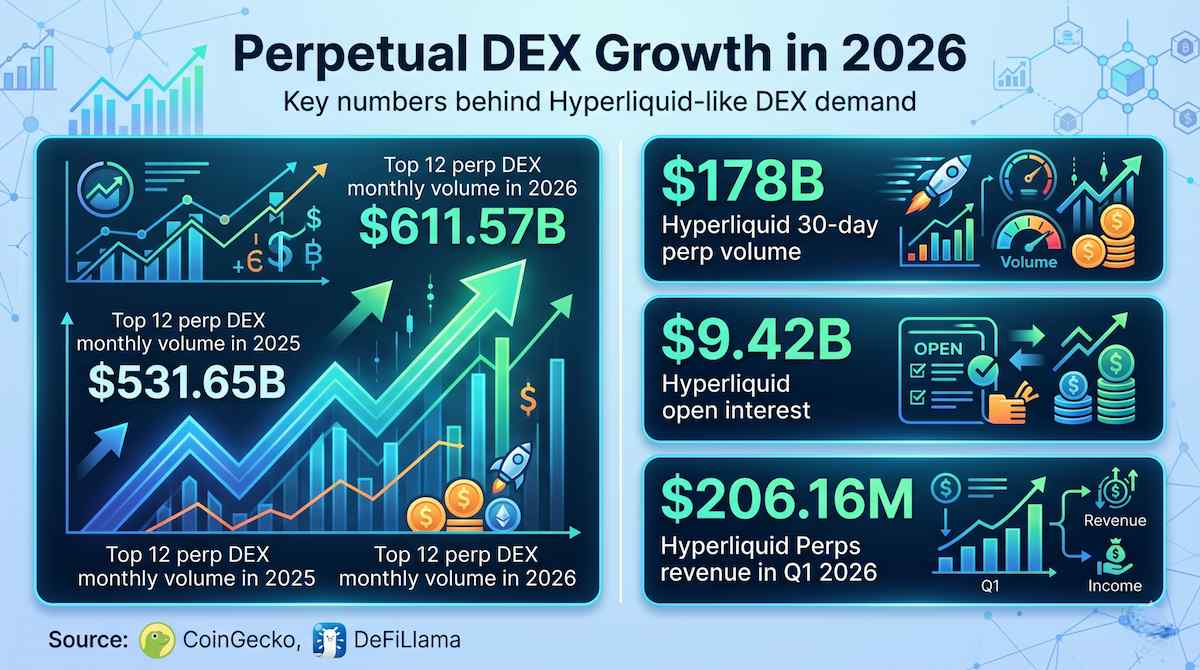
Perpetual DEXs have moved far beyond the early experiment stage. They now handle serious trading volume and revenue across the crypto market. CoinGecko reports that the top 12 perpetual DEXs averaged $611.57 billion in monthly trading volume in 2026, up from $531.65 billion in 2025. That jump shows clear demand for decentralized derivatives trading. Hyperliquid stands out in this shift. DeFiLlama data shows $178 billion in 30-day perp volume, $7.11 billion in 24-hour perp volume, and $9.42 billion in open interest for Hyperliquid at the time of review. The same source also reports $206.16 million in gross protocol revenue in Q1 2026 for Hyperliquid Perps. These numbers show why crypto entrepreneurs are paying close attention to Hyperliquid-like perpetual DEX development. A platform with strong execution, deep liquidity, and clear risk controls can attract active traders and build steady fee-based revenue.
What Defines a Hyperliquid-Like Perpetual DEX?
A Hyperliquid-grade perpetual DEX must deliver fast trading, deep liquidity, and clear settlement. Traders need quick order execution, live position updates, and reliable risk data. Order book trading is central here, as it supports limit orders, market orders, stop-loss, take-profit, and tighter spreads through market maker activity.
The platform also needs a strong matching engine, advanced margin controls, and a fair liquidation system. It must track collateral, leverage, PnL, funding rates, and liquidation prices in real time. Transparent on-chain settlement builds trust by showing how trades and funds move.
Why Entrepreneurs Are Building Hyperliquid-Like DEX Platforms
Entrepreneurs are building Hyperliquid-like DEX platforms because perpetual trading creates more activity than spot trading. Active traders open and close positions often, which creates steady fee revenue.
These platforms also meet rising demand for self-custody, transparent risk rules, and decentralized derivatives. Founders can launch crypto, RWA, commodity, index, and synthetic asset markets. A strong perpetual DEX can attract traders, market makers, liquidity providers, and institutions, making it a powerful DeFi business model.
Here is the same content with clearer subheadings added under each main section.
Why Perpetual DEX Development Is Gaining Momentum in 2026
Derivatives Now Lead Crypto Trading Activity
Crypto trading has moved far beyond spot buying and selling. In 2026, derivatives drive much of the market’s activity. CoinGecko reported $418 billion in daily derivatives volume in February 2026, against $108 billion in spot volume. That gap shows a clear trader preference for contracts that support hedging, short exposure, and capital control.
Traders Prefer Perps for Hedging and Speculation
Perpetual futures sit at the center of this demand. Traders use them to bet on price moves without holding the asset. They also use them to hedge spot bags during volatile sessions. A BTC holder, for example, can open a short BTC-PERP position to reduce downside risk without selling the original BTC.
Perpetual DEXs Are Becoming Core DeFi Infrastructure
Perpetual DEX platforms now play a larger role in DeFi infrastructure. Traders want self-custody, but they still expect fast execution, clear liquidation rules, and deep order books. Hyperliquid proved that a decentralized venue can feel close to a centralized exchange. DeFiLlama listed Hyperliquid with about $9.82 billion in open interest, which shows the scale of demand for high-performance on-chain perps.
Commercial Value for Crypto Businesses
For crypto businesses, the model brings strong commercial value. A perpetual futures exchange earns from trading fees, liquidation fees, API access, market maker programs, and token-based utility. It can list BTC, ETH, SOL, memecoins, RWA assets, and custom index markets.
Business Types That Can Benefit
This opportunity fits several business types: crypto exchange startups, DeFi founders, Layer 1 and Layer 2 ecosystems, RWA tokenization firms, market makers, fintech brands, institutional trading firms, and Web3 venture studios. Each group can use perpetual DEX development to build trader activity, liquidity depth, and long-term protocol revenue.
How Does a Hyperliquid Like Perpetual DEX Work?
Wallet Connection and Collateral Deposit
A Hyperliquid-like perpetual DEX starts with wallet access. Users connect MetaMask, WalletConnect, Phantom, or a hardware wallet. They deposit collateral, often USDC or USDT. The platform records that collateral through smart contracts, margin vaults, or an account-based trading layer.
Opening a Long or Short Position
The trader then selects a market. Common pairs include BTC-PERP, ETH-PERP, SOL-PERP, or RWA-PERP. The trader chooses position size, direction, and margin mode. The trading engine checks the available margin before the order enters the book.
Order Matching and Trade Execution
Execution happens through an order book. Market orders fill at the best available price. Limit orders wait for a chosen price. Stop-loss and take-profit orders help control risk. Reduce-only orders close or reduce current positions. Post-only orders help makers avoid taking liquidity by mistake.
Funding Rate Settlement
Funding rates keep perp prices near spot prices. If the perp trades above spot, long traders often pay short traders. If the perp trades below spot, shorts pay longs. This payment cycle keeps the contract price anchored to the underlying asset.
Margin Monitoring and Liquidation
The system tracks margin health throughout the trade. Initial margin opens the position. Maintenance margin keeps it active. If account equity falls below the required level, liquidation starts. Strong platforms use partial liquidation first. Full liquidation comes later. An insurance fund covers bad debt during sharp market moves.
Position Closure and PnL Settlement
A trader can close the position manually or through take-profit and stop-loss orders. The system then calculates realized profit or loss. It settles trading fees, funding payments, and liquidation costs before releasing the remaining collateral.
Core Features of a Hyperliquid like Perpetual DEX Platform
Built for Speed, Liquidity, and Trader Trust
A Hyperliquid like perpetual DEX needs more than basic swap or futures features. It must handle fast trades, high volume, deep liquidity, and strict risk checks at the same time. Traders expect the speed of a centralized exchange, but they also want self-custody and clear on-chain records. This is the main product challenge for any crypto business that wants to build a serious perpetual trading platform.
High-Speed Order Book Trading
High-speed order book trading sits at the center of this model. A central limit order book lets buyers and sellers place orders at exact prices. This creates real-time price discovery and tighter spreads, which matter most for active traders. Market makers also prefer this setup, since they can quote both sides of the market through APIs and manage large order flow with better control.
Advanced Trading Engine
The trading engine must match orders with low delay. It should validate margin, order size, leverage, and position limits before each trade reaches execution. A strong engine records trade history, settlement data, and order status without slowing the platform. This gives traders confidence during volatile sessions.
Leverage and Margin Trading System
Leverage and margin systems define how much risk each trader can take. Cross margin helps users manage multiple positions with shared collateral. Isolated margin limits risk to one position. Risk-tier-based leverage reduces exposure for volatile assets. These controls protect traders and reduce platform losses.
Funding Rate Mechanism
Funding rates keep perpetual prices close to spot prices. The system calculates funding through a premium index, interest component, and set funding intervals. Rate caps help prevent extreme payments during market stress.
Liquidation Engine
A liquidation engine protects platform solvency. It tracks position health, shows liquidation prices, supports partial liquidation, and connects with an insurance fund. Auto-deleveraging can act as a final safety layer during sharp price moves.
Oracle Price Feed Integration
Oracle price feeds supply index and mark prices. A strong platform uses multiple sources, such as Chainlink or Pyth, with fallback logic and manipulation checks. This keeps pricing fair and reduces the risk of false liquidations.
Liquidity Management System
The liquidity system brings market makers, liquidity vaults, spread tracking, and depth monitoring together. These tools help the platform maintain active markets, reduce slippage, and support larger trades. API-based liquidity provisioning also helps professional firms quote prices faster.
Trader Dashboard and Admin Panel
The trader dashboard presents live charts, open positions, PnL, margin ratio, funding history, liquidation risk, and trade records. The admin panel gives operators control over markets, fees, risk settings, user activity, compliance tools, and emergency pauses.
Hyperliquid-Grade Perpetual DEX Architecture
A Layered System for High-Volume Trading
A Hyperliquid-grade perpetual DEX needs a clean technical structure. Each layer must support speed, safety, and clear trade settlement. The frontend, matching engine, smart contracts, oracle systems, risk engine, and infrastructure layer must work as one trading system.
Frontend Trading Layer
The frontend trading layer is the user’s first contact with the platform. It should include a web trading terminal, mobile-responsive interface, TradingView charts, wallet connection, market overview pages, portfolio dashboards, and referral panels. A simple interface matters, but the product must still serve advanced traders. Fast order placement, clear position data, and visible liquidation risk can reduce costly mistakes.
Matching Engine Layer
The matching engine layer decides how trades get executed. Some platforms use off-chain matching with on-chain settlement. This gives faster execution and lower cost. Fully on-chain order books offer stronger transparency, but they need faster networks and careful cost control. Appchain-based matching gives the highest level of control. Rollup-based execution can balance cost, speed, and settlement clarity. A hybrid exchange architecture can suit businesses that want performance and auditability together.
Smart Contract Layer
The smart contract layer handles money and rules. It includes margin vault contracts, position manager contracts, funding rate contracts, liquidation contracts, fee distribution contracts, insurance fund contracts, and governance contracts. These contracts must be audited before launch, since one flaw can put user funds and platform revenue at risk.
Oracle and Data Layer
The oracle and data layer feeds the platform with real-time prices, index prices, mark prices, funding data, open interest, market analytics, and historical trade data. Good data keeps liquidations fair and funding rates accurate.
Risk Engine Layer
The risk engine calculates margin, collateral value, leverage limits, open interest caps, volatility controls, liquidation triggers, and circuit breakers. It is the platform’s defense system. It helps the exchange limit bad debt and stay stable during sudden price moves.
Infrastructure Layer
The infrastructure layer supports blockchain nodes, WebSocket servers, indexers, databases, caching systems, cloud servers, monitoring tools, and alerts. For crypto entrepreneurs, this architecture is not just technical planning. It decides how the exchange performs, earns revenue, protects users, and competes with leading perpetual DEX platforms.
Here are the next two blog segments with subheadings and a more natural blog style.
Step-by-Step Hyperliquid like Perpetual DEX Development Roadmap
Phase 1: Discovery and Business Strategy
A perpetual DEX starts with a clear business plan. The team must define its target market, supported assets, trading model, and revenue plan before writing code. A founder building for retail traders will make different choices than a team building for market makers or institutions. Competitor study matters at this stage. Hyperliquid, GMX, Drift, dYdX, and Jupiter Perps show different models for liquidity, order execution, risk, and user growth. The main outputs from this phase include a business model document, product requirement document, market positioning plan, compliance assessment, and development roadmap.
Phase 2: Architecture and Technology Stack Planning
The next phase turns the idea into a technical plan. The team chooses the blockchain infrastructure, matching engine model, oracle providers, margin rules, liquidation flow, smart contract modules, admin tools, and analytics layer. This stage shapes speed, cost, security, and future growth. A Hyperliquid like DEX may use appchain-based execution, off-chain matching with on-chain settlement, or a hybrid model. The main outputs include an architecture diagram, smart contract specification, database schema, API documentation, and infrastructure plan.
Phase 3: UI, UX, and Trading Interface Design
The trading interface must feel fast and clear. Traders need charts, order books, position data, margin details, funding rates, and liquidation prices in one place. The design team creates the trading terminal, onboarding flow, mobile screens, admin dashboard, and trader analytics interface. A good prototype helps founders test the product before development starts. The main outputs include wireframes, a UI design system, a clickable prototype, trading dashboard design, and admin panel design.
Phase 4: Smart Contract and Backend Development
This phase builds the core system. Developers create margin vaults, position manager contracts, funding rate logic, liquidation modules, fee contracts, backend services, APIs, oracle links, databases, and indexers. Each module must work with the trading engine and risk layer. Any fault in this stage can affect user funds, so clean code and testing matter from the first sprint.
Phase 5: Matching Engine and Liquidity Integration
The matching engine controls order execution. It must process orders fast, validate trades, update positions, and stream order book data in real time. The team then connects market maker APIs, liquidity vaults, spread tracking tools, and depth monitoring systems. Strong liquidity helps reduce slippage and attracts active traders.
Phase 6: Security Testing and Audit
Security testing checks how the platform behaves under stress. The team runs unit tests, integration tests, oracle manipulation tests, liquidation stress tests, load tests, and smart contract audits. A bug bounty can add one more review layer. The outputs include audit reports, testnet deployment, risk simulation reports, security fixes, and a mainnet readiness checklist.
Phase 7: Testnet Launch
A public testnet gives real users a chance to test the platform. Trading competitions, trader feedback, performance checks, and risk parameter reviews help the team improve the exchange before launch. The main outputs include a testnet platform, user feedback report, updated trading features, improved margin settings, and a pre-mainnet version.
Phase 8: Mainnet Launch and Liquidity Bootstrapping
The mainnet launch starts with audited smart contracts, seeded liquidity, active markets, market maker onboarding, referral campaigns, trading rewards, and community marketing. A strong launch needs both technical readiness and trader activity from day one.
Phase 9: Post-Launch Growth
After launch, the team adds new pairs, RWA markets, synthetic assets, institutional APIs, better fee tiers, AI-based risk tools, and cross-chain collateral. The outputs include product upgrades, new market listings, institutional dashboards, advanced analytics, and an ecosystem growth plan.
Want to Launch a Hyperliquid Like Perpetual DEX?
Build a high-performance perpetual trading platform with advanced order book trading, deep liquidity, strong risk controls, and a scalable architecture designed for long-term growth.

Monetization Models for Perpetual DEX Platforms
Trading Fees
Trading fees form the main revenue stream for most perpetual DEX platforms. The exchange earns from maker fees, taker fees, VIP trading tiers, and volume-based discounts. Active traders create repeat volume, so even small fees can turn into steady revenue at scale.
Liquidation Fees
Liquidation fees help protect the platform and reward liquidators. A part of the fee can go to the liquidator, a part can go to the protocol, and a part can support the insurance fund. This model gives the exchange a safety buffer during high volatility.
Funding Rate-Linked Revenue
Funding payments move between long and short traders, but the platform can build paid tools around funding data. Premium dashboards, funding alerts, risk reports, and trader analytics can create extra revenue for advanced users.
Market Listing and Builder Fees
A Hyperliquid like model can support new market creation. Asset issuers, communities, and RWA projects can pay fees to launch perp markets. This opens revenue beyond trading volume. It also helps the platform attract long-tail assets and niche trading communities.
Liquidity Vault Revenue
Liquidity vaults can charge management fees and performance fees. LPs supply capital, and the platform gives them access to market making yield. Market maker vaults can help deepen liquidity and reduce spreads.
API and Institutional Revenue
Professional traders need premium APIs, data feeds, low-latency access, dedicated infrastructure, and market maker tools. These services can become a high-value revenue stream. A business can also offer white label trading infrastructure to other Web3 brands.
Token-Based Value Capture
A platform token can support fee discounts, staking, governance, revenue sharing, liquidity rewards, and ecosystem access. The token must connect to real platform activity. Strong token design can turn user growth into long-term business value.
Cost of Building a Hyperliquid Like Perpetual DEX
Building a Hyperliquid like perpetual DEX costs more than a basic token swap platform. It needs a trading engine, order book, margin logic, liquidation system, oracle feeds, smart contracts, liquidity tools, admin controls, and trader dashboards. Each feature affects speed, safety, and revenue.
The total cost depends on the build model. A lean MVP with limited markets and core trading features costs less. A custom platform with advanced APIs, appchain support, deep liquidity tools, and institutional modules needs a larger budget. For many crypto startups, the best path is to launch with core modules first, then add advanced features after real trading activity starts.
The table below gives a reduced cost estimate for a practical MVP or mid-level perpetual DEX build.
| Feature | Description | Duration | Cost |
|---|---|---|---|
| Product Discovery and Business Planning | Covers target users, asset list, trading model, fee plan, competitor review, and launch roadmap. | 1 to 3 weeks | $3,000 to $8,000 |
| UI and UX Design | Includes trading terminal, mobile screens, wallet flow, dashboard, admin panel, and clickable prototype. | 2 to 4 weeks | $6,000 to $15,000 |
| Frontend Trading Interface | Builds web terminal, live charts, order forms, market pages, portfolio view, and wallet connection. | 4 to 8 weeks | $15,000 to $40,000 |
| Matching Engine | Handles order matching, order validation, order book updates, trade execution, and live trade records. | 6 to 12 weeks | $35,000 to $90,000 |
| Smart Contract Layer | Covers margin vaults, position manager, funding contract, liquidation contract, fee contract, and insurance fund. | 6 to 10 weeks | $30,000 to $80,000 |
| Leverage and Margin System | Supports cross margin, isolated margin, collateral checks, risk tiers, and leverage limits. | 4 to 8 weeks | $18,000 to $45,000 |
| Funding Rate Mechanism | Builds premium index logic, interest component, funding intervals, rate caps, and long-short balance checks. | 2 to 5 weeks | $10,000 to $25,000 |
| Liquidation Engine | Tracks position health, liquidation price, partial liquidation, insurance fund use, and bad debt controls. | 4 to 8 weeks | $20,000 to $55,000 |
| Oracle Price Feed System | Connects index prices, mark prices, Chainlink or Pyth feeds, fallback logic, and manipulation checks. | 3 to 6 weeks | $10,000 to $30,000 |
| Liquidity Management System | Includes market maker APIs, spread tracking, order book depth tools, and liquidity incentive controls. | 4 to 8 weeks | $20,000 to $60,000 |
| Backend and API Layer | Builds user data services, trading APIs, WebSocket feeds, order history, and reporting tools. | 6 to 10 weeks | $25,000 to $70,000 |
| Admin Panel | Gives operators control over markets, fees, risk settings, user activity, liquidity, and emergency pause. | 3 to 6 weeks | $10,000 to $30,000 |
| Data Indexing and Analytics | Tracks trades, open interest, funding history, market data, PnL, user activity, and platform revenue. | 3 to 6 weeks | $10,000 to $35,000 |
| Security Testing and Audit | Covers unit tests, stress tests, oracle tests, liquidation tests, smart contract review, and bug fixes. | 3 to 8 weeks | $20,000 to $80,000 |
| Testnet Launch | Includes public testnet, trader feedback, bug tracking, margin tuning, and pre-mainnet checks. | 2 to 4 weeks | $8,000 to $25,000 |
| Mainnet Deployment | Covers deployment, liquidity setup support, market maker onboarding, monitoring, and launch support. | 1 to 3 weeks | $10,000 to $40,000 |
| Post-Launch Maintenance | Covers upgrades, server monitoring, security patches, new markets, API support, and trading system updates. | Monthly | $5,000 to $25,000 per month |
A lean MVP for a Hyperliquid like perpetual DEX can cost around $120,000 to $250,000. A mid-level platform with stronger liquidity tools, custom risk controls, and better analytics can cost $250,000 to $600,000. A larger exchange with appchain design, advanced APIs, custom matching, and institutional features can cost $600,000 to $1 million or more.
The best way to reduce cost is to launch in phases. Start with two or three liquid markets, a clean trading terminal, audited smart contracts, basic market maker APIs, and strong risk controls. Then add RWA markets, advanced order types, institutional dashboards, and cross-chain collateral after the platform proves demand.
Business Use Cases of Hyperliquid-Like Perpetual DEX Development
Crypto Perpetual Futures Exchange
A Hyperliquid-like DEX can support BTC, ETH, SOL, and altcoin perpetuals for retail and professional traders. It offers long and short positions, margin trading, fast execution, deep order books, and steady revenue through trading fees.
RWA Perpetual Trading Platform
RWA perpetuals let users trade tokenized stocks, commodities, forex, indexes, and treasury-linked markets. This model connects DeFi trading with broader financial assets, but it needs strong oracle feeds, risk limits, and compliance checks.
Institutional DeFi Derivatives Platform
Institutional platforms serve funds, market makers, and trading desks with KYC-enabled access, custody integrations, reporting tools, and API-first execution. These users need reliable settlement, account controls, and custom fee models.
Ecosystem-Native Perpetual DEX
An ecosystem-native perp DEX is built for a specific Layer 1 or Layer 2. It keeps liquidity inside the network, drives native token use, and creates a core trading hub.
Memecoin and Long-Tail Asset Perp DEX
This model supports community-driven assets with faster listings, open interest caps, and risk-adjusted leverage.
Prediction and Event-Based Perpetual Markets
These markets support macro events, crypto volatility, sports, or political markets where legally permitted.
Conclusion
A Hyperliquid like perpetual DEX gives crypto businesses a strong path to enter the growing derivatives market with fast trading, deep liquidity, margin tools, risk controls, and self-custody. The best platforms are built with clear architecture, secure smart contracts, reliable oracle feeds, strong liquidity planning, and trader-first design. For entrepreneurs, the opportunity is not just to launch another exchange, but to create a revenue-focused trading platform that can attract retail users, professional traders, market makers, and institutions. Blockchain App Factory provides Hyperliquid Like Perpetual DEX Development to help businesses build, launch, and grow secure perpetual trading platforms with the right features, technical stack, and commercial strategy.

Vimal J is the Head of Sales at Blockchain App Factory, with 10+ years of experience in sales, client strategy, and Web3 business growth. He helps startups, enterprises, and project founders choose the right blockchain solutions for their goals, bringing a practical market perspective to topics like token development, crypto launches, and Web3 adoption.