



Key Insights
- Web3 projects must optimize for both traditional search results and AI answer engines like ChatGPT, Perplexity, and Google AI Overviews.
- Strong E-E-A-T, entity SEO, verified team details, security information, and credible third-party mentions are essential for ranking in crypto search.
- Crypto SEO is not instant. Projects that consistently improve technical SEO, content quality, backlinks, and brand consistency see stronger visibility over time.
Ever googled your crypto project’s name and found some random Reddit thread or a competitor’s page sitting above your own site? Well, that’s not luck or rare. It’s Google’s search engine deciding your project’s listing rank. And it doesn’t stop there. With AI overviews answering almost every question a person asks, ranking above them is quite difficult unless you’re getting cited in AI answering tools.
Most crypto agencies are trying hard to get ranked on Google while forgetting it’s just one part of the game; now ChatGPT, Perplexity, or Google’s AI Overview mentioning your name when someone asks about a Web3 or crypto project is everything. You will get insight into how crypto SEO works across both search and AI answers, what affects your visibility, and what helps your project get ranked across search engines with this blog.

Why Google Treats Crypto Differently Than Everything Else
Imagine you search for a coffee shop; Google would hand you the results within seconds. Whereas if you search for a crypto project that launched last week, it’s a completely different story. Well, this happens because Google decides how crypto projects rank in search results. Google treats crypto as YMYL “Your Money Your Life” content, which is a label for anything that could affect someone’s finances, health, or safety. Google watches these categories closely more than anything else online, as crypto projects have given a lot of reasons to keep an eye on over the years.
Rug pulls, fake exchanges, and pump-and-dump schemes are exactly why Google approaches this space with extra caution. A brand new DeFi protocol simply doesn’t get the same benefit of the doubt a coffee shop’s site gets by default. Google looks for accurate information, identifiable people, outside references, security details, and claims that users can verify. AI tools such as ChatGPT and Perplexity make a similar judgment before including a project in an answer and before leading someone towards your project. Different tools, same instinct, but most teams still only prepare for Google, even though search visibility now extends well past the regular results page.
Search Visibility Scoreboards: Rankings and Citations
Traditional search in Google gives you a page of 10 links and lets you decide what to open. Whereas AI answer tools work differently now. They scan information across several pages, pull the useful parts together, and return one written response with a small number of sources attached. This is what makes AEO (Answer Engine Optimization) and GEO (Generative Engine Optimization) separate from SEO.
A page sitting in fourth place on Google can still attract clicks. AI answer-only features a small number of sources, so nearly making the cut does not carry the same value as ranking fourth on Google. A smaller crypto project can still be included when its content answers the question directly, supporting the claim. This leaves the crypto teams with two things to look at: search rankings on one side, AI mentions on the other.
| Factor | Traditional SEO | AEO / GEO |
|---|---|---|
| Goal | Rank high on the results page | Get quoted inside the AI’s answer |
| What winning looks like | Position 1 to 10 | Being one of 2 to 3 cited sources |
| Content style | Keyword coverage, internal links | Direct, self-contained answers |
| Measured by | Rankings, clicks | Citation frequency |
| Who reads it | A person scanning links | An AI summarizing on someone’s behalf |
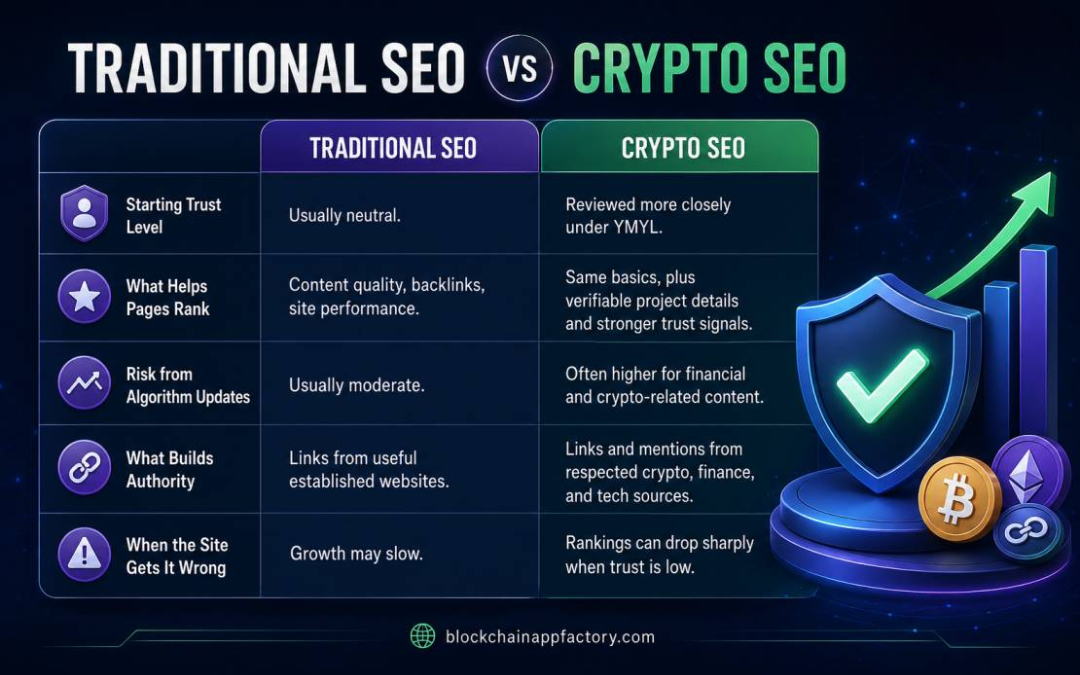
Traditional SEO Vs Crypto SEO
Traditional SEO and crypto SEO may have the same basics, but crypto projects are assessed against a much stricter standard of trust and credibility. Good content, backlinks, the right crypto marketing strategy and site speed all still matter, yet a crypto project needs strong proof around the team, product, security, and strong market claims.
| Traditional SEO | Crypto SEO |
|---|---|
| Starting trust level Usually neutral. |
Starting trust level Often reviewed more closely under YMYL. |
| What helps pages rank Content quality, backlinks, and site performance. |
What helps pages rank The same basics, plus verifiable project details and stronger trust signals. |
| Risk from algorithm updates Usually moderate. |
Risk from algorithm updates Often higher for financial and crypto-related content. |
| What builds authority Links from useful and established websites. |
What builds authority Links and mentions from respected crypto, finance, and technology sources. |
| What happens when the site gets it wrong Growth may slow. |
What happens when the site gets it wrong Rankings can drop sharply, especially when there is low trust. |
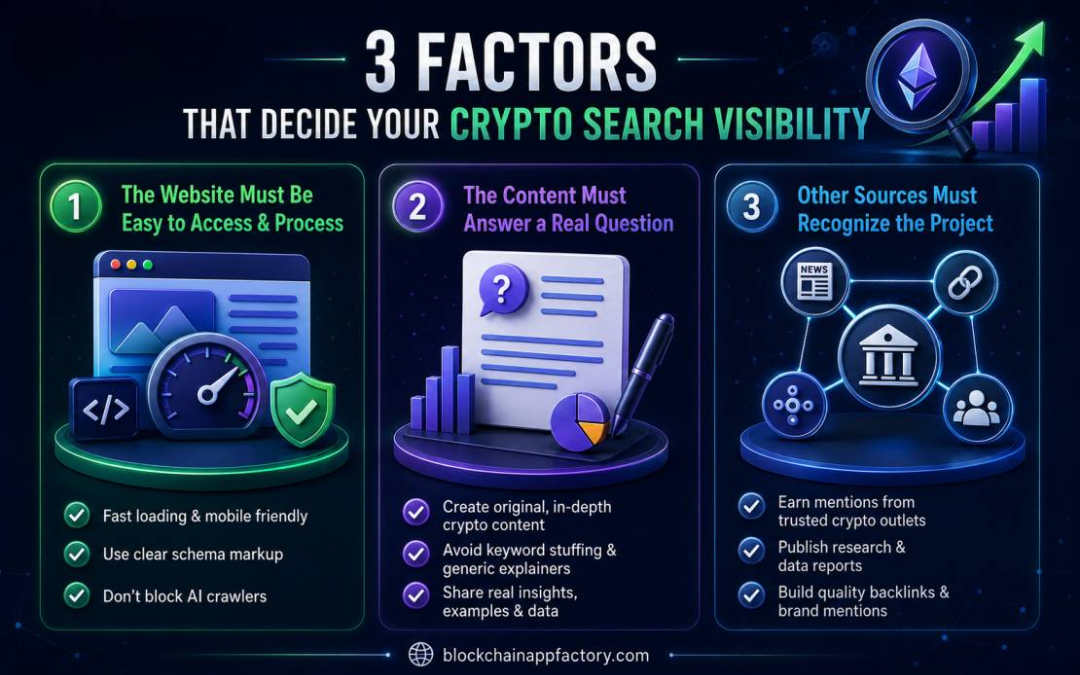
3 Factors That Decide Your Crypto Search Visibility
Crypto search visibility depends on three areas working together. Search systems need to access the website without delay, the content must answer questions with enough depth, and outside sources should provide some level of independent recognition. When one of these areas falls short, the value of the other two drops with it immediately.
- The Website Must Be Easy to Access and Process
Before Google or an AI search tool assesses the content, it first needs to load, read, and interpret the page. This is where many crypto websites get stuck. Heavy visual design may look impressive, but it often delays the information users and crawlers are actually looking for. As AI search engines measure load speed directly, a slow or broken page gets pushed down no matter how good the writing behind it is. Schema markup does something similar on the technical side; it tells search engines and AI systems exactly what the page actually is.
- Heavy 3D designs, oversized images, and wallet-connect scripts often load before a visitor even gets to see a text.
- Skip schema markup, and you’re leaving it up to machines to guess whether a page is a token, an FAQ, an organization, or a price chart.
- AI crawlers like PerplexityBot or Google-Extended get blocked by accident more often than you’d expect, quietly wiping a project from every AI answer out there.
The Content Must Answer a Real Question
Many crypto blogs still repeat basic definitions or force the same keyword into every heading like it was written for a search bot back in 2015. That may fill the page, but it rarely gives readers any new information. AI tools now have gotten very good at spotting exactly that.
- Keyword-stuffed headings, generic “what is blockchain” explainers, and “best exchanges” lists with no real comparison simply don’t rank anymore.
- What actually works is original, genuine first-hand crypto content that reads more as a field report than a textbook entry, an oracle integration that shows something the documentation missed, or a fee rule that new users regularly misunderstand.
- This is the kind of detail that will answer the question someone still has, even after reading five generic explainers elsewhere, and it’s exactly what AI tools tend to pull from.
Other Sources Must Recognize the Project
A crypto project cannot establish all of its credibility through claims made on its own website. Search and AI systems also look at how the project is discussed across the wider web. Though backlinks still count, it just isn’t the only thing that keeps it running.
- Getting mentioned by a real crypto outlet, like CoinDesk, Decrypt, or The Block, help you gain more credibility than any random directory listing does.
- Original research, data reports, and expert commentary tend to earn these mentions naturally.
- Journalists and writers need something worth pointing to in the first place, and that’s usually what earns the link.
Entity SEO: Getting Recognized as a Real Organization
Ranking individual pages is just one part of crypto SEO. Your project also needs to appear as one consistent organization across the web, known as entity SEO. When your name, team, product details, website, and public profiles all match up, search engines and AI tools have a much easier time identifying you correctly through Google’s knowledge graph and content linking back to the same source.
To make that easier, focus on four areas:
- Keep public profiles aligned
Your website, CoinGecko, CoinMarketCap, DefiLlama, X, LinkedIn, GitHub, and other official profiles should use the same project name, logo, website, description, and market category wherever possible. This is called brand consistency (SEO or NAP consistency) and creates a huge difference between search systems where they see one clear entity versus a bunch of disconnected pages that happen to share a name. - Explain who is behind the project
Your about page should state who runs the project, what each person does, and how the organization is structured. A company, foundation, DAO, or a team that operates under public aliases can still present this information for readers and search systems to follow. - Support the project with outside references
Media coverage, industry trackers, partner pages, business databases, and resources such as Wikidata can provide added context around the project and show that your project exists beyond just its own website talking about itself. - Connect every profile back to one source
Official profiles should link to the main website, while the website should link back to verified social pages, trackers, documentation, and public records. Keeping everything tied together instead of floating around as separate, disconnected pieces. This reduces confusion and gives the project a more consistent identity online.
E-E-A-T: The Trust Framework Behind Crypto Rankings
Search engines evaluate crypto content using something called E-E-A-T, which is experience, expertise, authority, and trust. Every industry deals with this to some degree, but crypto gets a tighter inspection, as one bad piece of advice can lead to someone losing their real money. This is exactly why AI-written content has become such a trap; unedited AI output with no content strategy has caused traffic losses of 60 to 95 after recent search updates, while AI-assisted drafts that a knowledgeable person actually reviews and adds real detail to exixting content perfomes well.
For a crypto project, E-E-A-T breaks down into four fairly concrete things:
- Experience: your team should have actually used what they’re writing about, not just described it from a distance
- Expertise: the person behind the content needs to actually understand the subject, technically and correctly
- Authority: this is where the entity signals and outlet backlinks from earlier come in, being recognized as a real, documented organization, not a page that appeared last week
- Trust: Clear information about risk, security practices, and a team that isn’t hiding behind vague claims
The Real Cost Of Skipping Crypto SEO Entirely
A DeFi protocol can have real funding behind it and a product that actually works, and still lose users because its own name pulls up a warning thread before the official site does. This actually happens as many crypto teams with solid tech have watched a single unresolved complaint or delayed airdrop sit at the very top of their branded search results for months, because nobody got around to building pages strong enough to push it down.
Here’s what that ends up costing:
- New users search the project name and run straight into doubt instead of documentation.
- Some walk away before they even open the site, no matter how good the product actually is.
- Whoever shows up first for your own name basically owns the first impression.
How Long Does Crypto SEO Actually Take To Work?
None of this happens right away, and it’s better to say that upfront than pretend otherwise. Most crypto sites see early movement in rankings within three to six months. Real traffic growth typically takes six to twelve months of steady work, and competing seriously in a crowded category can take twelve to eighteen months. Projects that see this as part of a real crypto marketing strategy are the ones that would still be visible even a year later, while teams chasing a quick spike usually give up right before the results would’ve shown up.
Final word
By now, one thing should be obvious. Crypto search is no longer only about where your website ranks on Google. It is also about whether ChatGPT, Perplexity, or another AI answer tool brings up your project when someone asks about a crypto company, Web3 service, or token platform. That depends on more than just publishing a few blog posts. Your site has to work properly, the content has to come from people who know the space, and your project has to look like one real organization across the web through entity SEO and strong E-E-A-T signals.
SEO for crypto projects takes time, and there is no point pretending otherwise. The projects that get lasting value from it are usually the ones that treat it as part of the wider crypto marketing plan, not as a last-minute task before launch. Keep your facts updated, make your project easy to verify, and give the work enough time to build momentum. That’s exactly what Blockchain App Factory focuses on, it builds crypto marketing strategies designed to work across Google and AI answer engines. Book a free call to see what that looks like for your project.

Vimal J is the Head of Sales at Blockchain App Factory, with 10+ years of experience in sales, client strategy, and Web3 business growth. He helps startups, enterprises, and project founders choose the right blockchain solutions for their goals, bringing a practical market perspective to topics like token development, crypto launches, and Web3 adoption.
Article Reviewed by:
Arun Kamala Santhanath
Marketing Head, Blockchain App Factory


