


Key Insights
- RWA tokenization in Dubai is now a regulated business opportunity, not just a blockchain use case. Platforms need legal structure, asset verification, investor checks, custody, and reporting from the start.
- VARA’s 2026 Rulebook makes compliance part of platform design.Investor eligibility, wallet controls, smart contracts, transfers, redemptions, and disclosures must work together.
- A successful RWA tokenization platform needs strong technology and clear asset backing. Verified assets, controlled token movement, secure custody, and audit-ready records help build investor trust.
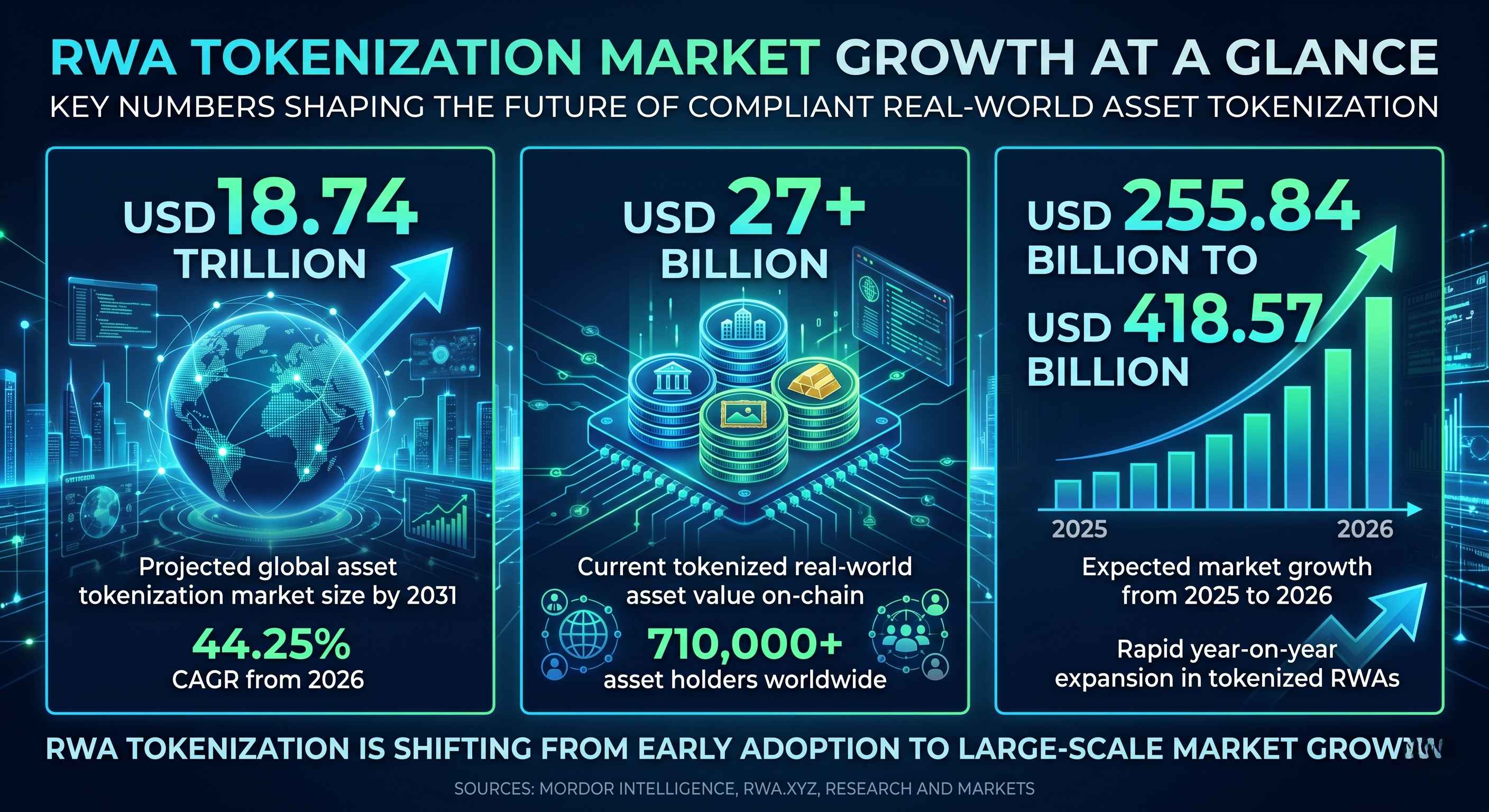
Dubai is no longer treating virtual assets as a side experiment. The city is building a serious market where digital assets, real-world finance, and regulation can work together. The timing is strong. The global asset tokenization market is projected to reach USD 18.74 trillion by 2031, with a 44.25% CAGR from 2026. The momentum is already visible today. Tokenized real-world assets account for more than USD 27 billion in on-chain value, with over 710,000 asset holders worldwide.
The near-term growth story is just as strong. The tokenized real-world asset market is expected to grow from USD 255.84 billion in 2025 to USD 418.57 billion in 2026. These numbers show that RWA tokenization is no longer a future concept. It is becoming a live business model for asset owners, investors, and financial firms.
RWA tokenization brings assets such as real estate, commodities, funds, private credit, invoices, and income-generating assets onto blockchain systems. In simple terms, it lets businesses represent asset-linked rights through digital tokens. Investors gain easier access to assets that were once hard to enter. Businesses gain a new way to raise capital, manage ownership records, and serve digital-first investors.
Dubai’s opportunity comes with responsibility. A platform cannot create tokens and claim market readiness. Under VARA’s 2026 Rulebook, businesses need governance, custody planning, investor protection, disclosures, risk controls, and reporting from the start. Compliance cannot be added at the final stage. It must sit inside the platform plan from day one.
Start With VARA-Aligned Business and Activity Mapping
Before writing code or choosing a blockchain, the business must define what the platform will do. This step decides almost everything that follows. A platform that only supports token issuance is different from one that manages custody, subscriptions, transfers, or secondary market activity.
Activity mapping helps the business understand where regulation enters the product. It also stops product teams from adding features that create licensing issues. In Dubai, a platform should not move into marketplace, brokerage, custody, or trading functions without reviewing the regulatory impact first.
Define the Platform’s Role
The platform’s role should be defined in plain business terms. Will it be an issuer platform where asset owners list and tokenize assets? Will it be a technology provider for other businesses? Will it act as a private investment portal for approved investors? Will it include custody support? Will it allow token transfers between investors?
Each answer changes the platform design. A platform that handles investor onboarding needs identity checks and risk review. A platform that supports custody needs wallet control, key management, and custody records. A platform that allows secondary transfers needs buyer checks, seller checks, transfer approval, and trade records.
The business should decide which tasks stay internal and which tasks go to regulated partners. KYC, AML screening, payment processing, custody, and valuation often involve third-party providers. This division should be mapped before development begins.
Identify the Regulatory Touchpoints
A compliant RWA platform has many points where regulation can apply. Token issuance is one point, but it is not the only one. Investor onboarding, asset promotion, wallet management, custody, transfer approval, secondary market access, transaction monitoring, and investor reporting all need review.
Investor onboarding is a key control point. The platform must know who enters the system. Asset promotion matters too. Claims about returns, ownership, liquidity, and risk must match the legal documents. Custody and wallet management matter as tokens must not move into unknown or restricted wallets.
The platform also needs activity monitoring after onboarding. Compliance does not stop after account approval. Transactions, transfers, redemptions, and payouts should remain traceable throughout the asset lifecycle.
Align the Platform Scope With the Rulebook
Once the activity map is ready, the platform scope should match the relevant compliance expectations. This helps the business decide which modules are needed for launch and which features should wait.
An MVP for one real estate asset may need investor onboarding, asset documents, token issuance, wallet whitelisting, payout records, and basic reporting. It may not need a full marketplace on day one. Adding marketplace features too early can raise compliance work, technical pressure, and operational risk.
A better plan is to build around the approved business model. Start with the modules that support issuance, investor access, token control, custody records, and reporting. Extra features can come later after the legal and operational model is ready.
Create the Legal Foundation for Tokenized Real-World Assets
RWA tokenization starts with one clear question: what does the token represent? Without a legal base, the token is only a blockchain record. Its real value comes from asset rights, backing, agreements, and the operating structure behind it.
Legal planning should come before smart contract work. The platform must define investor rights, asset control, ownership records, payout rules, and exit options. These details guide the token design, platform workflow, and investor documents.
Define the Token Rights
An RWA token can represent ownership rights, revenue rights, debt exposure, fund participation, commodity backing, or another asset-linked interest. The right structure depends on the asset type and investor model.
A real estate token can give investors access to rental income. A private credit token can represent exposure to loan repayments. A commodity-backed token can connect to stored goods. These models are different, so the platform should not treat every RWA token like a normal crypto token.
The investor dashboard, legal documents, and smart contract must say the same thing. If the platform promises payouts, the documents and payout workflow must support that claim. If the token has no redemption right, the platform must make that clear before purchase.
Structure the Underlying Asset
The platform must define who owns or controls the asset. This can involve an issuer, asset owner, special purpose vehicle, trustee, custodian, or platform operator. The structure should show how the asset is held and how investor rights are protected.
For income-based assets, the structure should explain how revenue is collected and paid out. For real estate, this can include title records, lease documents, valuation reports, and asset management duties. For commodities, this can include storage records, insurance, inspection reports, and custody proof.
A clear structure builds investor trust. Investors should know where the asset is, who controls it, how value is verified, and what happens during a dispute or asset sale.
Prepare Investor and Platform Documents
Strong documentation supports the whole platform. A VARA-aligned RWA platform should prepare token terms, offering documents, risk disclosures, subscription agreements, asset proof, valuation reports, custody agreements, platform terms, transfer rules, and redemption policies.
These documents should be accurate and easy to read. Investors should understand what they are buying, what rights they hold, what risks they carry, how payouts work, and whether transfers or redemptions are allowed.
The platform workflow should follow the same documents. If a lock-up period applies, the system should block early redemptions. If transfers are limited to approved investors, the wallet and compliance modules should stop unapproved transfers before they happen.
Build the Compliance Layer Into the Platform
A compliant RWA tokenization platform cannot keep compliance outside the product. Investor checks, wallet controls, transaction monitoring, and transfer limits should work inside the user journey.
The compliance layer acts as the platform’s control center. It decides who can enter, what they can view, what they can buy, where tokens can move, and which actions need human review. This is where VARA-aligned planning turns into platform design.
Add KYC and KYB Onboarding
Every investor should complete identity checks before accessing regulated RWA offerings. For individuals, this means ID verification, document checks, residency review, and investor profiling.
For companies and institutions, the platform needs KYB checks. These checks review company records, ownership structure, authorized representatives, and business activity. Beneficial ownership review is key, since business accounts can hide risk behind several ownership layers.
After verification, the platform should assign a risk profile to each user. Low-risk users can move faster. High-risk users should go through deeper review. All records should be stored in a secure, searchable system for audits and internal checks.
Screen for AML, CFT, and Sanctions Risk
AML, CFT, and sanctions checks should happen before investment access. The platform should screen users against sanctions lists, risk databases, and wallet risk tools.
Wallet checks matter as much as identity checks. A verified user should not send funds from a risky wallet or receive tokens in a restricted wallet. The platform should review wallet addresses before deposits, purchases, transfers, and redemptions.
Suspicious activity should trigger review. This can include large transfers, frequent wallet changes, mismatched profile details, or behavior that does not fit the investor’s profile. The compliance team should be able to review the case, request documents, approve the action, or block it.
Control Investor Eligibility
Not every investor should access every asset. Some offerings can be limited to professional investors. Some can be restricted by location. Others can require minimum investment amounts, risk acceptance, or completed documents.
The platform should classify investors by location, investor type, risk profile, document status, and offering access. This classification controls what users can view, subscribe to, hold, transfer, or redeem.
This protects the platform and the investor. It stops restricted assets from reaching the wrong audience and reduces the risk of tokens being held by users who are not approved for the offering.
Use a Compliance Rule Engine
A compliance rule engine turns platform policies into live actions. It removes the need for manual checks at every step and applies rules directly inside the platform.
The platform can block unverified investors, reject unapproved wallets, restrict users from banned locations, stop transfers during lock-up periods, limit investor holdings, and require approval for redemptions.
These rules should connect with smart contracts. If a token cannot move to an unverified wallet, the smart contract should reject that transfer. This makes compliance part of each transaction, not just a warning on an admin screen.
Build a Reliable Asset Onboarding and Verification Workflow
An RWA token is only as strong as the asset behind it. A polished platform cannot make a weak asset trustworthy. Before token creation, the platform must check asset ownership, value, legal status, and risk.
This step separates serious asset-backed offerings from loose claims. Investors need to know what asset they are entering, who controls it, how it is valued, and what risks come with it.
Select Assets That Can Support Tokenization
The first step is choosing assets that suit tokenization. A good asset should have clear ownership, a reliable valuation method, legal transferability, and a strong investor case.
Real estate, commodities, funds, private credit, invoices, bonds, and revenue-generating assets are common choices. These assets often have ownership records, measurable value, and market demand.
Not every asset in these categories is suitable. A property with title disputes, a commodity without storage proof, or an invoice with weak debtor records can create problems later. If the asset cannot be verified, valued, explained, and legally linked to investor rights, it should not move forward.
Run Asset Due Diligence
Asset due diligence is the platform’s fact-checking stage. The operator should verify ownership records, review valuation reports, check for claims or encumbrances, and confirm that the issuer can tokenize the asset.
Each asset type has its own risk points. For real estate, this can include title issues, rental vacancy, insurance gaps, and maintenance costs. For private credit, it can include borrower quality, repayment history, collateral, and default risk. For invoices, it can include debtor credibility, payment terms, and collection history.
All findings should be recorded before token creation. This gives the platform a clear review trail and helps investors understand the asset before they commit funds.
Create an Investor Data Room
An asset data room gives approved investors access to key documents before they invest. It should be organized, permissioned, and easy to review.
The data room can include ownership records, legal documents, valuation reports, financial statements, risk disclosures, insurance records, and issuer details. Access should be limited to verified investors who meet the offering rules.
A clean data room builds trust. Investors can review the asset with more confidence. Missing documents or unclear records can slow decisions and create doubt.
Set an Internal Asset Approval Flow
Before an asset goes live, it should pass through internal review. The asset team reviews the commercial case. The legal team reviews ownership and rights. The compliance team checks regulatory fit. The risk team reviews exposure. The technical team confirms token rules.
Token setup should also be reviewed before deployment. This includes supply, investor limits, lock-ups, transfer rules, payout logic, and redemption terms.
This approval flow keeps the platform disciplined. It prevents the business from launching an offering before the legal, compliance, risk, and technical teams are aligned.
Design the RWA Token Model
After the asset and legal structure are ready, the platform can design the token model. This step defines how the asset-linked interest will appear and behave on-chain.
The token model should answer four direct questions. What does the investor receive? How many tokens exist? Who can hold them? What happens during transfers, payouts, or redemption?
Choose the Token Structure
The token structure depends on the asset and the rights attached to it. An ownership-backed token can represent asset ownership or interest in an entity holding the asset. A revenue-sharing token can give access to asset income. A debt-backed token can represent exposure to repayments. A fund token can reflect units or interests in a fund structure.
Commodity-backed and real estate income tokens need careful setup. A commodity-backed token may depend on storage, inspection, insurance, and redemption rules. A real estate income token may depend on rent collection, property costs, payout schedules, and sale proceeds.
The platform should not use one generic model for every asset. RWA tokens need asset-specific logic since rights, risks, and workflows differ by asset type.
Define Token Economics
Token economics explains supply, pricing, and investor participation. This includes total token supply, price per token, minimum investment, maximum investment, allocation rules, holding limits, lock-up periods, and redemption terms.
A real estate offering can divide asset-linked rights into a fixed number of tokens. The minimum investment sets the entry point. The maximum holding limit controls concentration. The lock-up period controls transfers or redemptions.
These details should appear in the offering documents and platform workflow. If users can bypass rules through manual steps, the token model becomes weak.
Add Compliance-Based Token Restrictions
RWA tokens should not move like open public crypto tokens. In a regulated setup, token transfers need controls. Tokens should move only between verified wallets linked to eligible investors.
The platform can block restricted users, apply location rules, enforce lock-ups, and require approval for selected movements. Freeze, unfreeze, and pause functions can also help during legal, security, or operational events.
These controls make the token suitable for regulated use. They stop tokens from reaching unknown wallets, restricted regions, or investors who do not meet the offering rules.
Select a Suitable Token Standard
The token standard should support permissioned transfers, wallet checks, compliance rules, and reporting. A basic token standard may be fast to launch, but it may not support the controls needed for RWA tokenization.
The standard should work with custody providers, wallet systems, compliance tools, and reporting modules. It should also support audits and controlled updates where the legal and technical setup allows them.
The token standard must match the business model. If the platform needs investor restrictions, payout tracking, redemption, and transfer approvals, the token design should support those functions from the start.
Develop the Core Platform Modules
After compliance, asset checks, and token design are ready, the platform needs working modules. This is where the business plan becomes a product that investors, issuers, compliance teams, and admins can use.
Each module should support a clear role. The platform should not feel like separate dashboards placed together. Data should move cleanly from onboarding to issuance, token allocation, payouts, transfers, and reporting.
Build the Investor Portal
The investor portal is the main entry point for users. It should help investors register, complete KYC, check approval status, and view only the offerings they are allowed to access.
Investors should see asset details, supporting documents, subscription forms, token balances, payout history, and redemption options where available. The portal should make key information easy to find without support calls.
A clear investor portal builds trust. It also helps the platform reduce manual work during onboarding, subscriptions, reporting, and post-investment service.
Create the Issuer Dashboard
Asset issuers need a workspace to manage offerings. The issuer dashboard should allow asset owners to submit assets, upload documents, create offerings, and track fundraising progress.
During issuance, issuers should view investor allocations, subscription activity, and funding status. After launch, they should manage payout updates, asset performance notes, and investor communication.
The dashboard should also give issuers access to investor registers, allocation summaries, fundraising reports, and payout records. This keeps asset administration organized across the full asset lifecycle.
Add an Admin and Compliance Dashboard
The admin dashboard is the platform’s control center. Compliance teams and operations staff use it to review investors, approve business accounts, check AML alerts, review wallet results, and manage transfer requests.
The dashboard should show transaction activity, risk flags, pending reviews, and compliance exceptions. This helps teams act faster and maintain stronger control over platform activity.
Audit logs are key here. Every approval, rejection, update, and policy action should be recorded. Report exports should be available for audits, internal reviews, and regulatory submissions.
Manage the Token Lifecycle
Token management continues after issuance. The platform needs tools to manage token creation, minting, allocation, transfer control, payout processing, redemption, and token burning.
If an asset matures, sells, or completes its cycle, the platform should support exit management. This keeps investor records, asset status, and token activity aligned.
A dedicated token lifecycle module reduces manual errors. It also gives the platform a clear record of every token action from creation to closure.
Build Secure Custody and Wallet Infrastructure
Custody is a core part of an RWA tokenization platform. Investors focus on the asset, but regulators and institutions also look at how tokens are stored, moved, and protected.
Weak custody can create major risk, even with a strong asset and legal setup. Wallet and custody planning should start early in the platform design process.
Choose the Wallet and Custody Model
The platform must choose a custody model that fits its business. A custodial model places wallet control with the platform or a licensed custody provider. This gives stronger oversight and simpler recovery.
A non-custodial model gives investors control of their wallets and private keys. This gives users more control, but it also gives them more responsibility.
Some platforms use a hybrid model. Others connect with institutional custody providers for storage, security, and transaction control. The right choice depends on investor needs, operating model, and regulatory fit.
Link Wallets to Verified Investors
A compliant RWA platform should know who controls each approved wallet. Wallet verification should connect directly with investor onboarding records.
Each investor account should be linked to approved wallet addresses before token allocation. The platform should reject transfers to wallets that have not passed checks.
Investors may update wallet addresses over time. The platform should review, approve, and record each change. This keeps ownership records accurate across the token lifecycle.
Apply Custody and Transaction Controls
Custody controls protect both the platform and investors. They should apply to internal actions and investor-facing transactions.
The platform should support multi-signature approvals, role-based access, private key protection, transaction limits, transfer monitoring, and emergency recovery steps.
These controls reduce unauthorized actions and create a clear process for sensitive transactions. They also help the platform maintain stronger operational records.
Build Smart Contracts That Enforce Platform Rules
Smart contracts control how tokens behave after issuance. For RWA tokenization, they should do more than move tokens between wallets. They should follow the business rules, investor limits, and compliance controls built into the platform.
A good smart contract turns platform rules into automatic actions. This helps reduce manual checks and keeps token activity aligned with the legal and operating model.
Add Core Smart Contract Functions
The smart contract functions should match the asset and offering structure. Common functions include minting, burning, investor whitelisting, permissioned transfers, lock-up controls, holding limits, freeze actions, pause controls, redemption logic, and payout support.
These features help the token follow platform policies after issuance. For example, a token can block transfers during a lock-up period or reject movement to an unapproved wallet.
The goal is simple. The token should behave exactly as the platform rules require.
Connect Smart Contracts With Compliance Logic
Compliance rules should not stay only inside the admin dashboard. They should guide token behavior directly.
If an investor is not approved to hold a token, the smart contract should reject the transfer. If a wallet loses approval, token movement should stop. If a redemption needs review, the contract should wait for the required approval.
This connection keeps the platform consistent. Investor checks, wallet status, transfer approvals, and redemption rules work together. The dashboard should also receive smart contract updates so teams can track activity and maintain clean records.
Audit Smart Contracts Before Launch
Smart contracts need full review before launch. Code can look correct but still contain logic errors, weak permissions, or security risks.
The review should cover transfer rules, admin permissions, payout logic, redemption steps, pause controls, and emergency actions. Testing should include normal user actions and unusual cases that expose weak points.
A third-party audit adds another layer of trust. Auditors review the code, flag risks, and suggest fixes before deployment. For a regulated RWA platform, this confirms that the token follows the legal, compliance, and operating rules.
Design Subscription, Settlement, and Payout Workflows
An RWA platform should support the full investor cycle. Investors need a clear way to subscribe, pay, receive tokens, and collect payouts during the asset lifecycle.
Connected workflows reduce delays and keep records accurate. They also give investors a clear view of what happens before and after they invest.
Build the Investor Subscription Flow
The subscription flow starts after investor approval. Approved users should only see offerings that match their profile and access rights.
The journey should guide investors through asset review, disclosure review, agreement signing, investment amount selection, fund commitment, payment confirmation, and token allocation.
This flow creates a clear record of every investor action before tokens are issued. It also reduces manual work for the operations team.
Set Up Payment and Settlement Controls
Token allocation should happen only after payment settlement is confirmed. The platform can support bank transfers, payment gateways, or approved digital asset payments based on the business model.
Each payment should match the investor account, subscription amount, and offering record. The platform should confirm receipt, approve settlement, authorize token allocation, and create a transaction record.
This process keeps financial records accurate and reduces reconciliation issues.
Manage Payout Distribution
Many RWA tokens connect to income or exit proceeds. This can include rental income, interest payments, profit share, redemption proceeds, or asset sale proceeds.
The platform should identify eligible token holders before every payout. It should calculate distributions, process payments, generate statements, track payout history, and prepare reports.
Clean payout records help during audits, investor reviews, and financial reporting. They also show investors that the platform can manage asset income with discipline.
Prepare Controlled Transfer and Redemption Flows
RWA tokens usually need stricter movement rules than public crypto assets. Transfers may be limited to approved investors. Lock-up periods may apply. Redemption rights may depend on the offering terms.
For this reason, transfers and redemptions should follow structured workflows. The platform should check each action before tokens move or funds are paid.
Control Token Transfers
Token transfers should pass through validation before execution. The goal is not only to move tokens between wallets. The platform must confirm that the transfer follows investor, wallet, and offering rules.
A controlled transfer flow should review seller status, buyer eligibility, wallet approval, lock-up rules, transfer limits, and compliance checks. After approval, the smart contract can execute the transfer and update ownership records.
This process keeps investor records accurate. It also lowers the risk of tokens moving to unknown wallets, restricted users, or unapproved buyers.
Manage Redemption Requests
Some RWA tokens allow investors to redeem holdings under set conditions. The redemption process should follow the rules explained in the offering documents.
A strong redemption flow should review the investor request, lock-up period, eligibility status, issuer approval, token balance, and payment details. After approval, the platform can burn the redeemed tokens, process payment, and update investor records.
This keeps token records, payment records, and ownership records aligned. It also gives investors a clear process for exit where redemption is allowed.
Prepare for Secondary Market Access
Not every RWA platform needs secondary trading at launch. Some platforms may start with primary issuance and add transfer or trading options later.
If secondary access is part of the plan, the platform needs stronger controls. These include investor eligibility checks, wallet screening, transaction monitoring, transfer restrictions, reporting tools, and price visibility.
Secondary market features should match the legal structure and operating model. They should not be treated as standard add-ons, since they can create new regulatory and operational duties.
Add Reporting, Audit, and Recordkeeping Features
Reporting and records are just as important as token issuance. Every investor action, token movement, payout, approval, and document update can become important later.
The platform should build reporting into the architecture from the start. This helps investors, issuers, compliance teams, auditors, and regulators access the right information without manual searching.
Provide Investor Reports
Investors need a clear view of their holdings and asset activity. The investor portal should give them access to token balances, transaction history, payout records, redemption status, asset updates, and investment statements.
These reports reduce support requests and help investors track their participation with confidence.
Provide Issuer Reports
Issuers need reports that help them manage offerings and asset performance. Useful reports include investor registers, token allocation records, fundraising progress, cap table data, distribution records, and asset performance updates.
These reports help issuers manage the offering across the full asset lifecycle. They also support better communication with investors.
Provide Compliance Reports
Compliance teams need reports that support monitoring and review. The platform should show KYC status, KYB status, AML review history, wallet screening results, transfer approvals, high-risk investor records, and suspicious activity cases.
Having this data in one place makes internal reviews and external audits easier. It also gives compliance teams a clearer view of platform risk.
Maintain Complete Audit Logs
Audit logs show who did what, when, and why. They create a historical record of platform activity.
The platform should record user actions, admin actions, compliance approvals, rejections, smart contract activity, document uploads, transfers, redemptions, and payout execution.
A complete audit trail creates accountability. It also gives the platform evidence when past activity needs to be reviewed.
Ready to Build a VARA-Aligned RWA Tokenization Platform in Dubai?
Blockchain App Factory provides Real World Asset Tokenization Services for businesses that want to tokenize real estate, commodities, funds, private credit, and other asset classes. Our team helps you build secure platforms with investor onboarding, smart contracts, custody flows, compliance controls, reporting, and scalable platform modules designed for regulated markets.

Secure the Platform Before Launch
Launching an RWA tokenization platform without strong security controls can expose the business to financial, legal, and reputation risk. A strong asset model and clear compliance plan will not protect the platform if accounts, contracts, data, or transactions are weak.
Security should cover the full platform. This includes investor accounts, admin access, smart contracts, data storage, APIs, wallet flows, integrations, and payment workflows. The goal is to protect both digital assets and investor information.
Strengthen Platform Security
Platform security starts with access control. Every user should have the right level of access based on their role. Investors, issuers, admins, compliance users, and technical teams should not share the same permissions.
The platform should use data encryption, secure APIs, multi-factor authentication, role-based access, penetration testing, and live threat monitoring. These controls reduce the risk of unauthorized access and help teams detect unusual activity faster.
Security reviews should happen before launch and continue after launch. New features, vendor integrations, and contract updates can create fresh risk, so testing should remain part of the operating process.
Build Operational Resilience
Security also means preparing for disruption. The platform should keep running during system errors, cyber incidents, service outages, or vendor failures.
A strong resilience plan includes backups, disaster recovery steps, incident response workflows, vendor checks, and change control. These measures help the team respond faster and reduce downtime.
The platform should document who acts during an incident, what steps they follow, and how decisions are recorded. Clear response planning can reduce confusion during high-pressure events.
Protect Investor and Asset Data
RWA platforms handle sensitive data. This includes identity records, financial details, wallet data, ownership documents, asset files, and compliance records.
The platform should store this data in secure systems with permission-based access. It should also define how long records are kept and who can view, change, download, or approve documents.
Access logs are important. They show who opened a file, changed a record, approved a document, or downloaded information. These logs support audits, internal checks, and investigations.
Launch Roadmap for a VARA-Compliant RWA Tokenization Platform
A compliant RWA platform is easier to build with a staged launch plan. The business should not try to release every feature at once. A phased rollout gives legal, compliance, product, and technical teams time to review each step.
This roadmap helps reduce risk and keeps the project focused. It also lets the platform test real workflows before expanding to more assets, users, and features.
Define the Platform Model
The first step is deciding what the platform will offer. The business should define the asset class, target investors, platform role, transfer rules, redemption rights, and service provider model.
This decision affects legal planning, compliance duties, technical design, and operating workflows. Clear scope at the start prevents costly redesign later.
Complete Legal and Compliance Planning
After the model is clear, the team should prepare the legal and compliance base. This includes token rights, offering documents, risk disclosures, onboarding rules, AML policies, and custody planning.
The business should also select partners for KYC, KYB, AML screening, custody, payments, settlement, and asset valuation. These choices affect the platform workflow and user experience.
Design the Platform Architecture
The next step is mapping the full platform structure. This should cover investor journeys, issuer workflows, admin tasks, compliance reviews, token management, reporting, and external integrations.
The team should also select the blockchain network, token standard, wallet model, custody setup, and technology stack. Every choice should support the legal and business model.
Build and Integrate the Modules
Development begins after the architecture is clear. The platform should build the investor portal, issuer dashboard, admin dashboard, smart contracts, KYC tools, AML tools, wallet systems, custody links, payment flows, and reporting features.
Testing should happen during development, not only at the end. Each module should be checked as soon as it connects to another workflow.
Test and Audit Before Launch
Before investors access the platform, every main workflow should be tested. This includes onboarding, wallet checks, subscription, settlement, token allocation, transfer controls, redemption, payouts, reports, and audit logs.
Smart contracts should go through independent audits. The platform should also complete penetration testing and security reviews. The aim is to find weak points before the platform reaches live users.
Launch With a Controlled Pilot
A controlled pilot helps the team test the platform in a live setting with limited risk. The platform can begin with one asset class and a small group of approved investors.
During the pilot, the team should track onboarding, compliance reviews, settlement, payouts, reporting accuracy, and user feedback. After the pilot is stable, the platform can add more assets, investors, and features with greater confidence.
Conclusion
Building a compliant RWA tokenization platform in Dubai takes more than token creation. It requires a clear business model, strong legal structure, verified assets, investor checks, secure custody, controlled transfers, smart contract rules, clean reporting, and launch-ready security. VARA’s 2026 Rulebook gives serious builders a clearer path to create asset-backed platforms that can earn investor trust and support long-term market growth. Blockchain App Factory provides Real World Asset Tokenization Services for businesses that want to tokenize real estate, commodities, private credit, funds, and other asset classes through secure, scalable, and compliance-ready digital platforms.

Vimal J is the Head of Sales at Blockchain App Factory, with 10+ years of experience in sales, client strategy, and Web3 business growth. He helps startups, enterprises, and project founders choose the right blockchain solutions for their goals, bringing a practical market perspective to topics like token development, crypto launches, and Web3 adoption.
Article Reviewed by:
Arun Kamala Santhanath
Marketing Head, Blockchain App Factory


