


Key Insights
- Crypto adoption and stablecoin usage are growing fast, but users still need proof, education, and trust before they connect a wallet or buy a token.
- SEO, PR, community, technical content, retargeting, and wallet onboarding work together to move users from awareness to token purchase.
- Projects that show clear tokenomics, audits, compliance-aware messaging, and active community support gain stronger conversions and long-term holder value.
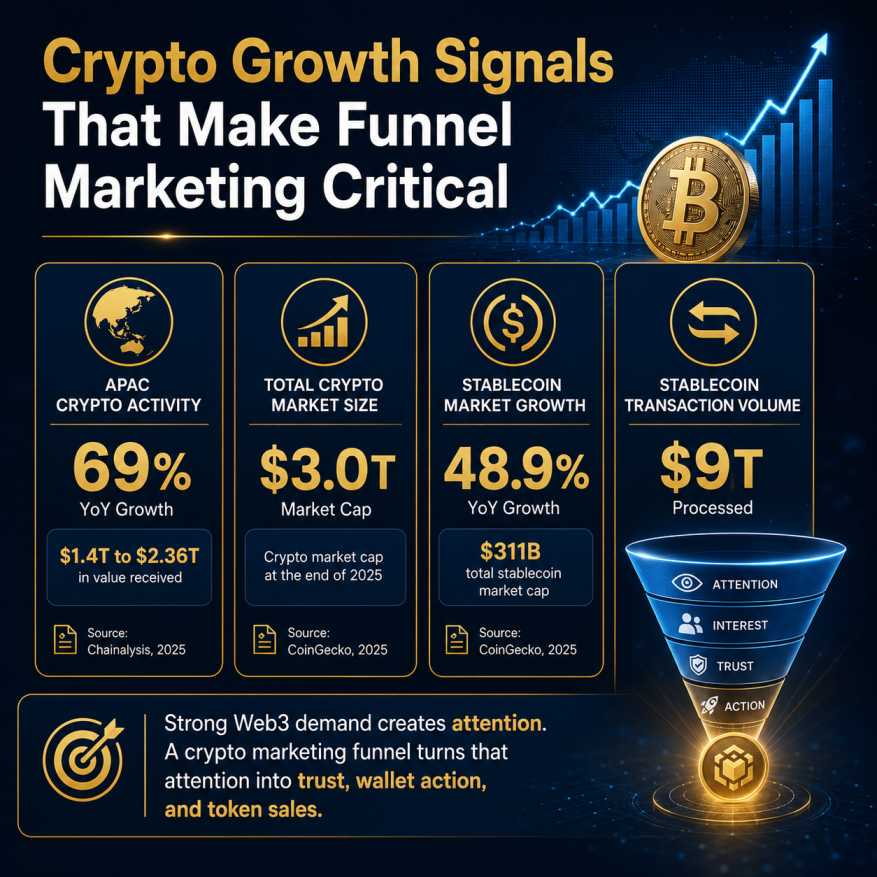
Crypto projects rarely fail from lack of attention alone. Many fail after that first moment of interest. A user sees a post on X, joins a Telegram group, scans the website, then leaves with no wallet connection or token purchase. The gap between curiosity and action is where a crypto marketing funnel creates value. The market data makes this gap harder to ignore. Chainalysis reported that APAC crypto activity grew 69% year over year, rising from $1.4 trillion to $2.36 trillion in value received in the 12 months ending June 2025. CoinGecko reported that the crypto market ended 2025 at about $3.0 trillion.
Strong demand does not guarantee token sales. People want access to Web3 growth, but they demand proof, clarity, and trust before they buy. CoinGecko reported that stablecoin market cap grew 48.9% in 2025, adding $102.1 billion and reaching $311 billion. a16z crypto reported that stablecoins processed $9 trillion in adjusted transaction volume over 12 months, up 87% from the previous year. These numbers show that crypto usage is expanding, but token projects still need a clear path from interest to action. A crypto marketing funnel turns scattered attention into education, community trust, wallet activity, token sales, and long-term holder value.
What Is a Crypto Marketing Funnel?
Crypto Marketing Funnel Definition
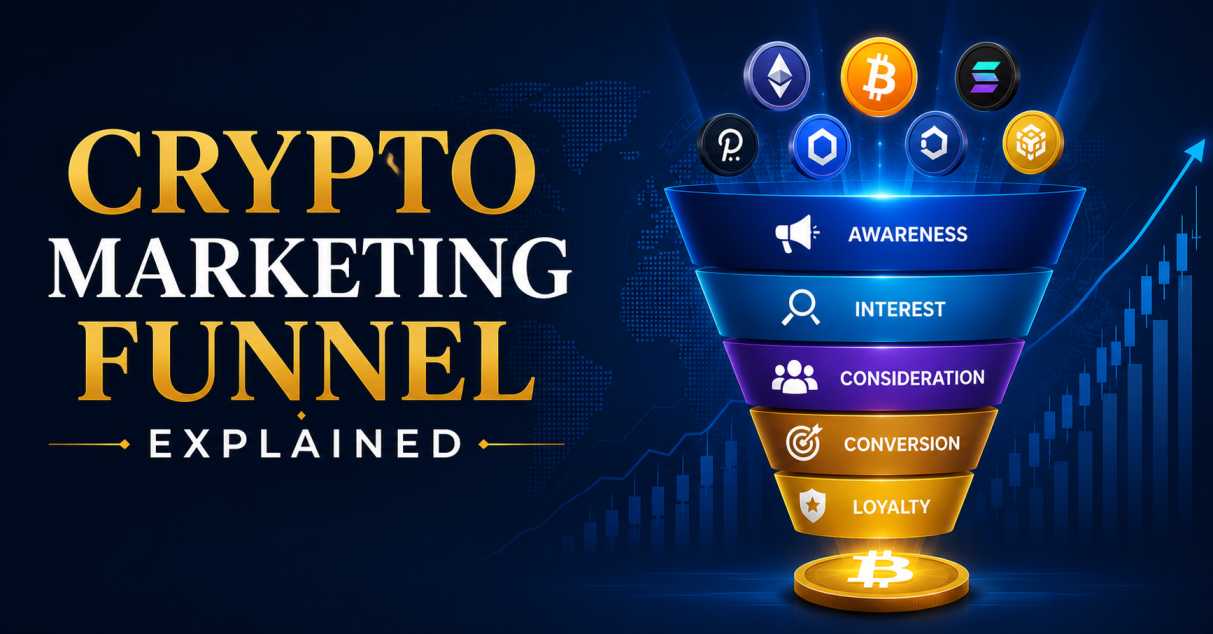
A crypto marketing funnel is the planned path that moves a potential buyer from first awareness to token purchase. It connects content, community, paid campaigns, PR, email, wallet onboarding, and post-sale engagement.
A Web2 funnel often ends with a sign-up, demo request, or product purchase. A Web3 funnel carries more friction. The user must understand the token, trust the team, check the contract, connect a wallet, pass KYC in some cases, and accept market risk. Each step can cause drop-off.
A good funnel removes doubt at each point. It does not rely on hype alone. It gives users the right proof at the right time.
Why Token Buyers Need More Education Than Traditional Customers
Token buyers do not buy a simple product. They buy into a network, an asset, a roadmap, and a risk profile. They study token utility, supply, vesting, liquidity, audits, exchange plans, governance, and the team’s record.
Education matters most at this stage. A DeFi investor wants to know how yield works. A GameFi user wants to know how the token supports gameplay. An enterprise buyer in real-world asset tokenization wants details on compliance, asset backing, and custody.
This is why whitepapers, tokenomics pages, audit reports, FAQs, and founder AMAs carry real commercial weight. They reduce fear and raise purchase intent.
Key Funnel Goals for Web3 Businesses
A crypto marketing funnel must do more than gain followers. It must attract the right audience and move them toward measurable action. Strong funnel goals include:
- Growing qualified traffic from search, PR, and social channels
- Turning visitors into community members and email subscribers
- Increasing whitelist registrations and wallet connections
- Raising token sale conversion rates
- Keeping holders active after the token generation event
For decision-makers, the funnel creates a clearer link between marketing spend and token sale results.
Crypto Marketing Funnel Stages: From Awareness to Token Purchase
Stage 1: Awareness: Attracting Web3 Interest
Awareness starts with visibility. A project must reach investors, traders, developers, partners, and users where they already spend time. Search content, crypto media, influencer posts, X threads, LinkedIn posts, podcasts, and YouTube explainers all serve this goal.
The best awareness content answers a real question. A DeFi project can publish guides on liquidity rewards. A layer 2 network can explain faster settlement and lower gas costs. A tokenization platform can write about real estate, carbon credits, or private credit on-chain.
Awareness should avoid empty claims. Strong first-touch content shows the problem, market need, and project role in plain language.
Stage 2: Education: Turning Curiosity into Understanding
Education turns a casual visitor into a serious prospect. This stage explains the project’s value in detail. The website should answer: What does the token do? Who needs it? Why does the network need a token? How does supply enter the market?
Good education assets include a whitepaper, tokenomics guide, roadmap, technical blog posts, wallet tutorials, and security explainers. a16z crypto reported heavy stablecoin activity in 2025, with $772 billion in adjusted transactions on Ethereum and Tron in September. This type of data helps projects show real-world Web3 use, not just theory.
Education must match the audience. Retail users need simple wallet and purchase guides. Institutional buyers need risk, compliance, custody, and liquidity details.
Stage 3: Engagement: Building Community and Trust
Community is the trust layer of Web3 marketing. Users study Telegram, Discord, X, and Reddit before they buy. They look for real discussion, fast answers, and honest updates.
A strong community has trained moderators, clear rules, scam warnings, weekly updates, and direct access to founders. AMAs work well here. They let users test the team’s knowledge and intent. Community quests on platforms such as Galxe or Zealy can drive early activity, but rewards must attract quality users, not only bounty hunters.
The main goal is not follower count. The goal is active belief. A smaller group with real questions and steady participation often converts better than a large silent channel.
Stage 4: Consideration: Preparing Users for Token Purchase
At the consideration stage, buyers compare the project with other crypto opportunities. They check supply, market timing, audits, partners, exchange plans, and vesting. They ask one direct question: Is this project credible enough for my wallet?
This is where conversion pages need depth. A token sale page should explain allocation, price, sale stages, accepted currencies, lockups, contract address rules, and risk notices. Case studies, product demos, testnet data, and partner logos can support the decision.
For B2B Web3 projects, this stage must include proof of business use. Real-world asset platforms, enterprise chains, and infrastructure projects need clear documentation and credible commercial cases.
Stage 5: Conversion: Driving Wallet Connection and Token Sale Participation
Conversion starts once a user takes action. That action can be whitelist registration, KYC submission, wallet connection, presale purchase, IDO participation, or DEX purchase.
This stage demands clear instructions. Many users abandon token sales from confusion, not lack of interest. They need to know which wallet to use, which network to select, how much gas to hold, and how to verify the official contract.
The page should use direct calls to action. It should load fast on mobile. It should show audit links, support channels, contract warnings, and a simple purchase flow. Each extra step must earn its place.
Stage 6: Retention: Turning Token Buyers into Long-Term Holders
A token sale is not the end of the funnel. Post-sale silence can damage trust and create sell pressure. Buyers need product updates, staking details, governance plans, exchange news, and community access.
Retention campaigns can include holder newsletters, staking tutorials, governance explainers, product release notes, and private community sessions. These actions keep holders close to the project and show continued execution after launch.
Stage 7: Advocacy: Creating Web3 Brand Ambassadors
The strongest crypto communities create their own growth. Holders share posts, answer questions, make tutorials, host local meetups, and defend the project during hard markets.
Advocacy works best after trust is earned. Referral campaigns, ambassador programs, meme contests, and user-generated content can spread reach. The project must still guide the message with clear facts and responsible claims.
A crypto marketing funnel turns Web3 interest into token sales through education, trust, and repeated proof. Businesses that build this system gain more than traffic. They gain qualified buyers, stronger communities, and a clearer path from attention to revenue.
Looking to turn Web3 interest into real token sales?
Turn Web3 attention into token sales with proven crypto marketing funnel strategies.

Crypto Marketing Funnel Framework for Token Sales
A crypto marketing funnel gives token projects a clear path from attention to purchase. It links search, content, community, paid media, wallet onboarding, and post-sale communication. This matters more in Web3 than in many other sectors. A token buyer does not only judge a product. The buyer judges a market, a team, a smart contract, a token model, and future demand.
The best funnel does not push every visitor toward a sale at once. It sorts users by intent. New users need education. Active community members need proof. Wallet-ready users need clear purchase steps. This structure helps a project spend its budget on users who show real interest.
TOFU, MOFU, BOFU Model for Web3 Projects
The TOFU, MOFU, and BOFU model works well for token sales. TOFU means top of funnel. It covers awareness. At this stage, a user finds the project through Google, X, YouTube, a crypto news site, or a KOL post. The goal is not a token purchase yet. The goal is interest.
TOFU content should answer broad questions. Examples include “What is real-world asset tokenization?” or “How does a DeFi lending token work?” These topics bring users into the project’s orbit. They also help the website rank for search terms with long-term value.
MOFU means middle of funnel. This stage turns interest into evaluation. Users read tokenomics pages, whitepapers, audit notes, roadmap updates, and use case articles. They join Telegram or Discord. They attend an AMA. They compare the project with other token launches.
BOFU means bottom of funnel. Users at this stage have high purchase intent. They need a presale page, KYC details, wallet guide, sale date, token price, accepted currencies, and contract safety notes. A clear BOFU page can reduce drop-offs. Confusion can cost sales within minutes during a token launch.
Web3 Funnel Mapping by User Intent
Search intent gives the funnel more accuracy. A user who searches “what is a crypto marketing funnel” wants education. A user who searches “best IDO marketing agency” has stronger commercial intent. A user who searches “hire crypto token launch agency” is close to a buying decision.
Web3 projects should map content around these intent levels. Informational content builds trust at the start. Commercial content compares services, tactics, and market needs. Transactional content invites the reader to request a quote, book a consultation, join a whitelist, or start a token sale campaign.
What makes Web3 intent different? Wallet behavior adds a second layer. A visitor who reads three blogs is useful. A visitor who joins Discord, opens a tokenomics page, and connects a wallet shows stronger intent. Projects should study both web data and on-chain signals.
Funnel Metrics Businesses Should Track
Strong teams track more than impressions and followers. Vanity numbers can hide weak demand. A Telegram group with 50,000 members can still fail to sell tokens. A smaller group with real questions, wallet activity, and repeat visits can perform better.
Useful funnel metrics include:
- Organic traffic from high-intent search terms
- Whitepaper downloads and tokenomics page visits
- Telegram and Discord engagement rate
- AMA attendance and replay views
- Whitelist signups
- KYC completion rate
- Wallet connections
- Token sale conversion rate
- Cost per qualified buyer
- Holder retention after launch
These numbers show where the funnel leaks. Low traffic points to weak awareness. Low whitelist conversion points to poor trust or unclear value. Low wallet connection points to poor onboarding or user fear.
Key Components of a High-Converting Crypto Marketing Funnel
A high-converting crypto funnel needs more than promotion. It needs a website, content, community, paid reach, media trust, and clean tracking. Each part must support the next step.
SEO-Optimized Website and Landing Pages
The website is the main proof center. It should explain the project, token utility, roadmap, team, audits, partners, sale stages, and risk notes. It should load fast and work well on mobile. Many crypto users move from X or Telegram to a website on a phone.
SEO brings lasting value. Paid traffic ends once the budget stops. Search traffic can keep bringing users for months. A project can target terms such as “crypto presale marketing,” “token launch strategy,” “DeFi tokenomics,” and “Web3 community marketing.”
Landing pages need clear calls to action. A token sale page should not hide the next step. It should guide users to join the whitelist, complete KYC, connect a wallet, or read the purchase guide.
Technical Content That Builds Investor Confidence
Technical content builds trust with serious buyers. It explains how the token works and why it belongs in the system. This includes smart contract logic, utility, supply, staking, governance, burn mechanics, and security audits.
A DeFi project should explain liquidity and risk. A layer 1 project should explain throughput, fees, validator design, and developer support. A GameFi project should explain token use inside gameplay. A real-world asset platform should explain asset custody, legal structure, and redemption rules.
Thin content creates doubt. Clear technical content shows that the team understands its own product.
Community Infrastructure for Web3 Growth
Community is not a side channel in Web3. It is part of the buying process. Users read group messages to judge trust. They watch how the team answers hard questions. They look for spam, fake accounts, and silence.
A strong community system needs trained moderators, pinned resources, scam alerts, weekly updates, and founder access. Telegram works well for fast updates. Discord works well for segmented groups, developer support, and ambassador programs. X supports reach and public proof.
The goal is quality interaction. Real questions and clear answers create more value than inflated member counts.
Paid Media and Retargeting for Token Sale Campaigns
Paid media can support token sales, but crypto ads face strict rules on many platforms. Projects must use careful claims and clear risk language. Paid campaigns work best after the website and content base are ready.
Retargeting has high value. A user who reads a whitepaper can see an AMA ad. A visitor to the tokenomics page can receive a whitelist reminder. A community member can get a sale-date update. Each message should match user intent.
Paid traffic should never carry the funnel alone. It works best with SEO, PR, KOL campaigns, and active community support.
Influencer, KOL, and Crypto PR Campaigns
KOLs and media coverage can speed up trust. A respected analyst, founder interview, or crypto publication can introduce the project to a wider audience. The wrong influencer can damage trust fast.
Good KOL campaigns focus on fit. A DeFi protocol needs voices trusted by DeFi users. A gaming token needs creators who understand player behavior. A B2B blockchain project needs LinkedIn, industry media, and partner-led content.
PR should give facts, not empty hype. Strong announcements cover audits, funding, partnerships, exchange listings, product milestones, and user growth.
Crypto Marketing Funnel vs Traditional Marketing Funnel
Traditional funnels sell products, subscriptions, or services. Crypto funnels sell participation in a token economy. That difference changes the whole process.
Key Differences Between Web2 and Web3 Funnels
A Web2 funnel often moves from ad to landing page to checkout or demo call. A Web3 funnel adds wallet setup, token education, smart contract checks, community review, and market risk.
Web3 users expect public proof. They review on-chain activity, token supply, holder distribution, audit status, and social channels. The buyer path is more open and more demanding.
Why Trust Is More Important in Crypto Funnels
Crypto markets carry fraud risk, price swings, and technical risk. Buyers know this. They look for signals that reduce fear. These signals include audits, public team profiles, clear tokenomics, active support, and honest risk notes.
A project that hides details loses serious buyers. A project that explains risk with clarity gains stronger trust.
Why Community Is the Core Conversion Layer
Community turns attention into belief. It lets users test the project before they buy. They can ask questions, watch team behavior, and see how other users respond.
This makes community the core conversion layer. Search brings users in. Content educates them. Community proves whether the project deserves their wallet. A strong crypto marketing funnel connects all three, then turns qualified interest into token sales.
Research basis: Chainalysis ranked India, the United States, Pakistan, Vietnam, and Brazil as the top five countries in its 2025 Global Crypto Adoption Index. CoinGecko reported that crypto market cap ended 2025 at $3.0 trillion, and stablecoin market cap reached $311 billion. a16z crypto reported $772 billion in adjusted stablecoin transactions on Ethereum and Tron in September 2025.
Step-by-Step Process to Build a Crypto Marketing Funnel
A crypto marketing funnel turns market attention into tracked buyer action. It gives token projects a clear path from first contact to wallet connection, sale entry, and post-sale retention. This structure matters in a market with strong adoption and high scrutiny. Chainalysis ranked India, the United States, Pakistan, Vietnam, and Brazil among the top five crypto adoption markets in 2025. CoinGecko reported that crypto market cap ended 2025 at $3.0 trillion. These numbers show demand, but demand alone does not create token sales.
Step 1: Define the Target Buyer Persona
A project must know who it wants to attract before it builds content or campaigns. A retail buyer needs simple language, wallet help, and clear risk notes. A DeFi user studies yield, liquidity, audits, and smart contract logic. A venture investor checks the team, token supply, market size, vesting, and exit risk. An enterprise buyer wants legal clarity, custody details, and proof of business use.
The buyer persona should include budget, region, crypto knowledge, risk level, preferred channels, and reason to buy. A GameFi project can target players, guilds, NFT collectors, and token traders. Each group needs a different message. One landing page cannot serve them all well.
Step 2: Map the Web3 Buyer Journey
The Web3 buyer path has more friction than a normal online purchase. A user may see a post on X, visit the website, read tokenomics, join Telegram, attend an AMA, connect a wallet, then enter a presale. Each step can lose users.
The funnel should map five stages: awareness, education, evaluation, purchase, and retention. Awareness builds reach. Education explains the project. Evaluation proves trust. Purchase guides users through KYC, wallet setup, and token sale entry. Retention keeps buyers active after launch.
The main question is simple: what blocks the user from taking the next step? The answer often sits in unclear token utility, weak proof, poor onboarding, or low community trust.
Step 3: Build Funnel-Specific Content Assets
Each funnel stage needs its own content. Awareness content includes SEO blogs, X threads, PR stories, videos, and founder interviews. Education content includes whitepapers, tokenomics pages, use case explainers, FAQs, and audit summaries. Purchase content includes whitelist pages, wallet guides, sale dates, contract safety notes, and presale instructions.
Serious buyers expect detail. a16z crypto reported $772 billion in adjusted stablecoin transactions on Ethereum and Tron in September 2025. Data like this helps projects connect their message to real market use. A stablecoin project can show payment demand. A DeFi project can explain liquidity needs. A tokenization platform can show how on-chain assets support faster settlement.
Step 4: Set Up Conversion Tracking and Attribution
A crypto project cannot improve what it does not measure. Tracking should connect traffic source, content touchpoint, community action, wallet connection, and token sale entry. Teams should use UTM links, analytics tools, CRM records, ad pixels where allowed, and Web3 tracking tools.
The core metrics include page visits, community joins, whitepaper downloads, AMA attendance, whitelist signups, KYC completions, wallet connections, and token purchases. These numbers show which channels bring buyers, not just visitors.
Step 5: Launch, Test, and Improve Campaigns
Campaign launch should start with controlled testing. Teams can test landing page headlines, calls to action, email copy, founder videos, KOL posts, and whitelist forms. The goal is simple. Find which message creates trust and which channel sends real buyers.
Testing should continue after the token generation event. Post-sale updates, staking content, governance explainers, and product news keep holders engaged. The funnel should support long-term value, not only launch-week hype.
Crypto Marketing Funnel Services Businesses Should Consider
Many token projects need outside support to build and run the full funnel. The right service mix depends on launch stage, budget, region, and buyer type.
Crypto Marketing Strategy Development
Strategy work defines the audience, message, funnel stages, campaign calendar, and launch plan. It connects business goals to channel activity. Without this step, teams often spend money across disconnected campaigns.
Crypto SEO and Content Marketing
SEO and content marketing build long-term traffic. Services include keyword research, blog writing, landing page copy, whitepaper support, tokenomics pages, and technical explainers. This content helps users find the project and understand its value.
Crypto PR and Media Outreach
PR builds public proof. It supports funding news, product launches, audits, partnerships, exchange updates, and founder stories. Good PR gives the market clear facts and third-party visibility.
Web3 Community Management
Community management keeps Telegram, Discord, X, and other channels active and safe. It covers moderation, AMA planning, scam alerts, weekly updates, and user support. This service has direct impact on trust.
Token Sale Marketing and Launch Campaigns
Token sale marketing covers whitelist growth, presale promotion, KYC support, launchpad coordination, KOL outreach, and sale reminders. The aim is to bring ready buyers to the sale page with clear instructions.
Analytics, CRO, and Funnel Improvement
Analytics and conversion rate work reveal what drives sales. Teams can study traffic source, page flow, form drop-off, wallet connection rate, and token sale data. Better data leads to better budget choices and stronger launch results.
Research basis: Chainalysis ranked India, the United States, Pakistan, Vietnam, and Brazil as the top five countries in its 2025 Global Crypto Adoption Index. a16z crypto’s 2025 report highlights institutional adoption, stablecoins, crypto and AI, and new crypto data dashboards. ESMA states that MiCA creates uniform EU market rules for crypto-assets, and the SEC says its Crypto Task Force is working on clearer lines between securities and non-securities, disclosure, registration paths, and investor information.
How to Choose the Right Crypto Marketing Funnel Partner
Choosing a crypto marketing funnel partner is a business decision, not a vendor search. The right partner shapes how buyers discover the project, study its token, join its community, and move toward purchase. The wrong partner can waste launch budget and attract low-quality traffic.
Crypto adoption has reached a broad global base. Chainalysis ranked India, the United States, Pakistan, Vietnam, and Brazil among the top five adoption markets in 2025. This demand creates opportunity, but it also raises competition. Token projects now need clearer messaging, stronger trust signals, and better funnel tracking.
Look for Web3-Specific Experience
A strong funnel partner must understand how token buyers behave. Web3 buyers study far more than a product page. They check token utility, vesting, contract safety, audits, founder history, community tone, and market timing. A partner with only Web2 experience can miss these details.
Web3-specific experience shows up in the questions an agency asks. It should ask about the token model, target chain, sale type, liquidity plan, launchpad, exchange goals, and buyer risk level. It should know the difference between a DeFi protocol, NFT marketplace, GameFi project, layer 2 network, and real-world asset platform.
A good partner will not push the same plan for every token. A DeFi launch needs liquidity education and audit proof. A gaming token needs player growth and creator campaigns. A B2B blockchain project needs founder-led content, LinkedIn reach, and case-based proof.
Check Their SEO, PR, and Community Capabilities
Crypto funnels work best through connected channels. Search brings long-term traffic. PR builds public proof. Community turns attention into trust. Paid media supports reach, subject to platform rules.
A strong partner should handle each of these areas with one shared plan. SEO content should answer real search intent. PR should support funding, audit, product, and partnership news. Community teams should keep Telegram, Discord, and X active with real updates, scam warnings, and quick answers.
The partner should also understand content depth. Thin blogs do not move serious buyers. A tokenomics guide, audit explainer, wallet tutorial, roadmap post, and founder interview can move users through the funnel with more confidence.
Evaluate Their Compliance-Aware Messaging
Crypto marketing now faces sharper review from users, platforms, and regulators. The EU’s MiCA rules created a common crypto rule set across member states. The SEC Crypto Task Force has also focused on clearer regulatory lines and investor information in the United States.
A funnel partner must treat compliance-aware messaging as part of brand trust. It should avoid income promises, price guarantees, false urgency, and unclear risk claims. It should write about utility, access, governance, product use, and market need with care.
This does not make the copy weak. It makes the copy stronger. Serious buyers respect plain risk language. They want to know the sale terms, lockups, restrictions, accepted regions, and token limits before they act.
Ask for Funnel-Based Reporting
Reports should not stop at impressions, clicks, and follower growth. Token businesses need funnel-based reporting. The report should show how users moved from search, PR, KOL campaigns, ads, and community channels into measurable actions.
Useful reporting includes:
- Organic traffic by keyword group
- Tokenomics page visits
- Whitepaper downloads
- Telegram and Discord activity
- AMA registrations and attendance
- Whitelist signups
- KYC completion rate
- Wallet connections
- Token sale conversion rate
- Cost per qualified buyer
This level of reporting shows which channels create buyers. It also shows where users drop out. A high click count with low wallet connection signals weak trust or poor onboarding.
Are you ready to boost your crypto conversions?
Conclusion
A crypto marketing funnel partner should bring Web3 knowledge, channel depth, compliance-aware copy, and clear reporting. The best partner helps a business attract qualified users, educate them, build trust, and convert interest into token sales.
The future of crypto funnels will rely on AI personalization, on-chain attribution, clear compliance, and community-led growth. Token projects that build these systems early will gain a stronger position. They will spend with more control, communicate with more clarity, and turn buyer attention into measurable market action.
For businesses planning a token launch, ICO, IDO, STO, DeFi platform, NFT marketplace, GameFi project, or blockchain ecosystem, Blockchain App Factory offers end-to-end crypto marketing funnel services built for measurable growth. As a crypto marketing agency, Blockchain App Factory supports crypto SEO, Web3 community management, crypto PR, token sale marketing, influencer marketing, KOL campaigns, and conversion tracking. Partnering with Blockchain App Factory helps Web3 businesses turn audience interest into wallet connections, qualified investors, token sales, and long-term community value.

Vimal J is the Head of Sales at Blockchain App Factory, with 10+ years of experience in sales, client strategy, and Web3 business growth. He helps startups, enterprises, and project founders choose the right blockchain solutions for their goals, bringing a practical market perspective to topics like token development, crypto launches, and Web3 adoption.
Article Reviewed by:
Arun Kamala Santhanath
Marketing Head, Blockchain App Factory


