


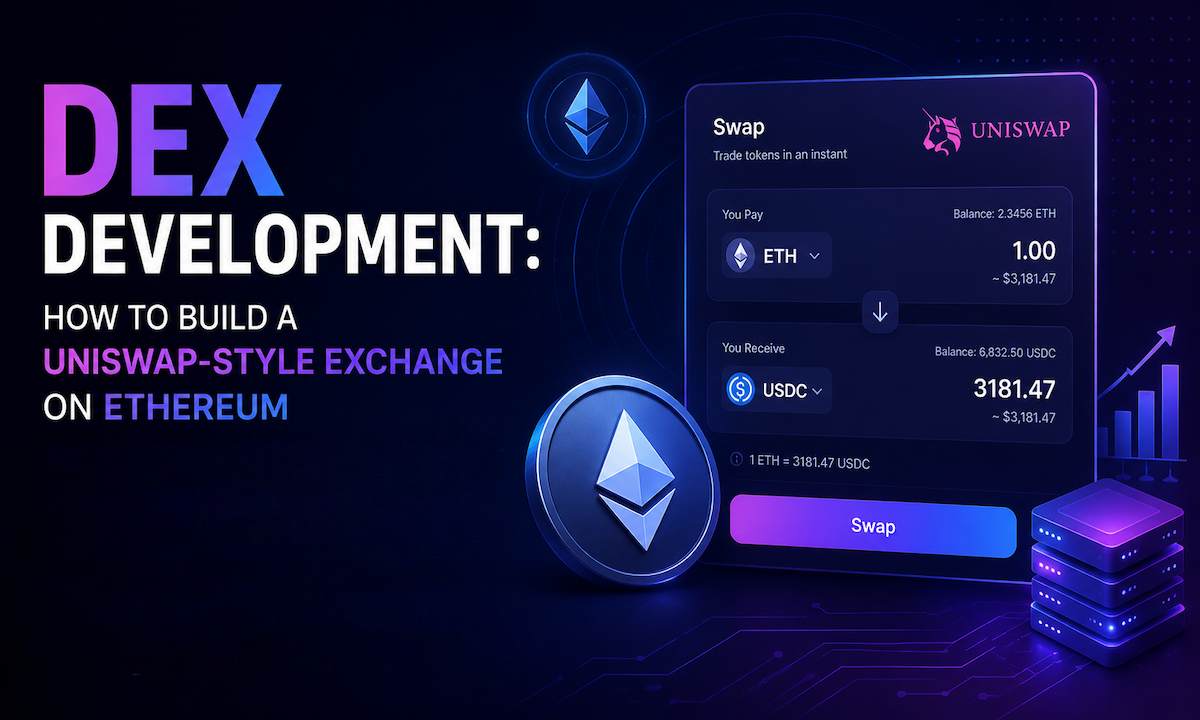
Key Insights
- A Uniswap-style DEX helps businesses launch swaps, create liquidity pools, and support ERC-20 trading through smart contracts.
This gives tokens practical use inside DeFi apps, launchpads, games, and tokenization platforms. - Users trade from their own wallets, so the platform does not hold customer funds.
This lowers custody risk and builds trust through transparent on-chain settlement. - Businesses can earn from swap fees, token launches, staking, liquidity rewards, analytics, and governance models.
Strong results need audited contracts, clear pool rules, wallet support, and a focused liquidity plan.
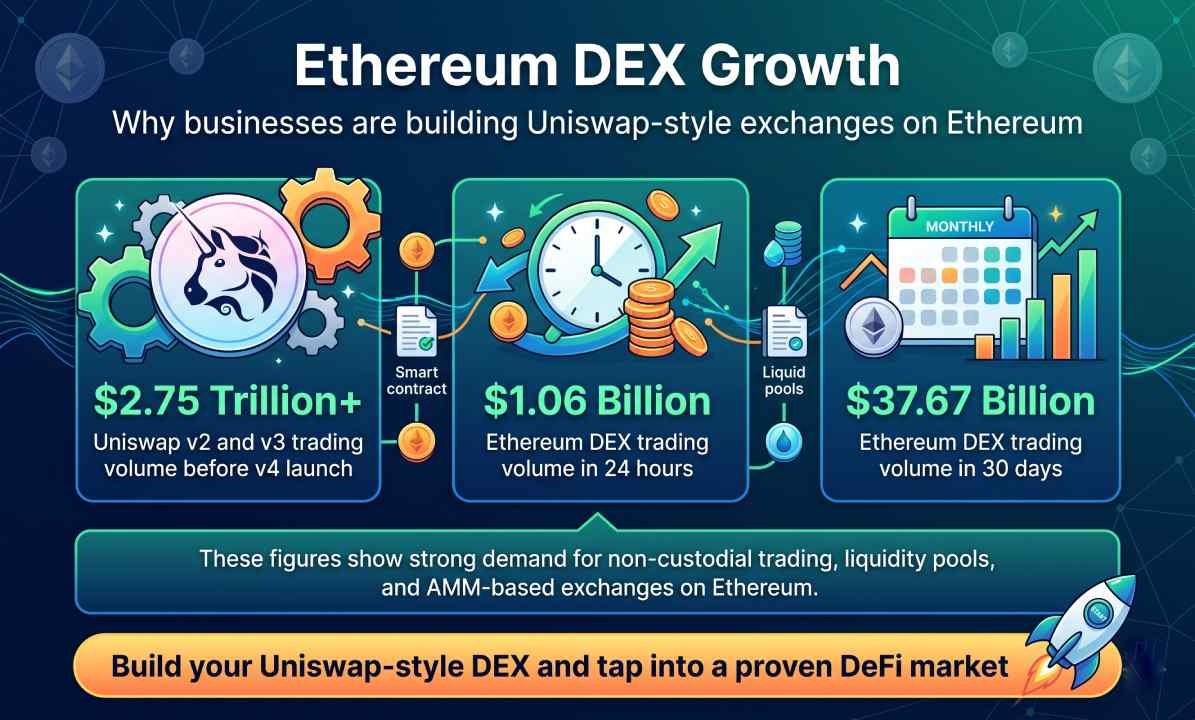
Ethereum DEX development is now a strong business play, not just a technical trend. Market demand backs that up with real numbers. Uniswap v2 and v3 processed more than $2.75 trillion in trading volume before v4 launched. At the same time, Ethereum-based decentralized exchanges recorded about $1.06 billion in 24-hour volume and $37.67 billion in 30-day volume at the time of research. These figures show clear user demand for non-custodial trading, on-chain liquidity, and automated token swaps. For startups, crypto exchanges, launchpads, gaming projects, and tokenization firms, building a Uniswap-style exchange on Ethereum offers a direct path to token utility, fee-based revenue, and stronger market presence.
What Is a Uniswap-Style DEX?
A Uniswap-style DEX is a blockchain-based trading platform where users swap tokens through smart contracts. On Ethereum, this usually means ERC-20 assets. The ERC-20 standard gives tokens a common interface, so wallets, exchanges, and smart contracts can read and transfer them with fewer custom rules.
The key change is the trading engine. Traditional exchanges match buyers and sellers through order books. A Uniswap-style DEX uses liquidity pools. Each pool holds two tokens. Traders swap against the pool, and the contract updates prices through a formula. In Uniswap v1 and v2, the constant product model uses x times y equals k, so token reserves set the price after every trade.
Businesses choose this model for speed and control. A Uniswap clone gives a proven base for swaps, pools, LP rewards, and fee logic. A custom DEX adds branded design, custom tokenomics, governance, and revenue rules. For a token project, launchpad, gaming platform, or DeFi brand, this creates a product that drives trading volume and long-term ecosystem value.
How a Uniswap-Style DEX Works
Automated Market Maker Architecture
A Uniswap-style DEX does not need an order book. It uses an automated market maker, or AMM, to price trades through liquidity pools. Each pool holds two ERC-20 token reserves. The price changes after each swap, based on the balance between those reserves. This AMM DEX development model lets users trade directly with smart contracts, not a central exchange desk. Uniswap’s own docs describe these pools as reserves of two ERC-20 tokens that update prices based on pool state.
Liquidity Pools and LP Tokens
Liquidity providers deposit token pairs into a pool, such as ETH and USDC. In return, they receive LP tokens. These tokens show their share of the pool. They also give the holder a claim on trading fees. For businesses, this creates a direct path to market liquidity. A project can seed its own pool, attract external liquidity, and reward users through liquidity mining or fee sharing.
Token Swaps and Price Discovery
A token swap starts with a user choosing one asset to sell and another to receive. The router finds the best pool path. For thin pools, slippage rises fast. For deep pools, trades settle closer to the quoted price. Arbitrage traders then help bring pool prices back in line with wider market prices. This keeps the DEX useful for live trading, treasury swaps, and token launch activity.
Smart Contracts Behind a DEX
The main contracts include factory contracts, pair or pool contracts, routers, fee contracts, and governance contracts. In Uniswap v2, core contracts handle key safety rules, and periphery contracts support routing and user-facing actions. The factory creates trading pairs, the pair contract stores reserves, and the router manages swaps across one or more pools.
Core Features of a Uniswap-Style DEX Platform
Token Swap Module
The swap module is the main product screen. It supports ERC-20 swaps, multi-hop routing, slippage settings, and transaction deadlines. These controls matter for traders, since Ethereum gas fees and price movement can change the final trade result within seconds.
Liquidity Pool Creation
A strong DEX lets teams create pools with clear rules. Pool creation can be open to all users or controlled by an admin. The platform should validate token contracts, set pool fees, and block duplicate or unsafe pairs.
Wallet Integration
Wallet login replaces username and password flows. MetaMask, WalletConnect, Coinbase Wallet, and Trust Wallet give users direct access through wallet signatures. This keeps custody with the user and reduces platform risk.
Admin Dashboard
The admin dashboard helps the business track trading volume, pool health, fee income, user activity, and transaction history. It also gives teams control over fee settings, token listings, and pool monitoring.
Governance and DAO Integration
A governance layer gives token holders voting rights. They can vote on fee changes, treasury use, reward plans, and protocol upgrades. This model suits DeFi startups that want community ownership.
Analytics and Reporting
A serious DEX needs live reporting for TVL, trading volume, liquidity depth, APY, active traders, and top pools. These numbers help founders judge growth, plan rewards, and prove traction to partners or investors.
Technical Architecture for Ethereum DEX Development
Ethereum Blockchain Layer
Ethereum gives DEX builders a tested base for DeFi exchange development. Its smart contract tooling is mature, and ERC-20 gives fungible tokens a shared format across wallets, dApps, and crypto exchanges. That standard makes token swaps easier to support across the Ethereum market.
Smart Contract Layer
A Uniswap-style exchange needs Solidity smart contracts. Solidity remains the main high-level language for EVM smart contracts, so most Ethereum DEX development teams use it for AMM logic. The contract set includes factory, pool or pair, router, fee, and governance contracts. The factory creates markets. Pools hold reserves. The router sends trades through the right path. Fee contracts split LP and protocol income. Governance contracts control voting, upgrades, and treasury rules.
Frontend Layer
The frontend turns these contracts into a real trading product. A Web3 interface needs a swap page, pool creation dashboard, liquidity manager, wallet connection, and portfolio view. MetaMask and WalletConnect remain common choices for user access.
Backend and Indexing Layer
The backend reads on-chain events through subgraphs or custom indexers. This data powers charts, pool analytics, trade history, and admin reports. Strong indexing also helps teams track volume, liquidity depth, user activity, and fee income.
Security Layer
Security sits across the full build. Teams need smart contract audits, formal checks for core logic, bug bounty testing, oracle controls, monitoring, and limits for risky actions. One missed check can drain a pool.
Step-by-Step Process to Build a Uniswap-Style DEX on Ethereum
Define the Business Model and Target Users
Start with the business model. A DEX for retail DeFi traders needs speed and simple swaps. A token launch platform needs pool creation and liquidity campaigns. A gaming, NFT, or enterprise token market needs custom rules and branded flows.
Choose the DEX Architecture
Next, choose the DEX model. A Uniswap v2-style AMM fits fast launches. A v3-style model supports concentrated liquidity. A v4-inspired build can use hooks, flash accounting, and dynamic fees for deeper control.
Design Tokenomics and Fee Structure
Define swap fees, protocol fees, LP rewards, native token utility, and governance incentives. This step shapes how users trade, how LPs earn, and how the platform captures revenue.
Develop Smart Contracts
Build the factory, pool, router, LP token, staking, and governance contracts. Each contract must follow clear access rules and pass strict testing before deployment.
Build the DEX Frontend
Create the trading interface, pool creation page, liquidity dashboard, user portfolio view, and analytics pages. The interface should make swaps simple for users and give teams clear data on platform use.
Integrate Wallets and Blockchain APIs
Connect MetaMask, WalletConnect, RPC providers, Ethereum nodes, and indexing infrastructure. These integrations let users trade from their wallets and let the platform read live blockchain data.
Test on Ethereum Testnets
Run unit tests, integration tests, mainnet fork tests, gas checks, and security tests. Testnets help teams catch contract errors before funds enter the protocol.
Conduct a Smart Contract Audit
Audit for reentrancy, flash loan abuse, access control errors, price manipulation, and liquidity loss. A third-party audit builds trust with users, LPs, and business partners.
Launch on Ethereum Mainnet
Seed liquidity, list key token pairs, run a community launch, and start LP incentive campaigns. Early liquidity depth helps reduce slippage and makes the first user experience stronger.
Expand With Layer 2 and Cross-Chain Support
After launch, expand through Arbitrum, Optimism, Base, Polygon, bridges, and cross-chain swap routes. This helps reduce trading costs and brings more users into the DEX ecosystem.
Want to Launch Your Own Uniswap-Style DEX on Ethereum?
Build a secure, scalable, and feature-rich decentralized exchange with expert Ethereum DEX developers.

How Much Does It Cost to Create a Uniswap-Style DEX?
The cost to create a Uniswap-style DEX on Ethereum depends on scope, smart contract depth, audit needs, and launch network. A basic MVP with token swaps, liquidity pools, wallet connection, and a simple admin panel often starts from $30,000 to $80,000. A custom DEX with advanced AMM logic, analytics, governance, staking, and security audits often reaches $150,000 to $500,000+. Recent market guides place DEX builds in a wide range, from about $20,000 for a functional MVP to $250,000+ for larger platforms. Blockchain agency rates on Clutch sit near $25 to $49 per hour, which affects total cost by region and team skill.
| Feature | Description | Duration | Cost |
|---|---|---|---|
| Planning and Architecture | Business model, AMM type, fee logic, user flow, and technical scope. | 1 to 3 weeks | $3,000 to $10,000 |
| UI and DEX Frontend | Swap screen, liquidity pages, wallet flow, and responsive interface. | 3 to 6 weeks | $8,000 to $25,000 |
| Smart Contracts | Factory, pool, router, LP token, fee logic, and access controls. | 5 to 10 weeks | $30,000 to $90,000 |
| Wallet Integration | MetaMask, WalletConnect, Coinbase Wallet, and transaction signing. | 1 to 3 weeks | $4,000 to $12,000 |
| Admin and Analytics | Pool tracking, fee controls, TVL, volume, user activity, and reports. | 3 to 6 weeks | $10,000 to $35,000 |
| Security and Audit | Testing, contract review, gas checks, and external audit support. | 3 to 8 weeks | $15,000 to $70,000 |
| Deployment and Support | Testnet, mainnet launch, contract verification, monitoring, and fixes. | 1 to 3 weeks | $6,000 to $20,000 |
| Advanced Add-ons | Governance, staking, farming, Layer 2, or cross-chain support. | 4 to 12 weeks | $25,000 to $120,000+ |
Industry Use Cases for Ethereum DEX Development
Ethereum DEX development helps businesses create token markets without holding user funds. It serves DeFi startups, crypto exchanges, launchpads, gaming projects, and tokenization platforms.
DeFi Startups
DeFi startups use Uniswap-style exchanges to launch tokens, create liquidity pools, and support direct trading through smart contracts. This gives the token real use inside the product and helps the business earn through swap fees, staking, liquidity rewards, and governance models.
Crypto Exchanges Expanding Into DeFi
Centralized exchanges use DEX platforms to offer non-custodial trading. Users keep control of their assets, and the exchange adds new revenue from swaps, token listings, routing, and premium tools.
Token Launchpads
Launchpads use DEXs to create liquidity right after token sales. This helps new projects move from IDO to public trading faster. It also supports fair launches, vesting contracts, and post-launch liquidity plans.
Gaming and Metaverse Projects
Gaming platforms use DEXs for in-game token swaps, reward assets, NFT marketplace tokens, and creator tokens. This keeps trading inside the game economy and gives players faster access to liquidity.
Enterprise Tokenization Platforms
Tokenization firms use DEX infrastructure for private pools, permissioned access, and controlled asset trading. This suits real estate tokens, carbon credits, loyalty points, treasury assets, and private credit products.
Commercial Value of Building a Uniswap-Style DEX
A Uniswap-style DEX creates revenue through swap fees, launch fees, liquidity programs, analytics, staking, and governance tokens. It also helps businesses build stronger token demand and user trust.
The best results come from the right AMM model, audited smart contracts, clear pool rules, strong liquidity rewards, and a simple trading interface. A skilled DEX development company can build a secure Ethereum exchange for traders, liquidity providers, and long-term business growth.
Conclusion
A Uniswap-style DEX gives businesses a direct path to launch token swaps, build liquidity, and create revenue through trading fees, staking, governance, and ecosystem growth. The right build needs audited smart contracts, a clean trading interface, strong wallet support, and a clear liquidity plan. Blockchain App Factory provides Decentralized Exchange Development services for startups, enterprises, exchanges, launchpads, and Web3 brands that want to build secure, scalable, and business-ready DEX platforms on Ethereum and other blockchain networks.

Vimal J is the Head of Sales at Blockchain App Factory, with 10+ years of experience in sales, client strategy, and Web3 business growth. He helps startups, enterprises, and project founders choose the right blockchain solutions for their goals, bringing a practical market perspective to topics like token development, crypto launches, and Web3 adoption.
Article Reviewed by:
Arun Kamala Santhanath
Marketing Head, Blockchain App Factory


