Key Insights
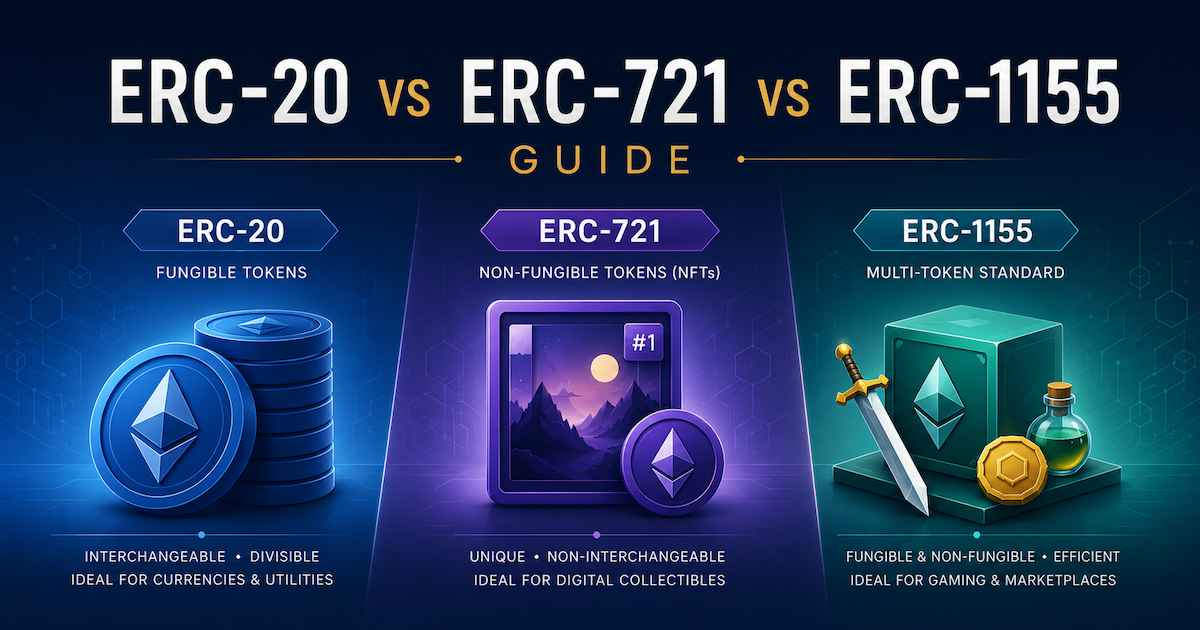
- ERC-20 fits fungible token use cases.It works best for payments, rewards, governance, staking, DeFi assets, and loyalty points.
- ERC-721 supports unique digital ownership.It suits NFTs, certificates, event tickets, luxury product records, and one-of-one collectibles.
- ERC-1155 works best for multi-asset systems.It helps games, marketplaces, loyalty platforms, and enterprises manage many asset types through one contract.
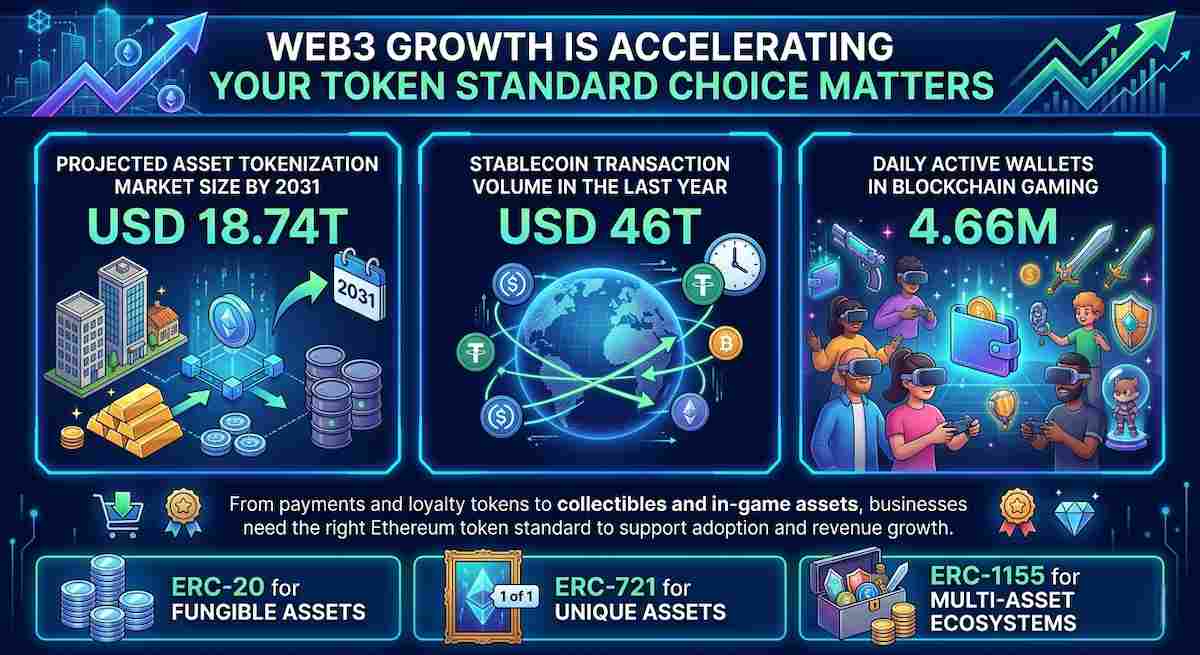
Token standards shape how a Web3 product works from day one. They define how tokens move, who owns them, how users trade them, and how external platforms read them. For businesses, this choice affects cost, speed, security, user trust, and future growth. As blockchain adoption grows across payments, digital assets, and gaming, choosing the right standard has become a strategic decision. The global asset tokenization market was valued at USD 2.08 trillion in 2025 and is expected to reach USD 18.74 trillion by 2031, while stablecoins now account for over USD 300 billion in supply and USD 46 trillion in annual transaction volume. Blockchain gaming also recorded 4.66 million daily unique active wallets in Q3 2025, showing how fast token-based ecosystems are expanding.
The debate around ERC-20 vs ERC-721 vs ERC-1155 matters for any company building on Ethereum. A fintech brand launching a reward token, a gaming studio selling in-game assets, a real estate platform tokenizing ownership, and an artist creating digital collectibles all need different token structures. Ethereum token standards give businesses a tested base for blockchain token development, helping them reduce custom logic, improve wallet and marketplace support, and build user confidence. Choosing the right token standard early can improve scalability, liquidity, adoption, and long-term revenue potential.
What Are Ethereum Token Standards?
Ethereum token standards are shared smart contract rules. They define how tokens are created, owned, transferred, approved, and used by blockchain apps. These standards help wallets, exchanges, marketplaces, and dApps read token data in a common format. This makes token behavior clear for users, developers, and businesses.
Ethereum Token Standards Explained
An Ethereum token works through a smart contract. The contract stores rules for supply, ownership, transfers, approvals, and balances.
ERC standards define the functions that token contracts should follow. ERC-20 supports fungible tokens. ERC-721 supports unique NFTs. ERC-1155 supports many token types in one contract, including fungible, non-fungible, and semi-fungible tokens.
Why ERC Standards Are Important for Businesses
ERC standards help businesses build tokens faster and with less risk. They reduce the need to create token logic from scratch. They also improve support across wallets, marketplaces, exchanges, and blockchain tools.
A company can use ERC-20 for reward tokens, ERC-721 for NFT memberships, and ERC-1155 for mixed asset systems. The right standard helps users access, trade, and trust the token.
Core Business Advantages of ERC Token Standards
ERC token standards offer clear business value:
- Standard smart contract functions
- Faster token development
- Easier wallet and marketplace support
- Better developer adoption
- Stronger audit readiness
- Lower technical risk
- Wider Ethereum ecosystem support
These benefits make ERC standards a strong base for smart contract development services and Web3 token development.
Common Types of Ethereum Tokens
Ethereum supports many token types for different business needs.
Fungible tokens
are equal in value and function. ERC-20 suits rewards, payments, governance, and asset-backed tokens.
Non-fungible tokens
are unique. ERC-721 suits art, collectibles, tickets, certificates, and memberships.
Semi-fungible tokens
start as identical assets, then can gain unique value later. ERC-1155 suits event tickets, gaming items, vouchers, and limited-use assets.
Other common token types include utility tokens, governance tokens, reward tokens, asset-backed tokens, gaming tokens, and NFT collectibles. Each type needs the right standard to support clear ownership, better user experience, and stronger business growth.
ERC-20 Explained: The Standard for Fungible Tokens
ERC-20 is the most common Ethereum standard for fungible tokens. Each token unit has the same value and function. It suits payment tokens, reward points, governance tokens, DeFi assets, and in-app currencies.
What Is ERC-20?
ERC-20 is a smart contract standard for creating fungible tokens on Ethereum. It defines how tokens move, how balances work, and how apps interact with the token.
Businesses use ERC-20 to build token economies. It works best for tokens that need equal value, liquidity, and wide wallet or exchange support.
How ERC-20 Tokens Work
ERC-20 tokens run through smart contracts. The contract manages supply, balances, transfers, approvals, and permissions.
Key functions include:
- Token supply for total or future supply rules
- Wallet balances for user ownership records
- Transfer functions for wallet-to-wallet movement
- Allowance and approval rules for DeFi and app payments
- Smart contract controls for minting, burning, vesting, or access
- Wallet and exchange support for storage, transfers, and trading
- DeFi access for staking, swaps, lending, and liquidity pools
Key Features of ERC-20 Tokens
ERC-20 tokens offer a clear base for business-grade token projects.
- Fungibility
- Divisibility
- Interchangeability
- Standard transfer logic
- DeFi compatibility
- Exchange listing potential
- Governance and staking support
- Wide ecosystem adoption
These features make ERC-20 useful for simple transfers, rewards, payments, and market activity.
Best Business Use Cases for ERC-20
ERC-20 works well for projects that need equal, tradable token units.
Common use cases include:
- Utility token development
- Governance token development
- DeFi token development
- Crypto payment tokens
- Stablecoin-like tokens
- Reward and loyalty tokens
- In-app currencies
- DAO tokens
- Token sale or fundraising projects
- Platform access tokens
Commercial Benefits of ERC-20 Token Development
ERC-20 token development helps businesses launch token-based products faster. It supports user rewards, access rights, liquidity, governance, staking, and payments.
Businesses can use ERC-20 to create incentive systems, build community voting models, connect with decentralized exchanges, and support token-based access. A strong ERC-20 token development company can plan tokenomics, smart contracts, audits, wallet support, and launch readiness.
Limitations of ERC-20 for Business Projects
ERC-20 does not fit every token model. It is not suitable for unique assets, digital collectibles, certificates, luxury goods, or one-of-one tickets.
Businesses also need careful tokenomics, legal review, smart contract audits, and gas fee planning. Poor planning can affect trust, adoption, and long-term value.
When Should a Business Choose ERC-20?
Choose ERC-20 when your project needs interchangeable tokens. It fits platform currencies, governance tokens, reward points, payment tokens, DeFi assets, and access tokens.
Use ERC-20 for equal units of value. Use ERC-721 or ERC-1155 for unique or mixed assets.
Transactional Keywords to Use in This Section
Use these keywords in service pages, comparison pages, call-to-action blocks, and FAQs:
- ERC-20 token development services
- ERC-20 token development company
- custom ERC-20 token development
- Ethereum token development services
- hire ERC-20 token developers
ERC-721 Explained: The Standard for Unique NFTs
ERC-721 is the Ethereum token standard for non-fungible tokens. Each token has a unique identity and can represent ownership of a distinct digital or physical asset. It fits NFTs, collectibles, certificates, tickets, memberships, and luxury product records.
What Is ERC-721?
ERC-721 is a smart contract standard for unique tokens on Ethereum. Each token has its own ID, so no two ERC-721 tokens are the same.
Businesses use ERC-721 to create NFTs for art, media, access passes, real-world asset records, and digital identity items.
How ERC-721 Tokens Work
ERC-721 tokens use smart contracts to record ownership and asset details.
Key functions include:
- Unique token IDs for each asset
- Ownership records stored on-chain
- NFT metadata for images, traits, and descriptions
- Transfer functions for wallet movement
- Approval rules for marketplaces and apps
- Provenance records for ownership history
- Marketplace support for listing and trading
- One-of-one asset representation
Key Features of ERC-721 Tokens
ERC-721 gives businesses a clear structure for unique digital assets.
- Non-fungibility
- Unique token identity
- Verifiable ownership
- Metadata support
- Provenance tracking
- NFT marketplace readiness
- Strong fit for rare and collectible assets
These features make ERC-721 useful for assets that need proof, rarity, and individual value.
Best Business Use Cases for ERC-721
ERC-721 works best for business models built around unique ownership.
Common use cases include:
- NFT collectibles
- Digital art
- Luxury goods authentication
- Event tickets
- Membership passes
- Real estate ownership records
- Certificates and credentials
- Music and media rights
- Digital identity assets
- Limited-edition brand campaigns
Commercial Benefits of ERC-721 NFT Development
ERC-721 NFT development helps businesses create scarce, traceable, and tradable digital assets. It supports ownership proof, premium NFT collections, royalties, and brand engagement.
Businesses can use ERC-721 to reduce ticket fraud, authenticate luxury goods, issue certificates, and create holder-only experiences. An NFT token development company can help with smart contracts, metadata, minting, marketplace support, and audits.
Limitations of ERC-721 for Business Projects
ERC-721 is not ideal for fungible assets or large batch transfers. It can cost more for high-volume games, marketplaces, or inventory-heavy platforms.
Projects also need careful metadata storage, royalty planning, marketplace setup, and smart contract audits. ERC-1155 often fits better for mixed asset systems.
When Should a Business Choose ERC-721?
Choose ERC-721 when each asset needs its own identity, ownership record, and metadata. It fits NFTs, collectibles, tickets, certificates, luxury product records, digital art, and membership credentials.
Use ERC-721 for unique assets. Use ERC-20 for equal-value tokens and ERC-1155 for mixed asset systems.
Transactional Keywords to Use in This Section
Use these keywords in service pages, landing pages, comparison guides, and sales sections:
- ERC-721 NFT development services
- NFT token development company
- custom NFT development services
- NFT smart contract development
- NFT marketplace development company
Need the right token standard for your Web3 project?
Blockchain App Factory helps you build ERC-20, ERC-721, and ERC-1155 tokens with secure smart contracts, wallet support, and launch-ready features.

ERC-1155 Explained: The Multi-Token Standard for Scalable Web3 Ecosystems
ERC-1155 helps businesses manage many token types through one smart contract. It supports fungible, non-fungible, and semi-fungible tokens. This makes it useful for games, NFT marketplaces, metaverse products, loyalty systems, and digital inventories.
What Is ERC-1155?
ERC-1155 is a multi-token standard on Ethereum. It lets one contract manage different asset types at once.
A gaming platform can use ERC-1155 for coins, weapons, skins, passes, and tickets. A marketplace can use it for editions, bundles, and mixed digital assets.
How ERC-1155 Tokens Work
ERC-1155 uses token IDs to manage many assets in one contract.
Key functions include:
- Multiple token types in one contract
- Batch transfers for many assets
- Batch balance checks
- Fungible and non-fungible token support
- Semi-fungible token support
- Reduced contract deployment work
- Better asset management
This structure helps platforms manage large asset systems with less contract clutter.
Key Features of ERC-1155 Tokens
ERC-1155 supports flexible and large-scale token models.
- Multi-token functionality
- Batch transaction support
- Lower gas use for grouped transfers
- Support for gaming assets
- Support for marketplace inventories
- Hybrid fungible and non-fungible asset models
- Scalable smart contract architecture
These features make ERC-1155 a strong choice for projects with many asset types.
Best Business Use Cases for ERC-1155
ERC-1155 works well for platforms that need many token categories and frequent transfers.
Common use cases include:
- Blockchain gaming platforms
- Metaverse ecosystems
- NFT marketplaces
- Multi-asset digital collectibles
- In-game currencies and items
- Semi-fungible event tickets
- Redeemable vouchers and coupons
- Loyalty reward systems
- Enterprise asset tokenization
- Digital inventory systems
Commercial Benefits of ERC-1155 Token Development
ERC-1155 token development helps businesses manage mixed assets with fewer contracts. It supports coins, NFTs, vouchers, tickets, rewards, and digital inventory in one structure.
Businesses can reduce repeated transactions, support batch transfers, build gaming economies, and run marketplaces with varied token inventories. ERC-1155 token development services should cover contract design, metadata planning, wallet support, marketplace fit, and audits.
Limitations of ERC-1155 for Business Projects
ERC-1155 is more complex than ERC-20 or ERC-721. Simple payment tokens or small NFT drops may not need it.
Projects need skilled smart contract developers, clear metadata rules, strong token logic, and platform compatibility checks. Poor planning can confuse users and make asset management harder.
When Should a Business Choose ERC-1155?
Choose ERC-1155 when your project needs multiple token types, batch transfers, gaming assets, marketplace inventories, or mixed asset models.
It fits blockchain games, metaverse platforms, NFT marketplaces, loyalty systems, and enterprise inventory products.
Transactional Keywords to Use in This Section
Use these keywords in service pages, landing pages, comparison guides, and call-to-action sections:
- ERC-1155 token development services
- multi-token development services
- blockchain game token development
- NFT gaming token development company
- Web3 asset tokenization services
H2: ERC-20 vs ERC-721 vs ERC-1155: Business Comparison Table
| Feature | ERC-20 | ERC-721 | ERC-1155 |
|---|---|---|---|
| Token Type | Fungible | Non-fungible | Fungible, non-fungible, semi-fungible |
| Best For | Utility tokens, governance, DeFi | Unique NFTs and ownership assets | Gaming, marketplaces, multi-asset ecosystems |
| Asset Uniqueness | No | Yes | Supports both |
| Batch Transfers | Not native | Not native | Supported |
| Smart Contract Efficiency | Strong for simple fungible tokens | Strong for unique assets | Strong for multiple token types |
| Business Fit | Platforms needing interchangeable value | Brands needing unique ownership | Businesses needing scalable token ecosystems |
| Common Industries | Fintech, DeFi, SaaS, DAOs | Art, entertainment, ticketing, luxury | Gaming, metaverse, retail, marketplaces |
| Example Use Cases | Rewards, payment tokens, DAO tokens | Collectibles, certificates, tickets | Game items, vouchers, currencies, NFT bundles |
How to Choose the Right Token Standard for Your Business
Choosing the right token standard starts with one question: what will the token represent? The answer shapes the contract, user flow, cost, and market fit.
ERC-20 fits equal-value tokens. ERC-721 fits unique assets. ERC-1155 fits systems with many asset types. The choice should match the product, users, revenue plan, and growth goals.
Step 1: Define the Asset Type
Start with the asset. The token standard should match how the asset works.
Ask these questions:
- Is every token unit identical?
- Does each token need its own identity?
- Will the asset be fungible, non-fungible, or semi-fungible?
- Does the project need one token type or many asset groups?
ERC-20 fits payment tokens and reward points. ERC-721 fits digital art, tickets, certificates, and luxury item records. ERC-1155 fits games with coins, skins, weapons, passes, and badges.
Step 2: Match the Token Standard to the Business Model
The token standard should support the commercial goal. A payment product needs a different contract from a collectibles platform.
ERC-20 for payments, rewards, governance, and DeFi
ERC-20 works for interchangeable tokens. Businesses use it for payment credits, loyalty points, staking rewards, governance tokens, and DeFi assets.
ERC-721 for unique ownership, NFTs, certificates, and collectibles
ERC-721 works for assets with individual identity. It suits NFTs, certificates, tickets, memberships, luxury records, and digital collectibles.
ERC-1155 for games, metaverse platforms, marketplaces, and multi-asset systems
ERC-1155 works for products with many asset types. It suits gaming items, marketplace inventories, coupons, tickets, and loyalty rewards.
Step 3: Evaluate Scalability Requirements
A token project should support current users and future growth. Early planning can prevent slow transfers, high costs, and contract issues.
Review these points:
- Number of expected users
- Number of token types
- Daily transaction volume
- Marketplace activity
- Batch minting needs
- Long-term product growth
ERC-20 fits one main token with many holders. ERC-721 fits unique assets. ERC-1155 fits large inventories and repeated batch activity.
Step 4: Consider Integration Requirements
A token should work with the tools your users already trust. Poor integration creates friction and reduces adoption.
Review these needs:
- Wallet support
- NFT marketplace support
- DEX or CEX listing goals
- DeFi compatibility
- Custody integration
- Cross-chain requirements
- Layer 2 deployment options
ERC-20 has strong exchange, wallet, and DeFi support. ERC-721 has strong NFT marketplace support. ERC-1155 works well for gaming and multi-asset products, but target platform support should be checked before launch.
Step 5: Analyze Cost and Gas Use
Token standards affect project cost and user cost. The right choice can reduce minting fees, transfer fees, and contract work.
Review these cost areas:
- Minting costs
- Transfer costs
- Batch transaction savings
- Contract deployment cost
- User onboarding cost
- Long-term maintenance
ERC-20 is simple for equal-value tokens. ERC-721 can cost more for large collections. ERC-1155 can reduce repeated actions through batch transfers.
Step 6: Review Security and Compliance Needs
Token contracts control value and ownership. Security review should be part of the project plan from the start.
Key areas include:
- Smart contract audits
- Admin access controls
- Minting permissions
- Upgrade rules
- Token supply controls
- Royalty mechanisms
- Legal review
- KYC and AML checks for regulated use cases
ERC-20 needs clear supply and vesting rules. ERC-721 needs safe minting and metadata control. ERC-1155 needs careful rules for each token ID and batch function. Legal review matters for payment tokens, asset-backed tokens, fundraising tokens, and investor access tokens.
Planning to launch a token-based business model?
Industry Use Cases: Which Token Standard Fits Your Business?
Each industry uses tokens in a different way. The right standard depends on the asset type, trading needs, user behavior, and revenue model.
DeFi and Fintech Platforms
Recommended standard: ERC-20
DeFi and fintech platforms need fungible tokens for trading, staking, lending, voting, and payments.
Common use cases include:
- Governance tokens
- Liquidity tokens
- Reward tokens
- Payment tokens
- Stablecoin-style assets
- Yield and staking tokens
ERC-20 fits finance-led Web3 products that need exchange support, wallet access, and DeFi compatibility.
NFT Marketplaces and Creator Platforms
Recommended standard: ERC-721 or ERC-1155
NFT marketplaces need support for unique assets, editions, royalties, and resale activity.
Common use cases include:
- Digital art
- Music NFTs
- Video NFTs
- Creator memberships
- Limited-edition collectibles
- Royalty-enabled digital assets
ERC-721 fits one-of-one NFTs. ERC-1155 fits editions, bundles, and mixed collections.
Blockchain Gaming Platforms
Recommended standard: ERC-1155
Games need many token types, such as coins, weapons, skins, avatars, land, and consumables.
Common use cases include:
- In-game currencies
- Weapons and skins
- Avatars
- Land parcels
- Consumable items
- Tradable game inventories
ERC-1155 supports batch transfers and mixed asset types, which helps game studios manage large inventories.
Real Estate and Asset Tokenization
Recommended standard: ERC-20, ERC-721, or ERC-1155 based on the ownership model
Real estate tokenization can use different standards based on the ownership structure.
Common use cases include:
- Fractional ownership tokens
- Property NFTs
- Asset-backed tokens
- Investor access tokens
- Ownership certificates
ERC-20 fits fractional ownership. ERC-721 fits unique property records. ERC-1155 fits platforms with many properties or mixed rights.
Retail, Loyalty, and Brand Engagement
Recommended standard: ERC-20 or ERC-1155
Retail brands use tokens for rewards, memberships, coupons, and brand collectibles.
Common use cases include:
- Loyalty points
- VIP memberships
- Redeemable rewards
- Digital coupons
- Brand collectibles
- Customer engagement tokens
ERC-20 fits loyalty points. ERC-1155 fits coupons, badges, limited drops, and mixed reward systems.
Events, Ticketing, and Membership Platforms
Recommended standard: ERC-721 or ERC-1155
Ticketing and membership platforms need ownership proof, access control, and fraud protection.
Common use cases include:
- Unique event tickets
- Batch-issued passes
- Redeemable tickets
- Membership cards
- Anti-counterfeit access tokens
ERC-721 fits VIP passes and unique tickets. ERC-1155 fits batch-issued tickets and event groups.
Enterprise and Supply Chain Systems
Recommended standard: ERC-721 or ERC-1155
Enterprise and supply chain products need proof, traceability, and asset tracking.
Common use cases include:
- Product authentication
- Warranty tokens
- Ownership history
- Asset tracking
- Digital certificates
- Inventory tokenization
ERC-721 fits unique product records. ERC-1155 fits batches, parts, warranties, and large inventory systems.
Conclusion
Choosing between ERC-20, ERC-721, and ERC-1155 becomes easier once the business goal is clear. ERC-20 fits fungible tokens such as payments, rewards, governance, and DeFi assets. ERC-721 fits unique assets such as NFTs, tickets, certificates, and collectibles. ERC-1155 fits projects that need many asset types, batch transfers, and larger Web3 product systems. The right standard can reduce development work, improve user trust, support marketplace access, and create stronger revenue options. Blockchain App Factory provides token development services for businesses that want to build secure ERC-20, ERC-721, and ERC-1155 tokens with smart contract development, wallet support, marketplace integration, and launch-ready Web3 features.

Vimal J is the Head of Sales at Blockchain App Factory, with 10+ years of experience in sales, client strategy, and Web3 business growth. He helps startups, enterprises, and project founders choose the right blockchain solutions for their goals, bringing a practical market perspective to topics like token development, crypto launches, and Web3 adoption.