



Key Insights
- A strong launch explains token utility, risk details, tokenomics, and project value clearly. This helps users, investors, partners, and exchanges act with confidence.
- Pre-launch builds awareness and community. Launch day drives visibility, and post-launch turns attention into product use.
- SEO content, community support, PR, KOL campaigns, and progress reports keep users engaged. They also help the token become useful beyond the first market wave.
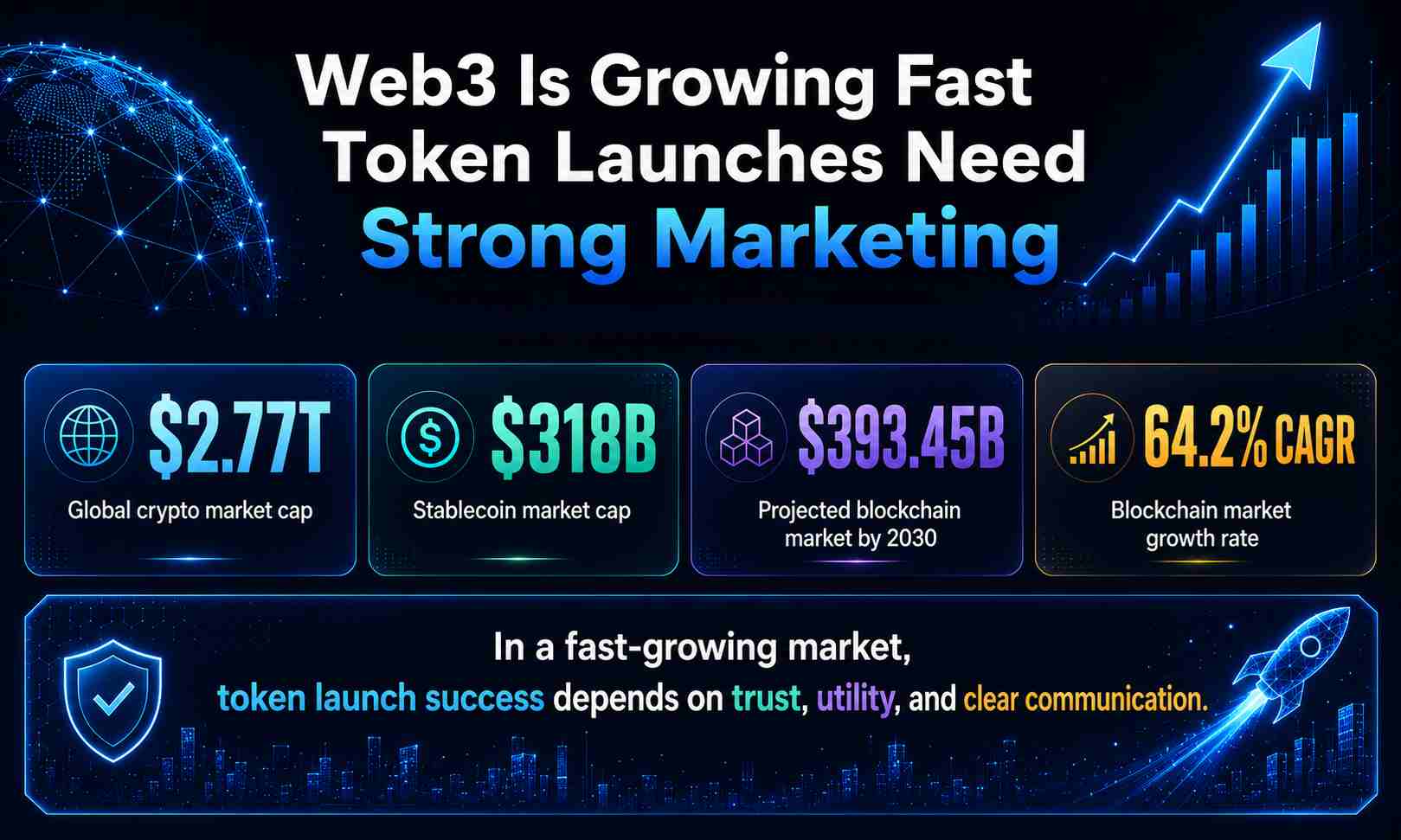
A token launch is more than a technical release. It is a public growth event where a project moves from private building to open market attention. Users, investors, partners, exchanges, and media begin to judge the token’s value based on its utility, trust, and clarity. The opportunity is large: CoinGecko reports the global cryptocurrency market at around $2.77 trillion, with stablecoins accounting for about $318 billion. The global blockchain market is also projected to grow from $32.99 billion in 2025 to $393.45 billion by 2030, at a 64.2% CAGR. These numbers show that token launches now happen in a fast-growing and highly competitive market.
For blockchain startups, DeFi protocols, Web3 games, infrastructure projects, and tokenized asset businesses, launch success depends on more than hype. People need to understand the token’s role, proof of utility, and a clear reason to join, use, stake, trade, vote, or build. A strong token launch strategy connects token utility with business goals, product use, community needs, and clear education. This guide explains how businesses can build awareness before, during, and after launch through pre-launch demand, TGE execution, post-launch adoption, key channels, launch readiness, and structured token marketing support from Blockchain App Factory.
Token Launch Marketing
Token launch marketing is the planned promotion of a new crypto token across channels like the website, white paper, tokenomics page, X, Discord, Telegram, PR, AMAs, email, exchange updates, and founder interviews.
Its goal is to build demand, trust, education, liquidity awareness, and community participation. A strong plan clearly explains what the token does, who it serves, why it matters, how it connects to the product, what role the community plays, and what risks or vesting terms users should know.
Unlike traditional product marketing, token marketing speaks to many groups at once: users, holders, validators, liquidity providers, voters, developers, creators, ambassadors, partners, and exchanges. It must explain token utility, governance, supply, allocation, vesting, and long-term value in simple language.
A good token launch campaign should:
- Build early awareness and trust before TGE
- Educate users, investors, partners, and exchanges
- Grow communities on X, Discord, Telegram, LinkedIn, Reddit, Farcaster, and email
- Drive real token utility such as staking, governance, rewards, payments, access, or liquidity
- Support exchange listing visibility with clear and safe information
- Reduce confusion around tokenomics, vesting, unlocks, and governance
- Create post-launch growth through product use, community updates, SEO, partnerships, and retention
Why Businesses Need a Token Launch Marketing Strategy
A token launch needs planning long before the token goes live. The market is crowded, user trust is fragile, and public claims carry business risk.
A clear token launch marketing strategy gives the team control over the story. It helps the market understand the token, the product, the team, and the reason to participate.
Market Competition Is Increasing Across Web3
Web3 teams now compete across many categories. DeFi, Layer 2 networks, AI crypto, RWA, gaming, DePIN, stablecoins, and infrastructure projects all fight for the same attention.
Users compare rewards, token utility, traction, audits, team quality, backers, liquidity plans, and community strength. Exchanges review demand signals. KOLs need stories their audiences care about. Journalists need a clear angle.
A strong product can still get ignored. A token launch campaign helps the project stand out with clear value, not empty hype. It gives the market a reason to pay attention and a path to learn more.
Trust Is a Commercial Asset in Crypto
Trust drives conversion in crypto. People do not join a token ecosystem after one catchy post. They look for proof.
That proof can include:
- Clear founder communication
- Public token documentation
- Security audits
- Transparent tokenomics
- Product demos
- Partner proof
- Roadmap updates
- Clear risk language
- Active community support
Trust grows through repetition. A project that shares useful updates over time looks more credible than one that appears one week before TGE.
Retail users want safety signals. Investors want clear token mechanics. Exchanges want demand and risk clarity. Partners want a team that communicates with care.
Compliance-Aware Marketing Reduces Business Risk
Token launch marketing needs careful language. Public claims must match the white paper, token documents, investor materials, website copy, and social posts.
Marketing teams should avoid price promises, return claims, and inflated adoption claims. They should use clear disclosures and explain risk in plain English.
Useful disclosure topics include:
- Issuer business details
- Project risks
- Token features
- Liquidity limits
- Supply and allocation
- Custody details
- Technology risks
- Cybersecurity risks
- Legal matters
- Promotional claims
This protects the company and helps users. People make better decisions with clear token facts, risk language, and public documents.
Strong Launch Marketing Supports Long-Term Token Utility
A weak launch chases attention for a few days. A strong launch builds activity that lasts.
The best campaigns push people toward real participation. This can include product onboarding, staking, governance, developer use, liquidity participation, partner integrations, and community programs.
Token utility needs education. Users need to know what the token does and where to use it. Developers need docs and examples. Partners need proof of demand. DAO members need clear governance steps.
A launch campaign should move people from awareness to use. It brings people in, teaches them, and guides them toward the next action.
The Three Phases of Token Launch Marketing
Token launch marketing works best in three phases: pre-launch awareness, launch execution, and post-launch growth. Each phase has a clear job.
Phase 1: Pre-Launch Awareness
Pre-launch marketing builds the base before TGE. This phase shapes the story, grows the audience, and prepares launch channels.
Key tasks include:
- Token positioning
- Market education
- Audience research
- Community setup
- Waitlist growth
- Launch narrative
- PR planning
- KOL mapping
- Email setup
- Landing page creation
- Analytics tracking
- White paper alignment
- Legal review
This phase gives the market time to understand the project. It gives the team time to test messages and learn what people care about.
A strong pre-launch plan answers one hard question: why should anyone care before the token exists? The answer should connect product value, token utility, and market timing.
Phase 2: Launch Campaign Execution
Launch execution brings all channels into one coordinated campaign. The team should know what goes live, who posts, which partners share, and how the community team responds.
Core launch activities include:
- Public launch announcement
- Exchange or DEX visibility
- Founder posts
- PR distribution
- Live events
- AMAs
- Social campaigns
- KOL activation
- Email alerts
- Community moderation
- Support response
- Conversion tracking
Timing matters here. Mixed messages create confusion. Late updates create frustration. Clear schedules help users follow the launch without guessing.
The campaign should direct people to one trusted source. This can be the token launch landing page or official docs hub. Every post, AMA, PR mention, and email should point back to verified information.
Phase 3: Post-Launch Growth
Post-launch marketing proves that the project can deliver after the first wave of attention.
Many projects lose momentum after listing. The community waits for updates. The market asks for progress. Users need reasons to stay active.
Post-launch growth should focus on:
- User retention
- Product adoption
- Liquidity awareness
- Governance participation
- Product milestones
- Partner campaigns
- Developer education
- SEO content
- Community updates
- Token utility use cases
The project should publish regular updates. Each update should show what changed, what shipped, and what users can do next.
Want your token to gain traction after launch?
Get expert support for token utility education, exchange visibility, community retention, SEO content, and long-term Web3 growth.

Pre-Launch Token Marketing: Building Demand Before TGE
Pre-Launch Token Marketing
Pre-launch marketing builds demand before TGE and gives the market time to understand the project. It should begin weeks or months before launch, depending on the product, token model, exchange plan, and community size.
Token Narrative
A token needs a clear story. The messaging should explain what problem the token solves, why it exists, who benefits, how it connects to the product, and why it matters now.
Messaging Framework
A strong framework keeps founders, marketers, community managers, PR teams, and partners aligned. It should cover product value, token utility, tokenomics, vesting, community benefits, governance, incentives, security, roadmap, and risks.
Landing Page
The token launch landing page should explain the token quickly and guide visitors to act. Key elements include a clear headline, token value proposition, CTA, utility summary, roadmap, tokenomics preview, FAQ, risk disclaimers, email capture, and official links.
SEO Content
Educational SEO content should be published before launch so it has time to rank. Useful topics include tokenomics, token utility, governance, launch participation, product use cases, risk guides, and founder interviews.
Community Building
A token community includes different groups such as retail users, developers, liquidity providers, validators, DAO participants, partners, exchanges, media, and analysts. Each channel should have a clear role, such as Discord for deep programs, Telegram for updates, X for reach, LinkedIn for partners, and email for direct contact.
Pre-Launch Campaigns
Pre-launch campaigns create early participation. Common formats include waitlists, quests, referrals, testnet campaigns, ambassador programs, AMAs, community calls, demos, and early access programs.
PR and Influencer Outreach
PR, KOL, and influencer work should begin before launch week. Teams should prepare media lists, founder interviews, creator briefs, disclosure rules, approved facts, launch details, risk language, and official links.
Compliance and Disclosures
All marketing must match official documents such as the white paper, tokenomics page, website, PR copy, and social posts. Teams should review supply details, vesting, utility claims, governance rights, risk disclosures, roadmap claims, and exchange language before launch.
Token Launch Readiness Checklist
A token launch needs more than a launch post and a countdown timer. Teams need assets, systems, documents, and clear owners before TGE.
Brand and Messaging Assets
Brand and messaging assets keep public channels aligned. Prepare brand guidelines, a core messaging document, founder bios, project descriptions, one-liners, boilerplate text, a press kit, media FAQ, and complete social profiles.
These assets help founders, marketers, community leads, PR teams, and partners speak with one clear voice. They also reduce rushed edits during launch week.
Technical and Product Assets
Technical assets help users, developers, exchanges, and partners verify the project. They also reduce support load on launch day.
Prepare the website, documentation, white paper, litepaper, tokenomics page, smart contract details, audit reports, GitHub resources, explorer links, and wallet instructions.
Publish contract addresses only through official channels. Add warnings about fake contracts and scam links.
Growth and Analytics Setup
Growth tracking helps teams measure real demand. It separates useful traffic from empty noise.
Set up UTM tags, web analytics, community analytics, CRM flows, email automation, referral tracking, social listening, KOL tracking, and funnel dashboards.
Track visits, signups, docs clicks, wallet actions, community joins, referrals, claims, staking, voting, and product use.
Exchange, DEX, and Liquidity Communications
Exchange and DEX activity brings attention fast. It can also bring confusion fast. Users will ask where to buy, how to trade, which pool is real, and which links are safe.
Prepare listing announcement templates, liquidity pool education, how-to-buy guides, market maker communication rules, risk warnings, support docs, and a real-time moderation plan.
Launch-Day Marketing: How to Maximize Visibility During TGE
Launch day is a coordination test. The goal is to create attention, guide users, and protect trust at the same time.
A good launch day feels clear from the outside. Users know what happened, where to go, and how to act safely.
Coordinate the Launch Announcement
The launch announcement should follow a clear order. This prevents broken links, mixed details, and community panic.
A strong launch sequence includes:
- Internal readiness check
- Website and documentation update
- Press release publication
- Social announcement
- Email announcement
- Community post
- Partner sharing
- KOL campaign rollout
- AMA or live event
- Post-launch support monitoring
The main project account should post first. Founders, partners, investors, creators, and community accounts can share after that. Every post should point to verified links.
Use PR to Build Credibility, Not Just Noise
PR should make the launch easier to understand. A press release alone will not carry the campaign.
Media outreach should focus on real substance. Cover token utility, product traction, funding, partnerships, founder credibility, market category, ecosystem impact, audits, and public documentation.
Good PR gives readers a reason to trust the project. It does not shout louder. It explains better.
Activate Web3 Influencers and KOLs Responsibly
KOLs can bring reach, but poor creator choices can damage trust. Treat influencer work as education, not just promotion.
Choose niche-relevant KOLs. A DeFi protocol needs different voices than a Web3 game. An infrastructure project needs creators trusted by developers.
Require clear disclosures. Avoid profit claims. Provide accurate briefs. Track performance through clicks, signups, wallet actions, community joins, replies, and content quality.
Use KOLs to teach. The best creator content explains the product, token utility, risks, and safe participation steps.
Host Live AMAs, Spaces, and Community Events
Live events help people hear directly from the team. They work well during launch week, as users want clarity and access.
Strong event topics include token utility, roadmap, tokenomics, governance, product demos, partner integrations, safe participation, and post-launch milestones.
Record each event. Then turn it into clips, recap posts, FAQ updates, and email content.
Publish “How to Buy” and “How to Use” Content
Support content reduces confusion. It also captures high-intent search traffic during launch.
Create pages around terms such as:
- How to buy [token]
- Where to buy [token]
- How to claim [token]
- How to stake [token]
- How to bridge [token]
- How to use [token] in [ecosystem]
Each guide should include screenshots, official links, wallet notes, risk warnings, and support steps. Users do not want theory during launch. They want clear steps and safe links.
Monitor Sentiment and Respond in Real Time
Launch day creates fast feedback. Some users ask valid questions. Some spread wrong claims. Scammers try to copy the brand.
Focus on Telegram and Discord moderation, scam account monitoring, FAQ updates, wallet support, liquidity questions, exchange confusion, and misinformation response.
Keep official links pinned. Remove scam posts. Answer common questions with approved replies. Update FAQs based on real user issues.
Looking to grow your Web3 community before TGE?
Post-Launch Token Marketing: Turning Awareness Into Adoption
A token launch can bring fast attention. The harder work starts after TGE. The project now needs to turn interest into product use, community action, and market trust.
Post-launch token marketing should guide people from “I heard about this” to “I understand it and use it.” That shift takes clear content, active support, and steady proof.
Shift From Launch Hype to Utility Adoption
Launch hype fades fast. Token utility needs a longer plan.
Post-launch messaging should move away from countdowns and big claims. It should focus on product usage, ecosystem incentives, partnerships, integrations, governance, and roadmap delivery.
The core message changes from “the token is launching” to “here is what the token lets you do.”
Strong post-launch content can explain how users can use the token, which rewards are live, which partners support it, how governance works, what the team shipped, and what comes next.
Create a 30-60-90 Day Post-Launch Growth Plan
A 30-60-90 day plan gives the team structure after launch. It keeps the project active, clear, and accountable.
First 30 Days: Support and Clarity
The first month should reduce confusion. Users need help with claims, wallets, exchanges, staking, bridges, and product access.
Focus on onboarding, FAQ updates, community support, launch recap content, exchange updates, wallet guides, scam warnings, and token utility explainers.
Days 31 to 60: Education and Participation
The second month should deepen product use. The audience now needs more than basic launch details.
Focus on product education, staking campaigns, governance campaigns, partner content, tutorials, ecosystem explainers, and community calls.
Days 61 to 90: Proof and Growth
The third month should show progress. The project should prove that launch attention turned into real activity.
Focus on case studies, ecosystem updates, developer campaigns, DAO participation, performance reports, partner results, and product milestone content.
Use Content Marketing to Build Long-Term Search Demand
Post-launch content keeps the project visible after the news cycle slows. It captures search traffic from users who want to learn, buy, stake, bridge, build, or vote.
Useful content types include token utility guides, ecosystem tutorials, use case articles, founder thought leadership, developer docs, comparison pages, case studies, governance explainers, and monthly transparency reports.
Search demand grows over time. A strong content library helps the project answer questions long after launch week.
Strengthen Community Retention
A large community means little without repeat activity. Retention comes from clear roles, useful rewards, and steady contact.
Strong retention programs include ambassador programs, contributor rewards, governance participation, product feedback loops, loyalty campaigns, community grants, and educational livestreams.
People stay active when they know their role and see progress. Give them ways to help, learn, vote, build, test, and share.
Report Progress Transparently
Progress reports build commercial trust. They show that the team can deliver after the token goes live.
Useful updates can cover roadmap delivery, product usage, treasury updates where suitable, governance decisions, security work, partnerships, ecosystem metrics, and token utility growth.
A good update uses clear numbers. Teams can share active wallets, product transactions, governance votes, developer grants, integrations, support volume, or docs usage.
Do not hide problems behind vague language. Clear issue reports can build more trust than polished posts. Users respect teams that explain what happened, what changed, and what comes next.
Token Launch Marketing Channels That Drive Results
Token Marketing Channels
Token launch marketing works best when several channels work together. SEO captures search demand, PR builds credibility, community creates trust, email keeps direct contact, and partnerships expand reach.
SEO and Content
SEO helps users find education, buying guides, staking guides, governance explainers, tutorials, case studies, and developer docs before, during, and after launch.
PR and Media
Crypto PR helps reach investors, users, partners, exchanges, and analysts. Useful formats include founder interviews, sponsored articles, podcasts, newswire releases, partner news, funding stories, and product milestone coverage.
Community Marketing
Community is central to Web3 growth. Discord, Telegram, X, Reddit, Farcaster, and forums should provide official links, pinned updates, moderation, safety warnings, events, feedback channels, and active team presence.
Paid Media
Paid ads can increase reach, but crypto campaigns face platform rules. Teams should review ad policies, target specific audiences, and make sure all claims match official documents.
KOL and Influencer Marketing
KOL campaigns can reach crypto-native audiences quickly. Choose creators based on audience fit, trust, disclosure habits, and topic knowledge. Track clicks, community joins, wallet actions, signups, and content quality.
Email Marketing
Email supports every launch stage. It can send waitlist updates, launch alerts, claim steps, listing details, safety warnings, staking guides, governance prompts, product updates, and monthly reports.
Partnerships
Partnerships add trust, reach, liquidity, and real use cases. Useful partners include wallets, exchanges, DeFi protocols, gaming platforms, infrastructure providers, launchpads, analytics tools, security firms, and ecosystem foundations.
Conclusion
A successful token launch needs more than attention. It needs clear messaging, trusted documentation, active community work, safe launch support, and steady post-launch growth. The strongest projects build awareness early, guide users during TGE, and keep proving token utility after launch. Blockchain App Factory provides token marketing support for Web3 businesses that need strategy, content, PR, community growth, KOL campaigns, exchange visibility, and post-launch adoption planning. With the right launch plan, a token can move beyond short-term buzz and become a useful part of a growing ecosystem.

Vimal J is the Head of Sales at Blockchain App Factory, with 10+ years of experience in sales, client strategy, and Web3 business growth. He helps startups, enterprises, and project founders choose the right blockchain solutions for their goals, bringing a practical market perspective to topics like token development, crypto launches, and Web3 adoption.
Article Reviewed by:
Arun Kamala Santhanath
Marketing Head, Blockchain App Factory


