



Key Insights
- Token launches now work better when users, product activity, liquidity, and proof already exist before the token reaches the market.
- Airdrops, TGEs, RWAs, and stablecoins need different launch plans, but all of them depend on trust, clear utility, and post-launch use.
- The strongest launches give the market something real to judge, such as active users, verified assets, reserve backing, or working product demand.
Crypto launches have entered a harder market. Attention is still there, but patience is thin. A launch now has to prove demand, use, liquidity, and trust faster than ever.
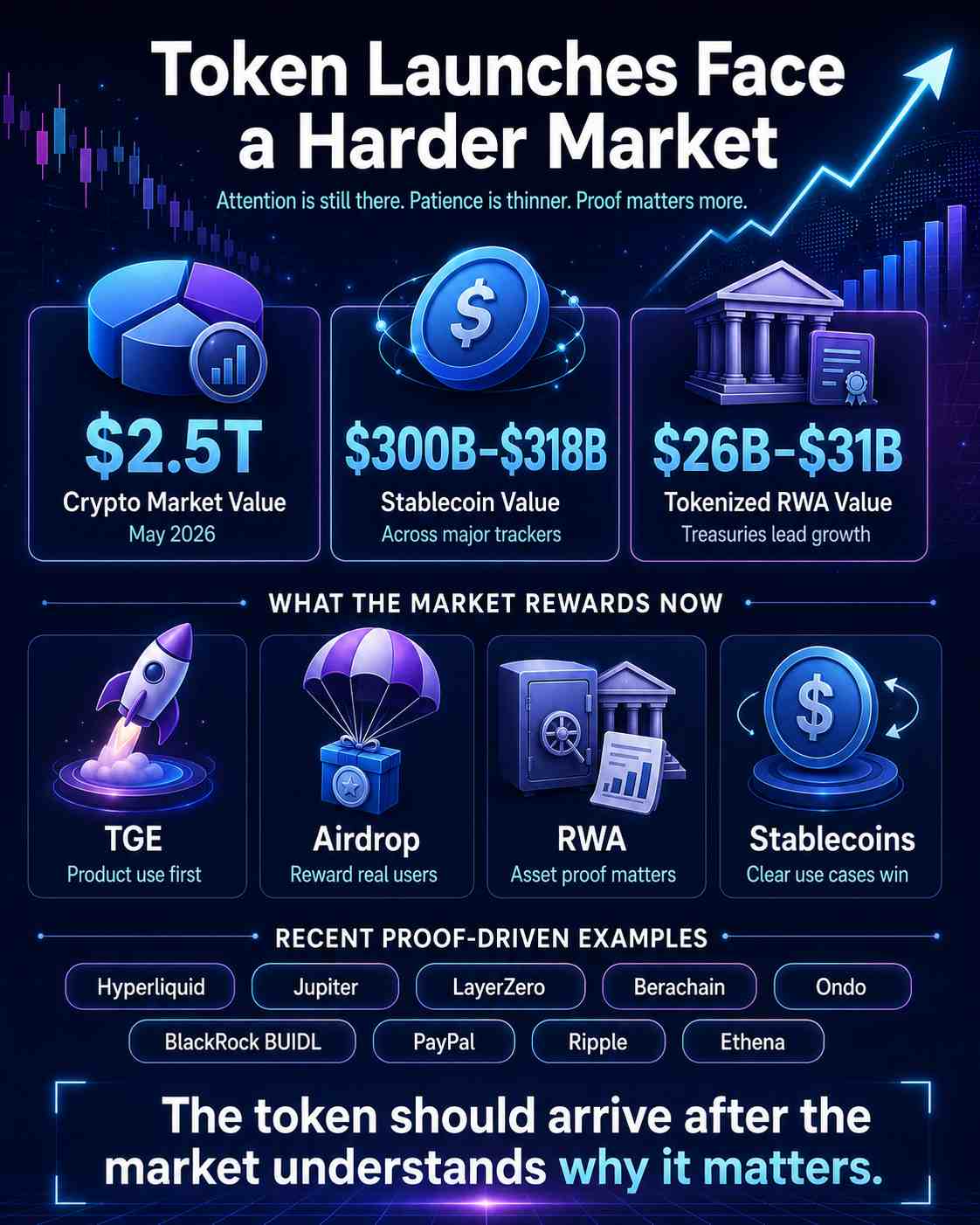
The numbers explain the pressure. The crypto market sits near the $2.5 trillion range in May 2026. Stablecoins hold close to $300 billion to $318 billion in value across major trackers. Tokenized real-world assets stand near $26 billion to $31 billion, with tokenized Treasuries taking a large share of that growth. These are not small side stories. They show where money, usage, and confidence are moving.
Founders can no longer treat a token launch as a single event. A TGE, an airdrop, an RWA rollout, or a stablecoin release now works only after the market already has proof. Hyperliquid had product use. Jupiter had Solana trading depth. LayerZero had cross-chain activity. Berachain had years of community formation. Ondo and BlackRock BUIDL had asset credibility. PayPal, Ripple, Ethena, and new bank-linked stablecoins had clear use cases.
The pattern is clear: the token should arrive after the market understands why it matters.
Market Context: The Launch Bar Is Higher in 2026
Crypto users have seen too many weak launches. They have seen high FDVs, thin floats, vague points programs, bot-heavy airdrops, and RWA claims with poor asset proof. That history changed how people judge new tokens.
Liquidity has become more selective too. Strong projects can still attract traders and users, but empty narratives fade fast. A large community count no longer means demand. A huge claim page no longer means retention. A listing no longer means long-term interest.
The strongest launches now share one trait. They turn existing activity into a token economy. The token is not asked to create the whole market alone. It gives ownership, access, governance, utility, or settlement to users who already have a reason to care.
TGEs Work Better After Product Proof
A TGE still creates attention. The difference now sits in timing. Stronger projects launch tokens after users have already touched the product, tested the value, and formed habits.
Hyperliquid shows this better than almost any recent launch. The platform had real trading activity before HYPE became the headline. Users were already following points, volume, vaults, and platform growth. The token launch felt connected to an existing product, not forced onto an empty page.
The product must carry the first wave
A TGE cannot hide a weak product for long. Traders now check volume, retention, active wallets, revenue, integrations, and user behavior before they trust a token.
Hyperliquid had a clear advantage. It was not selling a future idea alone. It had a working perpetuals exchange with users who already understood the platform.
For founders, the message is direct:
- Launch after product activity exists
- Show repeat user behavior
- Connect token value to platform use
- Avoid vague utility claims
- Prepare the next product release before listing
The market gives more time to tokens that enter a working system.
HYPE worked through fairness and focus
Hyperliquid’s HYPE airdrop sent 31% of total supply to community users. The project had no private investor allocation, which made the launch feel different from VC-heavy token models.
That mattered. Many users were tired of launches where public buyers entered after insiders already held the best terms. Hyperliquid gave the market a fairer story.
Fairness alone did not make HYPE work. Product activity, trading culture, and market timing mattered too. The fair distribution made those strengths easier to believe.
A TGE needs a second act
A weak TGE peaks on listing day. A strong TGE gives users reasons to stay after the first price move.
That second act can include:
- New product modules
- Staking or fee utility
- Governance proposals
- Liquidity programs
- Partner integrations
- Better dashboards
- New trading pairs
- Community updates backed by data
The launch should open the next phase. It should not drain the whole story in one day.
Valuation discipline wins more trust
The market now reacts quickly to inflated FDVs. A token with tiny float and a huge valuation faces instant doubt. Users ask who gets paid, who waits, and who sells later.
Better launches keep valuation closer to real traction. They make unlocks easy to read. They explain market-maker roles. They avoid hiding supply risks inside fine print.
Clean tokenomics now does part of the marketing.
Airdrops Work Better After Real Contribution
Airdrops still create huge attention. They attract farmers, bots, and short-term wallets too. The gap between a good airdrop and a wasteful one has grown.
The best airdrops now reward contribution that helped the product. Hyperliquid rewarded early platform users. Jupiter rewarded Solana traders. LayerZero rewarded cross-chain use, then tested a proof-of-donation claim. Berachain rewarded testnet users, NFT communities, ecosystem builders, and long-term supporters.
Jupiter showed the power of ecosystem fit
Jupiter’s JUP launch worked inside an active Solana market. Users already knew the product through swaps, routing, and trading. The airdrop did not need to explain why Jupiter mattered to Solana users.
That is why ecosystem fit matters. A token claim has more force after it lands inside an active user base. The claim becomes part of a larger chain story.
Airdrops work better after they reward:
- Product use
- Long-term activity
- Liquidity support
- Builder contribution
- Governance participation
- Real referrals
- Community work that helped demand
Random wallet activity creates noise. Measured contribution creates loyalty.
LayerZero made the claim itself part of the launch
LayerZero’s ZRO claim introduced proof-of-donation. Eligible users had to donate a small amount per ZRO to claim. The mechanism raised debate, but it showed a new idea: the claim process can shape user intent.
A claim page is not just a technical step anymore. It can filter low-intent wallets, support ecosystem causes, and test whether users value the allocation enough to complete the process.
The risk is communication. Any friction in a claim must be clear. Users need to know the purpose, the cost, and the outcome before they click.
Berachain showed why culture matters before mainnet
Berachain built a strong identity before BERA launched. Its bear-themed culture, proof-of-liquidity model, testnet activity, NFT links, and community rituals gave the launch a base.
That base did not remove debate. Allocation debates happen in almost every large launch. It did give the project a deeper community than a standard short-term campaign.
Long pre-launch culture cannot be copied in a week. It has to come from repeated community moments, clear product direction, and users who feel part of the project before tokens appear.
Post-claim use decides the real result
An airdrop looks strong on claim day. The real test starts after wallets receive tokens.
Projects need a reason for users to keep tokens active. That can include governance, staking, fee roles, app access, liquidity participation, quests, or future eligibility.
Airdrops fail after users claim, sell, and forget. They work after the claim starts the next user loop.
Ready to Launch a Token That the Market Can Trust?
We help startups plan, build, and launch tokens with clear utility, tokenomics, smart contracts, TGE support, and post-launch growth.

RWAs Work Better With Asset Proof First
RWA launches have gained attention for a simple reason. They connect tokens to assets users can assess outside crypto charts. Treasuries, private credit, real estate, commodities, and funds all have reference points.
That does not make RWA launches easy. It raises the standard. The token is only one part of the trust stack.
BlackRock BUIDL raised the proof standard
BlackRock’s BUIDL fund pushed tokenized funds into a more institutional conversation. It brought a familiar asset manager, a regulated structure, qualified investor rules, transfer-agent support, and treasury-linked backing into the on-chain market.
The launch mattered for one reason: the market could understand the structure. Investors did not have to guess what the token represented. The fund structure, asset type, and access limits were clear.
That is the lesson for RWA teams. The asset story must come before the token story.
Strong RWA launches answer:
- Who owns or controls the asset?
- Who provides custody?
- How is value measured?
- Who can buy?
- How do transfers work?
- What rights does the token represent?
- What happens at redemption or sale?
Weak answers turn an RWA token into a trust problem.
Ondo showed demand for tokenized treasuries
Ondo Finance gained traction with products linked to treasury exposure and on-chain yield. OUSG and USDY speak to a clear user need: stable, recognizable yield instruments that can move inside crypto rails.
The product works in a category with real demand. Crypto users need places to park capital. Institutions want on-chain instruments with familiar backing. DeFi protocols need collateral that feels more stable than volatile tokens.
That fit matters more than hype. The asset has to match a real financial need.
RWA content must be plain and exact
RWA buyers need clear language. Some understand crypto but not the asset. Some understand the asset but not token rails. Many need both sides explained without sales fog.
A strong RWA launch explains:
- The asset
- The ownership or exposure model
- The legal structure
- The transfer rules
- The revenue or value logic
- The risk
- The exit path
Vague words damage trust. Plain documents build it.
Liquidity claims need restraint
Many RWA projects talk about 24/7 trading. That promise can mislead readers. Asset rules, whitelists, investor checks, jurisdiction limits, and thin markets can all slow trading.
Better RWA messaging stays honest. It explains the trading model, access rules, and liquidity limits with care.
The market will accept limits. It does not accept hidden limits.
Stablecoins Work Better Through Distribution and Daily Use
Stablecoins are the clearest example of utility beating noise. They do not need wild price action to matter. They win through repeated use.
USDT and USDC remain dominant for one clear reason: traders, exchanges, DeFi users, wallets, and payment apps use them every day. Newer launches from PayPal, Ripple, Ethena, and SoFi show how the category is spreading across fintech, payments, trading, and on-chain finance.
PYUSD showed why payment brands matter
PayPal USD entered the market with a known consumer payments brand. Its Solana expansion gave the stablecoin faster, lower-cost rails for payments and app use.
That did not make PYUSD an instant USDT rival. It did give the market a clear reason to watch. PayPal had distribution, users, and merchant context. That is rare in crypto launches.
Stablecoin launches need places where users can spend, move, redeem, or hold the asset. A token contract is not enough.
Ripple’s RLUSD leaned into payment rails
Ripple USD launched as a dollar-backed stablecoin on XRP Ledger and Ethereum. The pitch fits Ripple’s long focus on payments and settlement.
RLUSD’s strength comes from fit. A stablecoin from a payment-focused company makes sense to users. It supports a known business direction rather than appearing as a random token release.
Stablecoins need trust, reserve clarity, chain support, and distribution. They need a reason to exist inside a company’s product line too.
Ethena showed demand for crypto-native dollars
Ethena’s USDe grew fast through a synthetic dollar design with yield mechanics tied to derivatives markets. ENA turned that attention into a governance and ecosystem token.
The growth showed real demand for crypto-native dollar products. It exposed risk too. Funding rates can change. Market stress can test hedging models. Yield cannot be treated like a fixed promise.
Ethena’s lesson is useful: strong demand can form around a new stablecoin design, but risk communication has to match the ambition.
SoFi shows where stablecoins are heading next
SoFi’s stablecoin move points to a wider change. Stablecoins are moving closer to banking apps, public chains, and consumer finance. Users do not need to care about the token launch story. They care about access, redemption, transfers, and trust.
That is the future stablecoin test. The best launches will not just ask users to buy. They will give users a reason to hold, send, settle, and return.
What These Launches Have in Common
The strongest token launches share one simple trait: they do not start from zero.
Hyperliquid had traders. Jupiter had Solana users. LayerZero had cross-chain activity. Berachain had culture and testnet history. BlackRock BUIDL had institutional trust. Ondo had treasury demand. Stablecoins had payment and settlement use.
Each launch had proof before the token became the main event.
Proof is now the real launch asset
Founders should think about proof before tokenomics.
Proof can look like:
- Active users
- Live revenue
- Trade volume
- App retention
- Validated assets
- Strong reserve data
- Real integrations
- Clear legal structure
- Known partners
- Liquidity depth
- Product usage before rewards
The market wants signals it can check. Screenshots and slogans no longer carry much weight.
Claims need to match reality
A project weakens itself after the launch message sounds bigger than the product.
Do not call a token an RWA without asset proof. Do not call a stablecoin safe without reserve clarity. Do not call an airdrop community-first after bots capture most of it. Do not call a TGE utility-led if the token has no real job.
The best launches keep language close to facts.
Post-launch silence kills momentum
A launch needs a content and product plan for the first 30 to 90 days. The market watches what happens after the claim, after the listing, and after the first price move.
Strong teams prepare:
- Weekly product updates
- Data dashboards
- Governance activity
- Exchange and liquidity updates
- Use-case demos
- Ecosystem partner news
- Clear unlock reminders
- Founder communication
A token launch is not one announcement. It is a timed series of proof points.
Practical Lessons for Founders
A token launch in 2026 needs more than hype. It needs a launch path that fits the token category.
For TGE launches
Build product usage first. Keep valuation close to traction. Explain unlocks in plain language. Show how the token fits the app from day one.
The TGE should feel like the market layer of an existing product, not the first proof of life.
For airdrops
Reward people who helped the network. Filter bots. Explain eligibility early. Keep the claim clean. Give users a reason to stay after they claim.
The airdrop should open deeper participation.
For RWA launches
Document the asset before promoting the token. Show custody, valuation, ownership logic, transfer rules, and risk. Avoid inflated liquidity claims.
The asset must carry trust before the token asks for capital.
For stablecoin launches
Focus on reserves, redemption, chain support, app distribution, and payment use. Stablecoins win through daily use, not launch-day emotion.
The strongest stablecoin is the one users can move, redeem, and trust without confusion.
Final Thoughts
Token launches are not dead. Weak launches are losing power.
The market still rewards strong TGEs, smart airdrops, credible RWA structures, and useful stablecoins. It just expects more proof now. Founders need users before tokens, assets before claims, reserves before payment promises, and product loops before listing day.
The best launch is no longer the loudest one.
It is the one that gives the market a reason to believe before the token starts trading. For startups planning that kind of launch, Blockchain App Factory provides token development services that cover token creation, tokenomics planning, smart contract development, TGE support, launch marketing, and post-launch growth support.

Vimal J is the Head of Sales at Blockchain App Factory, with 10+ years of experience in sales, client strategy, and Web3 business growth. He helps startups, enterprises, and project founders choose the right blockchain solutions for their goals, bringing a practical market perspective to topics like token development, crypto launches, and Web3 adoption.
Article Reviewed by:
Arun Kamala Santhanath
Marketing Head, Blockchain App Factory


